A Guide to British Standard BS 6387: Fire Resistant Testing for Critical Infrastructure Cables
A practical guide to BS 6387 fire-resistant cable testing, explaining Categories C, W, and Z and how to choose cables for critical infrastructure.
hongjing.Wang@Feichun
7/14/202614 min read
1. Introduction
In the architectural and engineering landscape of modern mega-projects—ranging from the iconic high-rise towers of Dubai and Riyadh to sprawling international airport terminals and subterranean metro networks across the Middle East—infrastructure reliability is paramount. When an emergency strikes, the structural integrity of a building is only as good as the electrical nervous system that keeps its life-safety systems alive.
During a major fire incident, the primary challenge changes instantly from operational continuity to human survival. To ensure that occupants can evacuate safely and emergency response teams can combat the hazard effectively, critical electrical systems must remain fully functional. This requirement has pushed fire performance to the top of project specifications across the global construction and industrial sectors.
Among the various international standards governing electrical safety, BS 6387 stands out as a critical benchmark. It is a rigorous British Standard that defines the performance requirements for cables required to maintain circuit integrity under fire conditions.
Unlike conventional cable standards that focus primarily on structural dimensions, conductor resistance, or chemical compounding specifications, BS 6387 focuses on a single, vital objective: verifying whether an electrical cable can continue to deliver power or transmit control signals while being actively destroyed by fire, water, and mechanical impact.
For consulting engineers, MEP contractors, project developers, and bidding consortia, understanding the nuances of BS 6387 is not merely a matter of technical compliance; it is a fundamental aspect of risk management and commercial strategy. In high-stakes tenders, specifying the incorrect tier of fire resistance can lead to costly project rejections by local Civil Defence authorities or, worse, catastrophic system failures during an actual emergency.
This comprehensive guide will examine what BS 6387 means, why maintaining circuit integrity is crucial, the specific testing protocols that cables must pass, and how to correctly select and specify these critical components for high-profile infrastructure projects.
2. What BS 6387 Means
To understand the practical application of BS 6387, it is essential to clarify what this standard evaluates. Formally titled as the specification for performance requirements for cables required to maintain circuit integrity under fire conditions, BS 6387 is an performance-driven testing standard. It does not dictate a single mandatory manufacturing recipe or restrict manufacturers to specific insulation thicknesses. Instead, it establishes an objective series of environmental stress tests that a finished cable assembly must survive.
The foundational concept of BS 6387 is circuit integrity. In the cable industry, there is a distinct difference between a cable that is flame-retardant and one that is fire-resistant.
A flame-retardant cable is designed to resist the spread of flame along its length, ensuring that the cable itself does not become a path for fire to travel through a building. However, a flame-retardant cable will typically short-circuit and fail electrically within minutes of direct flame exposure.
A fire-resistant cable, as certified by BS 6387, goes a step further: it resists flame spread, and its internal components are specifically engineered to continue operating under fire conditions, keeping the connected electrical circuit live.
[ Flame Retardant Cable ] ──► Prevents fire spread ──► Insulation melts ──► Circuit FAILS
[ Fire Resistant Cable ] ──► Prevents fire spread ──► Maintains form ──► Circuit LIVE (BS 6387)
When a cable achieves BS 6387 certification, it proves that it can continue carrying rated voltage and current during a fire. This performance allows emergency public address systems, smoke extraction fans, automated fire doors, and backup lighting networks to operate without interruption during a crisis.
Because of this specific capability, BS 6387 is a common requirement in engineering specifications for complex public spaces, high-density residential towers, and industrial environments where an instantaneous power outage during a fire could lead to severe consequences.
3. Why Circuit Integrity Matters
To fully appreciate the stringent testing requirements of BS 6387, we must look at the real-world conditions inside a building fire. When an electrical fire or structural blaze breaks out in an industrial facility or a commercial high-rise, standard commercial cables fail quickly. The intense thermal energy melts standard polymeric insulation materials like PVC or standard polyethylene within 2 to 3 minutes. Once the insulation liquefies or turns to ash, the bare copper conductors come into physical contact with each other or the surrounding grounded steel cable trays, causing immediate short-circuits, tripping circuit breakers, and cutting power to the circuit.
In ordinary circuits—such as standard office lighting or desktop power outlets—this rapid failure is acceptable because the immediate goal is to isolate the electrical fault. However, for critical infrastructure, a premature loss of power can be dangerous.
If the cables feeding a building's primary fire alarm system fail within the first few minutes, the control panel cannot trigger alarm sounders or voice evacuation announcements in distant zones of the property. Occupants in upper floors may remain completely unaware of a fire raging in the basement until smoke enters the stairwells.
Furthermore, modern fire mitigation strategies rely on active containment and evacuation support systems. If the cables driving smoke extraction fans, pressurization pumps, emergency exit signage, or automated fire curtains fail early in an event, escape routes can quickly fill with toxic smoke. This can reduce visibility to near zero and trap occupants inside the structure.
Circuit integrity is also critical for operational continuity and post-incident recovery. In environments like oil refineries, chemical processing plants, and nuclear facilities, an uncontrolled shutdown caused by severed control cables can trigger secondary explosions or hazardous material leaks.
By specifying BS 6387 compliant cables, engineers introduce a calculated factor of safety into the project. This design choice provides a predictable window of time—often up to 3 hours—for automated safety systems to execute orderly shutdowns, emergency backup systems to activate, and occupants to evacuate safely.
4. BS 6387 Test Categories
The core of the BS 6387 standard lies in its testing protocols. Recognizing that a real-world fire is rarely a static event with heat alone, the standard breaks down its performance evaluation into three distinct environmental stress categories: C, W, and Z.
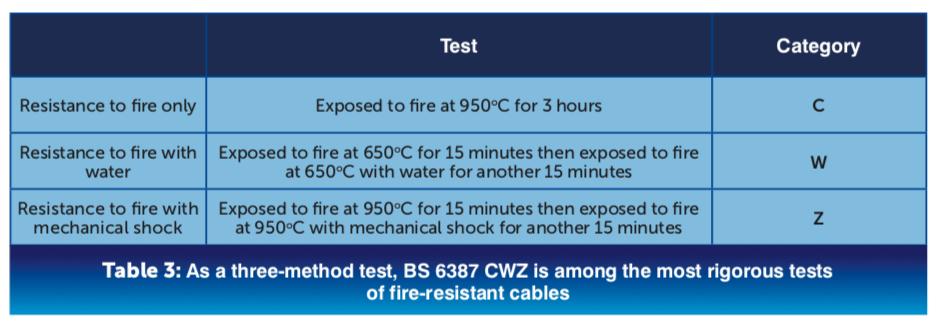
Each letter represents a specific type of physical or environmental hazard that a cable might encounter during a fire. To achieve the highest level of certification, a cable must pass all three individual tests using separate samples. When a product successfully withstands this full battery of tests, it is awarded the designation of BS 6387 Category CWZ. This combined rating is often specified by consultants for high-risk applications.
4.1 Category C: Fire Alone
Category C is the foundational component of the BS 6387 standard. It evaluates the cable’s ability to maintain circuit integrity when exposed exclusively to a high-intensity flame over an extended duration, without any external mechanical disturbances or water exposure.
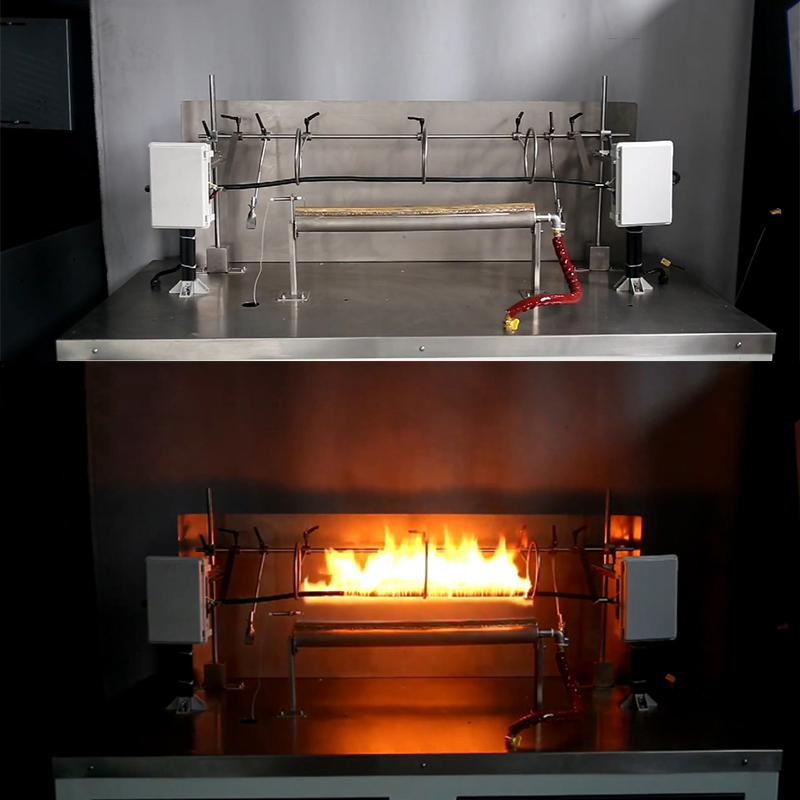
During the Category C test, a representative sample of the cable is mounted horizontally inside a test chamber. The cable is connected to a power supply operating at its full rated voltage (typically 600/1000 volts for standard low-voltage cables), and a current load is passed through the conductors to simulate real-world operation.
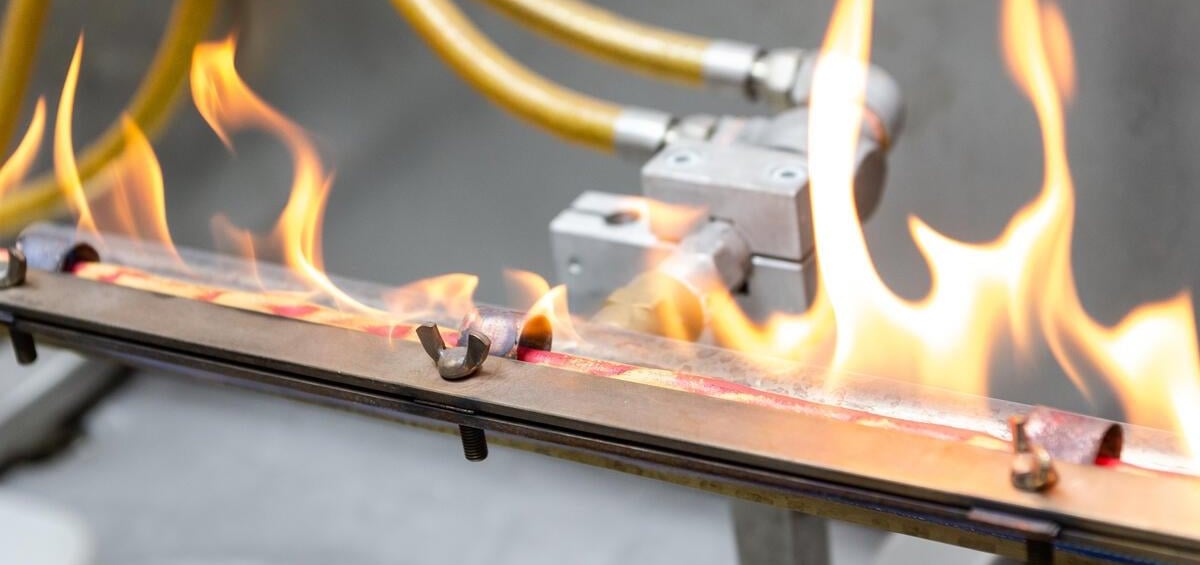
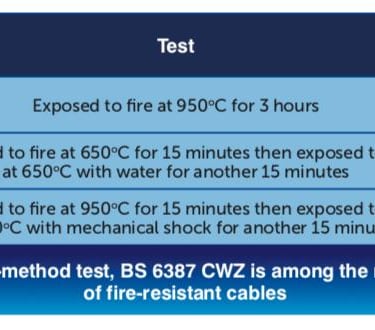
A specialized gas burner is then ignited directly beneath the cable, exposing the test sample to a continuous, uniform flame temperature of 950°C. The test requires the cable to withstand this direct flame exposure for a minimum duration of 180 minutes (3 full hours).
To pass Category C, the cable must not experience an electrical breakdown during the entire 3-hour test. This means the insulation must hold, the copper cores must remain isolated from each other, and the fuse or circuit breaker monitoring the circuit must not trip.
This category provides a baseline indicator of pure thermal resistance, simulating a localized fire where the cable is exposed to high temperatures but remains mechanically undisturbed on its tray.
4.2 Category W: Fire and Water
While pure heat resistance is important, real-world firefighting operations introduce a completely different hazard: water. When a building’s automated fire sprinkler system activates, or when civil defence teams begin directing high-pressure fire hoses into a burning room, the hot electrical cables are subjected to sudden thermal shock and direct water immersion.
Standard insulation materials that have begun to char or crack under heat will fail instantly when water penetrates the cracks, creating an immediate path for electrical current to short out.
To address this specific scenario, Category W subjects the cable to a combined fire and water test. A new sample of the cable is mounted horizontally and energized at its full rated voltage.
The test protocol begins by exposing the cable to a direct gas flame at a temperature of 650°C for an initial period of 15 minutes. Immediately following this initial burn phase, while the flame remains active, an overhead water spray system is turned on.
For the next 15 minutes, the cable is subjected to both the direct flame from below and a continuous spray of water from above, completely saturating the test zone.
To pass the Category W standard, the cable must maintain full circuit integrity throughout the entire 30-minute procedure. The internal fire barriers must successfully prevent the highly conductive water from penetrating the insulation and causing a phase-to-phase or phase-to-earth short circuit.
4.3 Category Z: Fire and Mechanical Shock
The final and often most challenging component of the BS 6387 protocol is Category Z. In a structural fire, a cable tray rarely remains pristine. As the fire progresses, ceiling tiles collapse, drywall falls, structural steel beams distort, and heavy debris drops onto exposed cable runs.
Furthermore, the force of explosions or the physical movement of emergency response teams can cause severe mechanical vibrations. If the insulation material has turned into a brittle ash or char, any physical impact will knock the protective coating off the conductors, leading to immediate electrical failure.
Category Z simulates these structural dynamics by testing the cable under a combination of flame and continuous mechanical shock. The cable sample is bent into a distinct U-shape and mounted onto a vertical steel chassis. The cable is fully energized at its working voltage.
A gas burner exposes the sample to a continuous flame temperature of 950°C. Simultaneously, an automated mechanical hammer mechanism is activated.
Every 30 seconds for a total duration of 15 minutes, the heavy iron hammer strikes the steel chassis holding the burning cable, delivering a sharp mechanical shock that vibrates the entire assembly. This vibration forces the brittle, burning insulation layers to resist flaking away from the copper cores.
To achieve a Category Z pass, the cable must maintain complete circuit integrity for the entire 15-minute test, proving it can survive the physical impacts of a collapsing building structure.
5. Category Comparison Logic
When analyzing the three test categories of BS 6387, engineers must understand the underlying logic that drives this classification system. The standard is designed as a modular framework where each letter step represents a different type of real-world environmental stress.
Category C (Fire Alone): Evaluates pure thermal survivability. It answers the basic question: can the insulation material withstand the heat of a fully developed fire without melting away or losing its dielectric properties? This is the baseline requirement for fire resistance.
Category W (Fire + Water): Introduces fluid dynamics and thermal shock. It shifts the focus from simple heat tolerance to sealing integrity, ensuring that the cable can handle fire suppression activities without shorting out.
Category Z (Fire + Mechanical Shock): Evaluates structural and mechanical durability. It tests the physical cohesion of the insulation materials under impact, ensuring that the fire barrier remains intact even when struck by falling debris.
Passing Category C alone indicates that a cable is capable of resisting heat, but it does not guarantee performance in more complex fire scenarios. A cable that passes Category C can still fail within seconds if hit by a sprinkler stream or disturbed by a falling ceiling tile.
Therefore, specifying the full CWZ classification ensures that a cable has been tested against all three primary hazards: thermal, fluid, and mechanical. This comprehensive approach is why Category CWZ has become a common benchmark for high-occupancy or safety-critical infrastructure projects.
6. Typical Application Areas
The specification of BS 6387 cables is determined by the specific function of the electrical circuit within the building's overall safety strategy. If the failure of a specific cable during a fire would directly hinder evacuation, disable emergency communications, or prevent fire containment, that circuit typically requires a certified fire-resistant cable.
Several key application areas across modern infrastructure projects commonly mandate BS 6387 CWZ cables.
6.1 Fire Alarm Systems
The fire alarm network is the primary life-safety system in any modern facility. BS 6387 cables are standard for:
Fire Alarm Loops: The primary data communication pathways connecting smoke detectors, heat sensors, and manual call points back to the main fire alarm control panel.
Alarm Sounders and Strobes: The output circuits that power audible horns, sirens, and visual strobe lights across all building zones to alert occupants.
Inter-panel Communications: The critical data links that connect separate sub-panels in multi-story towers or multi-building campuses, ensuring coordinated alarm broadcasting.
6.2 Emergency Lighting
When main power fails during a fire, buildings can fall into complete darkness, which complicates evacuation efforts. BS 6387 cables support emergency lighting infrastructure by powering:
Escape Route Lighting: Overhead backup luminaires positioned along corridors, stairwells, and transfer floors to maintain visibility.
Illuminated Exit Signage: Directional signs that guide occupants toward emergency doors and assembly areas.
Emergency Control Rooms: The dedicated spaces housing backup batteries, central inverters, and transfer switches that manage emergency power distribution.
6.3 Public Transport Infrastructure
Mass transit networks face unique challenges due to limited ventilation and dense passenger volumes. BS 6387 cables are common in:
Metro and Railway Systems: Powering underground station lighting, trackside signaling systems, and emergency communication lines.
Tunnel Control Circuits: Driving large ventilation fans used to extract toxic smoke from rail or vehicle tunnels during an active fire.
Evacuation Support Systems: Powering emergency drainage pumps, public address networks, and passenger cross-passage doors.
6.4 Airports and Large Public Buildings
With expansive floor areas and high daily foot traffic, major airport terminals and mega-malls rely on BS 6387 cables for:
Passenger Terminals: Ensuring that public address systems remain audible throughout terminal zones during an incident.
Critical Evacuation Controls: Wiring for automated baggage system shutdowns, security turnstile overrides, and fire curtain drops.
Emergency Management Centers: Connecting the command centers that coordinate airport safety responses with field sensors and communication arrays.
6.5 Hospitals and Critical Care Facilities
In healthcare environments, power continuity is directly linked to patient safety. Fire-resistant cabling is specified for:
Life-Safety Networks: Powering operating rooms, intensive care units, and life-support equipment fields that cannot tolerate interruptions.
Patient Evacuation Areas: Providing power to dedicated bed lifts, pressurized emergency exit enclosures, and ward intercoms.
Essential Utility Feeders: Linking backup diesel generators to critical sub-distribution boards serving intensive care sectors.
6.6 Nuclear and Other High-Risk Facilities
In heavy industrial zones, petrochemical refineries, gas processing plants, and nuclear stations, BS 6387 cables are used to support process safety:
Emergency Safety Shutdowns: Actuating critical valves, isolating fuel lines, and engaging automated cooling loops to prevent secondary industrial incidents.
Hazard Monitoring Arrays: Connecting toxic gas detectors, radiation sensors, and remote thermal cameras to central monitoring desks.
Command and Control Links: Ensuring that operators maintain remote control over hazardous sub-systems during a structural fire.
7. How BS 6387 Is Used in Specification
For consulting engineers and MEP designers, properly integrating BS 6387 into project specification documents requires clear, precise language. Simply stating that "cables must be fire-resistant" is insufficient and can lead to lower-performing or non-compliant materials being submitted by contractors during the procurement phase.
When writing a professional specification, the reference must explicitly detail the required testing tiers. The standard phrasing used in international contract documents is:
"All low-voltage power, control, and signaling cables serving life-safety, fire alarm, emergency voice communication, and smoke management systems shall be fully certified to British Standard BS 6387, achieving the comprehensive performance classification of Category CWZ. The manufacturer must provide independent, third-party test certificates (such as BASEC or LPCB approval) confirming full compliance with the 180-minute fire test at 950°C (Category C), the fire and water spray test (Category W), and the fire and mechanical shock test (Category Z)."
Furthermore, engineers should avoid over-specifying. While it may seem safe to mandate BS 6387 CWZ for every single cable run across an entire project, doing so significantly inflates material costs without adding functional safety.
Standard office outlets, non-emergency HVAC units, and general facility lighting do not require circuit integrity during a fire; they are designed to disconnect when an overcurrent occurs.
Therefore, specifications should selectively apply BS 6387 only to the specific circuits defined as safety-critical or essential for life safety.
During the tender review stage, engineering teams should require bidders to submit official test reports and product approval certifications from recognized third-party laboratory bodies, ensuring the proposed cables have been tested to the exact parameters required by the contract.
8. Common Fire-Resistant Cable Construction
To pass the rigorous requirements of the BS 6387 CWZ testing standard, manufacturers use specialized raw materials and multi-layered designs. A standard commercial cable cannot survive these tests; the internal structure must be engineered to resist extreme heat and mechanical forces.
The internal architecture of a standard high-performance BS 6387 fire-resistant cable typically follows this structured layout:
Stranded Copper Conductors: The electrical pathway utilizes high-purity, plain annealed stranded copper (Class 2) to ensure optimal current capacity and installation flexibility.
Mica-Based Fire Barrier Tape: The primary element that enables the cable to survive the BS 6387 tests. Before the primary electrical insulation is applied, each bare copper conductor is wrapped helically with a specialized, high-grade Mica glass tape. Mica is a naturally occurring silicate mineral with an exceptionally high melting point (often exceeding 1200°C). When the primary plastic insulation melts away during a fire, the Mica tape remains intact, forms a solid vitrified ceramic sleeve around each copper core, and prevents the live conductors from touching and short-circuiting.
Cross-linked Polyethylene (XLPE) Insulation: Extruded over the Mica tape, this layer provides high dielectric strength and excellent thermal characteristics under normal operating conditions, allowing for a continuous 90°C conductor working temperature.
Protective Bedding Layer: A non-halogenated internal layer that binds the insulated cores together, creating a uniform, round profile and protecting the inner cores from mechanical stress.
Low Smoke Zero Halogen (LSZH) Outer Sheath: The external jacket of the cable. Although BS 6387 focuses primarily on circuit integrity rather than smoke toxicity, modern safety requirements dictate that fire-resistant cables must also use LSZH sheathing compounds. This ensures that while the internal Mica tape keeps the circuit live, the outer jacket burns without releasing dense black smoke or toxic halogen acid gases, protecting both human respiration and surrounding electronic systems.
Engineers must recognize that fire resistance and low smoke performance are distinct requirements. A cable can be constructed with an LSZH jacket (such as a BS 6724 cable) but lack the internal Mica fire barrier tapes.
If exposed to direct flame, that LSZH cable will release minimal smoke, but its insulation will melt quickly, causing the circuit to fail within minutes.
Conversely, a BS 6387 cable uses its internal Mica tapes to maintain circuit integrity under fire, while utilizing its LSZH jacket to minimize smoke generation.
9. Example Product Positioning
In the international cable market, manufacturers position their BS 6387 certified ranges as premium, high-value technical solutions. Because these products require advanced manufacturing equipment and raw materials like Mica tape, they are marketed primarily toward safety-critical installations rather than generic commercial distribution.
When reviewing product datasheets, manufacturers emphasize certifications such as BASEC (British Approvals Service for Cables) or LPCB (Loss Prevention Certification Board) marks. These third-party logos show that the product undergoes continuous factory audits and regular testing, ensuring the cables supplied to a job site match the quality of the laboratory samples that passed the original BS 6387 CWZ tests.
Marketing materials for these ranges typically focus on technical reliability, using phrases like "guaranteed life-safety circuit continuity," "certified structural survivability," and "zero-halogen infrastructure protection." By emphasizing the performance outcomes—such as keeping smoke extractors running and preventing toxic gas migration—manufacturers help project consultants justify the higher material cost of these specialty items over standard commercial alternatives.
10. Practical Selection Guidance
To assist project engineers and procurement managers in making correct decisions during the material selection process, the following framework matches the tiers of BS 6387 performance to specific project risk profiles:
Specify Category C (Fire Alone) For: Simple, non-complex buildings with direct evacuation routes where the primary risk is a simple flame source. This tier is suitable for basic, low-voltage alarm loops in single-story retail stores, small open-plan workshops, or isolated utility sheds where water suppression systems are absent and structural impact risks are low.
Specify Category W (Fire & Water) For: Facilities equipped with automated fire sprinkler networks, deluge systems, or internal firefighter wet-riser valves. This tier is critical for large commercial spaces, multi-zone shopping centers, and industrial production zones where any fire will trigger automated water suppression systems, exposing hot cables to immediate water spray.
Specify Category Z (Fire & Mechanical Shock) For: Complex, high-density structures where a fire could cause localized structural collapses, falling masonry, or intense mechanical vibrations. This tier is suited for high-rise building stairwells, dense urban commercial centers, and industrial processing zones where maintaining power during structural distress is necessary.
Specify The Full Category CWZ For: High-risk, high-occupancy public infrastructure, and mission-critical assets. This comprehensive classification is standard for international airports, deep underground metro networks, subsea vehicle tunnels, major healthcare facilities, and heavy industrial facilities where cables must handle all three primary fire hazards simultaneously.
By matching the cable specification to the actual physical risks of each zone within a project, engineering teams can build robust, code-compliant installations that balance safety performance with project budgets.
11. Conclusion
British Standard BS 6387 is a key benchmark in modern electrical engineering, providing a reliable standard for fire-resistant cabling within critical infrastructure. By focusing on performance under fire, the standard provides engineers with a clear method to verify that vital circuits will remain functional during an emergency.
Understanding the specific testing categories—C for fire alone, W for fire and water, and Z for fire and mechanical shock—allows designers to look beyond generic product labels and select the precise level of fire resistance required for their application.
The primary engineering takeaway is straightforward: as the safety risk or operational importance of a system increases, the requirements for its electrical cabling must become correspondingly more robust.
Properly specifying BS 6387 Category CWZ cables for critical life-safety networks ensures that fire alarm loops, emergency illumination paths, and automated shutdown systems perform as intended during a crisis, protecting both human life and facility infrastructure.
Port crane cables | Mining cables | Reeling cables | Trailing cables | Festoon cables | Heavy-duty power cables | Medium voltage cables | Offshore crane cables | Underground mining cables | Dragline cables | Shearer cables | Container handling cables | STS crane cables | RTG cables | Mobile equipment cables | Armored cables | Flexible power cables | VFD cables | Submersible cables | Cold resistant cables | Abrasion resistant cables | Flame retardant cables | Marine environment cables | Opencast mining | Underground operations
© 2006 All rights reserved.
[INDUSTRIAL_CABLES]
INDUSTRIAL GRADE CABLE SYSTEMS | PORT & MINING SOLUTIONS
TEL: +86 153 7530 2641 |MAIL: hongjing.Wang@feichuncables.com