A Guide to Short-Circuit Ratings for High-Voltage Mining Cables
Learn how copper screens improve short-circuit protection in high-voltage mining cables, with practical guidance on screen sizing, fault current, and GCC mining applications.
hongjing.Wang@Feichun
7/16/202613 min read
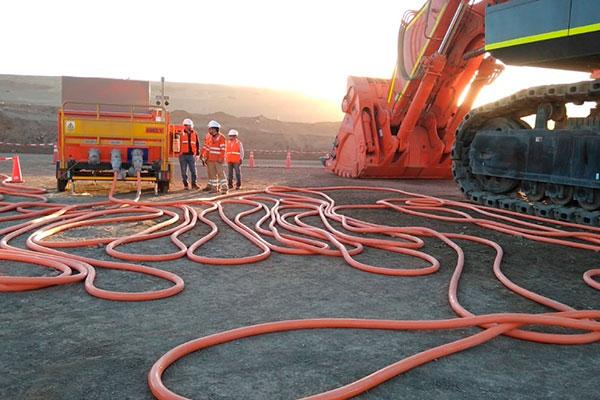
In large-scale modern extraction industries, power infrastructure works as the primary engine driving continuous operational capacity. Heavy machinery deployed across extensive mining concessions—ranging from massive open-cast multi-bucket reclaimers and heavy-duty stripping shovels to deep underground continuous roadheaders—relies entirely on a secure, high-capacity flow of medium- and high-voltage electricity. Because these mining systems operate in severe environment conditions, the physical and electrical integrity of every distribution link remains under constant stress. Within this demanding framework, the short-circuit rating of high-voltage mobile cables stands as a fundamental engineering requirement, directly impacting operational safety, asset protection, and the mitigation of catastrophic system downtime.
For project engineers, plant directors, and Engineering, Procurement, and Construction (EPC) contractors executing high-value industrial developments across the Gulf Cooperation Council (GCC)—particularly within the rapidly growing mining corridors of the Kingdom of Saudi Arabia—ensuring high reliability is an absolute operational priority. The electrical systems feeding mobile heavy equipment do not operate within static, climate-controlled utility channels. Instead, these cables are constantly exposed to mechanical impacts, structural pulling forces, continuous multi-axis bending, and severe solar heating. Under these conditions, a localized insulation failure can quickly escalate into a high-energy short-circuit fault if the cable architecture is not specifically engineered to manage these stresses.
To address these severe conditions, specialized high-voltage mining cables utilize an integrated metallic screening network. Far from being a simple wrap or optional accessory, the metallic copper screen forms a vital safety system. It provides a controlled path for fault currents, ensures reliable grounding, and coordinates properly with advanced protection relay systems. As a premier provider of heavy-duty industrial wiring systems, Feichun engineers high-voltage mining cables designed to manage heavy short-circuit stresses while maintaining structural integrity in the most demanding mining environments across the region.
1. Introduction: Why Short-Circuit Rating Matters in Mining
Heavy mining infrastructure operates under severe operational stress. Equipment like heavy draglines, bucket wheel excavators, automated stackers, and heavy continuous mining units draw megawatts of power at voltages typically ranging from 3.6/6kV up to 12/20kV. At these high operating energy levels, any breakdown in the electrical insulation system can quickly release massive amounts of thermal and electromagnetic energy.
If a high-voltage trailing or reeling cable suffers a dielectric breakdown or physical rupture due to an impact from falling rocks or heavy machinery tracks, the immediate consequences can affect the entire operation:
Catastrophic Equipment Risk: Uncontrolled electrical arcing at the point of failure can generate localized temperatures exceeding several thousand degrees, melting copper conductors, destroying insulation layers, and potentially igniting surrounding dust or oil reservoirs.
Severe Personnel Hazard: In the absence of a dedicated, low-resistance return path, high-voltage fault current can travel through the frame of the machine, creating dangerous step-and-touch potentials for operators nearby.
Extended Operational Stoppage: A major high-voltage fault can trip primary substation breakers, halting power across entire extraction zones. The time required to locate the fault, isolate the damaged section, and splice or replace the cable cuts directly into production targets.
This makes the short-circuit rating a vital design criterion for high-voltage mining cables. This rating defines the maximum current the cable's internal components—specifically the main phase conductors and the metallic grounding screens—can safely carry for a precise timeframe without suffering permanent structural damage, insulation melting, or jacket rupture.
By integrating a robust, high-conductivity copper screen into the cable design, engineers create a clear, low-resistance path for fault currents. This allows protection systems like overcurrent relays and ground-fault monitors to detect the fault instantly and clear it within milliseconds, protecting both personnel and expensive machinery.
2. Mining Cable Structure
To understand how a high-voltage mining cable manages intense electrical and mechanical stresses, it helps to examine its multi-layered structure. Every component in a premium Feichun high-voltage cable serves a specific purpose in maintaining dielectric stability and physical toughness.
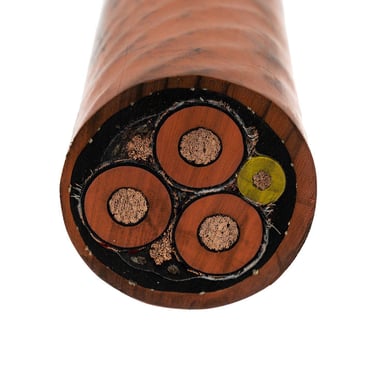
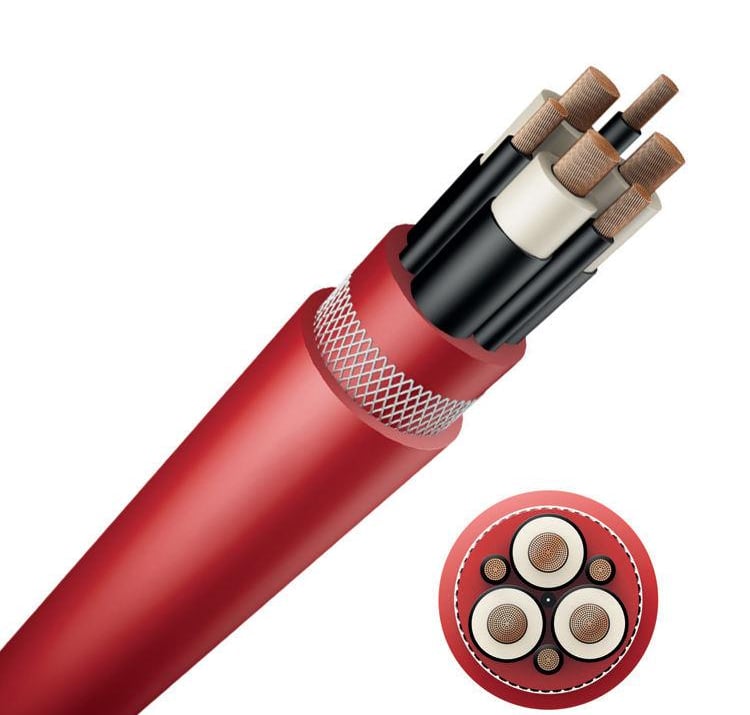
The structural design of a high-performance cable like the Feichun NTSKCGEWÖU consists of several engineered layers:
Central Phase Conductors: Formed from fine, high-purity tinned copper wires stranded together in accordance with Class 5 flexibility standards. Tinned copper provides excellent corrosion resistance against moisture and gases, while the fine stranding allows the cable to bend easily during mobile machinery movements.
Inner Semi-Conductive Layer: A specialized, extruded semi-conductive rubber compound applied directly over the stranded conductor. This layer smooths out the irregular surface profile of the individual copper wires, creating a perfectly uniform cylinder that eliminates localized electrical field stress concentrations.
Primary Insulation Layer: Extruded from a high-grade Ethylene Propylene Rubber (EPR) compound. EPR features excellent dielectric strength, low moisture absorption, and high thermal stability, allowing it to operate reliably at continuous temperatures up to 90°C and handle short-circuit thermal spikes up to 250°C.
Outer Semi-Conductive Layer: A second semi-conductive rubber layer extruded over the EPR insulation, completing the electrical stress control shield and containing the electrical field within the insulation matrix.
Metallic Copper Wire Screen: A protective shield composed of helically wrapped, high-conductivity tinned copper wires applied over the outer semi-conductive layer. This screen serves as the primary grounding path and carries fault currents during short-circuit events.
Inner Protective Bedding: An extruded rubber layer that cushions the internal screened cores, holding them securely in place while absorbing external shocks.
Reinforced Outer Sheath: A tough outer jacket made from high-grade synthetic rubber, such as Chlorinated Polyethylene (CPE) or heavy-duty polyurethane. This layer provides excellent resistance to tearing, abrasion, chemical exposure, and intense solar radiation.
This multi-layered approach balances electrical insulation performance with high mechanical durability, allowing the cable to withstand continuous flexing, vibration, dragging, and physical impacts common in open-pit and underground mining.
3. Why Copper Screen Is Needed
The metallic copper screen is a vital safety component in high-voltage mining cable design, providing key operational and protection benefits.
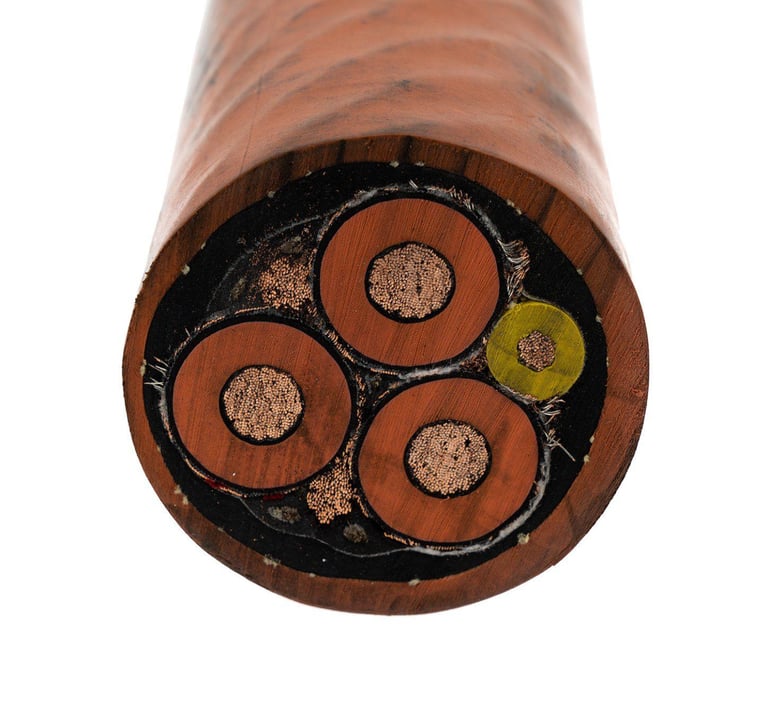
1. Providing a Low-Resistance Fault-Current Return Path
If the primary EPR insulation fails due to mechanical impact or long-term thermal aging, the high-voltage phase conductor will short out against surrounding elements. In a cable equipped with a comprehensive copper wire screen, the fault current flows directly into the low-resistance metallic screen rather than arcing unpredictably through the outer jacket or machine frame. This controlled return path directs the fault current safely back to the substation grounding system, triggering protective circuit breakers instantly.
2. Ensuring Symmetrical Electrical Field Distribution
In medium- and high-voltage applications, an unshielded conductor will generate asymmetrical electrical field lines that concentrate stress in irregular patterns, leading to rapid insulation breakdown. The copper wire screen, working with the underlying semi-conductive layers, forms a grounded shield around each insulated core. This maintains a uniform, radial electrical field within the insulation layer, preventing localized stress concentrations and extending the operating life of the cable.
3. Establishing a Continuous Safety Ground Screen
Because mobile mining equipment moves across varied terrain, maintaining a reliable grounding connection back to the main plant grid can be challenging. The integrated copper screen forms a continuous grounding shield around the entire length of the cable. This ensures the machine frame remains securely grounded to the main substation earth grid at all times, reducing touch-voltage risks for operators in the field.
4. Common Screen Cross Sections
The capacity of a copper screen to carry heavy short-circuit currents without melting or tearing depends on its total cross-sectional area. If a screen is sized too small for the available fault current, the rapid heat generation during a fault can damage the surrounding insulation, leading to costly repairs.
In standard industrial applications, high-voltage mining cables are manufactured with distinct, standardized copper screen cross-sections, with 16 mm², 25 mm², and 35 mm² being the most common sizes. Choosing the appropriate screen size requires a detailed engineering analysis of several key system parameters:
Prospective Short-Circuit Current Levels: The maximum prospective fault current delivered by the upstream power grid during a solid short-circuit event. Higher fault currents require larger screen cross-sections to carry the energy safely.
Protection Relay Clearing Time Settings: The time required for upstream circuit breakers and protective relays to detect and interrupt a fault. If a plant uses delayed clearing times to coordinate with other protection stages, the cable screen must feature a larger cross-section to survive the longer thermal exposure.
System Grounding Configurations: The way the system grid is grounded—whether through direct grounding, resistance grounding, or an ungrounded layout—determines the magnitude of earth fault currents and impacts screen sizing.
Selecting a larger copper screen cross-section improves the cable's short-circuit current capacity and lowers its overall grounding resistance. However, a larger screen also increases the cable's outer diameter, weight, and rigidity, which can make handling more difficult. Engineering teams must balance these factors, ensuring the screen is large enough to handle prospective fault currents while maintaining the flexibility needed for mobile mining machinery.
5. Short-Circuit Calculation Principle
Determining the exact short-circuit capability of a copper screen or phase conductor requires a fundamental thermodynamic calculation. During a brief short-circuit event—typically lasting from less than 100 milliseconds up to 3 seconds—the thermal energy generated within the copper conductor has no time to radiate outward through the outer protective sheaths. This condition is known as an adiabatic thermal state.
To determine the safe current limits under these conditions, engineers rely on the standard adiabatic short-circuit formula:
I = K×S/√t
Where:
I represents the maximum permissible short-circuit current carried by the screen, measured in Amperes.
k is a material-specific thermal constant that accounts for the initial operating temperature and the maximum allowable short-circuit temperature of the metal and surrounding insulation. For high-conductivity tinned copper screens paired with 90°C-rated EPR insulation and an allowable short-circuit peak of 250°C, $k$ is typically set at 143.
S is the actual cross-sectional area of the metallic copper screen, measured in square millimeters (mm²).
t represents the exact duration of the short-circuit fault condition, measured in seconds.
This formula demonstrates the close relationship between protection clearing speeds and cable dimensions:
Short-Circuit Duration (t) Decreases ──► Permissible Fault Current (I) Increases
OR Screen Cross-Section (S) Increases ──► Higher Short-Circuit Capacity (I) Achieved
For instance, if a mining grid features a prospective earth fault current of 3500 Amperes and uses a protection system that clears faults within 0.5 seconds, entering these values into the formula allows engineers to calculate the minimum required copper screen cross-section. This ensures the cable screen can handle the prospective fault energy safely without overheating or melting, preventing damage to the surrounding insulation layers.
6. NTSKCGEWÖU as the Main Example
When evaluating high-voltage cables designed for high mechanical and electrical stress in open-cast and surface mining, the Feichun NTSKCGEWÖU series serves as a primary reference model. Engineered specifically for heavy mobile machinery, this cable family is built to withstand demanding conditions while delivering reliable high-voltage power.
Core Voltage Ratings: Available in several medium- and high-voltage ratings, including 3.6/6kV, 6/10kV, 8.7/15kV, and 12/20kV installations.
Optimized Internal Layout: Built with Class 5 flexible tinned copper conductors insulated with high-dielectric EPR rubber. The phase cores are laid up around a central support element, distributing mechanical pulling forces evenly across the cable structure.
Robust Shielding System: Features individual tinned copper wire screens wrapped helically over each phase core, providing reliable grounding performance and excellent short-circuit current capability.
Tough Outer Protection: Wrapped in a heavy-duty, flame-retardant synthetic rubber outer jacket that resists surface abrasion, moisture infiltration, and ozone degradation.
This combination of flexible construction and reliable shielding makes the Feichun NTSKCGEWÖU series well-suited for high-stress mobile mining machinery. It is widely specified for large material handling systems, continuous excavators, stacker-reclaimers, and open-pit mining units where cables are regularly subjected to vibration, shifting terrain, and high physical impacts.
7. Reeling Version for Mobile Mining
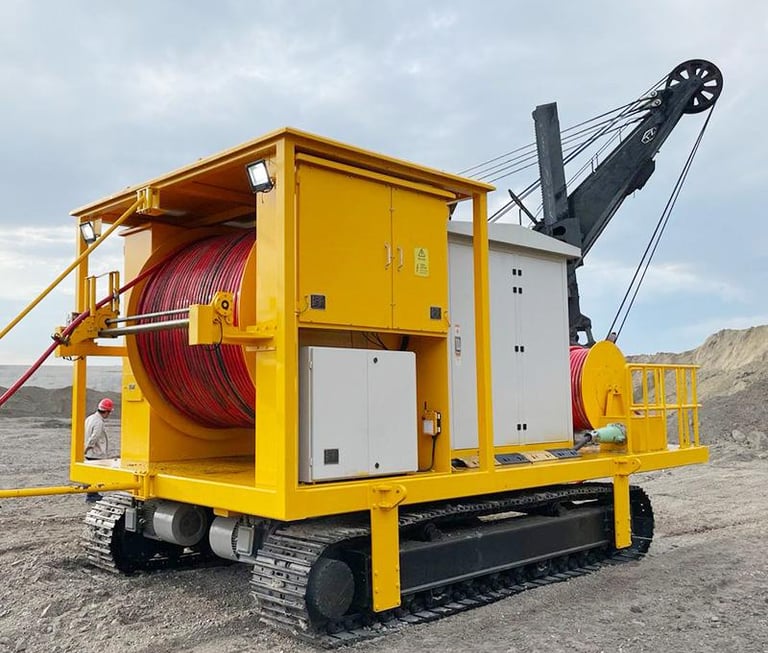
While the standard NTSKCGEWÖU series is well-suited for general trailing use and mobile equipment feeds, applications that involve continuous winding and unwinding onto motorized drums require a specialized mechanical design. For these high-stress reeling setups, the Feichun R-(N)TSCGEWÖU + FO series provides an optimized solution.
The R-(N)TSCGEWÖU series incorporates several specialized engineering features to handle the unique stresses of continuous reeling operations:
Integrated Fiber Optic Elements (FO): Can integrate single-mode or multi-mode fiber optic strands directly into the central core matrix. This design allows a single cable to handle both high-voltage power delivery and high-speed data communications for remote telemetry and automated control systems.
High-Strength Anti-Twist Braid: Features a high-tensile polyester reinforcement braid embedded between the inner and outer rubber sheaths. This braid resists torsional forces and prevents longitudinal twisting during fast winding cycles, eliminating structural deformations like the "corkscrew effect".
High Operational Speeds: Engineered to support heavy tensile loads up to 30N/mm² and continuous travel speeds reaching up to 240 meters per minute on monospiral or cylindrical reeling drums.
Robust Outer Jacket: Protected by a tough, weather-resistant outer rubber sheath that maintains its elasticity and structural durability over millions of reeling cycles.
By implementing the Feichun R-(N)TSCGEWÖU + FO series, mining operators can ensure reliable power distribution and real-time data connectivity for high-speed mobile equipment, avoiding the premature cable fatigue common with standard trailing cable designs.
8. GCC Mining Conditions
The Gulf Cooperation Council (GCC) region—particularly the Kingdom of Saudi Arabia—is experiencing a major expansion in its mining sector. Massive extraction projects targeting bauxite reserves, phosphate deposits, copper fields, and iron ore formations are being developed across remote areas. Operating high-voltage electrical equipment in these desert environments presents a unique set of challenges.
High Thermal Loading: Summer ambient temperatures regularly exceed 50°C, causing surface temperatures on exposed cables to pass 75°C due to direct solar heating. This high baseline temperature limits the cable's natural ability to dissipate heat, meaning the copper screen and phase conductors must have high thermal stability to handle short-circuit faults without overheating.
Abrasive Desert Dust and Sand: Constant winds and sandstorms deposit fine, abrasive dust over all moving components. Trailing cables dragged across rough, rocky terrain face continuous abrasive wear, requiring an outer jacket with high cut and tear resistance to protect the internal copper screens.
Continuous Operations: Modern mining complexes run on 24-hour cycles to meet production targets. This continuous duty means that cables experience constant electrical and mechanical loads, with no cooling-off periods, accelerating the aging of standard materials.
To maintain safety and reliability under these conditions, mining projects require robust cable architectures. The high thermal stability of vulcanized EPR insulation, combined with properly sized copper wire screens, ensures the cable can handle electrical faults safely even when pre-heated by the intense desert sun.
9. Why CPE Outer Sheath Works Well
To protect the internal components of a high-voltage mining cable from the harsh environmental conditions of the Middle East, selecting the right outer sheathing material is critical. Chlorinated Polyethylene (CPE) has proven to be an exceptionally reliable outer jacket compound for these demanding applications.
CPE outer jackets provide several key performance benefits for high-stress desert mining operations:
Excellent Thermal Stability: CPE retains its structural strength, elasticity, and impact resistance across a wide operating range, from cold winter nights down to extreme summer surface temperatures over 75°C. It does not soften or deform under intense heat, maintaining reliable protection for the underlying copper screens.
High Abrasion and Tear Resistance: The cross-linked molecular structure of CPE provides excellent resistance to cuts and abrasion. This allows the cable to slide over sharp rocks, rough gravel, and abrasive desert sand without tearing or exposing the internal components.
Chemical and Hydrocarbon Resistance: CPE resists degradation from industrial oils, hydraulic fluids, and grease common around heavy mining machinery, preventing these substances from softening the jacket and compromising the cable's integrity.
Superior UV and Ozone Protection: The material features inherent resistance to ultraviolet radiation, preventing surface cracking and brittleness caused by intense solar exposure.
By specifying Feichun NTSKCGEWÖU cables equipped with an advanced CPE outer jacket, mining enterprises can ensure their high-voltage power networks remain well-protected against the combined challenges of mechanical wear and severe environmental stress.
10. Cable Selection Logic
Selecting the correct high-voltage mining cable requires matching the equipment's operational motion profile and the system's electrical fault levels with the appropriate cable construction. Choosing a cable based solely on basic cross-sectional size or voltage rating can lead to early field failure if the design does not fit the application.
Engineering and procurement teams should follow a structured selection process based on three key operational profiles:
Is the application primarily static/trailing or continuous high-speed reeling? │ ┌──────────────────┴──────────────────┐ ▼ ▼ [ Trailing / Trajectory ] [ Continuous Reeling ] │ │ What is the prospective short-circuit level? │ │ │ ┌────────────┴────────────┐ ▼ ▼ ▼ Feichun R-(N)TSCGEWÖU + FO [ Standard Fault ] [ Heavy Fault ] • Integrated Fiber Optics Feichun NTSKCGEWÖU Feichun NTSKCGEWÖU • Anti-twist reinforcement • 16mm² Screen • 25mm² or 35mm² • Supports up to 240m/min Screen Upgrade
1. High-Voltage Mobile Trailing Applications
For heavy machinery that moves slowly or shifts positions infrequently—such as large stripping shovels or continuous excavators—the Feichun NTSKCGEWÖU series is the standard choice. It provides excellent mechanical protection and a robust copper wire screen to handle prospective short-circuit currents safely during trailing movement.
2. Continuous Winding and High-Speed Reeling Systems
When equipment requires a cable to wind and unwind repeatedly onto motorized drums—such as automated stacker-reclaimers or high-speed transfer cars—the Feichun R-(N)TSCGEWÖU + FO series should be specified. Its integrated anti-twist polyester reinforcement braid handles the continuous tension and prevents structural twisting, while its integrated fiber optic cores support high-speed data communications.
3. High Fault Current Levels or Delayed Protection Settings
If the electrical grid has high prospective short-circuit current levels, or if the system uses delayed protection clearing times to coordinate with other parts of the network, the cable's copper screen cross-section must be upgraded. Upgrading from a standard 16 mm² screen to a 25 mm² or 35 mm² screen ensures the cable can handle the higher thermal energy (I2t) during a fault without exceeding safe temperature limits.
11. Practical Installation Topics
Ensuring the long-term reliability of high-voltage mining cables requires careful attention to key installation and maintenance practices in the field:
Securing Reliable Shield Continuity and Grounding Path: During installation, the copper wire screens must be terminated using high-quality grounding kits to establish a clean, low-resistance path back to the substation ground grid. Any break or poor connection in the screen continuity can create dangerous voltage differentials and hinder fault detection.
Executing High-Quality Screen Terminations: Cable splices and terminations must be completed by trained technicians using proper stress-control components. Incorrectly prepared terminations can create localized electrical stress points, leading to insulation tracking and premature dielectric breakdown.
Accounting for Thermal Derating in Hot Climates: When laying cables out in full desert sunlight, engineers must apply appropriate thermal derating factors to account for the high ambient temperatures. This prevents the cable from running too close to its maximum 90°C limit during normal operation, preserving its capacity to handle short-circuit spikes safely.
Implementing Mechanical Protection in Surface Mining: While high-quality mining cables feature tough outer sheaths, they should still be routed away from primary vehicle paths whenever possible. Using dedicated cable bridges or protective trenches in high-traffic areas reduces the risk of heavy vehicle impacts and premature structural damage.
Establishing Routine Inspection Protocols: Implementing regular maintenance checks—including insulation resistance testing and visual inspections of the outer jacket—helps operators identify surface cuts or minor damage early. Addressing these issues promptly prevents moisture infiltration and avoids costly unexpected electrical faults.
12. Conclusion
In high-voltage mining operations, the short-circuit rating is a foundational design criterion that directly impacts system safety and operational reliability. The integrated copper wire screen serves as a vital safety system, providing a controlled, low-resistance path for fault currents and ensuring that protective relays can isolate electrical faults within milliseconds.
By using high-purity Class 5 tinned copper conductors, advanced EPR insulation, and tough outer protective sheaths, Feichun’s high-voltage mining cable families—including the NTSKCGEWÖU and R-(N)TSCGEWÖU + FO series—deliver the electrical performance and mechanical durability required for heavy industry. Whether specified for trailing applications on heavy excavators or continuous reeling systems on high-speed reclaimers, these robust cable solutions help mining operators build safe, efficient, and reliable power networks capable of performing dependably in the most challenging environments.
Port crane cables | Mining cables | Reeling cables | Trailing cables | Festoon cables | Heavy-duty power cables | Medium voltage cables | Offshore crane cables | Underground mining cables | Dragline cables | Shearer cables | Container handling cables | STS crane cables | RTG cables | Mobile equipment cables | Armored cables | Flexible power cables | VFD cables | Submersible cables | Cold resistant cables | Abrasion resistant cables | Flame retardant cables | Marine environment cables | Opencast mining | Underground operations
© 2006 All rights reserved.
[INDUSTRIAL_CABLES]
INDUSTRIAL GRADE CABLE SYSTEMS | PORT & MINING SOLUTIONS
TEL: +86 153 7530 2641 |MAIL: hongjing.Wang@feichuncables.com