Can N3GRD5G Replace LAPP Festoonflex in Port Crane Applications?
Evaluate whether N3GRD5G is a suitable alternative to Festoonflex cables for port cranes, RTGs, RMGs, and industrial festoon systems operating in demanding environments.
hongjing.Wang@Feichun
6/16/202628 min read
Introduction
Festoon systems remain one of the most widely used cable management solutions anywhere a crane or a trolley has to move while staying connected to power. Walk through any container terminal, bulk handling facility, or heavy industrial plant across the Gulf and the wider Middle East, and you will see them: the looping garlands of cable that gather and spread as a trolley travels, feeding electricity and control signals to equipment that never stays still. They are a mature, proven technology, and they work — provided the cable running through them is up to the job.
That last condition is where the real engineering lies, and it is why the question this article addresses comes up so often. As maintenance teams plan replacements and procurement officers weigh their options, many find themselves asking whether N3GRD5G can serve as an effective alternative to the cables commonly associated with the Festoonflex family. It is a sensible question, because festoon cable is a consumable in the long run — it wears, it ages, and eventually it must be replaced — and the choice of what to replace it with has a direct bearing on how long the new cable lasts, how much maintenance it demands, and how reliably the crane keeps running.
The honest starting point is that most engineers asking about Festoonflex are not wedded to a particular product so much as to a particular standard of performance. The name has come to represent a category: a dependable festoon cable that flexes smoothly through countless bending cycles, survives the mechanical knocks of trolley travel, and holds up under harsh outdoor conditions. What the engineer actually needs is a cable that delivers that performance reliably, and the brand name is simply a convenient shorthand for it. Once you see the question that way, it becomes less about loyalty to a name and more about matching a cable to a job — which is exactly how good engineering decisions get made.
This article explores the considerations behind that decision in depth. It explains how festoon systems work and what they demand of a cable, sets out what engineers genuinely expect from a Festoonflex-type cable, examines the design and capabilities of N3GRD5G, surveys the mechanical and environmental challenges that festoon cables face — with particular attention to the demanding conditions of Middle Eastern ports — and looks closely at why festoon cables fail prematurely. It then works through whether N3GRD5G can stand in as a Festoonflex alternative, maps the cable onto its typical applications, and offers a framework for selecting a festoon cable for long-term reliability. The thread running through all of it is a single principle: the right cable is determined by the real operating conditions of the system, not by the name printed on the sheath. Understand the conditions properly, and the choice of cable largely makes itself.
Understanding How Festoon Systems Work
To judge whether one festoon cable can replace another, it helps to be clear about what a festoon system is actually doing and why it places the particular demands it does on the cable. A festoon system is, at heart, a way of managing a cable that has to move with a travelling machine while remaining connected to a fixed power source. It does this elegantly, but the elegance comes at a cost the cable has to pay.
The Purpose of a Festoon System
Picture a crane trolley travelling along a track. It needs power and control signals delivered continuously, but the supply point is fixed while the trolley moves. The festoon system solves this by suspending the cable in loops from a series of carriers — small trolleys of their own — that ride along a track parallel to the crane's travel. As the crane moves away from the supply point, the carriers spread apart and the loops open out; as it returns, the carriers gather together and the loops fold back up, like an accordion or a hanging garland. The cable is always connected, never dragged on the ground, and never pulled taut beyond what it can bear.
Three purposes sit behind this arrangement. The first is managing moving cables: keeping the cable organised and controlled as the machine travels, so it neither tangles nor fouls the equipment. The second is supporting trolley travel: allowing the crane or trolley to move freely across its full range without the cable restricting it or being damaged by the motion. The third, and perhaps most important for cable life, is protecting the cable from excessive strain: the festoon carriers bear the cable's weight and distribute the movement across many loops, so that no single point of the cable takes the full mechanical load. Without a festoon system, a travelling cable would simply drag, stretch, and quickly destroy itself.
What this means for the cable is a specific kind of duty. The cable is not winding onto a drum, as in a reeling system, nor is it being twisted, as a rotating spreader cable might be. Instead it is being bent, repeatedly and predominantly in one direction, every time the loops open and close. This repeated, mostly unidirectional bending is the defining mechanical demand of festoon service, and it shapes everything about what makes a good festoon cable. A cable engineered for this duty is built to flex in this way for an enormous number of cycles without its conductors fatiguing or its sheath breaking down.
Typical Crane Applications
Festoon systems appear across the full range of port and heavy-lifting equipment, and the Middle East operates all of it. Ship-to-shore cranes — the towering machines that reach out over a vessel to lift containers directly from the ship — use festoon systems to feed power and control to their travelling trolleys. Rubber-tyred gantry cranes, which work the container stacks in the yard, use them on their trolley and hoist arrangements. Rail-mounted gantry cranes, increasingly common in automated terminals, rely on them too. Wharf cranes of various kinds, handling general and bulk cargo along the quay, use festoon systems for their moving cable management. And ship loaders, which travel along a berth to fill a vessel's holds evenly, depend on festoon cabling for the power that drives them.
The common thread across all of these is travel combined with the need for continuous power, and the festoon system serving them is only ever as reliable as the cable running through it. When that cable is correctly chosen for the duty, the festoon system delivers years of dependable service. When it is not, the cable becomes the weak point, and the whole arrangement is only as good as its most fatigued loop.
What Engineers Expect from Festoonflex-Type Cables
Before assessing N3GRD5G as an alternative, it is worth being precise about what the Festoonflex name actually represents to the engineers who specify it, because that defines the benchmark any alternative must meet. The reputation rests on a clear set of expected qualities, and these qualities are really the requirements of festoon service itself rather than anything unique to one brand.
Continuous Flexibility
The first and most fundamental expectation is continuous flexibility. A festoon cable bends every time the loops open and close, and in a busy terminal that happens an enormous number of times over the cable's life. The cable must withstand these repeated bending cycles without its conductors fatiguing and breaking. This is not the occasional flexing of an ordinary installation cable; it is relentless, lifelong bending, and it demands a conductor and a sheath engineered specifically to endure it. A cable that is merely "flexible" in the general sense will fatigue and fail under festoon duty; a true festoon cable is built for continuous flexing as its primary purpose.
Stable Movement
The second expectation is stable movement — smooth, predictable travel through the cable trolleys and along the festoon track. The cable must move cleanly as the carriers gather and spread, without snagging, kinking, or binding. A cable that does not travel smoothly puts uneven stress on itself and on the festoon hardware, accelerating wear on both. Stable movement depends on the cable's construction being consistent and its outer sheath being appropriately finished, so that it rides through the carriers as intended for the life of the system.
Long Service Life
The third expectation is long service life, which translates directly into reduced maintenance and fewer unexpected shutdowns. A festoon cable is a significant component to replace — it means taking the crane out of service, removing the old cable from its carriers, threading the new one through, and re-terminating everything — so every additional year of reliable service is worth a great deal. Engineers expect a Festoonflex-type cable to last, because the cost of frequent replacement is measured not just in cable but in lost crane availability. A cable that lasts longer between replacements is a cable that keeps the operation running.
Outdoor Durability
The fourth expectation is outdoor durability: reliable performance under changing and often harsh weather conditions. Festoon systems on port cranes are exposed to everything the environment can throw at them — sun, heat, moisture, salt, dust — and the cable must hold its properties through all of it. A cable whose sheath hardens and cracks under UV, or degrades in a coastal atmosphere, will fail prematurely regardless of how good its mechanical design is. Outdoor durability is therefore not a secondary consideration but a core requirement, especially in the demanding climate of the Middle East.
These four expectations — continuous flexibility, stable movement, long service life, and outdoor durability — form the practical specification that any Festoonflex alternative must satisfy. They are not proprietary; they are what the festoon application demands of any cable. The question for the rest of this article is whether N3GRD5G meets them.
What Is N3GRD5G Cable?
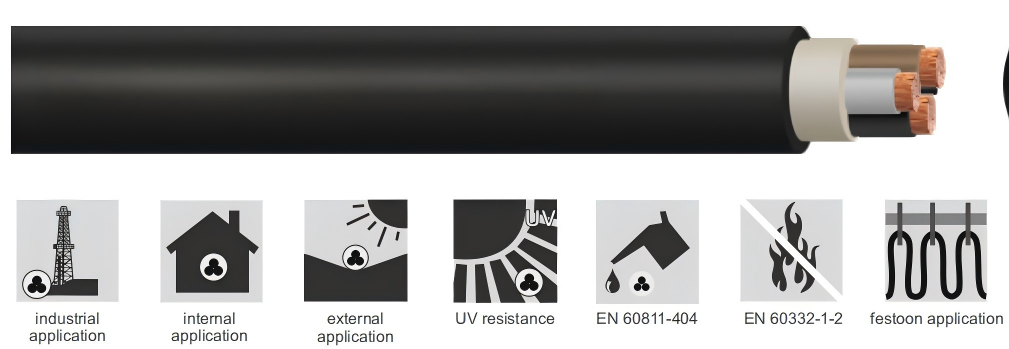
N3GRD5G is a flexible round festoon cable designed for power and control applications with high mechanical requirements, built specifically for the kind of frequent, predominantly single-direction bending that festoon service involves. That focus matters: this is not a general-purpose flexible cable pressed into festoon duty, but a cable engineered from the outset for the bending pattern that festoon systems impose. Rated at 0.6/1 kV, it is intended above all for festoon applications — trolley systems, drag chains on moving parts of machines, and conveyor installations — and it is suited to both indoor and outdoor use. In other words, its design intent maps directly onto the festoon role this article is concerned with.
Typical Design Features
The construction of N3GRD5G reflects its festoon purpose closely, and each feature addresses a specific demand of the duty. The conductors are finely stranded copper to the recognised flexible conductor class, which is the foundation of any festoon cable's flex life. Fine stranding distributes the bending strain across many thin strands so that each one experiences less stress per cycle, allowing the conductor to survive the enormous number of bends festoon service demands. A conductor with coarse stranding would fatigue and break quickly under this duty; fine stranding is what makes a cable genuinely suitable for continuous flexing.
The insulation is a high-grade rubber compound — a hardgrade EPR-type material — chosen for its resilience and its ability to stay flexible across a wide temperature range. This matters enormously for a cable that must flex on every cycle in fierce heat, because a brittle or temperature-sensitive insulation would crack and fail. The cores are stranded in layers around a central element, a construction that gives the cable a stable, round geometry and helps it bend evenly and travel smoothly through the festoon carriers.
The sheathing is where the cable's mechanical toughness lives. An inner sheath of synthetic rubber fills the spaces between the cores, locking the internal structure together and giving the cable its first layer of protection and its consistent round shape. Over this sits a heavy-duty rubber outer sheath, a robust compound formulated for mechanical durability and abrasion resistance, which takes the knocks and rubbing of trolley travel and shields the cable from the environment. Together these features — finely stranded flexible conductors, resilient high-grade insulation, a layered construction around a central element, and a tough multi-layer rubber sheath — add up to a cable built for high mechanical durability in exactly the conditions festoon systems create.
Common Industrial Applications
The applications N3GRD5G is suited to span the heavy-duty industrial world. It is used in ports and terminals, on the cranes and trolley systems that move containers and cargo. It serves in steel mills, where cables face heat, mechanical stress, and demanding duty cycles. It is used in mining facilities, among the most abrasive and punishing environments for any cable. It serves bulk handling equipment, the conveyors and machines that move grain, minerals, and aggregates. And it is used in crane systems generally, wherever a robust, flexible cable is needed to feed moving equipment.
These applications overlap almost entirely with the duties associated with the Festoonflex name — demanding, movement-intensive, mechanically harsh, and often outdoors. That overlap is the first strong sign that the comparison this article examines is a reasonable one: these are cables aimed squarely at the same kind of work.
Mechanical Challenges in Festoon Applications
Before deciding whether one festoon cable can replace another, it is worth understanding what festoon cables are actually up against mechanically, because the suitability of any alternative depends on whether it can meet these challenges. Festoon duty imposes a particular set of stresses, and each is a potential cause of failure if the cable is not equal to it.
Continuous Bending
The defining mechanical challenge of festoon service is continuous bending. Every time the festoon loops open and close as the trolley travels, the cable bends — and over the life of a busy crane, that happens a vast number of times. Each individual bend is harmless; it is the accumulation of millions of bends that causes conductor fatigue, as the fine copper strands flex back and forth until they begin to work-harden and crack. Crucially, festoon bending is predominantly in one direction, which is its own kind of demand: the cable is designed and laid up to flex this way, and a cable built for it survives far longer than a general-purpose cable that was never optimised for unidirectional festoon flexing. N3GRD5G's fine stranding and its festoon-specific construction are precisely the defence against this fatigue.
Shock Loading
The second challenge is shock loading. Cranes and trolleys do not move at a constant, gentle pace; they start, stop, accelerate, and decelerate, and each of those changes in motion sends a dynamic force through the cable. When a trolley starts suddenly, the festoon loops are jerked into motion; when it stops, their momentum has to be absorbed. These shock loads stress the cable far more than steady movement would, and a cable that cannot absorb them will suffer at its weak points — terminations, transitions, and any spot where the construction is less than robust. A festoon cable needs the mechanical resilience to take these repeated shocks over its whole life, which is part of why heavy-duty construction matters so much for this duty.
Abrasion
The third challenge is abrasion. As the cable travels and the loops open and close, the cable contacts the rollers, the trolley carriers, and the support systems that guide it. Every point of contact is a point of rubbing, and over time that rubbing wears the outer sheath. If the sheath wears through, the cable's environmental protection is breached and the way is opened for moisture, salt, and dust to reach the interior and accelerate every other failure mode. A festoon cable therefore needs a tough, abrasion-resistant outer sheath — exactly the heavy-duty rubber compound that N3GRD5G employs — to survive the constant low-grade wear of trolley travel.
Cable Twisting
The fourth challenge is twisting. Festoon service is fundamentally a bending duty rather than a twisting one, but improper installation can introduce unwanted torsion into the cable — for instance, if the cable is fitted with a twist already in it, or if the festoon carriers are misaligned so that the cable is forced to rotate as it travels. Torsion is a different and more destructive stress than bending, and a cable carrying unwanted twist will fail far sooner than one running cleanly. While the cure for twisting lies mainly in correct installation, a robustly constructed festoon cable with a stable, layered core arrangement tolerates incidental torsion better than a flimsy one. The key practical point is that twisting in a festoon system is usually a sign of an installation fault to be corrected, not an inherent feature of the duty.
Environmental Challenges in Middle East Ports
The mechanical demands of festoon service are universal, but the environmental demands depend heavily on where the cable works — and the Middle East presents some of the most challenging conditions anywhere for crane cables. A festoon cable that performs admirably in a temperate European port may be working much closer to its limits in a Gulf terminal in summer, and accounting for this honestly is essential to sound cable selection. The region's conditions deserve specific attention.
Extreme UV Exposure
The Middle Eastern sun is intense and sustained, and ultraviolet radiation is one of the great destroyers of polymer materials. Over time, long-term sunlight breaks down the molecular structure of jacket compounds that were not formulated to resist it, causing the sheath to harden, lose flexibility, discolour, and crack. For a festoon cable this is especially dangerous, because a hardened, embrittled jacket cannot flex as the loops open and close without cracking, and once it cracks the cable's protection is lost. UV resistance is therefore not a marginal benefit in the region but a central requirement, and a cable rated for unrestricted outdoor use with genuine UV resistance — as N3GRD5G is — is essential for festoon duty under the region's sun.
High Ambient Temperatures
Summer temperatures across much of the region routinely exceed what would be considered standard industrial conditions elsewhere, and the surfaces that festoon cables work near — steel crane structures, equipment frames — absorb solar heat and grow hotter still. A festoon cable in the region can therefore spend much of its working life at elevated temperatures, well above what its electrical load alone would produce. This has two consequences. First, the cable's thermal rating must comfortably accommodate these temperatures; a conductor rating suited to hot climates and a robust upper ambient limit are important. Second, the cable's current-carrying capacity must be de-rated for the high ambient temperature, because a cable that carries a given current in a cooler climate carries less in the heat before reaching its temperature limit. Sizing a festoon cable in the region without applying proper thermal de-rating risks overloading and prematurely ageing it.
Sand and Dust Contamination
The region's airborne sand and dust add a dimension that is easy to overlook but genuinely significant. Fine particles settle on and work into everything, and for a festoon cable they increase abrasion and maintenance requirements in two ways. First, dust on and around the cable acts as a mild abrasive, accelerating the wear that trolley travel already causes at contact points. Second, fine particles can infiltrate the festoon hardware — the carriers, rollers, and guides — contributing to wear and to the kind of misalignment that can introduce unwanted stress into the cable. This makes regular inspection and cleaning of the festoon system especially important in the region, both to preserve the cable's sheath and to keep the hardware running smoothly so that the cable travels cleanly.
Coastal Salt Exposure
Much of the region's port infrastructure sits hard against the sea, and the marine environment accelerates material degradation. Salt-laden air is corrosive, attacking metallic components and working into any breach in a cable's sheath to reach the conductors within. High coastal humidity promotes long-term degradation of materials. Where salt, humidity, and the region's heat combine, they reinforce one another's effects, so a festoon cable for coastal service needs a complete environmental package — resistance to UV, ozone, and moisture, and a robust sheath that keeps the corrosive atmosphere out. The moisture resistance built into a cable rated for unrestricted outdoor use is an important credential in this setting, not a luxury.
Taken together, these regional factors — extreme UV, high temperatures, sand and dust, and coastal salt — mean that festoon cable selection in the Middle East demands a cable with a genuinely complete set of environmental capabilities, and a festoon system maintained with real discipline. They also mean the margin between a cable's ratings and the application's demands should be generous rather than tight, because the regional conditions leave little room for error.
Why Festoon Cables Fail Prematurely
Understanding how festoon cables fail before their time is the other half of understanding the challenges they face, and it sharpens the assessment of any alternative considerably. Premature festoon cable failures almost always trace back to one of a handful of causes — and recognising these causes is essential both for choosing cables well and for diagnosing problems honestly when they arise.
Incorrect Cable Selection
The most common root cause of premature festoon failure is simply choosing the wrong cable — using a cable not designed for dynamic movement in an application that demands it. A general-purpose flexible cable, or worse a cable intended for fixed installation, may look superficially similar to a festoon cable and cost less, but it lacks the fine stranding, the festoon-specific construction, and the heavy-duty sheath that festoon duty requires. Dropped into a festoon system, such a cable fatigues and fails far sooner than a purpose-built one. The frustrating part is that this failure is entirely avoidable: it stems from a selection decision made before the cable ever went into service. Choosing a cable genuinely engineered for festoon duty — as N3GRD5G is — removes this cause of failure at its root.
Improper Installation
The second major cause is improper installation, particularly poor trolley spacing and inadequate cable support. A festoon system relies on its carriers being correctly spaced so that the loops form and travel as intended; if the spacing is wrong, some loops bear more than their share of the load and the cable is stressed unevenly. If the cable is inadequately supported, its weight concentrates at points it was not meant to carry, accelerating fatigue. Poor installation can also introduce the unwanted twisting discussed earlier, or force the cable to bend more tightly than its rating allows. The lesson is that even a perfectly chosen cable will disappoint in a badly installed system — installation quality matters as much as cable quality, a theme we will return to.
Excessive Mechanical Stress
The third cause is excessive mechanical stress — overloading the cable beyond its design limits. This can mean exceeding the cable's tensile capacity, bending it tighter than its minimum bending radius, running the festoon system faster than the cable is rated for, or subjecting it to shock loads beyond what it can absorb. Each of these pushes the cable past what it was built to withstand, and the result is accelerated wear and early failure. Avoiding this cause means matching the cable's ratings to the real demands of the system, with margin to spare, and respecting those ratings in operation — not asking the cable to do more than its specification allows.
Environmental Ageing
The fourth cause is environmental ageing — the gradual degradation of the cable's materials under UV, heat, and contamination over time. As discussed, the Middle East's conditions are particularly aggressive in this respect, and a cable whose sheath was not formulated to resist them will harden, crack, and lose its protective and mechanical properties well before it should. Environmental ageing weakens the cable's ability to withstand the mechanical stresses of festoon duty, so it often acts in combination with the other causes: an environmentally aged cable fails mechanically sooner than a fresh one would under the same loads. The defence is a cable with genuine environmental resistance suited to the region, installed and maintained so that contamination is managed.
Across all four causes, a pattern emerges: premature festoon failure is rarely the fault of festoon cabling as a category, and almost always the result of a wrong choice, a poor installation, an overload, or an environment the cable was not built for. Each of these is within an operator's power to address, which is encouraging — it means reliable festoon cable life is achievable through sound selection, installation, and maintenance.
Can N3GRD5G Be Used as a Festoonflex Alternative?
With the groundwork laid, we can address the central question directly. The honest answer is that N3GRD5G can indeed serve as a practical alternative to Festoonflex-type cables in many festoon applications — but the decision should rest on a careful matching of the cable to the specific requirements of the system, not on a simple brand swap. Let us look at how that matching should be done.
Evaluating Application Requirements
Several requirements deserve careful evaluation before committing to any festoon cable, and they apply equally whatever name the cable carries. The first is travel distance — how far the crane or trolley moves, which determines the length of cable involved and the number and size of festoon loops. The second is operating speed — how fast the festoon system travels, which the cable must be rated to handle. N3GRD5G carries a defined reeling speed rating, and the engineer should confirm this exceeds the system's actual maximum travel speed, because a system running faster than the cable allows will overstress it regardless of its other qualities. The third is mechanical loading — the tensile loads, shock loads, and bending the cable will experience, which must fall within the cable's rated capacities. The fourth is environmental conditions — the UV, temperature, dust, and salt the cable will face, which its environmental ratings must cover.
For N3GRD5G, these checks are favourable for genuine festoon duty. It is built for high mechanical requirements and frequent unidirectional bending, with fine-stranded conductors for flex life, a defined tensile load capacity, a bending radius specified separately for fixed installation and festoon application, and a speed rating suited to fast-moving festoon systems. Its environmental ratings — unrestricted outdoor use with resistance to UV, ozone, and moisture, and a thermal rating suited to hot conditions — address the regional demands. The engineer's task is to confirm that each of these ratings comfortably exceeds the actual demands of the specific application, with margin to spare. Where they do, the cable is technically suitable for the duty.
Matching Cable Design to Duty Cycle
This brings us to the principle at the heart of the whole article: real operating conditions matter more than brand preference. Brand-based selection — choosing a cable because of its name and reputation — is a reasonable shortcut and not wrong in itself, but it is incomplete. A name tells you what a cable has done well for others; it does not tell you whether that cable is correctly matched to your specific festoon system, nor whether another cable might match it equally well. Matching cable design to the actual duty cycle — the real pattern of travel, speed, loading, and environment the cable will experience — is a more rigorous approach, and it consistently produces better decisions.
The advantage of matching to the duty cycle is twofold. First, it ensures the chosen cable genuinely fits the system, rather than relying on the assumption that a well-regarded cable will be suitable everywhere; a cable can have an excellent reputation and still be wrong for a particular application if, say, the system travels faster than it is rated for, or the festoon geometry demands a tighter bend than it allows. Second, it opens the field to alternatives that meet the same duty cycle, giving the engineer more options on availability, lead time, and cost without compromising performance. In a region where major port and infrastructure projects run on tight schedules and substantial budgets, having more than one qualified option for a critical component is a real advantage.
Seen through this lens, the question "can N3GRD5G replace Festoonflex?" resolves into a more useful one: "does N3GRD5G meet the requirements of this specific festoon application?" If its mechanical, speed, bending, and environmental ratings all cover the duty cycle with margin, then it is a suitable alternative, and the different name on the sheath is immaterial to its performance. The brand was always a proxy for the requirements; once the requirements are checked directly against the duty cycle, the proxy is no longer needed.
Typical Applications for N3GRD5G
It is worth making this concrete by looking at the specific applications where N3GRD5G is well suited to be considered as a festoon cable, because seeing the cable mapped onto real duties makes its suitability tangible. Each of these is a demanding festoon application of exactly the kind the cable was designed for, and each is well represented across the Middle East's ports and heavy industry.
Container Handling Cranes
Container handling cranes are perhaps the most prominent festoon application in any modern port, and the Gulf's major terminals operate them in large numbers. The trolleys on these cranes travel back and forth continuously, and their festoon cables must flex through countless bending cycles while delivering power and control reliably. N3GRD5G's combination of fine-stranded conductors for flex life, festoon-specific construction for unidirectional bending, and robust environmental protection suits this duty well, provided its ratings are matched to the specific crane's travel speed, festoon geometry, and load. In the region's hot, often coastal, around-the-clock terminal environments, its weather resistance and thermal rating are particularly relevant.
Bulk Terminal Equipment
Bulk terminals — handling grain, cement, minerals, coal, and aggregates — run a range of travelling equipment that depends on festoon cabling. The trolleys, conveyors, and moving machines that handle bulk cargo flex their cables continuously and operate in dusty, abrasive, often coastal conditions. A festoon cable for this duty needs both mechanical robustness and strong environmental resistance, and N3GRD5G's heavy-duty rubber construction, resistance to abrasion, and weather durability make it a reasonable candidate where the system requirements align with its ratings. The region's substantial bulk handling operations make this a directly relevant application.
Automated Yard Systems
Automated container yard systems, increasingly central to modern terminals, run equipment through high numbers of repetitive, programmed movement cycles. The festoon cables serving this equipment must endure relentless, predictable bending with stable, smooth travel, because an automated system depends on every component behaving consistently. N3GRD5G's stable layered construction around a central element supports the smooth, even bending and clean travel that automated systems require, and its durability suits the high cycle counts these systems generate. As terminals across the region invest in automation, festoon cabling for automated yard systems becomes an ever more relevant application.
Ship Loading Facilities
Ship loaders travel along a berth to fill a vessel's holds evenly, paying their festoon cable through opening and closing loops as they move. This is sustained, repetitive festoon duty over a substantial travel distance, generating continuous bending cycles and the shock loads of starting and stopping. A cable for this application needs a long flex life and the resilience to absorb dynamic loads, both of which N3GRD5G is built to provide. Bulk and general cargo terminals along the region's coasts run ship loaders of this kind, making the cable's suitability for the duty practically significant.
Industrial Material Handling Systems
Beyond ports specifically, industrial material handling systems of every kind — the conveyors, transfer machines, and travelling equipment in steel mills, processing plants, and heavy industry — rely on festoon cabling to power their moving elements. These systems combine continuous operation, mechanical stress, and often harsh, hot, or contaminated environments. The robustness of N3GRD5G's construction and its resistance to mechanical stress and weathering make it well suited to this broad category, again subject to the standard matching of ratings to the specific system. The region's growing industrial base makes these applications increasingly common.
Across all of these, the pattern is consistent: N3GRD5G is engineered for demanding festoon duty — frequent unidirectional bending under high mechanical requirements in harsh environments — which is exactly the profile these applications require. Where its published ratings meet the specific system's requirements with margin, it is a sound choice, and these are the applications where that match is most likely to be found.
How Festoon Duty Differs From Reeling Duty
A point that often causes confusion in cable selection is the difference between festoon cables and reeling cables, because both serve travelling crane equipment and both must flex, yet they face genuinely different stresses and are built differently as a result. Understanding the distinction sharpens the assessment of any festoon cable and helps avoid the mistake of specifying the wrong type for the duty.
A reeling cable winds onto and off a motorised or spring-operated drum as the equipment travels. This subjects it to a particular combination of stresses: tension as the cable winds under load, the pressure of inner layers carrying the weight of outer ones, and — depending on the system geometry — torsion, the twisting stress that drum winding can introduce. A reeling cable is therefore built above all for tensile strength and anti-torsion performance, often with a dedicated reinforcement braid to resist twisting, because torsion is one of its primary failure modes.
A festoon cable, by contrast, does not wind onto a drum at all. It hangs in loops from carriers and flexes as those loops open and close, predominantly bending in a single direction. Its defining stress is repeated unidirectional bending rather than tension or torsion. The construction priorities shift accordingly: the emphasis falls on flex life under that specific bending pattern, on a stable round geometry that travels smoothly through the carriers, and on a tough sheath to handle abrasion from the trolleys and rollers. Torsion, while it can be introduced by poor installation, is not an inherent feature of festoon duty the way it is of reeling, so a festoon cable's design centres on bending endurance rather than anti-torsion reinforcement.
This distinction matters for the replacement question because it confirms what kind of cable N3GRD5G is and what it is optimised for. It is a flexible round festoon cable, designed for frequent bending in one direction, with a layered construction around a central element that gives it the stable geometry and smooth travel festoon service rewards. That design intent aligns precisely with festoon duty — which is the duty Festoonflex-type cables serve. The two are like for like in their fundamental purpose, both built for the bending-dominated world of festoon systems rather than the tension-and-torsion world of drum reeling. When matching a cable to a festoon application, this alignment of design intent is exactly what you want to confirm, and N3GRD5G has it.
The practical lesson is to be sure you are comparing cables that suit the duty you actually have. For a festoon system, you want a cable built for festoon bending; for a reeling system, you want a cable built for reeling tension and torsion. Pressing a reeling cable into festoon service, or vice versa, tends to disappoint because each is optimised for stresses the other application does not impose in the same way. The good news for this article's question is that N3GRD5G is squarely a festoon cable, matched in purpose to the Festoonflex-type cables it might replace.
Reading a Festoon Cable Specification With Confidence
When you set out to match a festoon cable to an application, the specification sheet is where the decision is actually made, and learning to read it with confidence is one of the most valuable skills a specifying engineer can have. A manageable handful of parameters carry most of the weight, and knowing what each one tells you turns a dense sheet of figures into a clear picture of whether a cable fits the duty.
Begin with the voltage rating, given as the conductor-to-earth and conductor-to-conductor figures — 0.6/1 kV for N3GRD5G. This must meet or exceed the system voltage, and for the low-voltage power and control duty typical of festoon systems it covers the great majority of applications. The specification also gives maximum permissible operating voltages in AC and DC systems and an AC test voltage, which together confirm the insulation's integrity margin above the nominal rating. There is no benefit in over-specifying voltage for a festoon application, since higher-voltage cables tend to be stiffer and that stiffness works against flexibility; match the rating to the system with sensible margin and no more.
Turn next to the thermal parameters, where the specification gives more than one figure for good reason. The ambient temperature rating is quoted separately for fixed installation and for flexible operation, because a cable that is flexing tolerates a slightly different range than one sitting still. The maximum permissible conductor temperature — 90 degrees Celsius for this cable — is the upper limit the conductor can sustain in normal operation, and it matters enormously in the Middle East, where a black-sheathed cable near hot crane structures in summer sun can run genuinely hot before its current load is even considered. A separate, higher short-circuit temperature gives the brief limit during a fault. When specifying for the region's climate, the conductor temperature rating combined with proper ambient de-rating is among the most important checks you can make, because under-rating a cable thermally in a hot climate is a direct path to premature ageing.
The mechanical parameters are where a festoon cable proves itself, and they reward close attention. The maximum tensile load tells you how hard the system can pull on the cable before risking damage — important because festoon loops, their carriers, and the shock of starting and stopping all impose tension. The bending radius requirements, given as multiples of the cable's outer diameter and quoted separately for fixed installation and festoon application, set the geometry the festoon system must respect; bend the cable tighter than its festoon-application figure and you pre-load it for early failure no matter how good the construction. And the reeling speed rating caps how fast the festoon system can travel without overstressing the cable — a figure that, for a fast festoon cable, comfortably covers brisk trolley travel. Check each of these against the real numbers of your system, and you will know with confidence whether the cable's mechanical capabilities cover the duty.
The construction details then explain why the cable performs as its ratings claim. A conductor described as finely stranded copper to a recognised flexible class tells you the cable is built for flex life. An insulation identified as a high-grade rubber compound confirms its suitability for flexing in a wide temperature range. A core arrangement stranded in layers around a central element signals the stable, round geometry that travels smoothly through festoon carriers. And inner and outer sheath descriptions — a synthetic rubber inner filling the interstices, a heavy-duty rubber outer for durability — reveal the toughness of the cable's protection. Reading these construction notes alongside the performance ratings lets you understand not just what the cable can do, but why, which is invaluable when comparing cables or diagnosing a problem in service.
Finally, the chemical and environmental parameters confirm the cable's fitness for its conditions. Oil resistance, fire behaviour, and weather resistance — including resistance to ozone, UV, and moisture — are each tied to recognised standards, and for outdoor festoon duty in a harsh climate these are baseline requirements rather than optional extras. The current-carrying capacities, referenced to the appropriate standard, let you size the cable electrically for its load, remembering to apply ambient de-rating for the region's heat. Read in this ordered way — voltage, thermal, mechanical, construction, environmental — a festoon cable specification becomes a clear description of exactly what the cable can do, and the comparison between any two cables, whatever their brands, becomes a straightforward matter of checking each one's parameters against your system's requirements. That is the practical foundation of choosing by duty rather than by name.
Selecting the Right Festoon Cable for Long-Term Reliability
Pulling everything together, choosing a festoon cable for long-term reliability comes down to working systematically through a few areas: mechanical performance, environmental resistance, maintenance expectations, and total cost of ownership. Getting all of these right is what separates a cable that lasts from one that becomes a recurring maintenance headache — and the approach applies equally to N3GRD5G, to Festoonflex, or to any other candidate.
Mechanical Performance Considerations
Mechanical performance is the foundation. Confirm that the cable's flex life comfortably exceeds the bending cycles the festoon system will generate over its planned service life, with margin for the unexpected. Check that the minimum bending radius — specified separately for fixed installation and festoon application — suits the festoon geometry, and never design a system that bends the cable tighter than its rating. Verify the tensile capacity against the real loads of the system, accounting for the cable's weight and the dynamic forces of trolley travel. And confirm the speed rating exceeds the system's maximum travel speed. For N3GRD5G, these parameters are published clearly and are suited to demanding, fast-moving festoon duty; the task is to match them to the specific application with appropriate margin.
Environmental Resistance Requirements
In the Middle East, environmental resistance is not optional. Require genuine UV resistance as a baseline, because the region's sun will harden and crack any sheath not formulated to withstand it. Require a thermal rating that accommodates the region's high ambient temperatures, and apply proper de-rating to the cable's current capacity for those temperatures. Require resistance to moisture and the corrosive coastal atmosphere where the installation is near the sea. And consider the abrasive effect of sand and dust, favouring a cable with a tough, abrasion-resistant sheath. N3GRD5G's rating for unrestricted outdoor use with resistance to ozone, UV, and moisture, together with its heavy-duty sheath, addresses these regional demands — but the engineer should confirm the ratings cover the specific conditions of the installation.
Maintenance Expectations
Think realistically about maintenance from the outset, because the cable is part of a system that must be looked after. A longer-lasting cable reduces how often the crane must be taken out of service for replacement, but no cable lasts indefinitely without proper care of the festoon system around it. Set expectations for regular inspection — checking the cable for sheath wear, the festoon carriers for correct spacing and free movement, and the whole system for the dust and contamination that the region's environment deposits. A cable chosen for durability, installed correctly, and maintained with discipline will deliver the long service life that makes it economical. Building these maintenance expectations into the plan from the start is part of selecting the cable well, not a separate afterthought.
Total Cost of Ownership
Finally, weigh the decision on total cost of ownership rather than purchase price alone. The cheapest cable on the day of purchase is very often the most expensive over its life, once the cost of more frequent replacement, the lost crane availability during each replacement, and the knock-on operational costs are counted. A cable that costs a little more upfront but lasts substantially longer, demands less maintenance, and fails less often is almost always the better value when the numbers are worked on a cost-per-year basis. This is the case worth making internally when justifying a festoon cable specification, and it is the lens through which any alternative — including N3GRD5G — should be judged: not "what does it cost to buy?" but "what does it cost to own and operate over its working life?" Judged this way, a durable, well-matched festoon cable consistently earns its place.
Conclusion
When evaluating alternatives to Festoonflex-type cables, the most reliable guide is not brand recognition but the actual operating conditions of the system. A brand name is a useful shorthand for a track record, but it is no substitute for checking that a cable genuinely fits the festoon system it will serve — the travel and bending it will endure, the speeds and loads it will face, and the environment it will work in.
Judged against that standard, N3GRD5G presents itself as a serious and practical alternative for many demanding festoon applications. It is a flexible round festoon cable engineered specifically for high mechanical requirements and the frequent, predominantly single-direction bending that defines festoon service. Its construction — finely stranded flexible copper conductors for long flex life, resilient high-grade insulation, a stable layered build around a central element for smooth travel, and a heavy-duty rubber sheath for mechanical durability and abrasion resistance — addresses directly the challenges that festoon cables face: continuous bending, shock loading, abrasion, and incidental twisting. Its ratings for bending radius, tensile load, travel speed, and weather resistance, including suitability for the hot, dusty, and often coastal conditions of the Middle East, equip it for the region's container handling cranes, bulk terminal equipment, automated yard systems, ship loading facilities, and industrial material handling systems.
None of this means N3GRD5G is automatically the right choice for every festoon application — no cable is. The right approach is to match the cable to the real duty cycle: define the system's requirements for travel, speed, loading, and environment; check the candidate cable against them with appropriate margin; install the cable correctly with proper trolley spacing, support, and alignment; maintain the festoon system with discipline; and judge the decision on total cost of ownership rather than purchase price. Carry out that process honestly, and in many demanding festoon applications N3GRD5G will emerge as a thoroughly suitable alternative.
For the engineers and maintenance teams across the region weighing this decision, the message is encouraging. You are not bound to a single name. By focusing on real operating conditions, mechanical performance, environmental resistance, and the true cost of ownership — and by giving the installation and maintenance the same care you give the selection — you can evaluate N3GRD5G, or any other cable, on its merits and choose with confidence. The cable that best serves your festoon system is the one that best meets its requirements, whatever name it carries.
Port crane cables | Mining cables | Reeling cables | Trailing cables | Festoon cables | Heavy-duty power cables | Medium voltage cables | Offshore crane cables | Underground mining cables | Dragline cables | Shearer cables | Container handling cables | STS crane cables | RTG cables | Mobile equipment cables | Armored cables | Flexible power cables | VFD cables | Submersible cables | Cold resistant cables | Abrasion resistant cables | Flame retardant cables | Marine environment cables | Opencast mining | Underground operations
© 2006 All rights reserved.
[INDUSTRIAL_CABLES]
INDUSTRIAL GRADE CABLE SYSTEMS | PORT & MINING SOLUTIONS
TEL: +86 153 7530 2641 |MAIL: hongjing.Wang@feichuncables.com