
Choosing the Right Reeling Cable for Port Cranes: A Practical Selection Guide
A practical port crane reeling cable selection guide for engineers and buyers: how to match cable to speed, bending radius, torsion, drum geometry, and marine environment, with a procurement checklist and clear final recommendations.
hongjing.Wang@Feichun
6/24/202616 min read
Introduction
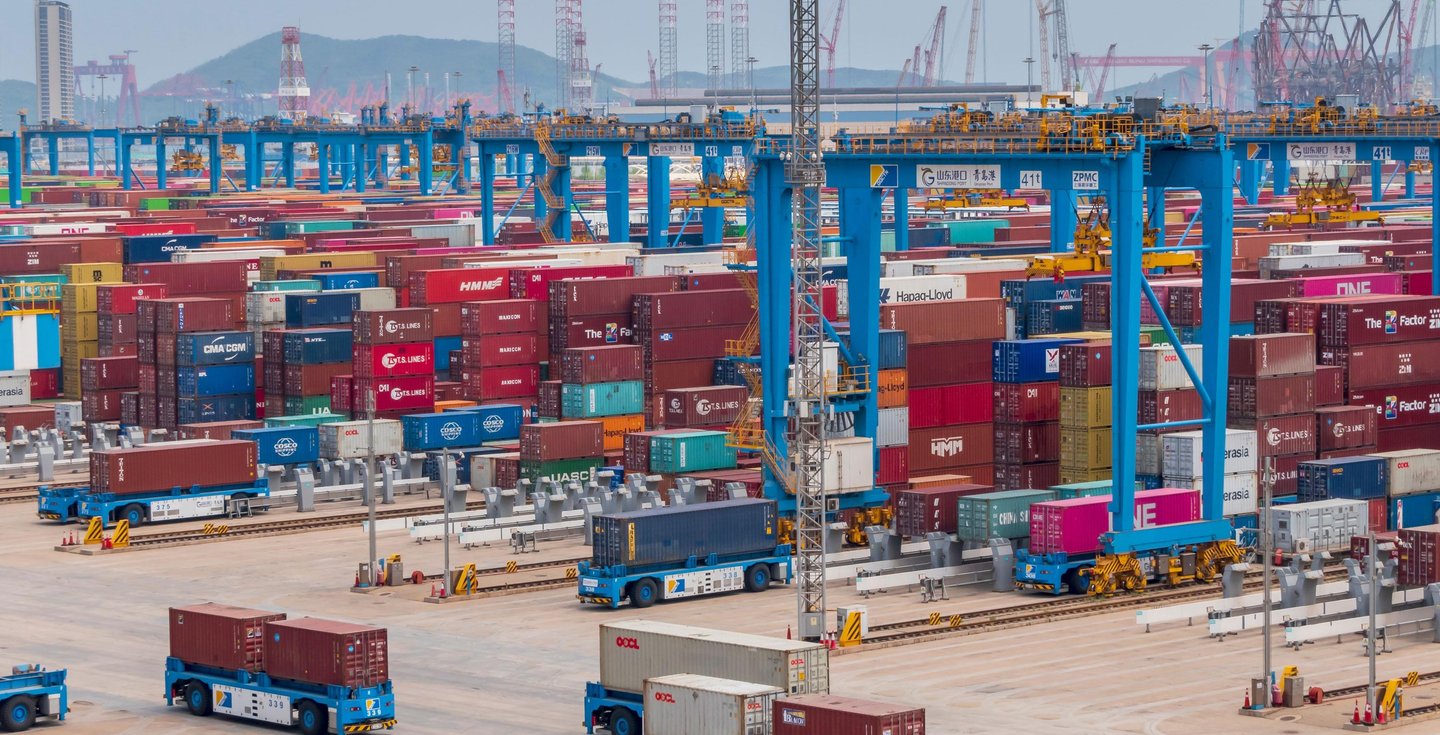
In every major port across the Middle East, from the container terminals of the Gulf to the bulk berths of the Red Sea and the Mediterranean coast, the cranes that keep cargo moving depend on one component that is easy to overlook until it fails: the reeling cable. This is the flexible power cable that feeds a moving crane, winding and unwinding on a drum thousands of times a day as the machine travels along the quay or through the yard. When it works, nobody notices. When it fails, a crane stops, a vessel waits at berth, and the cost mounts by the hour.
Port crane reeling cables are critical to both uptime and safety. They carry the power that drives travel motors, hoists, and control systems, and they do so while in constant, demanding motion. A cable failure under load is not just an operational inconvenience; it can be a safety hazard around high-power equipment and the people working near it. For terminal operators and engineers, reliable cable performance is directly tied to throughput, to safety records, and to the bottom line.
Here is the central problem this guide addresses: a standard power cable is often not enough for crane duty. An ordinary fixed-installation cable is designed to sit still. Its enemies are time and heat. A reeling cable lives in a completely different world, bending, twisting, stretching, and being compressed continuously for years. Place a standard cable in a reeling role and it will fatigue, crack, and fail in a fraction of the time. Crane duty demands a purpose-built cable, and choosing that cable correctly is a real engineering decision, not a catalogue lookup.
This article is written as a procurement and engineering decision guide, not a product brochure. Its promise to you is straightforward: it will help you choose the right reeling cable by matching it to the things that actually determine cable life, your reeling speed, your bending conditions, your torsional stress, your operating environment, and your duty cycle. By the end, you will know how to assess your own operating conditions, avoid the most common and costly selection mistakes, check the key technical parameters, and arrive at a sound final choice.
One theme runs through everything that follows, and it is worth stating plainly at the outset: cable choice is inseparable from the drum system. Drum diameter, winding geometry, fleet angle, and installation conditions directly affect how long a cable survives. You cannot specify a reeling cable in isolation from the reel it will run on. Treating the cable and the drum as a single system is the foundation of getting the selection right.
How to Judge Your Crane Operating Conditions
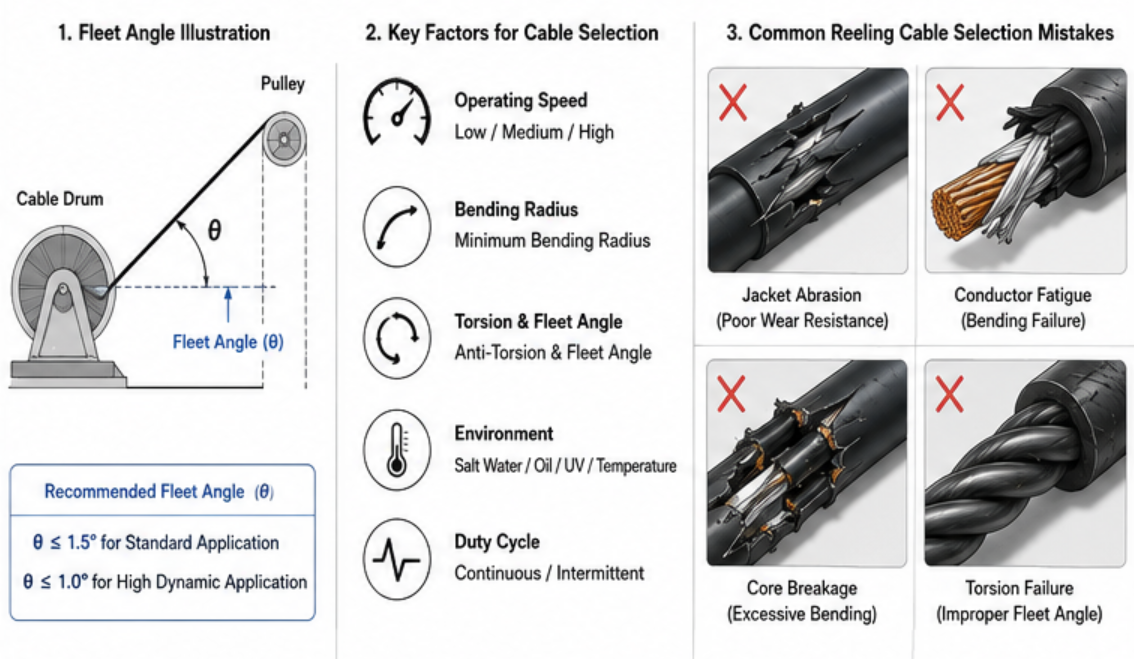
The single most important principle in reeling cable selection is this: start with the operating condition, not the product name. Too many buyers begin by asking "which cable should I buy?" when the right first question is "what conditions must the cable survive?" Once you understand the conditions, the right cable type follows naturally. Let us break the operating condition into its four key dimensions.
Speed Category: Low, Medium, or High-Speed Reeling
The speed at which the cable is wound and unwound is one of the most decisive factors. Reeling speed determines the dynamic stresses the cable experiences during acceleration, travel, and deceleration. As a rough framework, applications fall into low-speed reeling (conventional cranes operating at moderate speeds, often up to around 120 m/min for low-voltage heavy-duty cables), medium-speed systems, and high-speed reeling (fast-moving container cranes and automated terminals that can demand reeling speeds well beyond 120 m/min, with the most capable medium-voltage cables rated for effectively unrestricted gantry speeds up to several hundred metres per minute). The faster the system, the more dynamically robust the cable must be.
Bending Conditions: Minimum Bending Radius and Repeated Flexing
Every time the cable wraps around the drum or passes over a guide roller, it bends, and every bend is a small mechanical stress. The minimum bending radius the cable can tolerate, expressed as a multiple of cable diameter, must be respected at every bend point in the system. For reeling applications, heavy-duty cables typically require a minimum bending radius of at least 6 times the cable diameter, rising to 7.5 times on deflection pulleys, with even larger spacing (around 20 times the diameter) where the cable reverses direction in an S-shape. More severe duty cables built for higher cycle counts may specify larger flexed bending radii still. The frequency and severity of flexing, not just the radius, determines fatigue life.
Duty Pattern: Continuous vs Intermittent
Is the crane working around the clock, or in bursts? A continuously operating crane in an automated terminal subjects its cable to relentless, uninterrupted cycling, demanding maximum fatigue endurance. An intermittently operated crane gives the cable periods of rest and lower total cycle counts. The duty pattern directly affects how much margin you need to build into the cable's mechanical specification.
Environment: Salt Mist, Oil, Dust, UV, and Moisture
Finally, the operating environment shapes the specification profoundly, and Middle Eastern ports present some of the harshest conditions anywhere. Salt mist from the sea corrodes; oil and grease from machinery attack unsuitable sheaths; airborne dust abrades; intense year-round UV degrades poorly formulated jackets; and humidity threatens insulation. Each of these must be accounted for in the cable specification, not treated as an afterthought.
The takeaway is clear: define your operating condition first, across speed, bending, duty pattern, and environment, and let that definition drive the selection. The cable that survives your real working cycle is the right cable, and you can only identify it once you understand the cycle.
What Makes Reeling Cables Different?
Before going further, it is worth understanding precisely why reeling cables are a distinct product class, because this understanding underpins every selection decision.
Reeling cables are designed specifically for repeated winding and unwinding on a drum. This is a fundamentally different mechanical task from what an ordinary power cable performs. A fixed cable is installed once and never moves. A reeling cable is in motion for its entire working life, and that motion imposes a combination of mechanical stresses that would quickly destroy a standard cable.
Specifically, a reeling cable must handle flexing, compression, tension, and torsion far better than an ordinary power cable. As it winds onto the drum, the inner layers are compressed by the outer layers. As it is pulled off, it experiences tension. As it wraps and unwraps, it flexes. And in many reeling geometries, particularly spiral reels, it twists, experiencing torsional stress along its length. Often several of these stresses act simultaneously, the classic and most destructive combination being simultaneous tension and torsion.
To survive this, reeling cables are engineered from the conductor outward as integrated mechanical systems. The conductors are very finely stranded so they flex without fatiguing. The insulation is a flexible rubber compound such as EPR that bends through countless cycles. A vulcanized anti-torsion braid, typically of synthetic or polyester threads bonded between the inner and outer sheaths, carries the tensile and torsional loads so the conductors are protected. And a tough rubber or polyurethane outer sheath resists abrasion, oil, and weather.
The crucial point for buyers is this: cable construction and sheath materials in a reeling cable are chosen for mechanical endurance, not only electrical rating. This is the opposite of how many people instinctively think about cable, where voltage and current dominate the conversation. In reeling applications, the mechanical design is what determines whether the cable lasts five years or five months. The electrical rating tells you whether the cable can carry the load; the mechanical design tells you whether it will survive the motion. Both matter, but in reeling duty, the mechanical side is where cables succeed or fail.
Common Cable Selection Mistakes
Many reeling cable failures trace back to a handful of recurring selection mistakes. Recognizing them is one of the most valuable things a buyer or engineer can do, because each one is entirely avoidable.
Using a Normal Trailing Cable Instead of a True Reeling Cable
Trailing cables and reeling cables are not the same thing. A trailing cable is dragged along behind moving equipment; a reeling cable is wound onto a drum, which imposes additional bending and, critically, torsional stresses. Substituting a trailing cable, or worse, a standard power cable, for a true reeling cable is perhaps the most common and most damaging mistake. The cable simply is not built for the winding duty and fails prematurely.
Ignoring Fleet Angle and Allowing Cable Twist
The fleet angle, the angle at which the cable feeds onto the drum relative to the drum's axis, is frequently overlooked. A poor fleet angle forces the cable to twist as it winds, introducing torsional stress the cable may not be designed to handle and causing it to pile unevenly on the drum. Ignoring fleet angle leads to twist, uneven winding, accelerated wear, and early failure. It is a geometry problem, not a cable problem, but it destroys cables nonetheless.
Underestimating Acceleration and Deceleration Fatigue
It is during acceleration and deceleration, not steady travel, that the cable experiences its highest dynamic tensile loads. Fast-starting and fast-stopping cranes subject their cables to repeated peak forces, and over many cycles these peaks drive fatigue failure. Selecting a cable based only on steady-state conditions, while underestimating the punishing dynamics of rapid acceleration and braking, is a frequent error in high-speed systems.
Underestimating Salt Corrosion in Coastal and Port Environments
In the Middle East's coastal ports, salt-laden air is relentless and aggressive. It corrodes bare copper, attacks unsuitable sheath materials, and degrades cables that were specified without marine exposure in mind. Underestimating salt corrosion, perhaps because the cable performed well in an inland trial, leads to disappointing service life in the actual coastal installation. Marine exposure must be designed for explicitly.
Choosing a Cable Based Only on Voltage
Finally, the most fundamental mistake of all: selecting a cable on its voltage rating alone, without checking the motion and reel conditions. Voltage tells you the cable can handle the electrical stress, but it tells you nothing about whether the cable will survive the bending, torsion, speed, and environment of your specific reeling system. A cable correctly rated for voltage but wrong for the mechanical duty will fail. Voltage is necessary but never sufficient.
Key Technical Parameters to Check
Once you understand your operating conditions and the common pitfalls, you can evaluate cables against the parameters that actually matter. Here are the essential technical parameters for port crane reeling cable selection.
Bending Radius
The cable's minimum bending radius must match the drum and guide geometry. If the drum core diameter, deflection rollers, or guide sheaves force the cable into a tighter bend than its minimum radius allows, the cable will fatigue and fail early. This is a hard constraint: confirm that every bend point in your system respects the cable's specified minimum bending radius for reeling, for deflection pulleys, and for any S-type reversals.
Torsion Resistance
Where the cable experiences twisting during reeling, particularly on spiral reels, torsion resistance is essential. Heavy-duty reeling cables are commonly rated for a torsional stress of around ± 25 degrees per metre, achieved through a vulcanized anti-torsion braid. Confirm that the torsion your reel system imposes falls within the cable's rating, and remember that more severe, sustained twisting duty calls for cables with heavier reinforcement and verified torsional testing.
The Drum Reeling System
The drum reeling system itself is a core selection parameter, not a detail. Drum diameter, groove (or groove design), and winding stability directly determine the bending and torsional demands placed on the cable. A drum with too small a core diameter forces tight, damaging bends. A poorly designed grooving or winding arrangement causes uneven piling, crushing, and twist. Winding stability, how neatly and consistently the cable lays on the drum, affects both the cable and the reliability of the whole system. The cable must be matched to the drum, and the drum must be designed to respect the cable.
Current-Carrying Capacity
The cable's current-carrying capacity must match the electrical load and the installation conditions. Crucially, the rated capacity in a table assumes reference conditions, and real installations almost always require de-rating. When cable is wound in layers on a reel, the inner layers cannot dissipate heat as readily, requiring a reeling de-rating factor. And in the Middle East's high ambient temperatures and intense solar heating, a thermal de-rating factor is essential. For example, de-rating factors fall steadily as ambient temperature rises, dropping to well below half the reference capacity at the highest ambient temperatures around +80 °C. Always size the conductor on the de-rated capacity for your worst-case real conditions, not on the idealized table value.
Fleet Angle Impact
As noted among the common mistakes, fleet angle deserves explicit attention as a selection parameter. A poor fleet angle increases twist, accelerates wear, and drives premature failure. Good reel system design keeps the fleet angle within acceptable limits, and the cable selection should account for the twist the actual fleet angle will impose.
A point worth emphasizing: drum diameter and bending geometry are not optional details, they are core selection parameters. Buyers who treat the cable specification as separate from the reel design routinely end up with cables that fail not because the cable was poor, but because the geometry it ran in violated its limits. Specify the cable and the drum system together.
Cable Choice by Application Level
With the parameters understood, the selection logic can be organized by duty severity. The principle here is that the selection is based on duty severity, not on brand preference or price. Three broad application levels cover most port crane reeling needs.
Standard Port Crane Duty
For conventional port cranes operating at low voltage and moderate speeds, a robust low-voltage heavy-duty reeling cable of the NSHTOEU-J type is the appropriate choice. This covers the large majority of standard crane reeling, stackers, reclaimers, shiploaders, and moderate-duty material handling, where the duty is genuinely heavy but not extreme.
Medium to High-Speed Systems
For medium to high-speed systems, faster cranes, more aggressive reeling, and applications requiring medium voltage, a medium-voltage high-dynamic reeling cable of the (N)TSCGEWOEU type is the stronger choice. Its enhanced construction and medium-voltage capability suit the more demanding dynamic and electrical conditions.
Extreme Automated Terminals
For the most extreme cases, highly automated terminals and the most severe continuous duty cycles, higher-grade customized cable structures with stronger dynamic performance and project-specific design may be warranted. These bespoke solutions are engineered around the specific demands of the installation, pushing dynamic endurance, voltage capability, and environmental resistance to the highest levels.
In every case, the logic is the same: assess the severity of the duty and select the cable level that matches it. Over-specifying wastes money; under-specifying invites failure. The right level is the one that matches the real conditions.
NSHTOEU-J in Practice
The NSHTOEU-J cable earns its place as the practical workhorse of standard port crane reeling. It is a heavy-duty, low-voltage (0.6/1 kV) rubber reeling cable built with finely stranded tinned copper conductors, flexible EPR insulation, a heavy-duty rubber inner sheath filling the interstices, a vulcanized synthetic-thread anti-torsion braid, and a tough black rubber outer sheath, plus a green/yellow protective earth core for grounding safety.
It is best suited to conventional port cranes and moderate working conditions: standard cranes, stackers, reclaimers, shiploaders, and drum systems where speeds and stresses are within a manageable range. It offers a good balance of flexibility, durability, and cost, delivering robust heavy-duty performance without the added complexity and expense of medium-voltage construction.
The cable is appropriate when speed and torsional stress are within a manageable range, reeling speeds up to around 120 m/min and torsional stress within its ± 25 °/m rating. It operates across a wide temperature range (down to -40 °C in fixed installation, up to +80 °C ambient), handles a 90 °C conductor temperature and a 200 °C short-circuit temperature, and resists oil, ozone, UV, and moisture.
In short, the NSHTOEU-J is the right choice where the buyer wants robust, dependable performance without paying for top-tier dynamic capability they do not need. For the bulk of standard low-voltage reeling applications, it delivers exactly the right balance of capability and value.
(N)TSCGEWOEU in Practice
The (N)TSCGEWOEU cable family is the premium, high-performance option for more demanding duty. It is a medium-voltage reeling cable, spanning classes such as 3.6/6 kV, 6/10 kV, 8.7/15 kV, and 12/20 kV, built with Class 5 finely stranded tinned copper conductors, high-grade rubber (EPR-based) insulation, semiconductive field-control layers, a split earth conductor arrangement, a reinforced polyester anti-torsion braid, and a tough chloroprene or halogen-free polyurethane outer sheath.
It is better suited to higher-speed and more severe dynamic duty. Where the standard cable handles moderate reeling, this family is engineered for fast, aggressive reel systems and for the medium-voltage power demands of large modern cranes. It is more suitable for automated terminals and demanding marine crane systems, the high-throughput, continuously operating installations that push cables to their limits.
It is the better choice when the cable must survive more bending cycles and stronger torsional stress. Its heavier reinforcement and more sophisticated construction, verified by demanding tests such as reversed bending and torsional stress testing, give it the endurance to withstand the harshest dynamic conditions. It supports very high reeling speeds, with some variants rated for effectively unrestricted gantry speeds well beyond the low-voltage cable's range.
It is usually a higher-cost option, but that cost is justified when uptime and service life matter more than initial price. In a high-speed automated terminal where every hour of downtime carries an enormous cost, the premium for a cable that runs reliably for years is easily repaid. When the application genuinely demands this level of performance, the (N)TSCGEWOEU is the economically rational choice despite its higher purchase price.
Marine Environment and Corrosion Risks
For Middle Eastern ports, the marine environment is not a secondary consideration, it is a defining one. Salt spray, humidity, oil, ozone, and UV all shorten cable life, and they do so continuously and simultaneously. A cable that would last a decade inland may last only a fraction of that in a harsh coastal port if its environmental resistance was not properly specified.
Salt mist corrodes bare copper and attacks unsuitable sheath compounds. Humidity threatens insulation integrity and promotes corrosion. Oil and grease from machinery degrade jackets not formulated to resist them, causing swelling and softening. Ozone, often generated around electrical equipment, cracks lesser rubber compounds over time. And the region's intense, year-round UV radiation hardens and embrittles poorly formulated sheaths until they crack and fail.
Port cranes therefore need a sheath and insulation system specifically able to survive harsh outdoor exposure. This means tinned (rather than bare) copper conductors for corrosion resistance, EPR insulation for moisture and weathering resistance, and a tough outer sheath, heavy-duty rubber, chloroprene, or polyurethane, formulated to resist oil, UV, ozone, abrasion, and moisture. Many marine-duty cables also incorporate water-barrier layers within the sheath system for added protection.
The essential point is that environmental resistance is part of the cable specification, not an afterthought. It must be designed in from the start, evaluated alongside the mechanical and electrical requirements, and confirmed against the actual exposures at your site.
This is precisely why marine-duty cables differ from inland industrial cables. An inland cable can be optimized for mechanical and electrical performance with relatively modest environmental demands. A marine-duty cable must additionally survive a continuous chemical and radiative assault, salt, oil, ozone, UV, moisture, while still delivering all the mechanical endurance that reeling demands. The materials, the compounds, and the construction are chosen with that combined burden in mind. A buyer who treats a marine port installation as if it were an inland industrial one, and specifies accordingly, is setting up the cable to fail prematurely. In the coastal Middle East, marine-grade environmental resistance is not optional.
Procurement Checklist for Buyers
Use this checklist to structure your reeling cable procurement. Working through these questions, in order, ensures you capture every factor that determines the right choice. This is the practical core of how to choose a crane cable.
What is the cable speed requirement? Determine the maximum reeling speed your system demands and confirm the cable is rated for at least that speed. This often separates standard low-voltage cables from high-dynamic medium-voltage cables.
What is the minimum bending radius? Identify the tightest bend in your system, the drum core, deflection rollers, and guides, and confirm the cable's minimum bending radius is respected at every point.
What is the fleet angle and reel geometry? Assess the fleet angle and the drum's diameter, grooving, and winding arrangement. Confirm the geometry will not impose twist or tight bends beyond the cable's limits.
Is the duty continuous or intermittent? Establish the duty pattern, around-the-clock operation demands more fatigue margin than intermittent use.
What chemicals, moisture, or salt exposure exist? Catalogue the environmental exposures, salt mist, oil, dust, ozone, UV, humidity, and confirm the cable's sheath and insulation resist them all.
What voltage and current are required? Determine the electrical requirements, then confirm the cable's voltage class and de-rated current-carrying capacity match the load under your actual installation conditions.
Is the system standard, high-speed, or fully automated? Classify the overall system severity, this sets the application level and points you toward the appropriate cable grade.
Answering all seven questions before you buy is the single best discipline for avoiding a mismatched cable. Each unanswered question is a hidden risk of premature failure.
Final Selection Logic
Bringing it all together, the selection logic reduces to matching cable design to operating severity:
Choose NSHTOEU-J when the project is standard heavy-duty port crane work, the voltage is low (0.6/1 kV), the speeds and stresses are within a manageable range, and cost efficiency matters. This is the practical, robust, economical choice for the majority of conventional reeling applications.
Choose (N)TSCGEWOEU when speed, torsion, and dynamic endurance are more important, when the system runs fast or continuously, when medium voltage is required, or when the cable must survive the most demanding bending and torsional duty. This is the premium choice where performance and uptime justify the higher cost.
Choose a customized structure when the port is highly automated or the duty cycle is genuinely extreme, where project-specific design pushes dynamic performance, voltage capability, and environmental resistance to the highest levels.
The decisive principle, the one to carry away from this entire guide, is that the right choice comes from matching cable design to operating severity, not from defaulting to the "strongest" cable. Buying the most capable cable available is not automatically the smart move; if the duty is moderate, you are paying for capability you will never use. Buying the cheapest cable is equally unwise if the duty is severe. The correct choice is the one whose design is matched to the real severity of your operating conditions, no more, no less.
Conclusion
The main message of this guide bears repeating: port crane cable selection starts with the duty condition, not the product name. The temptation is always to begin by asking which cable to buy, but the right starting point is to understand what the cable must survive, how fast it reels, how sharply it bends, how much it twists, how continuously it works, and how harsh its environment is. Once those conditions are clear, the right cable becomes far easier to identify.
If there are three buying rules to remember above all, they are speed, bending, and environment. Get the reeling speed right, and you avoid dynamic failures. Get the bending geometry right, matching the cable to the drum and guide system, and you avoid fatigue failures. Get the environmental resistance right, specifying for salt, oil, UV, ozone, and moisture, and you avoid premature degradation in the harsh marine conditions of the region's ports. These three, more than any other factors, determine whether a cable thrives or fails.
And the most important relationship to internalize is that the cable and the drum system are inseparable. Drum diameter, winding geometry, fleet angle, and installation conditions are core selection parameters, not optional details. The cable can only perform to its rating if the system it runs in respects its limits.
The buyer-friendly takeaway is simple and durable: the best cable is the one that survives the real working cycle of the crane. Not the cheapest, not the most expensive, not the one with the most impressive specification sheet, but the one correctly matched to the actual speed, bending, torsion, duty pattern, and environment of your specific installation. Match the cable to the working cycle, treat the cable and drum as one system, and you will achieve the reliability, safety, and long service life that keep your cranes running and your terminal productive.
Port crane cables | Mining cables | Reeling cables | Trailing cables | Festoon cables | Heavy-duty power cables | Medium voltage cables | Offshore crane cables | Underground mining cables | Dragline cables | Shearer cables | Container handling cables | STS crane cables | RTG cables | Mobile equipment cables | Armored cables | Flexible power cables | VFD cables | Submersible cables | Cold resistant cables | Abrasion resistant cables | Flame retardant cables | Marine environment cables | Opencast mining | Underground operations
© 2006 All rights reserved.
[INDUSTRIAL_CABLES]
INDUSTRIAL GRADE CABLE SYSTEMS | PORT & MINING SOLUTIONS
TEL: +86 153 7530 2641 |MAIL: hongjing.Wang@feichuncables.com