Decoding German Cable Codes: What Do Letters in NSSHÖU and NSHTÖU Mean?
Decode German cable codes NSSHÖU and NSHTÖU, understand their construction and performance, and choose the right heavy-duty cable for cranes and reeling systems.
hongjing.Wang@Feichun
7/14/202615 min read
In the expansive industrial and infrastructure landscape of the Middle East, the demands placed on electrical infrastructure are among the most severe in the world. From the automated mega-ports handling millions of containers along the Arabian Gulf and the Red Sea to the deep industrial mining operations and massive urban infrastructure projects across the region, equipment must operate reliably under extreme environmental stress. Consulting engineers, procurement managers, and contractors frequently encounter specialized cable model numbers that appear highly complex at first glance. Among these, German-standard VDE cable designations like NSSHÖU and NSHTÖU are widely specified across major project tenders.
For international buyers and engineering procurement teams searching by exact model numbers, these combinations of letters can look confusing. However, these codes are not random sequences. They follow a highly structured, logical German naming framework governed by the VDE standardizing body. Both NSSHÖU and NSHTÖU represent heavy-duty rubber flexible cable types developed specifically for demanding industrial environments where standard PVC or commercial-grade cables would fail within days.
This article provides a comprehensive guide to help readers decode the naming logic of these industrial cables, understand their distinct internal constructions, and establish a clear engineering rationale for choosing the right cable for the right job. In large-scale regional projects, specifying the wrong heavy-duty cable can lead to expensive operational downtime or premature mechanical wear. These specialized cables are commonly used in industrial container cranes, deep-water ports, heavy open-cast mining, continuous-motion reeling equipment, conveyor systems, and other high-stress industrial applications. By understanding the underlying engineering principles behind these VDE codes, technical professionals can ensure higher system reliability, optimize procurement costs, and align their project specifications with international benchmarks.
1.Introduction
2. Why German Cable Codes Matter
In global industrial engineering, standardization ensures safety, interoperability, and predictable performance. The German VDE system for cable classification has established itself as a leading framework, particularly for flexible trailing and reeling rubber cables. Many engineers and procurement specialists across the Middle East look for the exact alphanumeric cable code during the tendering and sourcing phases rather than searching under generic product categories like heavy-duty rubber cable or flexible power cable. This exact search behavior is driven by the strict compliance requirements enforced by regional consultants and government bodies such as local Civil Defence authorities and ministries of infrastructure.
German cable names provide an efficient way to communicate technical information because they contain detailed clues about the cable's construction, insulation chemistry, inner and outer sheath types, and intended application environment. Every letter positioned within the designation tells an engineer exactly what materials were used in the factory and what physical forces the cable is rated to withstand. For example, knowing how to read these characters tells a professional whether a cable features an integrated anti-torsion braid or whether it is rated for permanent submersion in water.
Understanding this coding system helps reduce specification errors during the design phase and improves product selection during procurement. When an international contractor receives a bill of quantities specifying an exact VDE cable code, relying on generic alternatives can lead to project rejections, component mismatches, or system failures. For digital procurement managers and supply chain directors, the full model code is often the primary entry point for buyer intent. By matching these exact technical codes with clear, detailed explanations of their real-world capabilities, engineering firms and material buyers can bridge the gap between initial design documentation and field installation.
3. What NSSHÖU Means
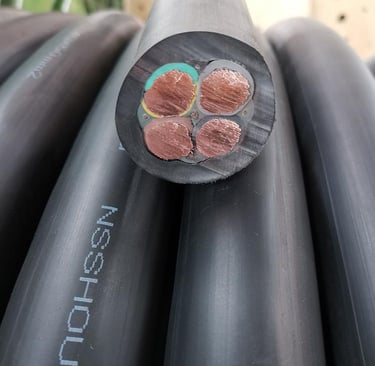
The NSSHÖU cable is a heavy-duty, tough rubber flexible cable engineered specifically to perform reliably in aggressive environments. It is designed to handle dynamic or static applications where high levels of mechanical stress, continuous flexing, and severe abrasion are expected on a daily basis. This makes it a standard choice for industrial applications that require a robust, flexible power supply under harsh conditions.
Environmental resilience is a key characteristic of the NSSHÖU design. The cable is fully suitable for installation in dry, damp, wet, and hazardous environments, and it can be used for both indoor and outdoor applications without degrading. A key feature of the Feichun NSSHÖU range is its ability to be permanently submersed in fresh water, salt water, storm water, oily water, and sewage-contaminated water to a maximum depth of 100 meters. This level of sealing is essential for maritime berths, dewatering pits in mining zones, and industrial processing wastewater systems. The cable is also flame-retardant, abrasion-resistant, and highly resistant to cuts, notches, tears, oils, and industrial fats. This ensures the cable remains operational even when subjected to rough handling or repeated movement over sharp surfaces.
3.1 Typical NSSHÖU Construction
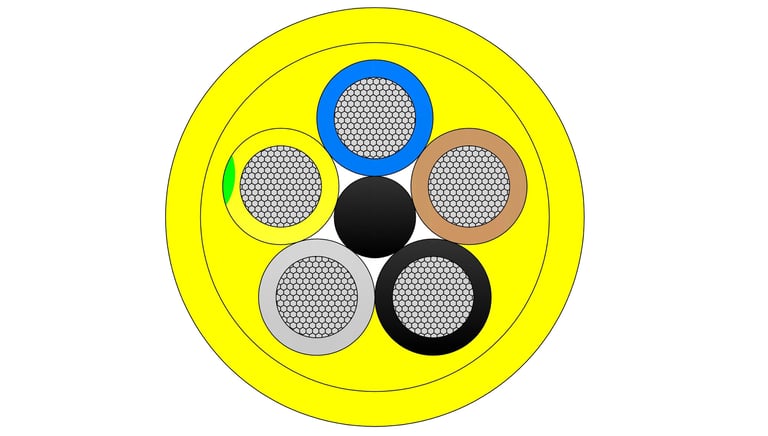
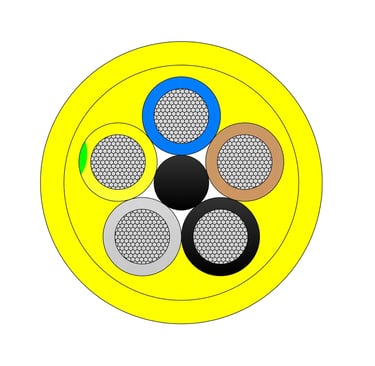
The internal structure of the Feichun NSSHÖU cable is built in distinct layers to balance electrical performance with mechanical durability:
Phase Conductor: The primary current carrier consists of a Class 5 flexible tinned copper conductor. The fine wire stranding provides high flexibility, while the tinning protects the copper from oxidation and corrosion when exposed to moisture or industrial chemicals.
Insulation: Extruded directly over the conductor is a high-grade rubber compound designated as Type 3GI3. This compound offers excellent dielectric strength and thermal resistance.
Individual Core Screen (Optional): Upon request for specific electromagnetic compatibility or safety shielding, the cable can include an individual core screen consisting of a copper braid for cross-sections up to 10 mm² or wrapped copper wires for sizes from 16 mm² upward.
Control Conductors (Optional): For multi-functional control loops, Class 5 flexible tinned copper control conductors can be integrated within the core layout.
Inner Sheath: The insulated cores are enclosed within an internal rubber compound layer designated as Type GM1b. This layer fills the gaps between the conductors, providing a cushioned bed that maintains the cable’s round shape and absorbs internal friction during flexing.
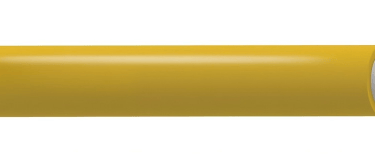
Reinforced Outer Sheath: The outermost layer is a tough, heavy-duty rubber compound designated as Type 5GM5. This specialized compound provides the cable's resistance against oil, tearing, and abrasion. The standard sheath color is yellow for high visibility in active industrial workplaces.
3.2 Key Electrical and Mechanical Data
The performance metrics of the NSSHÖU cable are verified by compliance with VDE 0250 Part 812, VDE 0295, and EN 60228 standards:
Nominal Voltage: Rated at 0.6/1 kV, allowing it to serve as a primary low-voltage power supply line for heavy machinery.
Test Voltage: Alternating current test rating of 3 kV to ensure the integrity of the insulation layer.
Fixed Installation Temperature: In stationary, secured positions, the cable operates reliably within a wide temperature range from -40°C to +80°C.
Flexible Use Temperature: When subjected to continuous movement and bending, the cable is rated to operate from -25°C to +80°C.
Maximum Short Circuit Temperature: In the event of an electrical fault, the internal components can withstand peak thermal loads up to +250°C without immediate insulation failure.
Minimum Bending Radius: For fixed installations, the minimum radius is restricted to 4 times the overall cable diameter. For flexible applications, the radius must be maintained at a minimum of 5 times the overall diameter to prevent internal stress.
Maximum Tensile Load Values: The mechanical pulling limits vary depending on the specific conductor cross-section and total core count, ensuring structural integrity during installation.
3.3 Where NSSHÖU Is Used
Due to its robust construction and resistance to environmental factors, the Feichun NSSHÖU cable is widely specified across multiple heavy industries:
Port Cranes: Serving as flexible power lines for heavy lifting systems and port transport vehicles operating near seawater.
Mining Equipment: Powering mobile machinery such as heavy excavators, blast-hole drills, and dewatering pumps in open-cast and underground mining environments.
Industrial Winches: Installed on heavy winding drums where the cable is subjected to continuous pulling forces and rough surface contact.
Heavy-Duty Flexible Power Systems: Used as a flexible power link in steel mills, foundries, shipyards, and large manufacturing complexes where cables are exposed to oils, mechanical shocks, and regular movement.

4. What NSHTÖU Means
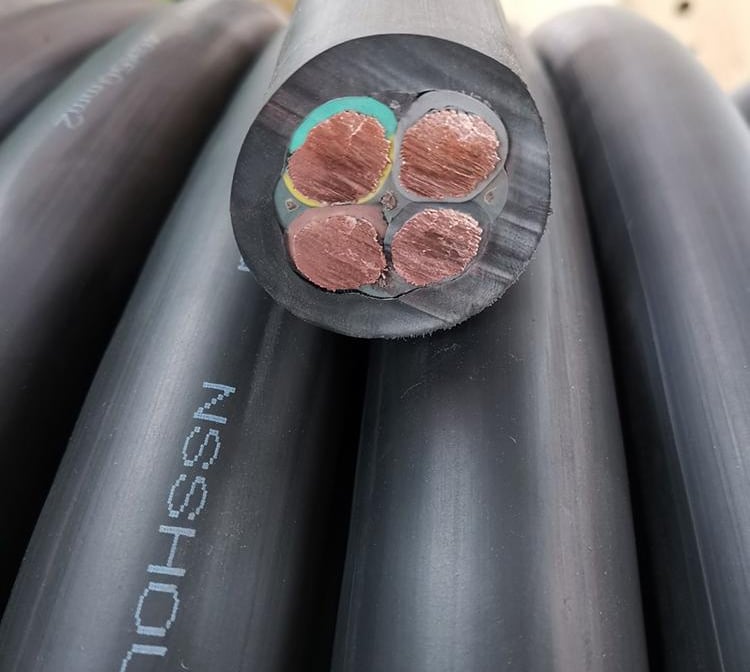
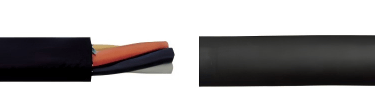
The NSHTÖU cable is a specialized low-voltage rubber power and control cable designed primarily for outdoor industrial applications, material handling machinery, and crane technologies. While it shares some material properties with other heavy-duty rubber cables, its internal architecture is engineered to handle a specific mechanical motion: continuous reeling and unreeling during active operation without being permanently fixed.
The primary operating environment for the NSHTÖU cable involves low to medium mechanical stress, but with the added requirement of resisting the severe torsional forces generated when a cable is rapidly wound and unwound around a motorized drum. To address this challenge, the Feichun NSHTÖU cable features an integrated supporting braid woven directly into its outer sheath layer. This internal textile or synthetic braid acts as an anti-torsion shield, preventing undesirable cable twisting and eliminating the "corkscrew effect" that often damages standard flexible cables when subjected to continuous winding. This design makes it a reliable choice for hoists, transport systems, conveyor technology, and dynamic energy supply chains operating under harsh outdoor conditions.
4.1 Typical NSHTÖU Construction
The construction of the Feichun NSHTÖU cable focuses on providing high tensile strength and anti-twisting capabilities:
Conductors: Built using fine strands of tinned copper wires compliant with VDE 0295 Class 5 and IEC 60228 Class 5 standards. This ensures excellent electrical conductivity and flexibility under continuous winding motions.
Core Insulation: Utilizes a specialized rubber compound categorized as Type 3GI3. This insulation provides consistent dielectric values and remains stable under thermal loads.
Core Identification: Cables containing up to 5 cores utilize a distinct color-coded system according to VDE 0293-308 standards. For configurations containing 6 cores or more, the cores are black and marked with clear white consecutive numbers for straightforward identification.
Integrated Supporting Braid: Woven directly between the inner and outer layers of the sheath assembly. This high-tensile braid absorbs the pulling forces and twisting stresses experienced when the cable is wound onto a reel.
Rubber Outer Sheath: The exterior protective layer is extruded using a tough rubber compound designated as Type 5GM3. This compound provides resistance against weather exposure, ultraviolet radiation, ozone, and oil contact.
4.2 Key Electrical and Mechanical Data
The operational capabilities of the NSHTÖU cable are verified by its certification under VDE 0250-814 standards:
Nominal Voltage: Rated at 600/1000 V (0.6/1 kV), making it suitable for low-voltage industrial power and control applications.
Test Voltage: Tested at a high potential of 4000 V alternating current to ensure full insulation reliability under operating stresses.
Flexible Use Temperature Range: Engineered to maintain its flexibility and structural integrity in temperatures ranging from -25°C to +80°C.
Minimum Bending Radius: The bending limits are calculated based on the outer diameter of the cable to minimize stress. For cables with an outer diameter under 21.5 mm, the minimum bending radius is 5 times the overall diameter. For larger cables with diameters exceeding 21.5 mm, the radius must be maintained at a minimum of 6.25 times the overall diameter to protect the inner core structure.
Flame Retardancy: Fully compliant with international standard IEC 60332-1-2, ensuring it resists flame propagation.
Oil Resistance: Certified according to EN 60811-404 standards, making it suitable for environments exposed to industrial lubricants and fuel splashes.
4.3 Where NSHTÖU Is Used
The anti-torsion design and winding capability of the Feichun NSHTÖU cable make it a primary choice for specific material handling sectors:
Crane Cable Reels: Wound onto motorized or spring-driven cable drums installed on ship-to-shore (STS) cranes, rail-mounted gantry (RMG) cranes, and overhead traveling cranes.
Hoisting Equipment: Integrated into heavy industrial hoists and lifting apparatus that require a moving power supply line.
Conveyor Systems: Supplying power along long-travel stackers, reclaimers, and bulk material handling conveyors used in mining and port facilities.
Dynamic Winding Systems: Used anywhere a cable must undergo continuous reeling, unreeling, and trailing maneuvers across concrete surfaces while remaining fully energized.

5. NSSHÖU vs NSHTÖU
When evaluating heavy-duty industrial rubber cables for a project, engineers often compare NSSHÖU and NSHTÖU. While both are high-quality low-voltage power options utilizing VDE-certified rubber compounding, they are designed for different mechanical challenges and operational environments. They are not interchangeable.
The primary difference lies in their mechanical design and motion profiles. The NSSHÖU cable is built for heavy-duty flexible performance in harsh, aggressive environments where resistance to external tearing, cutting, and liquid submersion is critical. The NSHTÖU cable is specialized for reelable crane and hoist applications, featuring an internal supporting braid engineered to withstand continuous winding tension and prevent twisting.
5.1 Application Difference
The application profiles for these two cables are distinct:
NSSHÖU: Designed for harsh open-cast mining sites, tunneling projects, heavy winches, and moving industrial machinery. It is built to be dragged across rough ground, rocks, and mud, and it can operate while permanently submerged in water.
NSHTÖU: Designed for high-speed motorized cable reels, vertical hoists, and long-travel conveyor systems. It is built to operate cleanly within a defined reeling guide, ensuring the cable wraps smoothly without twisting or deforming.
5.2 Flexibility Difference
Both cables feature fine wire Class 5 stranded copper conductors to provide high flexibility under load. However, their flexible behavior differs due to their outer layers:
NSSHÖU: Focuses on multi-directional flexibility, allowing the cable to bend, twist, and drape naturally over cable trays or rough terrain without damaging the inner conductors.
NSHTÖU: Features a more controlled, directional flexibility determined by its integrated supporting braid. This structure keeps the cable straight along its longitudinal axis during high-speed winding, minimizing twisting while allowing it to wrap tightly around a reel drum.
5.3 Mechanical Stress Difference
The two models are engineered to resist different types of physical stress:
NSSHÖU: Optimized to resist severe external forces such as abrasion, crushing, deep cuts, notch propagation, and tearing caused by sharp rocks or heavy machinery. It features a heavy-duty Type 5GM5 outer sheath to provide this protection.
NSHTÖU: Optimized to resist continuous axial tensile loads and torsional twisting forces experienced during mechanical winding. Its Type 5GM3 outer sheath works with the integrated supporting braid to absorb pulling forces, ensuring the internal copper conductors are not stretched or damaged during high-speed operation.
6. How to Read the Cable Code
To properly evaluate these cables, it is helpful to understand the German VDE cable designation system. Each letter in codes like NSSHÖU and NSHTÖU represents a specific material choice, structural layer, or performance capability.
Let us break down these two codes letter by letter to understand what their designations indicate:
N (National Standard): The opening letter "N" indicates that the cable is manufactured and certified according to established German national standards, specifically the VDE framework. This provides assurance that the cable complies with recognized testing procedures.
SS (Special Security / Extra Heavy Duty): In the NSSHÖU code, the double "S" indicates a heavy-duty reinforcement. It shows that the cable features enhanced insulation and sheathing walls, making it suitable for demanding industrial applications.
SH (Reelable / Winding Capability): In the NSHTÖU code, the combination of "S" and "H" typically indicates that the cable is specifically designed for reeling, conveying, and hosting applications where continuous mechanical winding is expected.
T (Tensile / Supporting Braid): The inclusion of the letter "T" in NSHTÖU refers to the integrated supporting braid woven into the outer jacket. This component provides the tensile strength needed to absorb pulling forces during mechanical winding.
Ö (Oil-Resistant): The letter "Ö" indicates that the outer rubber compounding provides certified resistance against mineral oils, fats, and industrial lubricants, preventing the sheath from swelling or cracking upon contact.
U (Flame-Retardant / Robust Protection): The final letter "U" indicates that the outer sheath compound is flame-retardant and provides protection against environmental factors like UV radiation, ozone, and severe weather exposure.
When analyzing these designations, engineers should note that exact interpretations can vary slightly depending on the manufacturer's context or updated standard revisions. It is always best to use clear phrasing like "designation indicates" or "typically refers to" rather than oversimplifying the suffixes. This approach ensures technical accuracy when preparing formal project documentation or writing technical specifications.
7. Typical Application Scenarios
The choice between NSSHÖU and NSHTÖU cables is rarely determined by operating voltage alone, as both share an identical low-voltage rating of 0.6/1 kV. Instead, specification decisions are driven by the mechanical duty cycle, the specific motion profile of the connected machinery, and the surrounding environmental conditions. Several real-world application scenarios illustrate where each cable type is most effective.
7.1 Port Cranes
Modern deep-water ports operate continuously, and their material handling systems must withstand both high mechanical loads and corrosive coastal environments. On massive ship-to-shore (STS) container cranes and rail-mounted gantry (RMG) systems, the cables supplying power and control commands undergo continuous motion.
For the main motorized cable reels that feed power from the ground terminal up to the moving crane structure, the Feichun NSHTÖU cable is the standard choice. Its integrated supporting braid absorbs the structural tension generated during rapid vertical and horizontal acceleration, protecting the internal copper conductors from stretching. Additionally, the oil-resistant outer sheath protects the cable from potential contact with hydraulic fluids and lubricants on the crane platform.
7.2 Mining Winches
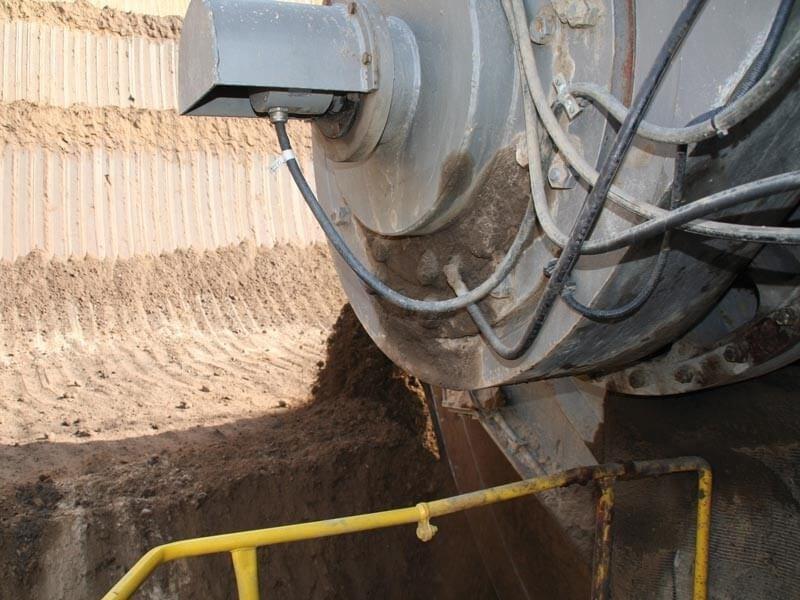
In heavy mining operations, electrical components face extreme conditions, including mud, standing water, abrasive rock dust, and rough handling. When operating heavy extraction winches or mobile slusher cars, cables are dragged across rough ground surfaces.
For these applications, the Feichun NSSHÖU cable is highly effective. Its thick Type 5GM5 outer sheath provides excellent resistance against deep cuts, notches, and tearing when dragged over sharp granite or flint surfaces. If a mining pit floods, the cable’s water sealing allows it to remain submersed down to 100 meters while maintaining full power delivery to dewatering equipment.
7.3 Cable Reels
Automated manufacturing centers, timber processing yards, and bulk steel storage warehouses rely on automated transfer cars and material hoists to move goods. These machines often use compact spring-driven or motorized drums to manage their power cables as they move back and forth.
Standard flexible cables will quickly develop a permanent twist under these conditions, leading to internal core kinking and jacket failure. The Feichun NSHTÖU cable addresses this issue through its anti-torsion construction. The integrated supporting braid keeps the cable aligned during winding cycles, preventing twists and ensuring smooth operation on the reel drum.
7.4 Tunnelling Equipment
Tunnel boring operations present a unique combination of confined space constraints and severe mechanical environments. Roadheaders, drilling rigs, and muck cars require a continuous, high-current power supply while working in damp, vibration-heavy underground spaces.
Cables in these environments are frequently stepped on, run over by light vehicles, and exposed to continuous moisture and abrasive grit. The Feichun NSSHÖU cable is well-suited for these conditions. Its multi-layer rubber construction absorbs mechanical impacts, while its flexible Class 5 tinned copper cores resist vibration-induced fatigue, ensuring reliable power delivery to critical excavation equipment.
8. Why Buyers Search by Model Code
In the industrial supply chain, procurement patterns for specialized components like heavy-duty cables differ from standard commercial purchasing. Many procurement officers, maintenance managers, and bidding engineers search for replacement parts using the exact alphanumeric VDE model code rather than generic terms. This specific search behavior is driven by two main factors: technical precision and risk mitigation.
First, heavy industrial machinery is built to strict engineering specifications. When a port crane, tunnel boring machine, or mining winch is manufactured, its cable trays, motorized reel drums, and electrical enclosures are sized precisely for the outer diameter, weight, and bending radius of a specific cable type.
If a maintenance team needs to replace a worn cable on a crane drum, searching for a generic "flexible rubber cable" provides too many unsuited options. Specifying the exact code—such as NSHTÖU—ensures the replacement cable will match the mechanical parameters, tensile strength, and anti-torsion ratings required by the machinery, avoiding fitment issues during installation.
Second, using exact model codes helps streamline the regulatory approval process for international projects. When working on high-profile infrastructure tenders in the Middle East, contractors must submit technical data sheets to consulting engineers and municipal authorities for approval.
Providing a verified, standardized designation like NSSHÖU or NSHTÖU simplifies this review process. It immediately indicates to the reviewer that the product complies with VDE testing methodologies, helping to prevent project delays and procurement mismatches.
9. Feichun Product Positioning
As a supplier of heavy-duty industrial cable solutions, Feichun focuses its product development on engineering precision and application-specific performance. Rather than offering generic products, the Feichun NSSHÖU and NSHTÖU ranges are engineered to meet specific operational motion profiles and environmental conditions.
[ Industrial Stress Profile ]
│
├──► Continuous Winding & Torsion ──► Feichun NSHTÖU (Integrated Braid)
│
└──► Severe Abrasion & Submersion ──► Feichun NSSHÖU (Reinforced 5GM5 Sheath)
The Feichun NSSHÖU line is positioned as the primary solution for extreme environmental durability. By focusing on high resistance to abrasion, cuts, tears, and water submersion, Feichun targets industries like open-cast mining, heavy winching, and deep-water ports where cables face rough handling and contact with liquids. The integration of Class 5 tinned copper conductors and specialized Type 5GM5 outer rubber sheathing ensures long-term reliability in these harsh environments.
The Feichun NSHTÖU line is positioned as a specialized solution for motorized material handling systems. By emphasizing its anti-torsion performance and high tensile strength, Feichun addresses the specific challenges faced by crane operators, container terminal managers, and conveyor systems designers. The integrated supporting braid is designed to prevent the corkscrew effect during high-speed winding cycles, extending operational life and reducing maintenance overheads.
Feichun’s approach centers on providing an optimal engineering fit. By offering distinct options for different motion and stress profiles, the company helps project managers select cables based on their exact operational requirements, avoiding both under-specification risks and unnecessary material costs.
10. Conclusion
Navigating the technical details of industrial cable procurement requires a clear understanding of international standards and naming frameworks. While alphanumeric designations like NSSHÖU and NSHTÖU may initially appear confusing to buyers, they provide a structured, logical summary of a cable's internal materials and mechanical capabilities.
In summary, while both products are high-performance low-voltage rubber cables rated at 0.6/1 kV, they are engineered for different operational challenges:
NSSHÖU: The standard choice for all-round industrial flexibility and durability in harsh, aggressive environments. Its design provides excellent protection against severe abrasion, cutting, tearing, and permanent water submersion down to 100 meters.
NSHTÖU: A specialized solution for motorized cable reels, hoists, and continuous winding systems. Its integrated supporting braid provides the tensile strength and anti-torsion performance needed to withstand high-speed reeling without twisting.
The key takeaway for engineers and procurement professionals is clear: material selection should be driven by the specific movement profile, mechanical stress levels, and environmental conditions of the installation, rather than relying on model codes alone.
By properly matching the Feichun NSSHÖU or NSHTÖU cable to the exact operational needs of a project, engineering teams can ensure long-term system reliability, prevent unexpected equipment downtime, and optimize procurement efficiency across large-scale infrastructure assets.
Port crane cables | Mining cables | Reeling cables | Trailing cables | Festoon cables | Heavy-duty power cables | Medium voltage cables | Offshore crane cables | Underground mining cables | Dragline cables | Shearer cables | Container handling cables | STS crane cables | RTG cables | Mobile equipment cables | Armored cables | Flexible power cables | VFD cables | Submersible cables | Cold resistant cables | Abrasion resistant cables | Flame retardant cables | Marine environment cables | Opencast mining | Underground operations
© 2006 All rights reserved.
[INDUSTRIAL_CABLES]
INDUSTRIAL GRADE CABLE SYSTEMS | PORT & MINING SOLUTIONS
TEL: +86 153 7530 2641 |MAIL: hongjing.Wang@feichuncables.com