Demystifying LSZH Cables: Meeting Municipal Codes and Civil Defence Standards in the UAE
Understand why LSZH cables are preferred under UAE fire and life safety requirements in Dubai and Abu Dhabi, reducing toxic smoke and corrosion while supporting compliance in metro, airport and building projects.
hongjing.Wang@Feichun
7/17/202611 min read
1. Audience, Region and Article Focus
In the rapidly evolving construction landscapes of Dubai, Abu Dhabi, and the wider United Arab Emirates (UAE), building codes are among the most stringent in the world. For Mechanical, Electrical, and Plumbing (MEP) consultants, electrical contractors, and procurement managers, navigating these local regulations is a critical part of securing project approvals and ensuring long-term safety. Whether designing a high-rise residential tower in Dubai Marina, a massive retail destination in Abu Dhabi, or critical infrastructure such as airport terminals and metro networks, choosing the right cabling system is paramount.
This article explores why Low Smoke Zero Halogen (LSZH) cables are increasingly specified by authorities and consultants for critical infrastructure across the UAE. As high-density environments and deep underground transport systems expand, municipal authorities have recognized that the material composition of electrical cabling can mean the difference between a minor incident and a catastrophic life-safety event.
This guide serves as Part 4 in our ongoing series on cable fire performance. In previous installments, we analyzed general flame propagation and structural cable properties. This guide focuses specifically on regional compliance, detailing how to meet municipal codes and secure crucial Civil Defence approvals in Dubai and Abu Dhabi.
2. What Is LSZH and How Is It Different from PVC?
To appreciate why LSZH is the modern standard for public infrastructure, it is necessary to understand its chemical formulation and how it differs from traditional options.
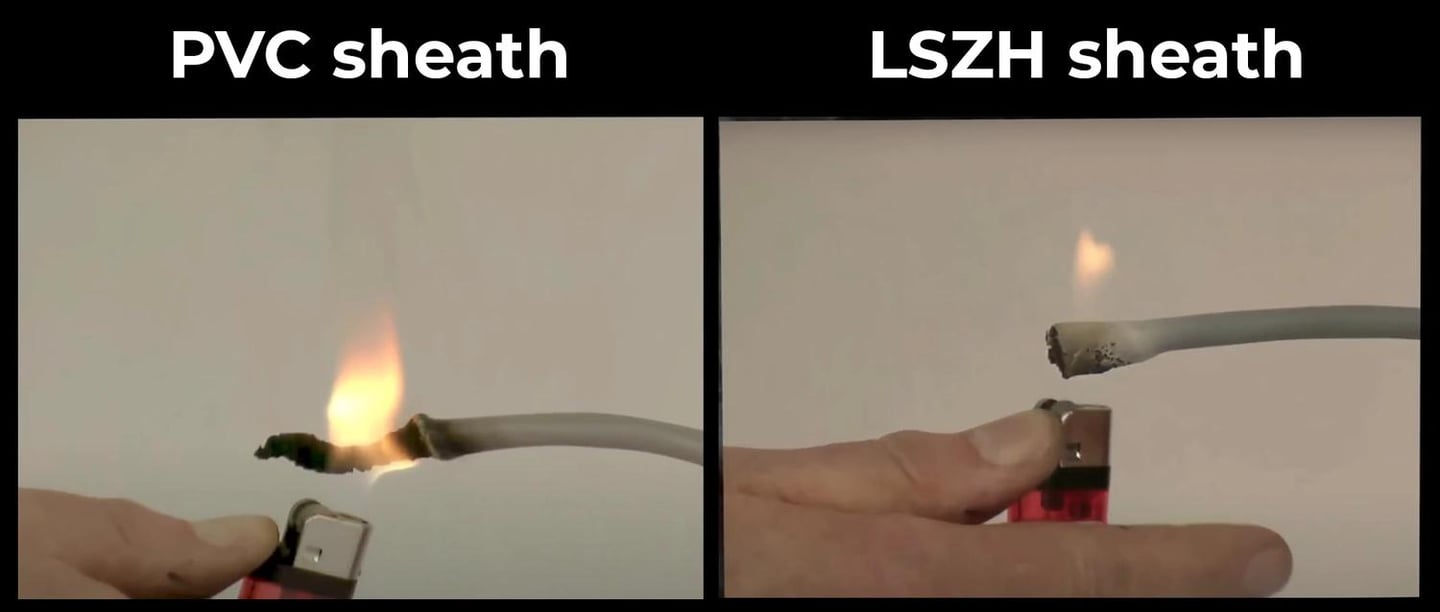
Low Smoke Zero Halogen (LSZH) is a classification of cable jacketing and insulation materials formulated to emit extremely limited, light-colored smoke and zero corrosive halogen gases when exposed to high heat or direct flame. Traditional cable sheaths have long relied on Polyvinyl Chloride (PVC) due to its excellent electrical insulation properties, physical durability, and low initial cost. However, PVC contains chlorine, a highly reactive halogen.
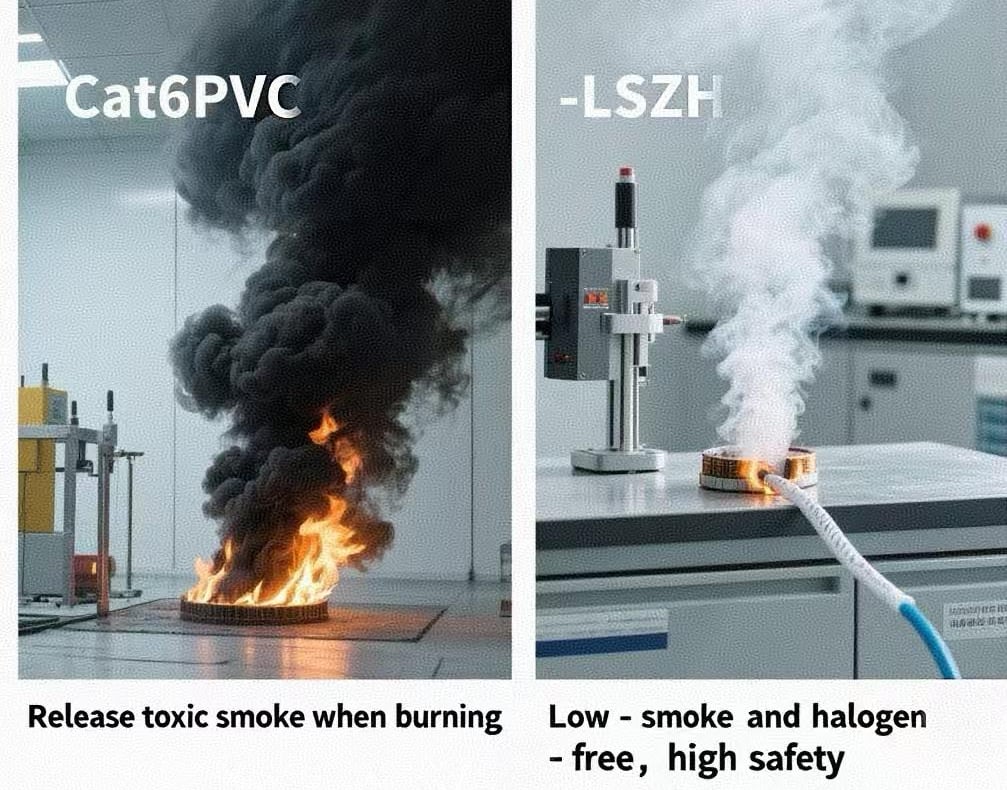
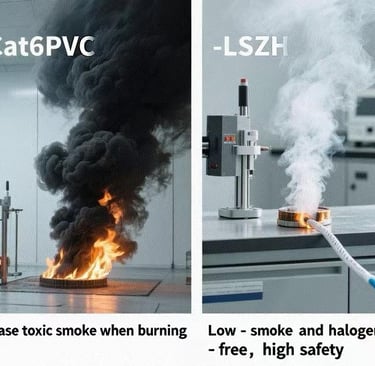
When a standard PVC-jacketed cable catches fire, the chemical reaction releases dense, dark, suffocating smoke. Additionally, the burning PVC releases hydrogen chloride (HCl) gas. If this gas comes into contact with moisture—including the humidity in the air, the sweat on human skin, or the moist lining of human lungs—it instantly converts into highly corrosive hydrochloric acid.
In contrast, LSZH cables are engineered using thermoplastic or thermoset compounds that are entirely free of halogens like chlorine, fluorine, bromine, and iodine. These compounds are typically based on halogen-free flame-retardant polyolefins or specialized elastomers. Under fire conditions, these materials undergo a controlled chemical decomposition that produces a very light, translucent water vapor and non-acidic byproducts, dramatically reducing safety hazards.
3. Why Toxic Smoke and Halogen Gases Are Critical in Fires
Statistical analyses of building fires globally show that direct burns from flames account for a minority of casualties. Instead, the vast majority of fire-related injuries and fatalities are caused by smoke inhalation and toxic gases. This hazard is magnified in enclosed, high-occupancy public spaces such as underground metro stations, deep road tunnels, airport terminals, and multi-level shopping malls where evacuation routes are long and complex.
When a fire breaks out in a cable tray packed with standard PVC cables, the consequences can be immediate:
Obscured Visibility: The dense, black soot from burning PVC rapidly fills the corridors and emergency escape paths. Within minutes, emergency lighting can be completely obscured, inducing panic, disorienting occupants, and slowing down evacuation efforts.
Firefighter Impediment: First responders entering a burning structure rely on clear lines of sight. Thick, toxic smoke makes it difficult to locate the seat of the fire or rescue trapped occupants.
Corrosive Acid Attack: The hydrogen chloride gas released by PVC does not stay confined to the immediate fire zone. It travels through ventilation shafts and cable risers, attacking structural steelwork, copper busbars, and delicate silicon components inside server rooms and control panels. This can permanently destroy expensive building management systems (BMS), communications systems, and emergency control networks that were untouched by the actual flames.
By utilizing LSZH compounds, the volume of smoke is kept to a minimum and remains light in color, preserving visibility. Because there are no halogens to release, the risk of toxic acid formation is eliminated, protecting human tissue and valuable electronic assets.
4. LSZH Performance Benefits: Safety, Corrosion and Visibility
Implementing LSZH cables across high-occupancy and high-value projects yields three clear physical benefits:
I. Minimizing Smoke Generation (Visibility)
By maintaining a highly translucent environment during a thermal event, LSZH cables help ensure that exit signage, emergency paths, and structural doors remain visible. Occupants can find their way out quickly, and civil defence personnel can navigate the building safely.
II. Eradicating Corrosive Gas Generation (Asset Protection)
In major commercial environments like data centers, control rooms, and airport communications hubs, electronic equipment is highly sensitive. Acidic soot from PVC can destroy multimillion-dollar switchgear and IT servers, leading to total operational failure even if the fire itself was localized and quickly extinguished. LSZH cables prevent this acid-driven destruction, helping to ensure that unaffected systems remain fully operational.
III. Supporting Post-Fire Recovery
Because the combustion products of LSZH are non-acidic and produce minimal soot, clean-up operations after a fire are significantly faster and cheaper. Steel conduits, structural concrete, and surrounding equipment do not require deep chemical neutralization, allowing facilities to resume operations with minimal downtime.
5. Overview of LSZH Standards and Test Methods
To verify that a cable is truly Low Smoke Zero Halogen, project specifications must rely on standardized, repeatable testing rather than manufacturer claims. When drafting specifications or preparing Civil Defence submittals, three core International Electrotechnical Commission (IEC) standards are universally referenced:
IEC 60754: Assesses the evolution of halogen acid gas during combustion.
IEC 61034: Measures the density of smoke produced under controlled fire conditions.
IEC 60332: Evaluates flame propagation to ensure the cable does not actively spread fire along its run.
In the UAE, MEP design specifications and Civil Defence guidelines frequently reference these three testing protocols. For a cable to be approved for critical areas, manufacturers must provide certified test reports from accredited third-party laboratories demonstrating compliance with all three aspects.
6. IEC 60754 – Halogen Gas Emission
The IEC 60754 standard is split into two parts to measure both the presence and the acidity of gases evolved during combustion.
IEC 60754-1
This test determines the amount of halogen acid gas released when the cable's polymer components are burned in a laboratory furnace at approximately 800°C. The gases are absorbed into a chemical solution, which is then analyzed. For a cable to qualify as halogen-free, the halogen acid content must not exceed 5 mg/g (or 0.5%).
IEC 60754-2
Because even trace amounts of gases can vary in acidity, this part of the standard measures the pH value and conductivity of the dissolved combustion gases. The test ensures that the resulting solution remains non-acidic. Compliance requires the pH value to be not less than 4.3, and the electrical conductivity must not exceed 10 microsiemens per millimeter ($\mu\text{S/mm}$).
Meeting these limits ensures that the cable will not generate corrosive hydrochloric, hydrofluoric, or hydrobromic acids, protecting emergency electronics, structural elements, and human lungs.
7. IEC 61034 – Smoke Density
To verify that a cable will not obscure emergency escape paths with dense, black soot, it must undergo the IEC 61034 smoke density test, often referred to as the "3-Meter Cube Test."
The test is performed inside a sealed chamber measuring exactly 3 meters on each side. A specified length of cable is placed over a clean-burning alcohol fuel source and ignited. A photometric system, consisting of a light source at one end of the chamber and a photo-detector at the other, continuously measures the light transmission through the air.
+---------------------------------------------------------+ | 3-Meter Cube Chamber | | | | [Light Source] ==========> [Smoke] ==========> [Sensor]| | | | Light Transmittance >= 60% | +---------------------------------------------------------+
As the cable burns, the smoke blocks a portion of the light beam. To pass IEC 61034, the cable must maintain a light transmittance value of at least 60% throughout the test. Standard PVC cables often drop to under 10% transmittance within minutes, causing near-total darkness. Achieving 60% or greater light transmittance helps ensure that exit routes remain clear and readable for occupants and rescue teams.
8. IEC 60332 – Flame Propagation
It is a common misconception that "LSZH" automatically means "flame-resistant" or "non-burning." LSZH relates strictly to smoke density and halogen content. Therefore, cables used in public infrastructure must also be tested to verify they will not propagate fire along their installation path.
The IEC 60332 standard evaluates this flame-retardant performance under two primary configurations:
IEC 60332-1
This test applies a single vertical flame source to a single vertical cable specimen. It ensures that when a localized source of heat is removed, the cable self-extinguishes and does not allow the flame to travel up its length.
IEC 60332-3
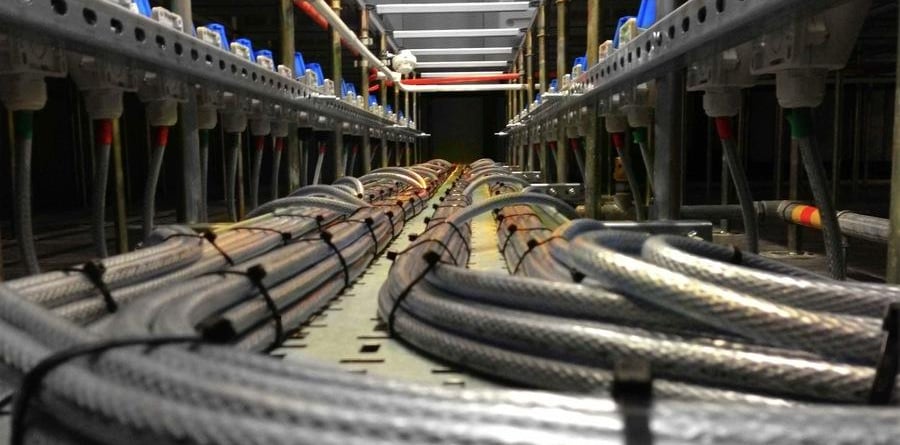
This more rigorous test evaluates vertical flame spread on bunched cables. In real projects, cables are rarely installed individually; they run in tightly packed groups along horizontal and vertical trays. Under IEC 60332-3, multiple cables are mounted together on a vertical ladder and exposed to a high-powered gas burner for a set duration. The test measures how far up the array the flame travels.
[ IEC 60332-1: Single Cable ] [ IEC 60332-3: Bunched Cables ] | | | | | | <--- Flame | | | | <--- High Heat | | | | | (Self-extinguishes quickly) (Limits vertical burn spread)
For UAE infrastructure projects, specifying compliance with IEC 60332-3 (often Category C or higher) is typically required to prevent a fire from traveling between floors via vertical service risers.
9. UAE Fire and Life Safety Expectations for LSZH
The UAE Fire and Life Safety Code of Practice, enforced by Civil Defence authorities in Dubai, Abu Dhabi, and other emirates, establishes clear requirements for materials used in escape routes, public spaces, and critical safety systems.
While standard PVC cables are still permitted in certain open-air installations, low-voltage outdoor runs, or non-critical residential spaces, their use is heavily restricted in enclosed public spaces. The regulations require that any cables installed in escape corridors, public assembly zones, underground levels, and critical systems must be low-smoke, halogen-free, and flame-retardant.
During the project approval phase, MEP consultants must submit comprehensive technical submittals, including third-party test certificates, to local Civil Defence departments. During on-site inspections prior to handing over the building, Civil Defence inspectors routinely verify that the installed cabling matches the approved LSZH specifications and carries the appropriate product markings.
10. Typical LSZH Applications in Dubai and Abu Dhabi
To put these requirements into perspective, let us look at where LSZH cables are commonly mandated in the UAE:
I. Metro and Rail Systems
In underground tunnels and enclosed metro stations, there is very little natural ventilation. A cable fire in these areas can quickly trap passengers in toxic smoke. Therefore, all power, signaling, and telecommunication cables running through UAE metro stations and tunnels must be LSZH-certified, protecting passengers and keeping critical control systems online during an evacuation.
II. International Airports
Airports are massive, highly congested facilities packed with complex radar, baggage handling, and security networks. A fire that releases corrosive acid can destroy airport IT networks, forcing prolonged shutdowns. By using LSZH cables in terminal buildings and passenger concourses, airport operators protect both the traveling public and their high-value tech infrastructure, enabling rapid recovery after an incident.
III. Commercial Towers, Shopping Malls, and Enclosed Tunnels
Modern UAE mixed-use developments feature high-occupancy spaces above ground and extensive parking or service areas below. LSZH cables are typically required for all vertical distribution shafts, high-density cable trays, and critical emergency circuits—such as fire extraction fans, emergency exit lighting, and public address systems.
11. Comparing LSZH with PVC and Other Cable Types
When selecting cables, it is helpful to compare LSZH against other common sheathing options:
Standard PVC: Highly flexible and cost-effective, but releases dense smoke and corrosive hydrogen chloride (HCl) gas when ignited. It remains suitable for open, well-ventilated areas where smoke buildup is not a concern, but is increasingly restricted in modern indoor spaces.
Low-Smoke PVC (LSPVC / LSF): These cables use modified PVC compounds designed to emit less smoke than standard PVC. However, they are not halogen-free. They still release corrosive acid gases during a fire. It is vital not to confuse "Low Smoke Fume" (LSF) with true LSZH, as LSF cables do not meet the zero-halogen requirements of strict municipal codes.
Fire-Resistant (Circuit Integrity) Cables: Often referred to as "fire-rated," these cables are designed to continue operating and supplying power even when directly engulfed in flames (frequently verified via standards like BS 6387 or IEC 60331). It is important to note that a cable can be LSZH without being fire-resistant. For critical life-safety systems (like fire pumps and smoke extraction fans), specifications generally require the cable to be both fire-resistant and LSZH.
12. Examples of LSZH Cable Types for UAE Projects
To meet these varied design requirements, Feichun manufactures several key families of LSZH-compliant cables:
I. Fixed Installation Power Cables: Feichun N2XH Series
For main power distribution in buildings and industrial facilities, the Feichun N2XH series is a widely specified solution. This cable features a highly robust XLPE (Cross-Linked Polyethylene) insulation paired with an LSZH outer sheath.
Voltage Rating: 600/1000V
Temperature Range: Fixed installations from -20°C to +90°C
Conductor Design: High-conductivity solid copper (Class 1) for sizes up to 16 mm², and stranded copper (Class 2) for cross-sections above 16 mm²
Standard Compliance: Built and tested in accordance with VDE 0276 Part 604, IEC 60502-1, and IEC 60332-3-24 Category C flame propagation standards. It provides reliable power delivery while meeting the most stringent smoke and halogen limits.

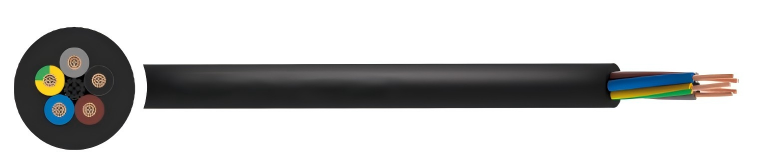
II. Flexible Power and Control Cables: Feichun H07ZZ-F Series
For applications that require high flexibility alongside robust fire safety, the Feichun H07ZZ-F series is designed to withstand medium mechanical stresses in both indoor and outdoor environments.
Voltage Rating: 450/750V
Construction: Class 5 highly flexible copper conductors insulated and sheathed with specialized cross-linked LSZH rubber compounds.
Temperature Range: Operating temperatures up to +90°C under fixed installations and -5°C to +50°C in flexed applications.
Standard Compliance: Fully compliant with BS EN 50525-3-21, CENELEC HD22-13, and IEC 60332-3 bunched flame tests. It is highly suited for temporary power connections, mobile machinery, and theatrical or event setups in major UAE venues.
III. Flexible Crane and Festoon Cables
In heavy-duty industrial settings, such as logistics terminals and ports in Dubai or Abu Dhabi, cranes and moving handling equipment operate in semi-enclosed structures. Feichun provides highly flexible LSZH crane and festoon cables engineered to handle continuous bending and high tension without releasing toxic halogens or dense smoke in a fire.
13. Specification Tips for Consultants and Procurement in the UAE
To ensure smooth project delivery and avoid delays during Civil Defence inspections, MEP consultants and procurement teams should consider the following best practices:
Be Explicit in Cable Schedules: Do not simply write "low smoke" or "LSF" in your project specifications. Write out the exact standard requirements: "Cables must be Low Smoke Zero Halogen (LSZH) in accordance with IEC 60754-1/2, IEC 61034-2, and IEC 60332-3."
Require Independent Third-Party Testing: Ensure that the cable manufacturer provides test certificates from accredited, independent testing bodies (such as BASEC, LPCB, or Intertek). Civil Defence authorities routinely look for these formal approvals during the submittal process.
Verify Both Sheath and Insulation: A cable is only as safe as its weakest component. Verify that both the outer sheathing and the inner insulation layers are halogen-free.
Coordinate Early: Engage with cable suppliers during the early FEED (Front-End Engineering Design) stage. This helps ensure that the selected cable dimensions, bend radii, and current-carrying capacities align with the project's spatial constraints and electrical designs, avoiding costly changes later.
14. Positioning Your LSZH Portfolio for UAE Projects
At Feichun, we understand the rigorous engineering standards and municipal approvals required to execute complex infrastructure projects in the Middle East. Our extensive portfolio of LSZH power, control, instrumentation, and flexible crane cables is fully engineered and certified to meet the highest international standards.
We provide comprehensive technical support to consultants, contractors, and procurement managers in Dubai, Abu Dhabi, and across the UAE. This includes assisting with detailed technical submittals, providing compliance matrices for local Civil Defence reviews, and delivering certified fire test reports.
Are you working on an upcoming commercial tower, airport expansion, metro extension, or port project in the UAE? Contact the Feichun technical team today to request data sheets, third-party certificates, or customized product guidance.
Would you like to review the technical datasheets for our Feichun N2XH or H07ZZ-F ranges to assist with an active Civil Defence submittal?
Port crane cables | Mining cables | Reeling cables | Trailing cables | Festoon cables | Heavy-duty power cables | Medium voltage cables | Offshore crane cables | Underground mining cables | Dragline cables | Shearer cables | Container handling cables | STS crane cables | RTG cables | Mobile equipment cables | Armored cables | Flexible power cables | VFD cables | Submersible cables | Cold resistant cables | Abrasion resistant cables | Flame retardant cables | Marine environment cables | Opencast mining | Underground operations
© 2006 All rights reserved.
[INDUSTRIAL_CABLES]
INDUSTRIAL GRADE CABLE SYSTEMS | PORT & MINING SOLUTIONS
TEL: +86 153 7530 2641 |MAIL: hongjing.Wang@feichuncables.com