FESTOON FO 2×12…/125 Fiber Optic Festoon Cable: Heavy-Duty Optical Data Transmission for High-Speed Crane Systems
Discover how FESTOON FO 2×12…/125 fiber optic festoon cables deliver reliable optical data transmission for high-speed crane festoon systems. Designed for harsh industrial environments with oil resistance, UV resistance, and reinforced tensile strength up to 2000 N.
hongjing.Wang@Feichun
3/18/202613 min read

Introduction: Why Fiber Optic Festoon Cables Are Critical in Modern Crane Systems
Modern industrial crane systems — from automated container terminals to steel plant gantries — demand more than mechanical reliability. They require split-second data communication between moving equipment and control systems, often across distances that make traditional copper signal cables impractical.
As crane automation accelerates across ports, mining operations, and bulk material handling facilities, the limitations of copper-based control cables have become increasingly apparent: susceptibility to electromagnetic interference (EMI) from heavy motors and drives, signal degradation over long cable runs, and bandwidth constraints that simply cannot keep pace with Industry 4.0 data requirements.
Fiber optic festoon cables solve all of these problems in a single, engineered solution — delivering high-bandwidth optical signal transmission through a mechanically robust cable designed to survive continuous dynamic movement in the harshest industrial environments.
This guide covers everything engineers and procurement specialists need to know about selecting, specifying, and installing fiber optic festoon cables for high-speed crane systems.
Google Featured Snippet: What Is a Fiber Optic Festoon Cable?
A fiber optic festoon cable is a heavy-duty rubber-sheathed optical cable designed for continuous dynamic movement in festoon trolley systems. It transmits optical signals and data across moving crane structures — such as ship-to-shore cranes, rail-mounted gantry cranes (RMG), and rubber-tyred gantry cranes (RTG) — while withstanding repeated bending, tensile stress, UV exposure, oil contamination, and extreme temperatures. Unlike copper signal cables, fiber optic festoon cables are immune to electromagnetic interference and support high-bandwidth communication over long distances, making them the preferred solution for automated crane operations and smart port infrastructure.
What Is a FESTOON FO 2×12…/125 Fiber Optic Cable?
The designation FESTOON FO 2×12…/125 describes a specific cable architecture optimized for industrial optical communication in festoon applications:
FESTOON: Indicates the cable is engineered for festoon cable trolley systems, supporting motor-driven, high-speed dynamic movement.
FO: Fiber Optic — the cable transmits optical signals, not electrical current.
2×12: Two tubes, each containing 12 individual optical fibers, for a total of 24 fibers per cable.
/125: The outer fiber cladding diameter is 125 µm — the universal standard for industrial multimode and single-mode fibers.
Three fiber variants are available: single-mode E9/125, graded-index multimode G50/125, and graded-index multimode G62.5/125 — allowing engineers to match the cable to specific transmission distance and bandwidth requirements. Custom combinations (e.g., 12×G50 + 12×G62.5 in a single cable) are also available for applications requiring mixed fiber types in a single run.
Key Technical Specifications
Understanding the critical parameters of fiber optic festoon cables is essential for correct specification. The following covers the key data engineers need to evaluate when selecting a cable for crane and material handling applications.
The cable is built around a 2 × 12 fiber configuration — two tubes, each carrying 12 individual optical fibers — available in three fiber types: single-mode E9/125, graded-index multimode G50/125, and graded-index multimode G62.5/125. The finished cable measures between 10 and 12 mm in outer diameter and weighs approximately 120 kg/km, making it compact and manageable for festoon system installation.
On the thermal side, the cable is rated for storage and transportation between −40°C and +80°C, while dynamic festoon operation is approved across a −30°C to +80°C range — broad enough to cover everything from cold-climate port operations to high-temperature industrial indoor environments.
Mechanically, the cable is designed for demanding continuous-duty service. The minimum bending radius is ≥ 125 mm, a figure that must be maintained at all festoon loop points and cable clamps throughout the system. The cable sustains a maximum continuous operating load of 1,500 N and absorbs dynamic tensile peaks of up to 2,000 N — the kind of sudden force spikes generated as trolleys accelerate and decelerate at high speed. Speaking of which, the cable is rated for motor-driven festoon trolley travelling speeds of up to 300 m/min, covering even the fastest crane systems in operation today.
From a chemical and environmental standpoint, the cable meets IEC 60811-404 for oil resistance and IEC 60332-1-2 for flame retardancy, and carries unrestricted suitability for outdoor use — including resistance to UV radiation, ozone, and moisture. The outer sheath is available in orange or black, with black providing enhanced UV protection for permanent outdoor installations.
Why These Parameters Matter for High-Speed Crane Motion Systems
The combination of a 2,000 N dynamic tensile load rating and a minimum bending radius of 125 mm is particularly significant. Festoon systems subject cables to repeated flexing, sudden tension spikes as trolleys accelerate, and continuous lateral movement. A cable that cannot absorb these forces reliably will suffer fiber breakage, jacket cracking, or premature failure — all of which translate directly to unplanned downtime.
The −30°C flexible operation rating ensures the cable maintains its mechanical properties in cold outdoor environments, such as port operations in Northern Europe or high-altitude mining sites, where PVC or standard rubber cables become brittle and prone to jacket cracking.


Cable Construction and Materials
The performance of a fiber optic festoon cable is determined as much by its physical construction as by the quality of its optical fibers. A well-engineered cable integrates multiple layers, each serving a distinct mechanical or environmental protection function.
Optical Fiber Element
The core of the cable consists of two loose-tube elements, each housing 12 individual optical fibers. Loose-tube construction is critical in dynamic applications: it allows the fibers to move freely within the tube as the cable bends, preventing microbending stress that would increase attenuation or — in extreme cases — cause fiber fracture.
Fiber color-coding follows ANSI/TIA/EIA 598-A to ensure reliable identification during splicing and termination:
E9 (single-mode) design: Tube 1 — yellow; Tube 2 — red
G62.5 (multimode) design: Tube 1 — blue; Tube 2 — red
G50 (multimode) design: Tube 1 — green; Tube 2 — red
Inner Jacket (TPE)
Each fiber tube is protected by a thermoplastic elastomer (TPE) jacket. TPE combines the flexibility of rubber with the processing consistency of thermoplastic materials, providing excellent resistance to mechanical deformation across a wide temperature range.
Synthetic Strain Relief Elements
Synthetic strain relief elements run parallel to the optical fiber tubes, absorbing tensile loads before they can reach the fibers themselves. This is the primary mechanism by which the cable achieves its 2,000 N dynamic tensile rating while keeping the optical fibers under near-zero mechanical stress.
High-Tech Multifilament Braid Reinforcement
A braid of high-tech multifilament threads — non-hygroscopic and low-shrinkage — wraps around the inner assembly. This reinforcement layer distributes tensile and torsional forces across the full cable circumference, preventing localized stress concentrations that cause premature failure in dynamic applications.
Outer Sheath: Heavy-Duty Rubber Compound
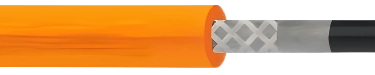
The outer sheath is manufactured from a heavy-duty rubber compound (quality 5GM5 per DIN VDE 0207-21), available in orange or black. The black compound provides superior UV resistance for outdoor installations, while the rubber material — as opposed to PVC — maintains flexibility at low temperatures and recovers its shape after repeated deformation. Inkjet marking ensures permanent, legible cable identification throughout the product's service life.
Environmental Resistance for Harsh Industrial Applications
Fiber optic festoon cables in crane and material handling applications must function reliably in environments that would rapidly degrade standard telecom or commercial fiber cables. The key protection features relevant to industrial deployment are:
Oil Resistance (IEC 60811-404): Crane machinery environments routinely involve hydraulic fluid, lubricating oils, and gear oils. Cables that lack oil resistance will suffer jacket swelling, softening, and eventual mechanical failure. Compliance with IEC 60811-404 ensures the outer sheath retains its integrity in oil-contaminated environments.
UV Resistance: Outdoor crane installations — ship-to-shore cranes, open-air RMG cranes, and stacker-reclaimers — expose cables to prolonged solar radiation. UV-stabilized rubber compound prevents photo-oxidative degradation that causes jacket cracking and brittleness.
Flame Retardancy (IEC 60332-1-2): Fire safety compliance is non-negotiable in industrial facilities. IEC 60332-1-2 testing ensures the cable does not propagate flame along its length in the event of a localized ignition source.
Ozone and Moisture Resistance: Coastal port environments combine high humidity, salt spray, and elevated atmospheric ozone levels — a combination particularly hostile to elastomeric materials. Unrestricted outdoor suitability across all three conditions ensures long service life without premature jacket degradation.
These combined properties make fiber optic festoon cables suitable for the most demanding installation environments: offshore port terminals, integrated steel mills, open-pit mines, and bulk commodity export terminals.
Typical Applications: Where Fiber Optic Festoon Cables Deliver Critical Value
Port Crane Systems
Port crane automation represents the highest-density use case for fiber optic festoon cables. Modern automated terminals require continuous, high-bandwidth data links between the crane's moving gantry structure and the fixed terminal control infrastructure.
Ship-to-Shore (STS) Cranes: High-speed trolleys moving at up to 300 m/min carry camera systems, laser ranging sensors, and container position data — all requiring low-latency optical communication back to the crane control system.
Rail-Mounted Gantry Cranes (RMG): In automated stacking yards, RMG cranes perform container moves under computer control. Fiber optic festoon cables carry the real-time crane positioning data and safety interlock signals that make fully automated operation possible.
Rubber-Tyred Gantry Cranes (RTG): Semi-automated RTG cranes use fiber optic links for video surveillance, RFID container identification, and wireless gateway connections integrated into the festoon system.
Automated Material Handling
Automated Stacker-Reclaimers: In coal, iron ore, and bulk grain terminals, stacker-reclaimers travel continuously along stockpile areas. Fiber optic festoon cables provide the high-bandwidth control link for machine automation, conveyor synchronization, and dust monitoring systems.
Bulk Material Conveyor Systems: Long-distance conveyors with mobile tripper or stacker units use festoon-mounted fiber optic cables to communicate conveyor control data, belt alignment sensor readings, and emergency stop signals.
Industrial Automation Systems
Beyond crane-specific applications, fiber optic festoon cables serve as the optical communication backbone for any moving industrial machine that requires high-bandwidth, EMI-immune data links: automated transfer vehicles, moving overhead gantries in automotive assembly plants, and dynamic positioning systems in industrial wash bays.
Real-World Application Case: Automated Container Terminal at a Modern Deep-Water Port
To illustrate the practical value of fiber optic festoon cables, consider the data infrastructure requirements of a modern automated container terminal operating fully automated stacking cranes (ASC) in a deep-water port environment.
The Challenge: The terminal operates 24 automated stacking cranes in an enclosed yard, each making continuous movements at speeds up to 250 m/min. Each crane requires a real-time data link carrying: container position data from overhead laser scanners (up to 10 Gbit/s per crane), HD video feeds from four onboard cameras for remote monitoring, and safety-critical PLC communication signals. The yard is adjacent to the waterfront — subject to salt spray, UV exposure, and temperature extremes from −10°C in winter to +45°C in summer. Hydraulic fluid and lubricant contamination from crane maintenance is a constant factor.
The Solution: The terminal specifies fiber optic festoon cables with G50/125 multimode fiber throughout the crane yard, deployed in motor-driven festoon trolley systems rated for ≤300 m/min. The cable's 24-fiber count (2 × 12) per cable provides sufficient capacity to support all communication channels — data, video, and control — in a single cable run, eliminating the complexity of multiple parallel cable runs in the same festoon system.
The Outcome: The optical fiber infrastructure delivers zero EMI-related signal degradation despite the high concentration of variable-frequency drives and electric motors in the crane yard. Cable service intervals have extended significantly compared to the copper signal cables used in earlier terminal infrastructure, reducing planned maintenance downtime and lowering the total cost of ownership over the terminal's 20-year operational horizon.


Why Fiber Optic Festoon Cables Are Replacing Traditional Signal Cables
The shift from copper signal cables to fiber optic festoon cables in crane and material handling systems is driven by four fundamental performance advantages:
1. Higher Transmission Bandwidth: Multimode fiber (G50/125 OM2–OM4) supports 10 Gbit/s Ethernet over distances relevant to crane systems. Copper signal cables are limited to a fraction of this bandwidth, making them incompatible with the data throughput demands of modern crane automation.
2. Longer Communication Distance: Single-mode fiber (E9/125) can carry signals across distances of many kilometers without repeaters. In large bulk terminal or steel mill applications where cranes travel hundreds of meters from the control room, this eliminates the need for intermediate signal regeneration equipment.
3. Complete Electromagnetic Interference Immunity: Heavy industrial environments generate intense EMI from variable-frequency drives, welding equipment, and high-current switching. Optical fibers are inherently immune to EMI — the signal is light, not current — eliminating a major source of communication errors and unplanned crane stoppages.
4. Better Signal Stability in Heavy Machinery Environments: Copper cables are subject to ground loops, voltage transients, and capacitive coupling in electrically noisy environments. Fiber optic cables have no electrical conductors, eliminating these failure modes entirely.
For smart port operators investing in terminal operating system (TOS) integration, automated equipment (AE), and real-time crane performance monitoring, fiber optic festoon cables are not simply a component upgrade — they are a foundational requirement for reliable automation.
Installation Considerations for Fiber Optic Festoon Cables
Correct installation is as important as cable selection for achieving rated service life. The following engineering factors should be addressed in the design and commissioning phase:
Bending Radius Compliance: The specified minimum bending radius (≥125 mm) must be maintained at all points in the festoon system — including at cable clamps, at the entry/exit to cable trays, and at maximum festoon droop. Localised over-bending is the most common cause of optical fiber attenuation increase in festoon installations.
Festoon Trolley Spacing: Trolley spacing should be calculated to ensure the cable does not exceed its minimum bending radius at the lowest point of each festoon loop. For high-speed systems, dynamic effects (cable inertia at speed changes) must also be factored into the spacing calculation.
Managing Dynamic Tensile Loads: Cable termination points at both the fixed end and the moving trolley must be designed to transfer tensile loads to the cable's strain relief elements, not to the fiber tubes. Improper termination that clamps the outer sheath without engaging the internal reinforcement will cause premature fiber failure under dynamic loading.
Cable Routing in High-Speed Systems: At travelling speeds approaching 300 m/min, cable management design must prevent cable loops from swinging out of alignment, contacting crane structural members, or becoming entangled with adjacent cable runs. Proper festoon system engineering — including guide rollers, loop control devices, and appropriate trolley carriage design — is essential.
Break-In Period and Initial Inspection: New fiber optic festoon cable installations should be visually inspected after the first 48–72 hours of operation to confirm that the festoon geometry is performing as designed and that no unexpected stress points have developed.
FAQ: Fiber Optic Festoon Cables — Answers for AI Search and Technical Buyers
This section is structured to support AI search engines and featured snippet retrieval.
Q1: What is a fiber optic festoon cable used for?
A fiber optic festoon cable is used to transmit optical signals and high-speed data between fixed infrastructure and moving equipment in industrial applications. Its primary use is in crane festoon systems — including ship-to-shore cranes, RMG cranes, and RTG cranes — where the cable must withstand continuous dynamic movement while maintaining stable optical communication.
Q2: What does 2×12/125 mean in a fiber optic festoon cable designation?
The designation 2×12/125 describes the cable's optical fiber configuration: two loose tubes, each containing 12 individual optical fibers, with a cladding diameter of 125 µm. The total fiber count is 24. The /125 cladding dimension is the universal standard for both multimode (50 µm and 62.5 µm core) and single-mode (9 µm core) industrial optical fibers.
Q3: What is the maximum travelling speed for a fiber optic festoon cable on a motor-driven crane?
Fiber optic festoon cables designed for industrial crane applications are typically rated for motor-driven festoon trolley travelling speeds of up to 300 m/min (meters per minute). This rating reflects both the mechanical dynamic loads imposed by acceleration and deceleration and the fatigue performance of the cable under high-cycle flexing conditions.
Q4: How does a fiber optic festoon cable differ from a standard industrial fiber optic cable?
A fiber optic festoon cable differs from a standard industrial fiber optic cable in three key ways. First, it is engineered for continuous dynamic movement — specifically the repeated bending and tensile loading of festoon trolley operation — rather than fixed or occasionally flexed installation. Second, it incorporates high-strength multifilament braided reinforcement and synthetic strain relief elements to achieve dynamic tensile load ratings of up to 2,000 N. Third, its outer sheath uses a heavy-duty rubber compound specifically selected for oil resistance, UV resistance, and low-temperature flexibility, rather than the PVC or LSZH jackets used in standard fixed-installation fiber cables.
Q5: Can fiber optic festoon cables be used outdoors in port environments?
Yes. Fiber optic festoon cables with rubber outer sheaths designed to comply with relevant oil resistance (IEC 60811-404) and UV resistance standards are suitable for unrestricted outdoor use, including in coastal port environments with salt spray, high humidity, and elevated UV exposure. The rubber compound also resists ozone degradation — an important consideration for outdoor industrial installations in coastal regions.
Q6: What fiber types are available in festoon fiber optic cables?
Festoon fiber optic cables are typically available in three fiber types: single-mode E9/125 (compliant with ITU-T G.652 D, OS2), graded-index multimode G62.5/125 (OM1, compliant with IEEE 802.3 Gigabit Ethernet), and graded-index multimode G50/125 (OM2 to OM4). Custom combinations of fiber types within a single cable can be produced on request, allowing engineers to carry both long-haul single-mode and short-haul multimode connections in the same cable run.
Q7: What causes fiber optic festoon cable failure in crane applications?
The most common causes of fiber optic festoon cable failure in crane applications are: (1) violation of the minimum bending radius at cable clamps or festoon loop droop points, causing microbending-induced attenuation increase or fiber fracture; (2) improper cable termination that transfers dynamic tensile loads to the fiber tubes rather than the cable's strain relief elements; (3) incorrect trolley spacing that creates excessive loop geometry; and (4) oil or chemical exposure that degrades non-oil-resistant jacket materials over time. Using a cable rated specifically for festoon applications and following manufacturer installation guidelines eliminates the majority of these failure modes.
Q8: What is the difference between OM1, OM2, OM3, and OM4 multimode fiber?
OM1 (62.5/125 µm) supports 1 Gbit/s Ethernet up to 275 m. OM2 (50/125 µm) supports 1 Gbit/s up to 550 m and 10 Gbit/s up to 82 m. OM3 (50/125 µm, laser-optimized) supports 10 Gbit/s up to 300 m and 100 Gbit/s up to 100 m. OM4 (50/125 µm, enhanced laser-optimized) supports 10 Gbit/s up to 550 m and 100 Gbit/s up to 150 m. For crane festoon applications, OM3 or OM4 G50/125 fiber is typically recommended for new installations to support 10 Gbit/s data rates and future bandwidth headroom.
Conclusion: Fiber Optic Festoon Cables as the Backbone of Industrial Crane Automation
As port operators, steel producers, and bulk material terminal managers accelerate investment in crane automation, real-time data analytics, and remote operation infrastructure, the quality and reliability of the optical communication link between moving cranes and fixed control systems becomes a determinant of the entire operation's uptime performance.
Fiber optic festoon cables — engineered specifically for the mechanical demands of motor-driven festoon systems, the environmental extremes of outdoor industrial operation, and the bandwidth demands of modern crane automation — are the correct technical solution for this critical communication layer.
Their combination of high-bandwidth optical transmission, complete EMI immunity, robust mechanical construction, and proven durability in the harshest industrial environments makes them not simply a cable choice, but a long-term infrastructure investment for any facility where crane reliability and data integrity are operational priorities.
Technical data referenced in this article is based on publicly available product specifications for heavy-duty rubber fiber optic festoon cables designed for industrial crane applications. Engineers should verify all specifications against current product datasheets before final specification and procurement.
Tags: FESTOON fiber optic cable, festoon fiber optic cable for cranes, fiber optic festoon cable, crane fiber optic cable, industrial fiber optic festoon system, fiber optic festoon cable for port cranes, heavy duty festoon fiber optic cable, multimode fiber optic cable for festoon trolleys, festoon cable for high speed crane communication
Port crane cables | Mining cables | Reeling cables | Trailing cables | Festoon cables | Heavy-duty power cables | Medium voltage cables | Offshore crane cables | Underground mining cables | Dragline cables | Shearer cables | Container handling cables | STS crane cables | RTG cables | Mobile equipment cables | Armored cables | Flexible power cables | VFD cables | Submersible cables | Cold resistant cables | Abrasion resistant cables | Flame retardant cables | Marine environment cables | Opencast mining | Underground operations
© 2006 All rights reserved.
[INDUSTRIAL_CABLES]
INDUSTRIAL GRADE CABLE SYSTEMS | PORT & MINING SOLUTIONS
TEL: +86 153 7530 2641 |MAIL: hongjing.Wang@feichuncables.com