Flexible Round Festoon Cables (N)3GRD5G-J/O Rated 0.6/1kV for High Mechanical Stress in Crane Trolley Systems and Drag Chains
Discover (N)3GRD5G-J/O flexible round festoon cables rated 0.6/1kV, ideal for high mechanical stress, frequent one-direction bending in crane trolley systems, drag chains, and conveyor facilities. Oil-resistant, UV/ozone-proof rubber-insulated power and control cables for indoor/outdoor use from -40°C to 80°C.
CRANE CABLE
hongjing.Wang@Feichun
3/2/202610 min read
Introduction
In crane trolley systems, drag chains, and automated conveyor facilities, the cable is rarely the first component an engineer thinks about — until it fails. A cable failure in a high-cycle festoon application doesn't just mean downtime; it can mean safety incidents, costly crane inspections, and cascading production losses. The (N)3GRD5G-J/O cable series, rated 0.6/1kV, was developed precisely to eliminate this weak point. This article examines the structural design, material science, and engineering rationale behind this cable family, and explains why it outperforms general-purpose flexible cables in demanding festoon environments.
Structural Design: Built for Motion, Not Just Installation
Standard power cables are engineered primarily for static or semi-static installation. Their conductors, insulation systems, and sheath compounds are optimized for thermal endurance and dielectric strength — but not for tens of millions of bending cycles under tensile load. The (N)3GRD5G-J/O takes a fundamentally different structural approach.
Conductor Architecture
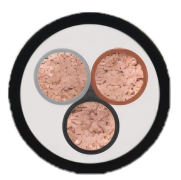
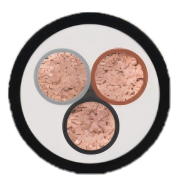
The conductor is manufactured from bare copper wire, finely stranded to Class 5 per DIN EN/IEC 60228. Class 5 stranding uses a significantly higher number of thinner individual wires compared to Class 2 (the standard for fixed-installation cables). This fine stranding accomplishes two critical things simultaneously: it dramatically reduces the bending stiffness of the conductor, preventing metal fatigue at bend points, and it distributes mechanical stress across a far larger number of individual filaments, so no single wire bears a disproportionate load during flexing.
In a festoon system where the cable may travel at reeling speeds up to 240 m/min, conductor fatigue is the primary failure mode in inferior cables. The Class 5 stranded architecture directly addresses this.
Core Arrangement and Central Element
Individual insulated cores are stranded in layers around a central element rather than simply laid in parallel. This helical lay geometry is not incidental — it ensures that as the cable bends, each core follows a controlled helical path that distributes bending strain evenly along its length. The central element provides a mechanical backbone that prevents the cores from migrating or compressing against one another under repeated flexing.
This design maintains the cable's circular cross-section integrity over time, which is essential for consistent current-carrying capacity and for predictable behavior within festoon carrier systems.
Dual-Layer Sheath System
The sheath system is a two-compound design that separates distinct functions:
Inner Sheath (GM1b/EPDM synthetic rubber per DIN VDE 0207-21): This layer fills the interstices between the stranded cores, preventing relative movement between cores during bending. Without this filling, cores would abrade against one another in high-cycle applications, leading to insulation damage from the inside out — a failure mode that is notoriously difficult to detect during routine inspection.
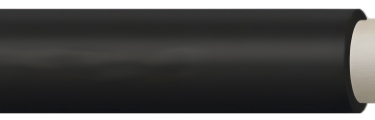
Outer Sheath (5GM5 heavy-duty rubber compound per DIN VDE 0207-21): The outer jacket is a premium rubber formulation selected for its combination of mechanical toughness, chemical resistance, and environmental durability. It provides the cable's primary protection against the physical and chemical hazards of industrial environments.

Material Performance: Why Rubber, and Why These Compounds
The choice of rubber-based insulation and sheathing over PVC or thermoplastic polyurethane (TPU) is deliberate and technically justified for festoon applications.
HEPR Insulation
The conductor insulation uses Hard Ethylene-Propylene Rubber (HEPR) compound per IEC 60502-1. HEPR offers a superior thermal operating ceiling compared to PVC insulation (which is typically limited to 70°C conductor temperature). The (N)3GRD5G-J/O is rated to a maximum permissible conductor temperature of 90°C, with a short-circuit temperature tolerance of 250°C — essential for maintaining cable integrity under fault conditions without triggering catastrophic insulation breakdown.
HEPR also retains its flexibility at low temperatures far better than PVC. This directly enables the cable's -30°C to 80°C flexible operating range, meaning the cable can be placed into service in unheated outdoor environments or cold storage crane applications without a warm-up period.
Oil Resistance (EN/IEC 60811-404 Compliant)
In machine shop cranes, steel mill overhead lines, and manufacturing conveyor systems, oil mist and direct oil contact are routine hazards. The outer sheath compound passes the oil resistance test per DIN EN/IEC 60811-404. PVC cables can swell and soften upon prolonged oil contact, causing the sheath to crack or lose its grip on the cable structure beneath. The rubber compound used here maintains dimensional stability and mechanical integrity in these environments.
UV and Ozone Resistance
Ozone is a particularly insidious threat to rubber compounds. Electrical equipment generates ozone, outdoor installations expose cables to ambient ozone concentrations, and both environments produce ozone-induced cracking in inferior elastomers. The outer sheath compound is specifically formulated with ozone-stabilizing chemistry, enabling unrestricted outdoor installation without sleeving or additional protective conduit.
Combined UV stabilization ensures that the cable does not embrittle or chalk over years of solar exposure — a common failure mode in crane applications where cables run along the underside of roof-mounted runway beams with direct sunlight exposure.
Flame Retardancy
The cable meets the single cable flame retardancy test per DIN EN/IEC 60332-1-2. In the event of an electrical fault, the cable will not propagate flame along its length, containing the incident to the point of fault rather than allowing it to spread through a cable festoon system to adjacent equipment or structures.
Applicable Crane Types and Motion Profiles
The (N)3GRD5G-J/O is not a general-purpose flexible cable — it is specifically engineered for frequent one-direction bending as occurs in festoon and drag chain systems. Understanding the motion profile is key to appreciating why this matters.
Festoon Trolley Systems
In a festoon (garland) cable system, the cable hangs in a series of loops supported by trolleys running along a beam or rail. As the crane bridge or hoist travels, loops are successively taken up and released. The cable at each trolley support point undergoes a distinct bending cycle with every traverse. In a busy production facility, a single cable installation may accumulate hundreds of thousands to millions of such cycles over its service life.
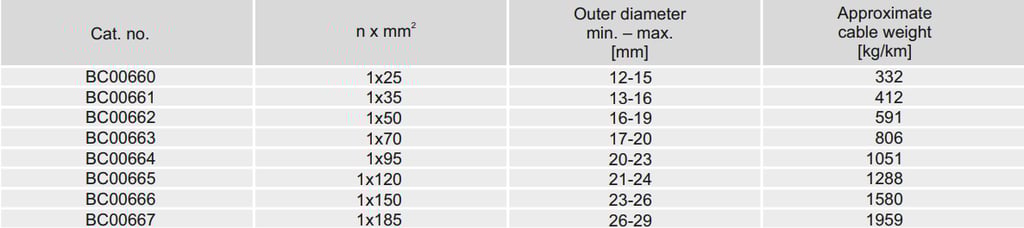
The minimum bending radius for the (N)3GRD5G-J/O in festoon applications is ≥5x the outer diameter, per DIN VDE 0298-3. This is a tighter allowable radius than many comparable cables, reflecting the conductor and core geometry's capacity to handle tighter bends without accumulated fatigue damage. The trolley system must be designed so that the cable never operates below this minimum radius.
The cable's maximum tensile load rating of 15 N/mm² per conductor provides a clear engineering limit for system designers calculating the longitudinal tension imposed by the weight of hanging cable loops.
Drag Chain Applications on Moving Machine Parts
In drag chain (energy chain) installations on crane bridges, the cable is continuously pushed and pulled through a rigid guide system as the machine moves. The mechanical regime is harsher than festoon in some respects: the cable must resist compressive lateral forces from adjacent cables in the chain, and the bending radius is fixed by the chain geometry at every cycle.
The combination of the filled inner sheath (preventing inter-core migration) and the robust outer rubber sheath (resisting abrasion from chain contacts) makes this cable well-suited for drag chain use. The Class 5 conductor stranding again provides the requisite flexibility for consistent performance at the fixed bend radius over the life of the installation.
Overhead Crane Bridge and Hoist Applications
For runway-to-bridge or bridge-to-hoist power supply in overhead cranes (EOT cranes, gantry cranes, jib cranes), the cable operates in combined bending and tensile loading as the crane traverses and the cable catenary changes shape. The wide operating temperature range — from -40°C in fixed installation to 80°C ambient — covers the range from Arctic-rated outdoor gantry cranes to indoor foundry cranes operating in high-ambient thermal environments.
The rated voltage of 0.6/1kV (with maximum operating voltages of 0.7/1.2kV AC and 0.9/1.8kV DC) makes this cable directly applicable to standard industrial crane power systems operating at 400V–690V three-phase, with headroom for transient overvoltages. The AC test voltage of 2.5kV confirms the dielectric robustness of the insulation system.


Comparison with Standard Flexible Cables
The differentiation between (N)3GRD5G-J/O and a general-purpose flexible cable such as H07RN-F or a standard NYY-J is significant and must be understood by engineers specifying cables for festoon duty.
Starting with conductor construction: both the (N)3GRD5G-J/O and the H07RN-F use Class 5 fine-stranded conductors, whereas the NYY-J uses Class 2 rigid stranding that is entirely unsuited to any dynamic application. However, conductor class alone does not define festoon suitability. The (N)3GRD5G-J/O achieves a minimum dynamic bending radius of 5× the outer diameter — a tighter allowable radius than the 6–7× typically required for H07RN-F in dynamic use, and an irrelevant figure for NYY-J, which carries no dynamic bending rating whatsoever.
The inner sheath is perhaps the most structurally significant differentiator. The (N)3GRD5G-J/O includes a filled EPDM inner sheath that locks the stranded cores against relative movement during bending. Neither H07RN-F nor NYY-J incorporates this layer, leaving the cores free to migrate and abrade against one another in high-cycle service — a failure mechanism that develops invisibly within the cable structure before any external sign of damage appears.
On chemical resistance, the (N)3GRD5G-J/O is fully compliant with IEC 60811-404 for oil resistance and is explicitly rated for ozone and UV exposure, enabling unrestricted outdoor installation. The H07RN-F offers limited oil and ozone resistance that may be adequate for light-duty or intermittent exposure but is not designed for sustained contact with industrial lubricants or prolonged outdoor service. The NYY-J provides no meaningful oil resistance and no ozone protection — its PVC sheath will swell, soften, and crack under conditions that the rubber-sheathed cables handle routinely.
Thermal performance reveals another clear gap. The (N)3GRD5G-J/O supports a maximum conductor temperature of 90°C and retains flexible operability down to -30°C. The H07RN-F is typically limited to 60°C conductor temperature, and while rubber construction gives it some cold-weather capability, it is not formally rated to the same low-temperature floor. The NYY-J is rated to 70°C conductor temperature under PVC insulation rules, but PVC begins to stiffen and embrittle well above -10°C, making it functionally unusable in cold outdoor environments and prone to cracking during installation in winter conditions.
Finally, the (N)3GRD5G-J/O carries an explicit festoon and drag chain rating under DIN VDE 0298-3, including a defined maximum reeling speed of 240 m/min. Neither H07RN-F nor NYY-J carries any such application-specific certification. In a liability and compliance context, this distinction matters: using a cable without an explicit festoon rating in a festoon application places the burden of demonstrating suitability entirely on the system integrator or end user, rather than on a tested and certified product specification.
The H07RN-F is a widely used rubber flexible cable that is often pressed into festoon service as a cost-reducing measure. While it shares rubber construction with the (N)3GRD5G-J/O, it lacks the filled inner sheath that prevents inter-core movement, it is not specifically rated for festoon bending cycles, and its dynamic bending radius requirements are less favorable. In high-cycle applications, H07RN-F installations typically show significantly shorter service lives, with failures occurring at the point of maximum repeated bending.
PVC cables (NYY-J and equivalents) are fundamentally unsuited for festoon use. PVC hardens at low temperatures, making it prone to cracking during installation or operation in cold environments. Its dynamic bending performance is poor, and it has no meaningful oil or ozone resistance. Using PVC cable in a festoon application is a maintenance liability waiting to materialize.
Engineering Value: Lifespan, Reliability, and Safety
Service Life and Total Cost of Ownership
The economic case for a purpose-designed festoon cable over a general-purpose alternative is strongest when viewed through a total cost of ownership lens. Cable replacement in a festoon system is not simply a material cost — it involves crane downtime, labor for removal and reinstallation, testing and commissioning, and in some cases production losses that dwarf the cable cost itself.
The structural and material investments in the (N)3GRD5G-J/O — fine stranding, inner sheath filling, dual-compound rubber system, and explicit festoon rating — translate directly into extended replacement intervals. Where a standard flexible cable in festoon duty might require replacement every 2–4 years in a high-cycle application, a purpose-built festoon cable properly matched to the system's bending radius and tensile load requirements routinely delivers service lives of 8–12 years or more.
Reliability in Safety-Critical Crane Systems
Cranes are classified as safety-critical lifting equipment under national and international standards (EN 13001, ISO 4301 series). A cable failure during crane operation can result in loss of power to drives, control systems, or braking systems — with potentially severe consequences. The (N)3GRD5G-J/O's explicit compliance with DIN VDE 0298-3 bending radius requirements, its defined tensile load limits, and its conformance to IEC electrical test standards provide the engineering traceability that safety assessments require.
The availability of grounded multi-core configurations (e.g., 3x25+3x16/3) enables the integration of protective earth conductors in the cable assembly itself, simplifying installation and ensuring that earth continuity is maintained even under the dynamic mechanical loading of festoon service.
Safety in Fire Scenarios
The IEC 60332-1-2 flame retardancy compliance is not merely a box-ticking exercise. In an overhead crane system, the cable runs through areas that may be inaccessible to rapid fire suppression. A cable that does not propagate flame limits the scope of any electrical fire incident, protecting both the crane structure and the facility beneath it.
Conclusion
The (N)3GRD5G-J/O festoon cable series represents a purposefully engineered solution to a specific and demanding application class. Every element of its construction — the Class 5 fine-stranded copper conductor, the HEPR insulation system, the EPDM-filled inner sheath, and the heavy-duty rubber outer jacket — addresses a real and quantifiable failure mode that occurs when general-purpose cables are misapplied to festoon and drag chain service.
For engineers specifying power and control cables for crane trolley systems, conveyor festoons, and drag chain installations, the selection of a purpose-built cable is not a premium — it is the baseline of responsible engineering practice. The (N)3GRD5G-J/O delivers on this requirement with a comprehensive performance profile that spans mechanical endurance, chemical resistance, thermal range, and electrical safety, backed by explicit compliance with the DIN VDE and IEC standards that govern industrial cable application.
Specifying the right cable at the design stage is always less expensive than replacing the wrong one in service.
Technical specifications referenced in this article are based on DIN VDE 0298-3, DIN VDE 0207-21, DIN EN/IEC 60228, IEC 60502-1, IEC 60332-1-2, and DIN EN/IEC 60811-404. Engineers should consult the full product datasheet and applicable local standards when designing festoon cable installations.
Port crane cables | Mining cables | Reeling cables | Trailing cables | Festoon cables | Heavy-duty power cables | Medium voltage cables | Offshore crane cables | Underground mining cables | Dragline cables | Shearer cables | Container handling cables | STS crane cables | RTG cables | Mobile equipment cables | Armored cables | Flexible power cables | VFD cables | Submersible cables | Cold resistant cables | Abrasion resistant cables | Flame retardant cables | Marine environment cables | Opencast mining | Underground operations
© 2006 All rights reserved.
[INDUSTRIAL_CABLES]
INDUSTRIAL GRADE CABLE SYSTEMS | PORT & MINING SOLUTIONS
TEL: +86 153 7530 2641 |MAIL: hongjing.Wang@feichuncables.com