FLGÖU vs NGFLGÖU: Understanding Round and Flat Cable Dynamics on RTG and STS Port Cranes
Compare FLGÖU and NGFLGÖU flat festoon cables for STS cranes. Learn construction differences, flexing endurance, and selection tips.
hongjing.Wang@Feichun
7/9/202614 min read
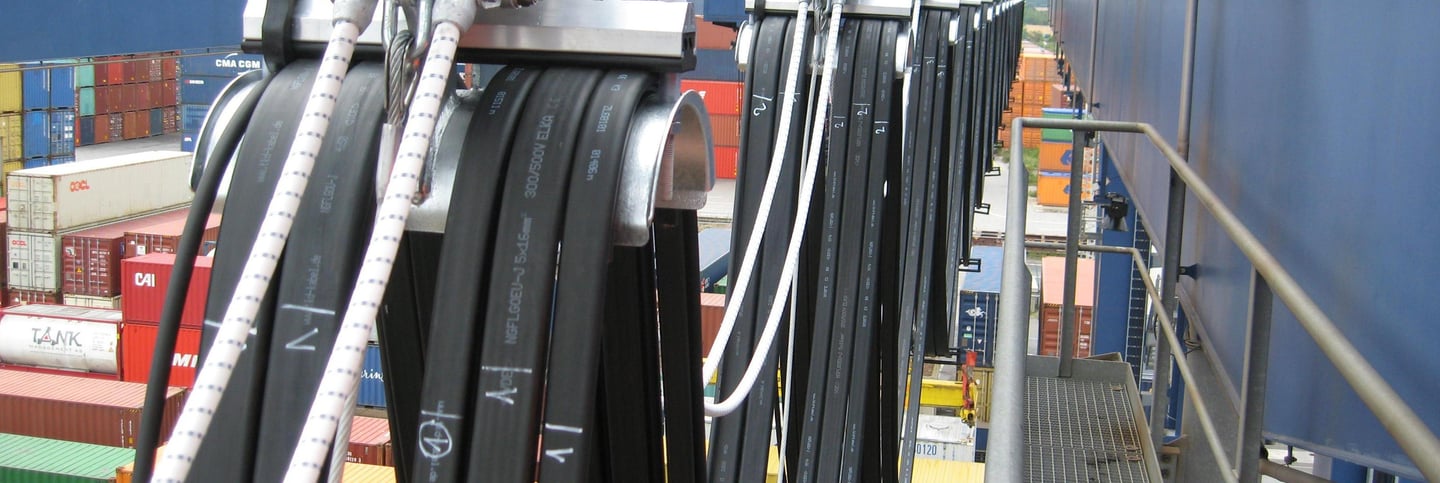
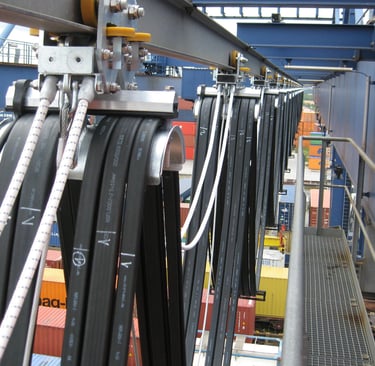
The intense rapid development of maritime logistics across the Middle East has positioned regional ports as global benchmarks for automated container terminal operations. Mega-terminals such as DP World’s Jebel Ali Port in Dubai, Khalifa Port in Abu Dhabi, King Abdulaziz Port in Dammam, and Hamad Port in Qatar manage millions of Twenty-Foot Equivalent Units annually. To maintain these demanding cargo schedules, terminal operations depend on high-speed Ship-to-Shore (STS) cranes and Rubber Tyred Gantry (RTG) yard cranes operating nearly continuous duty cycles. Within these massive heavy industrial systems, electrical power, control signals, and real-time data transmission must be delivered flawlessly to moving parts, including traveling trolleys and telescopic container spreaders.
A frequent technical challenge encountered by procurement managers and electrical engineers involves selecting between different cable geometry profiles. In the standardized wire and cable classification frameworks, the models FLGÖU and NGFLGÖU appear linguistically similar, yet they represent entirely different structural designs, mechanical handling capabilities, and application targets.
Specifically, FLGÖU is a heavy-duty round cable built with a central supporting element and cores stranded in layers, making it highly effective for vertical lift installations, teach pads, and general hoisting. Conversely, NGFLGÖU is a classic flat flexible cable designed with cores arranged in parallel, specifically engineered for single-plane bending on high-speed port crane festoon trolley systems. Selecting the incorrect geometry for a specific crane mechanism directly accelerates physical breakdown, induces severe rotational distortion, and risks sudden operational failure in harsh maritime environments.
The Severe Middle Eastern Port Environment and Polymer Stress
Before analyzing the detailed technical specifications of FLGÖU round cables and NGFLGÖU flat cables, it is necessary to examine the severe environmental conditions of coastal regions across the Arabian Gulf and the Red Sea. Industrial cables installed on heavy outdoor crane machinery must endure a combination of severe chemical, thermal, and mechanical stresses that degrade standard industrial materials.
High Air Salinity and Conductive Salt Crusts
The coastal atmosphere surrounding major hubs like Jebel Ali or King Abdullah Port contains an exceptionally high concentration of aerosolized sea salt particles. Waves breaking against berths release micro-crystalline sodium chloride droplets that remain suspended in the air.
When high ambient humidity levels, which regularly exceed 85 percent during summer nights, combine with this salt load, a continuous moisture film forms on exposed machinery. This salt solution carries active chloride ions that penetrate porous materials, speed up metal corrosion in grounding screens, and attack standard polymer compounds.
Severe Solar Loads and Photolytic Damage
The Middle East experiences high solar radiation and an intense ultraviolet index year-round. When standard industrial materials are exposed to direct sunlight, high-energy UV photons break down the polymer chains, leading to photo-cleavage.
During peak summer months, ambient shade temperatures regularly reach 45 degrees to 50 degrees. Direct uninterrupted solar radiation can easily heat the dark outer surface of a hanging or spooled crane cable to over 65 degrees. This extreme surface heat drives out flexible plasticizers from conventional materials, causing jackets to turn brittle, crack, and lose their bending flexibility.
Dynamic Mechanical Loads and Coastal Wind Stresses
Port crane systems operate on high-velocity schedules. An STS crane trolley accelerates quickly, reaching speeds up to 180 meters per minute along the boom, while an RTG crane travels rapidly across yard tracks with frequent reversing cycles.
These rapid movements generate high dynamic mechanical loads. Coastal crosswinds apply strong lateral forces, pushing suspended cable loops out of their vertical paths and causing continuous friction against guide rollers, steel fairleads, and storage baskets. If a cable is not structurally engineered to handle these multi-axial forces, the outer protective sheath will experience early tearing and deformation.
FLGÖU Round Cable Technology: Layer-Stranded with Central Support
The designation FLGÖU represents a distinct design family of polychloroprene-sheathed control and power cables. Despite common industry misconceptions that associate the letters with flat layouts, the internal architecture of FLGÖU is strictly round, built for specific multi-directional and vertical suspension applications.
Internal Structural Architecture
A detailed cross-sectional examination of an FLGÖU round cable reveals a layout optimized for high tensile load distribution and multi-directional flexibility:
Conductor Base Material: The core conductors utilize bare copper strands built to meet extreme flexibility standards, complying with DIN VDE 0295 Class 6 and IEC 60228 Class 6. This extremely fine-stranded layout allows individual wires to move freely during bending, reducing localized metal fatigue.
Core Insulation Compound: The conductors are jacketed with a premium rubber compound that provides high electrical insulation, excellent dielectric strength, and stable performance under fluctuating thermal conditions. Line identification follows VDE 0293-308 color coding up to 5 cores, while configurations from 6 cores onward utilize black insulation printed with white numerals alongside a green/yellow ground core.
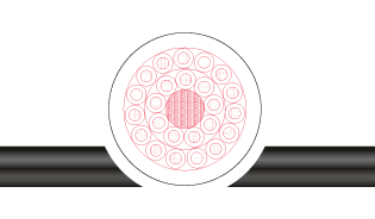
The Core Stranding Layout: Unlike flat designs, the insulated conductors within an FLGÖU cable are stranded in layers around a central textile supporting element. This layer-stranding technique ensures that when the cable is bent in any direction, the compression on the inner side of the bend and the tension on the outer side are evenly balanced across the cores.
High-Tensile Central Supporting Element: Located at the physical center of the cable cross-section is a high-strength textile supporting element. This structural core absorbs vertical tensile loads, preventing the weight of a suspended cable from stretching or damaging the copper conductors.
Outer Sheath Formulation: The entire assembly is enclosed within a special polychloroprene or synthetic rubber compound sheath, typically deep black in color. This outer jacket is formulated to offer good weatherproofing, ozone resistance, flame retardancy, and oil resistance, making it suitable for both indoor and outdoor heavy machinery.
Primary Engineering Applications
Because the round geometry handles tensile loads evenly across a 360-degree axis, FLGÖU cables are widely specified for specific industrial applications:
Vertical Elevator and Lift Facilities: Powering moving control pods and heavy vertical lift mechanisms where the cable hangs unsupported over long vertical distances.
Conveyor and Hoisting Devices: Delivering control and power links to mobile tripper systems, construction hoists, and overhead assembly cranes.
Teach Pads and Mobile Control Stations: Providing durable connections for handheld industrial crane control pendants that are continuously moved, pulled, and twisted by machinery operators in dockyards and workshops.

NGFLGÖU Flat Cable Technology: Parallel-Aligned for Festoon Systems
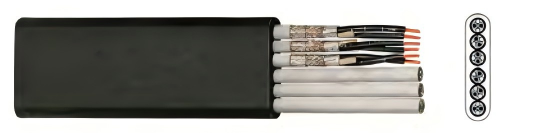
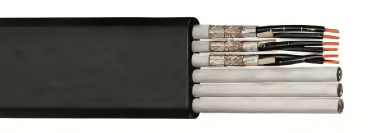
The NGFLGÖU design line represents a specialized category of low-voltage flat flexible cables. Engineered strictly for applications requiring repetitive bending restricted to a single plane of motion, this flat profile serves as a standard option for large-scale maritime crane festoon trolley networks.
Internal Structural Architecture
The cross-section of an NGFLGÖU flat cable displays a geometric arrangement optimized for predictable 2D tracking and space-saving storage:
Conductor Alignment: The copper conductors are arranged in a flat, perfectly parallel layout. For cross-sections up to 25 square mm, the cable utilizes extremely finely stranded electrolytic bare copper matching Class 6 standards. For larger cross-sections above 35 square mm, it uses fine-stranded copper matching Class 5 standards.
EPR Core Insulation: The core insulation features a basic Ethylene Propylene Rubber compound categorized as Type 3G13 under DIN VDE 0207 standards. This material allows a maximum permissible continuous operating temperature of 90 degrees at the copper conductor, enabling the cable to carry heavy current loads in hot environments.
Individual Electromagnetic Shielding: Specific variations, such as shielded power configurations, include a tinned copper wire braided screen around individual phase cores or twisted control pairs. This screen provides high protection against electromagnetic interference, ensuring clean data transmission.
Reinforced Heavy-Duty Outer Sheath: The parallel core assembly is fully encased in a heavy-duty Chloroprene Rubber compound categorized as Type 5GM3. This thick rubber jacket provides high resistance to tearing, mechanical abrasion, mineral oils, greases, ozone, and ultraviolet radiation.
Primary Engineering Applications
The geometric layout of the NGFLGÖU flat cable restricts its use to specific mechanical setups:
High-Speed Ship-to-Shore (STS) Festoon Systems: Delivering primary power and control signals from the main crane cabin across the boom to the moving trolley.
Material Handling Gantry Cranes: Managing power connectivity on automated stacking cranes where cables are suspended from heavy-duty towing trolleys.
Connecting Moveable Machine Parts: Providing electricity to mobile industrial components that travel back and forth along a fixed linear track, ensuring the cable loops stack neatly without twisting out of alignment.
Mechanical and Torsion Dynamics: Round vs. Flat Geometry
To select between FLGÖU round cables and NGFLGÖU flat cables for port infrastructure, engineering teams must evaluate how different cable geometries react to mechanical forces like bending, tension, and torsion.
Bending Performance Across Single and Multi-Axial Tracks
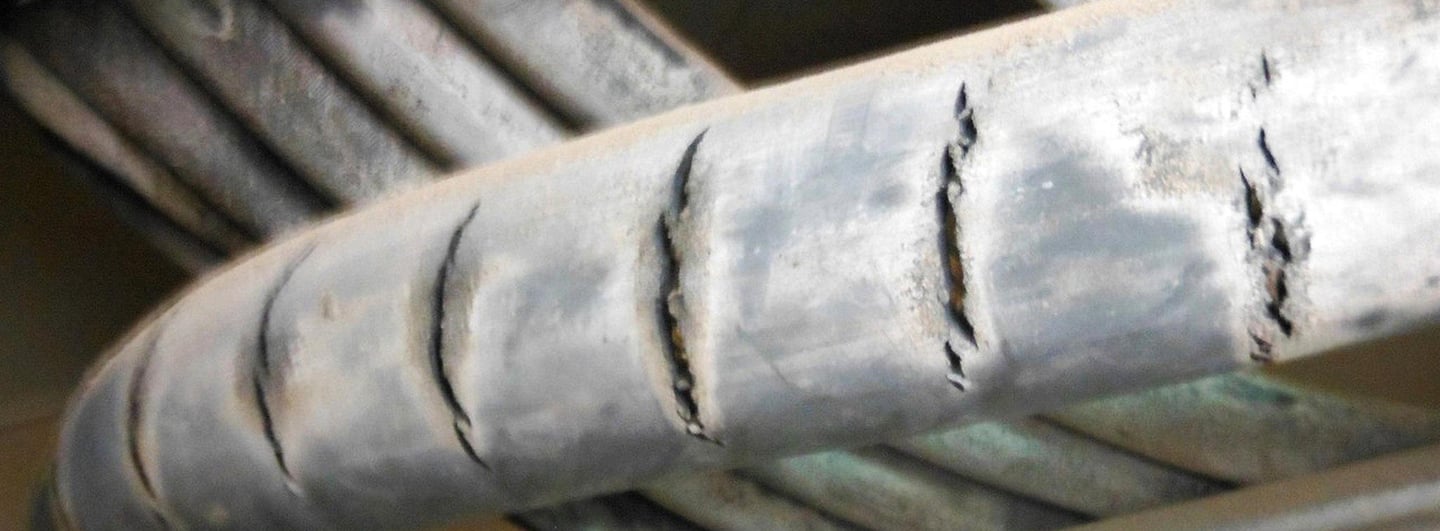
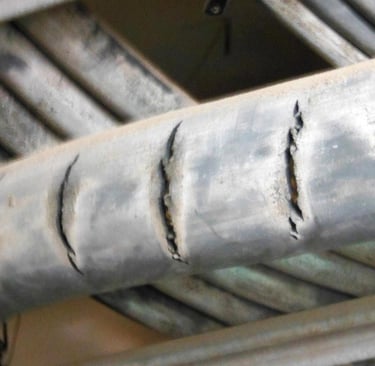
An NGFLGÖU flat cable is engineered to bend in only one plane of motion. The parallel arrangement of its internal cores allows the flat body to flex smoothly over festoon saddles, minimizing space when the loop stacks together at the end of a runway track. However, this flat profile cannot handle multi-directional bending or twisting. If a flat cable is forced out of its primary plane of motion, the outer edges experience extreme shear stress, leading to early jacket splits.
Conversely, the round geometry of an FLGÖU cable offers equal flexibility across all 360 degrees. The layer-stranded design allows the cable to bend freely in multiple directions, roll over directional sheaves, and handle non-linear pathways without accumulating localized stress.
Torsional Torque Distribution and the Risk of Bird-Caging
Torsional stress, or axial twisting, represents a significant hazard for mobile cables. On equipment like automated motorized reels or high-speed long-travel gantries, rapid acceleration and crosswinds introduce twisting forces into the cable body.
When a flat cable experiences torsional stress, its lack of structural symmetry prevents it from distributing rotational torque evenly. The twisting force pushes the parallel conductors against one another, causing them to slip out of alignment, bulge outward, and deform the rubber jacket. This deformation can lead to a severe mechanical failure known as bird-caging, where the conductors break through the outer sheath.
An FLGÖU round cable manages rotational torque much more effectively. When a twisting force hits the round body, the round shape distributes the stress evenly across the entire outer circumference. The internal cores, wrapped around a central supporting core, resist displacement, allowing the cable to handle moderate rotational movements without losing its structural shape.
Technical Performance Contrast
To clarify selection parameters for engineering and procurement operations, let let us look at how the structural dimensions of these two distinct cable lines translate into field performance:
Regarding structural geometry and shape, the FLGÖU utilizes a fully concentric round profile with cores stranded in layers, whereas the NGFLGÖU utilizes a wide, low-profile flat layout with cores arranged in a parallel matrix.
The internal reinforcement methods show a clear engineering difference. The FLGÖU features a central textile supporting element with high tensile strength positioned at its physical core to support vertical suspension loads. In contrast, the NGFLGÖU relies on a heavy-duty Type 5GM3 chloroprene rubber outer jacket to provide structural containment, featuring no central support core.
These design differences determine their ideal application environments. The FLGÖU round cable is designed for multi-directional bending, vertical hanging, hoisting, and mobile pendant control use, handling tensile loads evenly across all axes. The NGFLGÖU flat cable is engineered strictly for single-plane bending, space-saving loop stacking, and horizontal long-travel festoon trolley applications, offering limited performance if subjected to axial twisting or multi-axial routing.
By analyzing these characteristics, port engineers can properly match the cable design with the specific mechanical movements of their terminal machinery, ensuring long service life and avoiding premature operational failures.
Field Insights and Real‑World Middle Eastern Port Case Studies
Technical discussions on machinery maintenance forums, such as the operational maintenance threads on Heavy Equipment Forums, emphasize that incorrect selection of cable geometry is a frequent cause of unscheduled terminal downtime. Analyzing real-world failures highlights the value of proper selection.
Case Study 1: Resolving Festoon Failures at an Oman Container Terminal
A major container port along the coastline of Oman experienced frequent control signal drops on its main fleet of high-speed STS cranes. The cranes used large festoon systems to manage power and control links across a long travel distance along the boom. During monsoon seasons, high coastal crosswinds hit the terminal, pushing the suspended cable loops out of their vertical paths.
The system was initially fitted with unshielded flat cables that lacked a heavy-duty Type 5GM3 outer rubber compound. The strong lateral wind forces subjected the flat profiles to severe multi-axial bending and axial twisting. Within months of deployment, the outer jackets developed deep splits along the edges, allowing salt spray and moisture to penetrate the internal cores. This moisture caused electrical short circuits and tracking faults that halted crane operations.
The engineering team resolved the issue by upgrading the trolley systems to high-performance PLANOFLEX NGFLGÖU-J series flat cables. This model features an extra-thick Type 5GM3 chloroprene outer jacket and an internal layout with individual tinned copper wire braided screens around the critical control pairs. The reinforced flat structure maintained stable single-plane bending despite the wind loads, while the premium rubber compound protected the core from salt spray, eliminating unscheduled downtime.
Case Study 2: Correcting Vertical Hoist Failures at a Saudi Red Sea Port
An industrial bulk-handling terminal at a port along the Red Sea in Saudi Arabia used heavy overhead hoisting machinery to load dry materials into cargo vessels. The heavy pendant control boxes used by operators were connected via standard flexible cables that lacked internal structural support elements.
As operators pulled, twisted, and dragged the control pendants across the concrete berths in summer temperatures exceeding 45 degrees, the cables experienced severe tensile and torsional stresses. Because the standard cables lacked a central core to absorb these forces, the internal copper strands began to shift and wrap around one another tightly. This built up internal torque that eventually caused severe bird-caging, cracking the outer sheaths and exposing the phase wires.
The maintenance department corrected the issue by replacing the damaged lines with specialized LIFTTEC FLGÖU round cables featuring Class 6 fine copper conductors stranded around a central textile supporting element. The high-tensile structural core absorbed the vertical pulling forces, while the round layer-stranded design allowed the cable to twist and bend freely without core deformation. This change extended the operating life of the pendant controls significantly.
Technical Data and Sizing Parameter Analysis
When reviewing product documentation or technical submittals from specialized cable factories like Feichun, engineers must verify that the selected dimensions and mechanical ratings match the system's operational requirements.
Standard Dimensions for FLGÖU Round Cables
Size 4 G 1.5 mm²: Outer diameter of approximately 11.0 mm, copper weight index of 62 kg/km, total cable weight of 144 kg/km.
Size 7 X 1.5 mm²: Outer diameter of approximately 14.5 mm, copper weight index of 110 kg/km, total cable weight of 239 kg/km.
Size 12 X 1.5 mm²: Outer diameter of approximately 20.9 mm, copper weight index of 182 kg/km, total cable weight of 471 kg/km.
Size 24 X 1.5 mm²: Outer diameter of approximately 25.0 mm, copper weight index of 346 kg/km, total cable weight of 850 kg/km.
Standard Dimensions for NGFLGÖU Flat Cables
Size 4 G 4 mm²: Flat cross-sectional dimensions of approximately 9.2 mm × 26.3 mm, nominal cable weight of 550 kg/km.
Size 4 G 6 mm²: Flat cross-sectional dimensions of approximately 9.5 mm × 28.8 mm, nominal cable weight of 630 kg/km.
Size 4 G 25 mm²: Flat cross-sectional dimensions of approximately 13.0 mm × 41.0 mm, nominal cable weight of 1720 kg/km.
Size 4 G 50 mm²: Flat cross-sectional dimensions of approximately 17.6 mm × 54.4 mm, nominal cable weight of 3010 kg/km.
Critical Mechanical Note on Minimum Bending Radii: To maximize service life and prevent premature material fatigue, engineers must ensure the physical layout of the crane machinery respects the cable's minimum bending thresholds:
FLGÖU Round Cables: The minimum bending radius for flexible moving applications is 5 × the cable outer diameter for diameters up to 20 mm, and 6 × the outer diameter for sizes above 20 mm.
NGFLGÖU Flat Cables: The minimum free-moving bending radius is 4 × the flat cable thickness for profiles under 12 mm, and 5 × the thickness for profiles exceeding 12 mm.
Sizing and Selection Checklist for Engineering Teams
To optimize system reliability and streamline procurement operations for port crane infrastructure, engineering and technical purchasing teams should use this checklist during product specification:
[ ] Analyze Mechanical Motion Profiles: Specify the flat parallel NGFLGÖU line for single-plane festoon systems. Specify the round layer-stranded FLGÖU line for vertical suspension, hoisting, or multi-directional pendant usage.
[ ] Verify Core Insulation and Temperature Capacities: Confirm the core insulation uses premium rubber compounds (such as Type 3G13 EPR) rated for a continuous operating temperature of 90 degrees at the conductor to handle high current loads in hot environments.
[ ] Check Outer Jacket Compound Specifications: Ensure the outer sheath utilizes a heavy-duty, UV-stabilized chloroprene rubber compound (such as Type 5GM3) certified to resist salt spray, ozone, and mineral oils according to EN 60811-404 standards.
[ ] Apply Ambient Temperature Derating Factors: For installations in the Middle East where peak summer ambient air temperatures reach 50 degrees, apply a thermal correction derating factor of 0.75 to the standard current ratings to prevent overheating.
[ ] Verify Tensile Strength and Central Reinforcement: For vertical hanging applications, check that the cable datasheet includes a verified high-tensile central supporting element capable of supporting the full suspended weight of the line.
[ ] Confirm Compliance with International Standards: Request laboratory documentation showing official type-approvals, such as compliance with DIN VDE 0250-809 standards for flat cables and DIN VDE 0250-814 guidelines for heavy round cables.
Conclusion
Selecting the proper cable geometry and material specification is essential for maintaining reliable, efficient crane operations in modern port terminals. While the FLGÖU round cable line excels in vertical hoisting, lifting, and multi-directional pendant control applications due to its layer-stranded design and central supporting core, it is not intended for the single-plane tracking requirements of high-speed festoon systems. For those applications, the parallel-aligned NGFLGÖU flat cable line serves as the standard option, providing clean, space-saving loop stacking along the crane boom.
Using high-durability specifications—such as Feichun's premium FLGÖU round hoisting lines and reinforced Type 5GM3 chloroprene-jacketed NGFLGÖU flat festoon solutions—helps port operators protect their power and data connections from severe coastal environments, intense solar heat, and high mechanical stresses. Investing in engineered, type-approved cabling solutions minimizes unexpected maintenance costs, extends equipment operational life, and ensures smooth, continuous terminal logistics.
Contact Us for Technical Consultations and Custom Quotes
Are you managing a port expansion project, designing a crane festoon system, or seeking solutions for cables showing signs of early wear in a high-salinity marine environment? Feichun specializes in manufacturing high-durability, type-approved round and flat flexible cables tailored for severe maritime and heavy industrial operations. Contact our technical sales division today to consult with an engineering specialist, request detailed product datasheets, or obtain a comprehensive commercial price quotation.
Technical Frequently Asked Questions (FAQs)
Is the FLGÖU cable a round or a flat cable structure?
The FLGÖU is a round cable structure. A common industry misconception associates the letters with flat layouts, but the internal design consists of flexible copper conductors stranded in concentric layers around a high-tensile central textile supporting element. This round geometry allows the cable to bend freely in multiple directions, handle vertical suspension loads, and resist twisting, making it distinct from flat parallel cable lines.
What primary mechanical applications require an NGFLGÖU flat cable?
The NGFLGÖU flat cable is engineered for applications requiring repetitive flexible movement restricted to a single plane of motion. Its primary applications include high-speed Ship-to-Shore (STS) crane festoon trolley systems, automated rail-mounted yard stacking cranes, and mobile machine tool linkages where space is limited and the cable loops must stack together neatly without twisting out of alignment.
Why do standard industrial PVC-jacketed cables fail prematurely in Middle Eastern ports?
Standard PVC jackets fail quickly in coastal environments due to the intense combination of high ambient heat, strong UV radiation, and high air salinity. Solar exposure dries out the volatile plasticizers within standard PVC, causing the material to harden, fade, and form surface micro-cracks. Under constant mechanical flexing, these cracks split open, allowing conductive salt spray to penetrate the inner core, corrode metallic screens, and cause phase-to-phase short circuits.
What role does the central textile element play inside an FLGÖU round cable?
The high-strength central textile supporting element serves as the primary load-bearing component. In vertical suspension, hoisting, or pendant control applications, the cable hangs unsupported over long vertical distances. The central core absorbs the resulting vertical tensile forces and dynamic pulling stresses, preventing the weight of the assembly from stretching or damaging the copper conductors.
Can an NGFLGÖU flat cable be installed on a motorized winding reel drum?
No, an NGFLGÖU flat cable should not be used on a motorized reeling drum system. Winding reels subject cables to significant axial torque, lateral crosswind forces, and multi-axial bending as the line spools onto the drum. Because flat cables lack structural 360-degree symmetry, rotational forces concentrate stress along the flat outer edges, displacing the parallel conductors and leading to severe structural deforming or bird-caging. Winding reels require specialized round reeling cables with integrated anti-torsion braids, such as the NSHTÖU series.
What essential data parameters must be provided to obtain a detailed product quotation?
To issue a precise commercial and technical price quotation, please provide the complete structural model required (FLGÖU round or NGFLGÖU flat), the system operating voltage, the exact core configuration (the number of power and control cores multiplied by their cross-sectional areas, such as 4 G 25 square mm or 12 X 1.5 square mm expressed in standard numerals), the total continuous ampacity load, the required length, and details regarding specific environmental exposure levels like peak local temperatures and salt spray conditions.
Port crane cables | Mining cables | Reeling cables | Trailing cables | Festoon cables | Heavy-duty power cables | Medium voltage cables | Offshore crane cables | Underground mining cables | Dragline cables | Shearer cables | Container handling cables | STS crane cables | RTG cables | Mobile equipment cables | Armored cables | Flexible power cables | VFD cables | Submersible cables | Cold resistant cables | Abrasion resistant cables | Flame retardant cables | Marine environment cables | Opencast mining | Underground operations
© 2006 All rights reserved.
[INDUSTRIAL_CABLES]
INDUSTRIAL GRADE CABLE SYSTEMS | PORT & MINING SOLUTIONS
TEL: +86 153 7530 2641 |MAIL: hongjing.Wang@feichuncables.com