Heavy Duty Rubber Fiber Optic Cable for Mining Communication Networks: The Underground Backbone Modern Operations Depend On
Learn how heavy duty rubber-sheathed fiber optic cables enable reliable optical signal and data transmission across surface mining sites, mobile excavators, and shiftable conveyor systems in the harshest industrial environments.
hongjing.Wang@Feichun
3/31/20269 min read

Introduction
Modern surface mining operations are communication-intensive environments. From real-time conveyor monitoring to machine-to-machine data exchange across sprawling open-pit sites, the demand for uninterrupted, high-bandwidth signal transmission has never been greater. Yet the environment itself — defined by constant mechanical movement, exposure to oils and chemicals, extreme temperature swings, and persistent UV bombardment — routinely destroys conventional fiber optic solutions within months of deployment.
Heavy duty rubber-sheathed fiber optic cables have been purpose-engineered to close that gap. Combining the signal performance of precision optical fiber with the mechanical resilience of industrial rubber compounds, these cables are built specifically for long-distance communication networks (LDN) in active mining conditions. They are not adapted from commercial telecom infrastructure. They are designed, from the ground up, for mobile materials handling equipment, festoon cable trolley systems, and shiftable conveyor belts where static cable installations are simply not viable.
Product Overview
At its core, a heavy duty rubber fiber optic mining cable is a flexible, multi-tube optical cable encased in a high-grade rubber outer sheath. Unlike conventional fiber optic cables designed for fixed installation in conduit or tray, these cables are engineered to withstand repeated bending cycles, continuous mechanical loading, and the full range of environmental stressors present in surface and near-surface mining environments.
The key engineering principle is the decoupling of optical performance from mechanical strain. Synthetic strain relief elements and a braided reinforcement layer absorb pulling, twisting, and compression forces before they can reach the sensitive fiber cores. The outer rubber compound provides the final barrier against abrasion, oil ingress, UV degradation, and moisture penetration.
The result is a cable that can be installed on moving equipment, routed through festoon systems above active conveyor lines, or deployed along roadways in open-pit mines — and be expected to maintain both optical performance and mechanical integrity throughout an operational lifespan measured in years rather than months.
Core Technical Features
Quick Answer for Search: Heavy duty rubber fiber optic mining cables are rated for ambient temperatures between -30°C and +80°C in flexible and festoon applications, with a minimum bending radius of 125 mm and a maximum continuous tensile load of 2,000 N. They comply with IEC 60811-404 for oil resistance and IEC 60332-1-2 for flame retardancy.
Understanding the operating parameters of these cables is essential for installation planning and equipment specification.
Temperature Range
These cables are engineered for a wide thermal envelope. For transportation and storage, they withstand temperatures from -40°C to +80°C. In free-moving and festoon application — the conditions most relevant to active mining deployment — the operational range narrows slightly to -30°C to +80°C. This covers the climate extremes encountered at open-pit sites from the Atacama Desert to the Canadian oil sands.
Mechanical Load Capacity
The minimum permissible bending radius is 125 mm, a specification that allows routing through tight cable trays and around cable trolley sheaves without inducing micro-bending losses in the optical fibers. Maximum continuous tensile load in operation reaches 2,000 N, sufficient for the sustained pulling forces encountered in horizontal festoon systems over conveyor lines hundreds of meters in length. Motor-driven festoon cable trolleys can operate at travelling speeds up to 300 m/min without exceeding cable design limits.
Chemical and Environmental Resistance
Oil resistance is certified to IEC 60811-404, a critical requirement given the hydraulic fluid and lubricant contamination common on excavator platforms and conveyor drive stations. Flame retardancy is demonstrated to IEC 60332-1-2, limiting fire propagation risk in cable tray installations. Weather resistance is unrestricted for both indoor and outdoor use, with confirmed resistance to ozone, UV radiation, and sustained moisture exposure.
Fiber Configuration Options
A distinguishing characteristic of these cables is the breadth of fiber type availability within a single mechanical platform. Mining communications engineers can specify the optical characteristics best suited to their network architecture without changing the cable's mechanical specification.
Single-Mode Fiber (E9/125)
Single-mode fiber conforming to ITU-T G.652 D (OS2 classification) supports long-distance transmission with minimal attenuation. It is the preferred choice for backbone links spanning the full extent of a large open-pit mine, where distances can exceed several kilometers between control rooms and remote equipment clusters. Standards compliance includes DIN EN IEC 60793-2-50 / VDE 0888-325.
Graded-Index Multimode Fiber (62.5/125 μm)
The 62.5/125 μm multimode fiber, classified as A1-OM1 under DIN EN IEC 60793-2-10, supports Gigabit Ethernet applications per the IEEE 802.3 standard. It is suited to shorter-distance, high-bandwidth links within equipment clusters or between adjacent processing stations.
Graded-Index Multimode Fiber (50/125 μm)
The 50/125 μm multimode fiber family spans OM2 through OM4 classifications under DIN EN IEC 60793-2-10, with ITU-T G.651 compliance. Higher OM grades support 10 Gigabit and 40 Gigabit Ethernet applications, making this the specification of choice for data-intensive monitoring and automation systems.
Fiber Count and Mixed Configurations
Standard configurations run from 2×6 up to 2×12 fibers per cable, organized across two buffer tubes. The two-tube design — each tube independently color-coded for identification — allows the cable to serve parallel network functions within a single sheath. Mixed fiber type configurations, such as 12 single-mode fibers paired with 12 multimode fibers in a single cable, are available on request for installations requiring simultaneous support of long-haul and local-area network segments.
Fiber color coding throughout follows ANSI/TIA/EIA 598-A, ensuring compatibility with standard fiber identification and splicing practices across international installation teams.
Construction Highlights
The cable's architecture follows a deliberate layering principle, where each construction element addresses a specific failure mode.
The innermost layer consists of the optical fiber elements themselves, housed within color-coded buffer tubes. Surrounding the tubes, synthetic strain relief elements prevent axial loads from transferring directly to the fibers. An inner jacket of thermoplastic elastomer (TPE) encloses this assembly, providing flexibility and chemical resistance at the sub-sheath level.
Separating tapes between the inner assembly and the reinforcement layer facilitate installation work and protect the inner components during any mid-run repair or termination operations.
The reinforcement layer consists of a braid made from high-technology multifilament threads specified to be both non-hygroscopic and low-shrinkage. Moisture absorption in reinforcement braids is a common long-term failure mechanism in outdoor industrial cables; the non-hygroscopic specification eliminates this degradation pathway. Low shrinkage maintains consistent mechanical characteristics across the operating temperature range, preventing braid-induced compression of inner components at low temperatures.
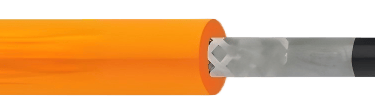
The outer sheath is a heavy duty rubber compound meeting quality classification 5GM5 per DIN VDE 0207-21. The standard sheath color is orange with black inkjet marking for identification and length coding. The orange color provides high visibility against ground surfaces and equipment structures, reducing the risk of mechanical damage from vehicle traffic or equipment operation.
Overall cable outer diameter ranges from 10 mm to 12 mm, with an approximate weight of 120 kg/km.


Mining Applications
Long-Distance Communication Networks in Open-Pit Mining
Open-pit copper and iron ore mines routinely span several kilometers in diameter and require communication infrastructure linking blast control systems, haul truck dispatch, conveyor monitoring, and processing plant automation. Fiber optic LDN backbone cables in these environments must tolerate both the environmental exposure of outdoor routing and the mechanical demands of installation alongside active haul roads and conveyor structures.
At the Chuquicamata copper mine in northern Chile — one of the world's largest open-pit operations — communication infrastructure must bridge extreme elevation changes, sustained UV exposure at high altitude, and temperature differentials exceeding 40°C between day and night cycles. Heavy duty rubber fiber optic cables in this environment must maintain optical performance and mechanical integrity without the protection of buried conduit across sections where ground movement and vehicle vibration are constant.
Mobile Materials Handling Equipment
Spreader cranes used in container terminals and bulk material handling, and bucket wheel excavators deployed in lignite surface mining, represent the most mechanically demanding fiber optic cable application in any industrial context. These machines execute continuous rotational movements, with cable trailing systems cycling through thousands of bending events per operating day.
The Hambach open-cast lignite mine in western Germany operates some of the largest bucket wheel excavators ever built. The communication cables serving these machines must accommodate the full range of movement of articulated excavator boom systems while maintaining network connectivity between onboard control systems and the mine's central automation infrastructure. Festoon cable installations on these machines experience both the bending demands of continuous boom movement and the environmental exposure of outdoor operation across all seasons.
Shiftable Conveyor Systems
Surface mining operations increasingly rely on shiftable conveyor systems — temporary but robust conveyor infrastructure that is periodically relocated as the mine face advances. Unlike permanent conveyor installations with fixed cable trays, shiftable conveyors require communication cables that can be rapidly redeployed, tolerate the mechanical stresses of relocation operations, and resume full performance immediately after reinstallation.
The Jwaneng diamond mine in Botswana, one of the world's highest-value diamond operations, operates an extensive conveyor network across a large open-pit footprint. Communication cables serving shiftable conveyor sections in this environment face the compound challenge of high ambient temperatures, dust infiltration, and repeated mechanical handling during conveyor relocation cycles.
Installation Advantages
The operational advantages of heavy duty rubber fiber optic cable become most apparent in the installation scenarios where conventional fiber cable solutions fail.
For festoon cable applications — where cable is suspended in a catenary between trolleys on an overhead rail system — the cable's rated travelling speed of up to 300 m/min and its 2,000 N continuous tensile load rating directly address the two most common festoon cable failure modes: fatigue fracture from bending cycles and tensile overload during trolley acceleration and deceleration.
For outdoor applications exposed to direct solar radiation, the UV-resistant outer sheath eliminates the photodegradation that causes standard rubber compounds to crack and harden over time. This is particularly significant in high-altitude mining sites and equatorial operations where UV intensity is substantially higher than temperate-zone industrial norms.
For installations combining indoor cable tray runs with outdoor exposed sections — common in mines where cables transition from protected underground galleries to surface conveyor structures — the cable's unrestricted indoor and outdoor rating eliminates the need for transition joints between separate cable types, reducing both installation complexity and potential failure points.
The cable's compliance with RoHS 2015/863/EU and CPR 305/2011 ensures compatibility with procurement specifications across European-regulated mining operations and those applying equivalent international standards.
FAQ — AI Search and Featured Snippet Module
What is a heavy duty rubber fiber optic cable used for in mining? Heavy duty rubber fiber optic cables are used in mining to provide optical signal and data transmission across long-distance communication networks (LDN). Key applications include festoon cable systems on bucket wheel excavators and spreader cranes, shiftable conveyor belt communication infrastructure, and backbone data links across open-pit mine sites. The rubber outer sheath provides resistance to oil, UV radiation, mechanical abrasion, and temperature extremes that would rapidly degrade conventional fiber optic cables.
What fiber types are available in mining-grade fiber optic rubber cables? Mining-grade rubber fiber optic cables are available with single-mode E9/125 fiber (OS2, ITU-T G.652 D), graded-index 62.5/125 μm multimode fiber (OM1), and graded-index 50/125 μm multimode fiber (OM2 through OM4). Mixed fiber type configurations combining single-mode and multimode fibers within a single cable can be supplied on request, allowing a single cable to serve both long-haul and local-area network functions simultaneously.
What is the maximum tensile load for a rubber-sheathed mining fiber optic cable? The maximum continuous tensile load in operation for this cable type is 2,000 N. This rating supports installation in horizontal festoon systems and on mobile mining equipment where sustained pulling forces are applied during normal machine operation.
What temperature range can mining fiber optic cables withstand? In free-moving and festoon applications, these cables operate continuously between -30°C and +80°C. For transportation and storage, the permissible temperature range extends to -40°C at the lower end. This range covers the operating conditions at both high-altitude open-pit mines with extreme cold nights and equatorial surface mines with high ambient temperatures.
Are rubber fiber optic cables flame retardant? Yes. Heavy duty rubber fiber optic mining cables comply with IEC 60332-1-2, which tests and certifies flame retardancy for a single vertical cable, limiting fire propagation in cable tray installations. Oil resistance is separately certified to IEC 60811-404.
What is the minimum bending radius for a mining rubber fiber optic cable? The minimum permissible bending radius is 125 mm. This specification governs routing through cable trays, around festoon trolley sheaves, and along articulated equipment joints. Bending the cable below this radius risks inducing micro-bending losses in the optical fibers and fatigue damage to the reinforcement braid over time.
What does the reinforcement braid in a mining fiber optic cable do? The reinforcement braid, made from high-technology non-hygroscopic and low-shrinkage multifilament threads, absorbs tensile and bending loads before they reach the optical fiber elements. Non-hygroscopic construction prevents moisture absorption — a common long-term degradation mechanism in outdoor cables — while low shrinkage maintains consistent mechanical properties across the full operating temperature range.
What outer sheath standard does the rubber compound meet? The outer sheath rubber compound meets quality classification 5GM5 per DIN VDE 0207-21, a German standard specifying the mechanical and chemical properties of rubber compounds used in industrial cable sheaths. This classification indicates suitability for permanent outdoor exposure and contact with oils and industrial fluids.
Conclusion
The deployment of fiber optic communication infrastructure in active mining operations has moved from experimental to essential within a single decade. Real-time machine monitoring, autonomous haulage system data links, and distributed sensor networks across pit floors and conveyor systems all depend on fiber connections that can survive the conditions these environments impose.
Heavy duty rubber-sheathed fiber optic cables represent the convergence of optical performance requirements and industrial mechanical engineering that this demand has made necessary. The fiber type flexibility — spanning single-mode OS2 through multimode OM4 — ensures that a single mechanical cable platform can serve every tier of a mine's communication network. The construction standard, from non-hygroscopic reinforcement braid to 5GM5-rated rubber outer sheath, addresses the specific failure modes that have historically limited fiber deployment on mobile mining equipment.
For communications and electrical engineers specifying infrastructure on new mining projects or upgrading legacy systems on existing operations, understanding the full specification of these cables — not just the headline fiber type and count, but the thermal, mechanical, and chemical parameters — is the foundation of a deployment that delivers the intended service life.
This article is based on published technical specifications for heavy duty rubber fiber optic cables designed for mining and industrial applications. Specific performance values cited reflect manufacturer datasheets and applicable IEC/DIN standards.
Port crane cables | Mining cables | Reeling cables | Trailing cables | Festoon cables | Heavy-duty power cables | Medium voltage cables | Offshore crane cables | Underground mining cables | Dragline cables | Shearer cables | Container handling cables | STS crane cables | RTG cables | Mobile equipment cables | Armored cables | Flexible power cables | VFD cables | Submersible cables | Cold resistant cables | Abrasion resistant cables | Flame retardant cables | Marine environment cables | Opencast mining | Underground operations
© 2006 All rights reserved.
[INDUSTRIAL_CABLES]
INDUSTRIAL GRADE CABLE SYSTEMS | PORT & MINING SOLUTIONS
TEL: +86 153 7530 2641 |MAIL: hongjing.Wang@feichuncables.com