High-Flex Fibre Optic Festoon Cable for Port Crane Systems: A Technical Deep-Dive into TRATOSFIBRE DB and the Feichun Alternative
TRATOSFIBRE DB fibre optic cable – DIN VDE certified Kevlar-reinforced flexible festoon cable for RTG, RMG, ASC and STS cranes. Designed for -40°C to +80°C operation, 5000N tensile strength and festoon speeds up to 240 m/min. Feichun provides a cost-effective, high-performance alternative fibre optic crane cable.
REELING CABLE
hongjing.Wang@Feichun
2/28/202611 min read
Introduction: Why Fibre Optics Matter in Modern Container Terminals
Container terminals today operate under relentless pressure — higher throughput, greater automation, and tighter turnaround windows. At the heart of this transformation is reliable, high-speed data communication between control systems and moving equipment. Copper-based communication cables that once served this purpose are increasingly being replaced by fibre optic solutions that offer immunity to electromagnetic interference, higher bandwidth capacity, and superior signal integrity over long cable runs.
But fibre optic cables in crane applications face a challenge that office or building installations never encounter: continuous, high-speed mechanical stress. A cable running on a Ship-to-Shore (STS) crane trolley may complete thousands of bending cycles per shift. A festoon system on a Rubber Tyred Gantry (RTG) crane may accelerate and decelerate dozens of times per hour. An Automatic Stacking Crane (ASC) operating in an arctic-climate terminal must maintain signal integrity at -40°C or below. These are not ordinary cable conditions — and ordinary cables fail under them.
This article examines the TRATOSFIBRE DB flexible fibre optic festoon cable as a technical benchmark for crane applications, explores the specific mechanical and thermal demands placed on cables across different crane types, and introduces Feichun's high-performance fibre optic festoon cable as a technically equivalent, cost-optimized alternative for port operators, crane OEMs, and terminal integrators worldwide.
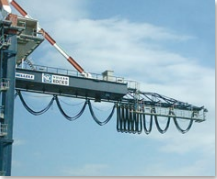
Application Environments Across Crane Types
Understanding what each crane type demands from its fibre optic cable is essential before specifying any product.
STS (Ship-to-Shore) Cranes
STS cranes are the largest and most mechanically demanding crane type in any container terminal. With boom spans extending over 70 metres and trolley travel distances often exceeding 100 metres per cycle, the festoon cable system must endure enormous cumulative travel distances each day. Cable trolleys running on the festoon rail experience both lateral tension loads and vertical gravitational stress. Crucially, STS cranes are exposed to open sea wind loads — in some ports, sustained winds exceeding 20 m/s are not uncommon during operations. This introduces a torsional component to the cable stress profile that most manufacturers underestimate. A cable that cannot resist torsion will develop internal fibre twisting over time, leading to signal attenuation that is difficult to diagnose and impossible to reverse without cable replacement.
RTG (Rubber Tyred Gantry) Cranes
RTG cranes are the workhorses of most mid-size container yards. They are mobile, self-powered, and typically connected to the terminal control system via festoon cables suspended from overhead catenary systems. The mobility of RTGs means cable systems must accommodate not just trolley motion but full gantry travel, sometimes at speeds up to 120 m/min. Additionally, RTG festoon systems are frequently installed outdoors with minimal shelter, exposing cables to direct UV radiation, thermal cycling between cold nights and sun-heated days, and rain ingress. The outer sheath compound and UV stabilization of any cable used here must be industrial-grade without exception.
RMG (Rail Mounted Gantry) Cranes
RMG cranes operate on fixed rails and are common in automated container terminals. Their cable travel systems are more predictable in geometry but no less demanding in cycle count. An RMG in a busy automated terminal may execute gantry travels continuously, 24 hours a day, 7 days a week. Over a 10-year cable design life, this translates to millions of bending cycles. Cable fatigue is the primary failure mode here — and it is insidious, because fibre degradation from micro-bending and sheath fatigue cracking begins long before any visible external damage appears.
ASC (Automatic Stacking Cranes)
ASC cranes take automation to its highest level, operating without any on-board operator. Communication cable reliability is therefore absolutely mission-critical — any signal interruption means an immediate crane stop and production loss. ASC systems often run in enclosed or semi-enclosed structures, which moderates temperature extremes somewhat, but the high cycle rates and precise positioning requirements make any cable slack, elongation, or attenuation event unacceptable. Many ASC installations are also in cold-climate ports in Northern Europe, Canada, or Northeast Asia, where cable flexibility at sub-zero temperatures is a genuine engineering concern rather than a theoretical one.
Ship Unloaders and Stackers/Reclaimers
Beyond container cranes, bulk material handling equipment — ship unloaders, bucket wheel reclaimers, and portal stackers — also increasingly relies on fibre optic communication. These machines combine very long cable travel distances (often 150–300 metres one-way) with heavy vibrational loads from continuous bulk material movement. Cable systems here are often monospiral reel-fed rather than festoon-style, which changes the mechanical stress profile but does not reduce its severity.
Mechanical Stress Analysis — What Really Damages Fibre Optic Cables in Crane Service
Torsion
Torsion is frequently overlooked in cable specifications but is one of the most damaging stress modes in practice. It occurs when a cable does not lie perfectly in its intended plane of travel — caused by wind load on a long festoon span, asymmetric cable weight distribution, or minor misalignment in festoon trolley guides. In a twisted fibre optic cable, individual fibres experience lateral compression against the buffer tube walls. This produces micro-bending losses that increase progressively over time. Anti-torsional protection layers and optimized lay configurations are the engineering response to this failure mode, and they must be present in any cable specified for exposed, high-speed festoon service.
Tensile Stress
In long festoon systems — particularly on STS cranes or ship unloaders where travel distances exceed 80–100 metres — the cable's own weight creates significant tensile loads at the attachment and trolley points. Add the dynamic tensile spike from rapid acceleration of the trolley, and the cable must sustain both static and dynamic tensile forces simultaneously. A tensile strength rating of 5000 N, as specified for the TRATOSFIBRE DB, is the appropriate engineering level for demanding STS and bulk handling applications. Under-rated cables experience fibre elongation within the cable structure, which permanently alters attenuation characteristics even after the load is removed.
Bending Cycles
Every pass of a festoon trolley imposes a bending cycle on each span of cable. At 240 m/min trolley speed, and accounting for acceleration and deceleration zones, a cable section may experience complete bending reversal hundreds of thousands of times per year. Optical fibres can tolerate bending without signal loss only if the bend radius remains above the critical threshold — for the cable designs under discussion, this means maintaining a minimum dynamic bending radius of 250 mm in reel systems and appropriate values in festoon configurations. Cable designs that do not adequately control minimum bend radius through internal structural elements will show progressive attenuation increases over their service life, with complete fibre failure eventually occurring at fatigue crack initiation points.
Installation Methods and Their Specific Engineering Requirements
Festoon Systems
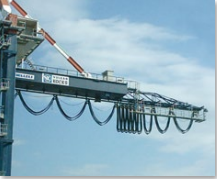
The festoon installation is the most common arrangement for STS trolleys, RTG gantry travel, and RMG gantry travel. In this system, the cable hangs in a series of loops from trolleys running on a monorail, with the active end connected to the moving crane structure. The key engineering considerations are: controlling the catenary loop geometry to prevent cable-on-cable contact, ensuring cable weight is low enough to minimize trolley loading at high speeds, and providing sufficient torsion resistance to prevent cable rotation under wind load. Cable outer diameter matters here too — an oversized cable increases wind drag and trolley friction, reducing system reliability and potentially overloading motorized trolley drives.
Monospiral Reel Systems
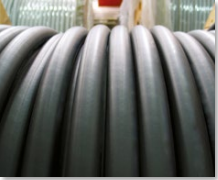
Monospiral reels, also called end-feed reels, are used where festoon systems are impractical — typically for very long travel distances or in enclosed crane systems where cable management space is limited. The cable is wound in a single layer on a rotating drum, with one end connected to the fixed infrastructure and the other to the moving crane element. This system subjects the cable to a constant repetitive bending-and-straightening cycle at the reel tangent point, combined with torsional loads as the drum rotates. Maximum speed capability of 300 m/min for the TRATOSFIBRE DB design reflects the more controlled geometry of reel systems compared to open festoon arrangements. Cable selection for reel systems must prioritize torsion resistance and bending fatigue life at the specific reel diameter being used.
Vertical Drop and Trailing Systems
Some crane applications — particularly in tower cranes, bucket elevators, and certain ASC configurations — require cables to run vertically or in a trailing drag configuration along the ground or along a crane leg. Vertical drops impose pure tensile stress, requiring strong central support members and Kevlar reinforcement to prevent fibre elongation under the cable's own weight over long drops. Trailing cables on the ground face abrasion from the terminal surface, and their outer sheath must resist both mechanical wear and chemical contamination from fuel spills, hydraulic oil, and salt spray in port environments.
Typical Failure Modes and Engineering Solutions
Failure Mode 1: Sheath Cracking and UV Degradation
Risk: In outdoor RTG and STS installations, the combination of UV radiation and thermal cycling between cold nights and solar-heated days causes standard sheath compounds to embrittle and crack within 3–5 years. Once the sheath is compromised, moisture enters the cable structure and accelerates fibre degradation.
Engineering Solution: Industrial-grade, UV-stabilized special compound sheaths with verified performance across the full -40°C to +80°C operating range are the correct specification. Generic cable sheath compounds are not adequate. Cables should be verified against DIN EN 60811-404 for thermal and UV ageing resistance.
Failure Mode 2: Progressive Signal Attenuation from Micro-Bending
Risk: Cables with insufficient internal structural control — particularly those lacking adequate Kevlar reinforcement or anti-torsional layers — allow optical fibres to migrate within the cable cross-section under repeated mechanical stress. This produces micro-bending at the fibre-buffer interface, causing attenuation that increases progressively over the cable's service life and typically becomes unacceptable within 2–4 years in high-cycle applications.
Engineering Solution: A tightened internal construction that constrains fibre movement, combined with high-strength central support and appropriately sized Kevlar reinforcement, maintains fibre position under dynamic loading. Regular attenuation monitoring using OTDR testing provides early warning before signal loss becomes operationally significant.
Failure Mode 3: Tensile Overload and Fibre Elongation
Risk: In long festoon spans or high-speed trolley systems, cables with insufficient tensile strength ratings experience fibre elongation under peak dynamic loads. Because optical fibres have virtually zero tolerance for elongation — even fractions of a percent — this produces permanent attenuation increases and, in severe cases, complete fibre fracture.
Engineering Solution: Cables specified for tensile strengths appropriate to the application — 5000 N for demanding STS and bulk handling service — combined with proper cable support spacing in festoon systems to prevent excessive catenary sag under load.
Failure Mode 4: Torsion-Induced Fibre Twisting
Risk: Exposed festoon systems on STS and RTG cranes subject cables to wind-induced rotation, particularly in open spans exceeding 3–4 metres between trolleys. Over time, accumulated torsional stress causes fibres within the cable to twist against internal structural elements, producing both attenuation increases and mechanical fatigue at fibre buffer interfaces.
Engineering Solution: Anti-torsional protection layers integrated into the cable design, combined with proper festoon trolley spacing and swivel-type end terminations where geometry permits. Cable selection should explicitly verify torsion resistance performance, not just tensile and bending specifications.
Failure Mode 5: Low-Temperature Embrittlement
Risk: Standard-specification cables specified down to -20°C or -30°C are frequently installed in ports where actual ambient temperatures reach -35°C or below — northern European ports, Canadian terminals, and Northeast Asian facilities. At temperatures below the rated limit, the sheath compound loses flexibility, increasing the effective bending stiffness of the cable dramatically. In festoon systems, this can cause the cable to resist proper loop formation, overloading trolley drives and concentrating bending stress at fixed points.
Engineering Solution: Extended low-temperature versions rated to -60°C for dynamic use are available and should be mandatory specifications for terminals in cold-climate regions. The cost premium over standard-rated cables is negligible compared to the cost of premature cable replacement or crane downtime in winter.
TRATOSFIBRE DB — The Technical Benchmark
The TRATOSFIBRE DB establishes the performance standard against which other fibre optic festoon cables should be measured in serious crane applications. Its specification reflects genuine engineering understanding of the port crane environment:
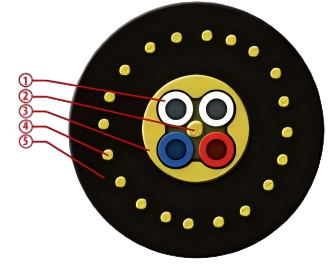
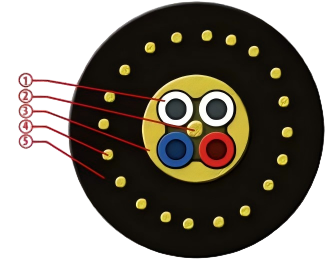
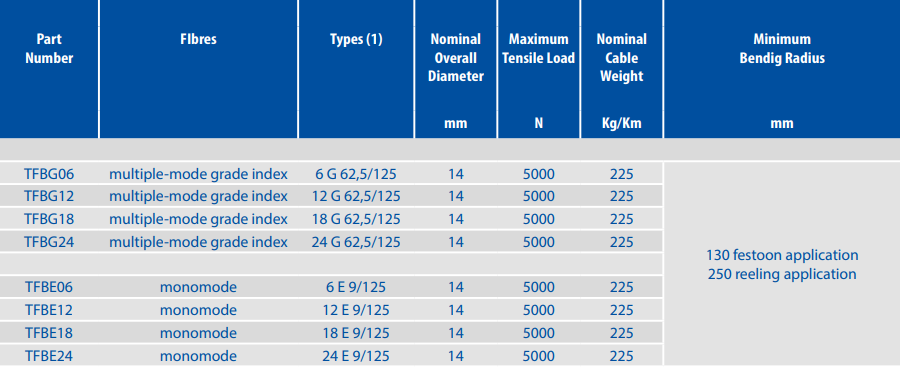
The cable is available in both multimode 62.5/125 and single mode 9/125 fibre configurations, with standard 24-fibre cores and options down to 6 fibres for lower-count applications. The Kevlar-reinforced construction with anti-torsional protection layer addresses the two most common failure modes in festoon service. The 5000 N tensile strength rating covers all but the most extreme travel distance and speed combinations. The -40°C to +80°C fully flexible operating range (with -60°C extended version available) covers the vast majority of global port locations. Travel speed capability of 240 m/min for festoon systems and 300 m/min for monospiral reels encompasses all current high-speed automated terminal requirements.
Compliance with DIN VDE 0207 Part 21, DIN EN 60811-404, DIN VDE 0298-3/0298-4, and ITU-T G651/G651.1 provides documented verification of mechanical durability, optical transmission reliability, and industrial safety performance. These are not marketing certifications — they represent specific, verifiable test protocols that cables either pass or fail under controlled laboratory conditions.
Feichun Flexible Fibre Optic Festoon Cable — Technical Equivalence at a Better Price
Feichun has engineered its flexible fibre optic festoon cable line specifically to match the performance parameters that make TRATOSFIBRE DB the reference product in this market — while delivering a significantly more competitive cost structure that makes it the right choice for cost-conscious port operators, crane manufacturers sourcing for new builds, and terminal operators managing cable replacement programmes.
Technical Equivalence
Feichun's fibre optic festoon cable delivers the same fibre specifications — both 62.5/125 multimode and 9/125 single mode — and the same fibre count range from 6 to 24 cores, with custom configurations available for non-standard applications. The 5000 N tensile strength design mirrors the TRATOSFIBRE DB specification and has been validated for long-span festoon service on STS cranes and ship unloaders. Bending radius performance matches the benchmark — 130 mm for fixed installations and 250 mm for cylindrical reel systems. The cable is rated for festoon travel speeds of 240 m/min and reel system speeds of 300 m/min, covering the full range of current automated terminal requirements. Temperature performance spans -40°C to +80°C for standard dynamic use, with the -60°C extended low-temperature version available for cold-climate installations.
Engineering Optimizations
Feichun's cable design incorporates an optimized cross-section that reduces outer diameter compared to conventional designs. In practice, this means lower wind drag on exposed STS festoon runs, reduced trolley loading in motorized festoon systems, and more compact cable storage on reel systems. The torsion resistance layer has been refined specifically based on feedback from port installations in high-wind coastal environments where standard torsion protection proved inadequate over multi-year service periods. Kevlar reinforcement has been enhanced to provide consistent tensile performance across the full temperature operating range — an important detail, because Kevlar's effective contribution to tensile strength is temperature-dependent and must be accounted for in cold-climate cable design.
Customization capability is a genuine competitive advantage for Feichun in this market. Travel distance, operating speed, climate zone, terminal automation level, and specific installation geometry can all be incorporated into the cable specification. Port operators replacing cables mid-lifecycle or crane OEMs specifying for a new terminal project with specific performance requirements can work directly with Feichun's engineering team to confirm the optimal specification before order placement.
Compliance and Quality Assurance
Feichun's manufacturing and quality control processes are aligned with DIN VDE and ITU-T standards applicable to this cable type, providing the same documentary compliance basis that procurement teams and technical approvers require when evaluating alternative cable sources. In-house quality control covers fibre geometry, attenuation measurement, tensile testing, bending cycle testing, and sheath compound verification — the full test matrix required to confirm performance rather than merely claim it.
The Cost Advantage
The price premium associated with European-branded cable products in this segment reflects brand positioning and distribution margins as much as it reflects manufacturing cost. Feichun's modern production facility, optimized supply chain for raw materials including optical fibre, Kevlar, and specialist sheath compounds, and direct technical sales approach eliminate the layers of cost that inflate end-user prices for equivalent European products. The result is a cable that delivers the same mechanical strength, thermal performance, and optical communication reliability — at a price point that meaningfully improves the economics of cable replacement programmes and new crane commissioning projects.
For a large terminal operator replacing festoon cables across a fleet of 10 STS cranes, the difference is not marginal. For a crane OEM sourcing cable for a 20-crane new terminal project, Feichun's competitive pricing can represent a substantial and defensible cost saving without any sacrifice in technical specification or reliability expectation.
Conclusion: Specifying Smart for the Long Term
Fibre optic festoon cables are not a commodity product. The difference between a correctly specified, high-quality cable and an under-engineered substitute is measured not at purchase but over years of crane operation — in maintenance calls, production losses, troubleshooting hours, and premature replacement costs that accumulate invisibly until they become undeniable.
The mechanical parameters that matter — tensile strength, bending radius, torsion resistance, travel speed capability, and temperature range — are well defined by the TRATOSFIBRE DB benchmark. The standards that verify these parameters — DIN VDE 0207, DIN EN 60811-404, ITU-T G651 — provide objective, testable criteria that any credible cable supplier should be able to meet.
Feichun meets them. And Feichun does so at a price that makes technical excellence accessible rather than aspirational. For port operators, crane manufacturers, and system integrators who need to deliver reliable fibre optic crane communication without overpaying for it, Feichun's flexible fibre optic festoon cable is the practical, engineered answer.
Port crane cables | Mining cables | Reeling cables | Trailing cables | Festoon cables | Heavy-duty power cables | Medium voltage cables | Offshore crane cables | Underground mining cables | Dragline cables | Shearer cables | Container handling cables | STS crane cables | RTG cables | Mobile equipment cables | Armored cables | Flexible power cables | VFD cables | Submersible cables | Cold resistant cables | Abrasion resistant cables | Flame retardant cables | Marine environment cables | Opencast mining | Underground operations
© 2006 All rights reserved.
[INDUSTRIAL_CABLES]
INDUSTRIAL GRADE CABLE SYSTEMS | PORT & MINING SOLUTIONS
TEL: +86 153 7530 2641 |MAIL: hongjing.Wang@feichuncables.com