How Fiber Optic Integrated Cables (NSHTÖU-O) Optimize Automated Port Operations: A Deep Technical Analysis for Middle Eastern Terminals
Explore how fiber optic integrated cables support real-time telemetry, remote crane operation, and smarter automation in modern container terminals.
hongjing.Wang@Feichun
7/10/202614 min read
1. Introduction
In the global maritime logistics landscape, the container terminals of the Middle East serve as primary economic lifelines. Operational hubs such as Jebel Ali Port in Dubai, Khalifa Port in Abu Dhabi, King Abdullah Port in Rabigh, and the Port of Salalah in Oman handle vast cargo volumes annually. To manage this continuous traffic, regional terminal operators are transitioning from conventional human-operated crane environments toward fully automated and semi-automated smart-port infrastructures. This evolution changes the technical demands placed on every physical component within a port, especially the flexible cable systems that power and control heavy cargo-handling equipment.
Automated container ports require a unified moving cable architecture capable of simultaneously carrying massive electrical power and mission-critical, low-latency telemetry data. In an automated terminal, a power outage or a split-second interruption in data transmission will instantly halt operations, triggering a cascade of logistical delays and financial losses across the entire supply chain. This is why the integration of fiber optic sub-units within heavy-duty crane reeling cables has emerged as a major development in maritime engineering.
The specialized Feichun NSHTÖU-O cable series is designed specifically to address this requirement. By housing high-capacity fiber optic elements alongside low-voltage power conductors within a single, reinforced rubber enclosure, the Feichun NSHTÖU-O series reduces cable deployment complexity while enabling reliable, real-time telemetry, advanced remote control capabilities, and a lower overall maintenance risk profile. This topic represents a high-value focus for contemporary port engineering because it connects the strategic goals of port automation and digital transformation with the practical realities of severe-duty cable design.

2. The Landscape of the Automated Port: The Middle Eastern Context
The shift from conventional container terminals to automated and semi-automated operations is transforming maritime logistics across the Middle East. Regional terminal operators are investing heavily in automated stacking cranes, automated guided vehicles, and remote-controlled ship-to-shore crane architectures to maximize container throughput, improve berth safety, and minimize human error.
Consider the real-world example of Jebel Ali Port in Dubai, managed by DP World. In 2026, DP World advanced its smart-port strategy by announcing Phase II of its AI-driven terminal automation initiative. This large-scale modernization program introduces a new generation of automated stacking cranes and integrates advanced predictive AI models directly into yard and vessel operations to optimize container placement and ship turnaround times. Similarly, Khalifa Port in the United Arab Emirates continues to lead in technological adoption, with industry documentation showcasing the ongoing deployment of full terminal automation and advanced remote-operation systems across its primary container terminals.
These modern automated installations rely on three core system architectures:
First are Automated Stacking Cranes (ASCs), which operate continuously in the container yard without onboard human drivers, stacking and retrieving boxes based on instructions sent from a centralized terminal operating system.
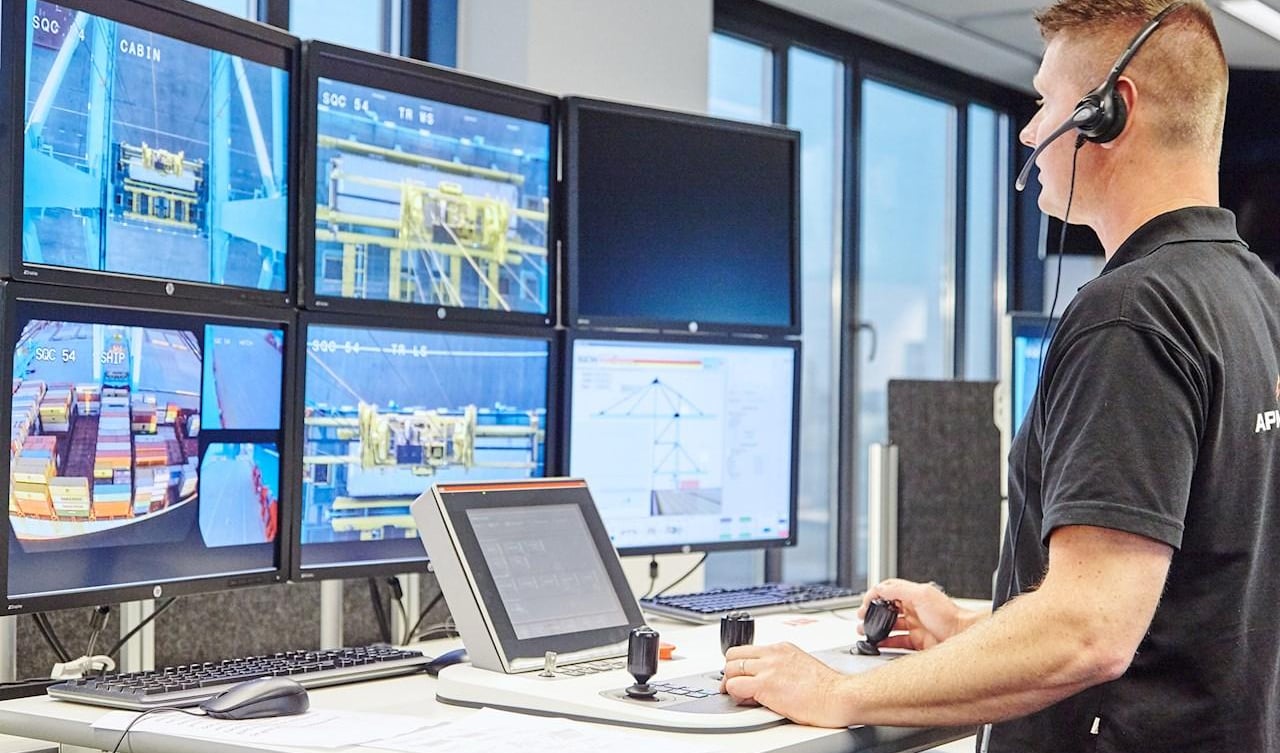
Second are Remote Crane Operation setups, which allow professional crane operators to control massive Ship-to-Shore (STS) gantries from a centralized, climate-controlled control room located several kilometers away from the active berth, using high-definition video feeds and real-time joystick controls.
Third are Terminal Automation Systems (TAS) and Terminal Operating Systems (TOS), the digital brains that coordinate the real-time movements of thousands of assets simultaneously across the entire port layout.
For these automated systems to function safely and efficiently, they require a highly stable, low-latency, and electromagnetic interference-resistant communication link between the moving crane, the terminal yard infrastructure, and the central control room. If a remote-control video stream drops for even a fraction of a second, or if an automated stacking crane loses its positioning telemetry, safety interlocks will instantly trigger emergency shutdowns. Consequently, the physical data links running along the crane's travel path must be completely reliable under all conditions.
3. Why Fiber-Integrated Cables Are Needed: Moving Past Legacy Systems
In conventional crane setups, power delivery and data communication were treated as completely separate engineering problems. This legacy design relied on two completely independent systems: a heavy-duty, multi-core rubber insulated cable to deliver low-voltage or medium-voltage electrical power, and a completely separate trailing or reeling cable dedicated solely to carrying low-voltage control signals and copper-based data communications.
This traditional multi-cable model creates serious problems when applied to modern automated terminals:
First, it increases the total number of moving cables on the crane, leading to higher system complexity and requiring multiple, independent reeling drums or cable management trays.
Second, it requires significantly more installation space within the tight structural framework of the crane trolley and gantry systems.
Third, it adds extra dead weight to the moving crane structure, increasing the energy required for rapid acceleration and deceleration cycles.
Fourth, it introduces more potential failure points into the system, as each separate cable is exposed to its own set of mechanical stresses, abrasions, and jacket tears.
Fifth, it creates a much heavier maintenance burden for port engineering teams, who must continuously inspect, test, and repair multiple separate cable lines across every crane in the yard.
In contrast, the modern composite cable model replaces this complex arrangement with a single, highly engineered cable solution: housing both the high-current power conductors and the high-bandwidth fiber optic lines within a single outer jacket. Port Equipment Manufacturers Association (PEMA) technical documentation notes that many modern crane power reeling cables now integrate fiber optics directly into their core structure. PEMA also states that single fiber optic cables can be successfully deployed in specialized reeling applications to upgrade data transmission security and provide a highly resilient data backbone for older port equipment. For automated ports, this composite design eliminates inter-cable friction, reduces structural weight, and ensures that data and power move together along a single, controlled path.
4. The Engineering Layout of the Feichun NSHTÖU-O Cable
The ability of a composite cable to reliably transmit high-voltage power and delicate digital data simultaneously over millions of operating cycles depends entirely on its structural layers. The Feichun NSHTÖU-O cable is engineered from the inside out to isolate delicate glass fibers from heavy electrical fields and severe mechanical forces.
The internal construction of the Feichun NSHTÖU-O cable follows a precise, layered sequence:
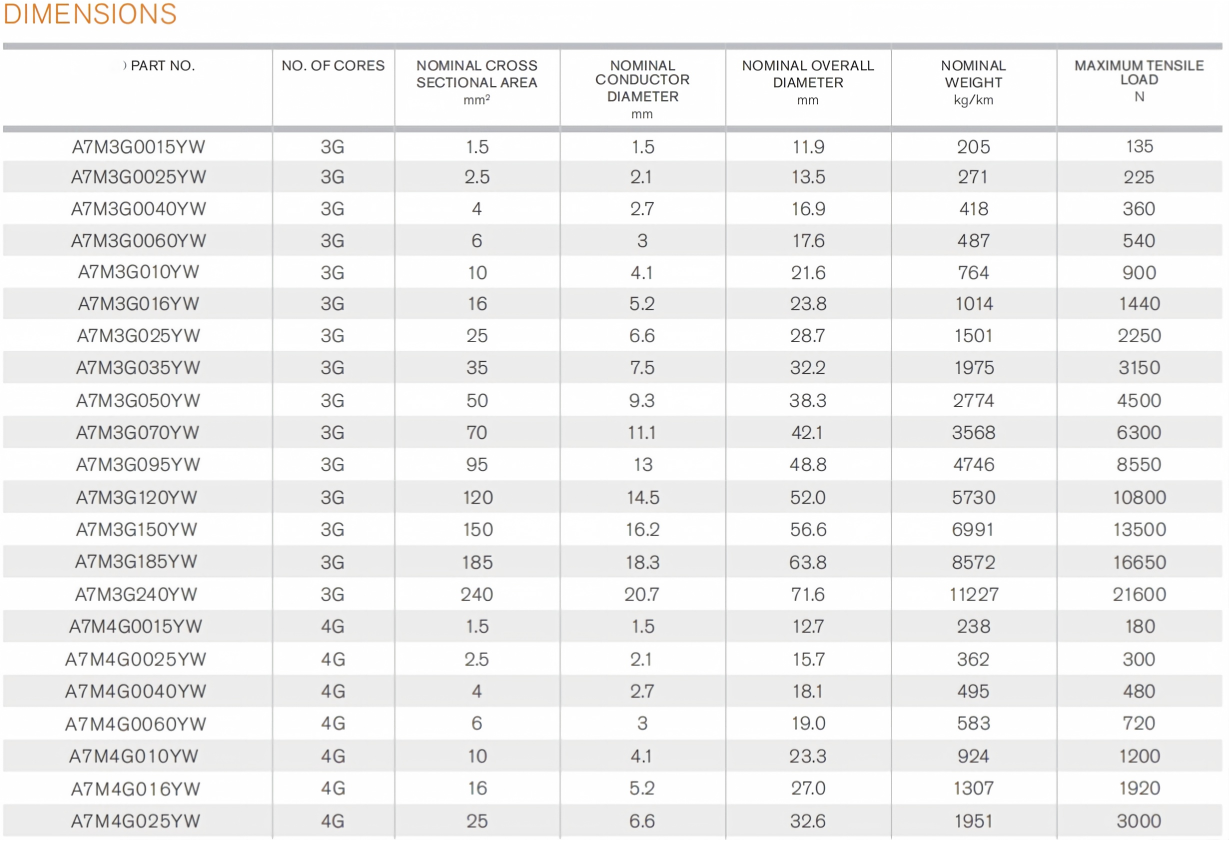
At the center of power delivery are the flexible copper conductors, manufactured using Class 5 fine-stranded tinned copper wires according to international standards. The use of tinning protects the individual copper strands from galvanic corrosion in humid, salty maritime environments.
Surrounding each conductor is a high-grade Ethylene Propylene Rubber (EPR) insulation layer, typically designated as type 3G13. This rubber insulation provides excellent dielectric strength along with long-term elasticity and thermal stability.
Alongside the main power lines are the auxiliary control cores, which handle low-voltage signals for brake controls, thermal sensors, and local safety interlocks.
Embedded within the internal layout is the specialized fiber optic unit. This sub-assembly houses the delicate optical fibers inside a protective, gel-filled loose tube or a ruggedized elastomeric element that cushions the glass strands, shielding them from the physical compression and stretching forces experienced by the surrounding power conductors.
Wound tightly around the internal bedding layer is a high-strength reinforcement layer, typically consisting of an integrated polyester braid or a textile supporting braid. This structural layer serves as an anti-twist element, absorbing rotational torque and preventing the cable from twisting into a corkscrew shape during rapid winding operations.
The final external defense layer is a heavy-duty outer sheath, formulated from a high-performance Chlorinated Polyethylene (CPE) or synthetic rubber compound, designated as type 5GM3. This thick outer jacket is engineered to resist extreme abrasion, ozone cracking, UV radiation, tearing, and chemical exposure from industrial oils and fuels.
This integrated structural design ensures that each component handles its specific task: the copper conductors carry the main electrical load, the EPR insulation provides vital electrical isolation, the control cores manage auxiliary signals, the fiber optics deliver high-speed data transmission, the internal reinforcement layer provides structural stability, and the outer rubber jacket protects the entire assembly from the harsh external environment.
5. Optical Fiber Parameters and Transmission Design
When integrating glass-based optical fibers into a heavy-duty rubber cable that is continuously wound, pulled, and accelerated, engineers must carefully manage various optical and mechanical parameters. The Feichun NSHTÖU-O series can be equipped with either single-mode or multimode optical fibers, allowing port operators to match the cable to their specific network architectures.
To ensure reliable data routing, several key fiber parameters must be accounted for during system design:
First is the Fiber Type selection. For shorter data runs within a localized container yard block, multimode fibers are often chosen due to their lower termination costs and ease of connection. However, for long-distance data transmission stretching from a remote post-Panamax STS berth back to a central terminal control room, single-mode fibers are preferred because they offer minimal signal loss over long distances.
Second is the Fiber Count within the cable core. While it might seem beneficial to include as many fibers as possible for future network expansions, the total fiber count must be balanced against mechanical limits and attenuation risks. PEMA guidelines note that fiber optic elements must be integrated with extreme care, and the association recommends limiting the total count to no more than 24 fibers within a main power cable to prevent excessive signal attenuation caused by internal physical crowding.
Third is the Transmission Speed requirement. The integrated fiber sub-unit must support high-bandwidth, real-time data protocols without lag, allowing the terminal operating system to receive uninterrupted video and control feeds.
Fourth is the Bend Radius constraint. Fiber optic elements are sensitive to micro-bending and macro-bending losses. If a composite cable is bent too sharply, the glass fibers will suffer light leakage, causing data packet loss and signal degradation. For this reason, composite cables containing fiber optics require a larger minimum bending radius than standard, power-only cables.
Fifth is the Tensile Strength matching. The internal fiber optic tubes must be designed to stretch and compress in perfect harmony with the overall cable structure, ensuring that the high pulling forces generated during crane acceleration are absorbed by the integrated polyester reinforcement braid rather than being transferred to the glass fibers.
PEMA technical documentation highlights that standard fiber families utilized in modern crane applications include multimode classifications such as G50/125 micrometers and G62.5/125 micrometers, alongside high-performance single-mode classifications such as E9/125 micrometers. By utilizing these standardized fiber geometries, port engineers can easily terminate the Feichun NSHTÖU-O cable using standard industrial fiber connectors and patch panels.
6. Practical Application Scenarios in Automated Ports
The integration of power and fiber optic data links within a single Feichun NSHTÖU-O cable enables a wide range of real-time automated systems to function reliably on modern container terminals. By providing a continuous, high-bandwidth data channel along the crane's active travel path, this composite cable supports several critical automation functions:
Crane Position Feedback: Automated stacking cranes rely on continuous, millimetric positioning data from laser scanners and GNSS sensors to navigate the container yard safely. The integrated fiber link carries this positioning data back to the central control system with zero latency.
Dynamic Load Monitoring: Sophisticated load cells on the spreader unit continuously measure container weights and eccentric load distributions to prevent crane overloads. This data is transmitted instantly through the fiber lines to ensure safe lifting operations.
Anti-Collision and Laser Scanning Systems: Automated cranes use 3D lidar sensors and radar scanners to detect obstacles, personnel, or misplaced containers along their path. The massive data streams generated by these scanners require the high transmission speeds of fiber optics to process safety data in real time.
Remote Equipment Diagnostics: Modern cranes track thousands of internal data points, including motor temperatures, inverter statuses, and brake wear metrics. Fiber-integrated cables allow maintenance teams to monitor these diagnostics live, enabling effective predictive maintenance scheduling.
Condition Monitoring and Live Terminal Control: Operators working in remote control rooms rely on smooth, high-definition video feeds from multiple onboard cameras to supervise crane actions and take manual control when handling exceptional situations. The fiber core provides the necessary bandwidth to stream these video channels simultaneously without lag.
In high-throughput facilities like Jebel Ali Port and Khalifa Port, these technical capabilities translate directly into major operational benefits: faster equipment response times, reduced unscheduled downtime, safer remote-control operations, and highly optimized predictive maintenance workflows. By keeping automated ship-to-shore cranes and automated stacking cranes continuously connected, the Feichun NSHTÖU-O cable acts as a vital structural component that keeps the entire automated port moving.
7. Technical Advantages of the Composite Cable Design
Transitioning from a legacy multi-cable system to an integrated, composite Feichun NSHTÖU-O cable layout provides several clear technical advantages for port crane engineering.
First, deploying a single composite cable simplifies cable routing and significantly reduces installation complexity. Instead of aligning, clamping, and tensioning multiple separate lines along the crane's chassis, installation teams only need to manage one robust cable assembly.
Second, reducing the total number of moving parts inherently lowers the system's overall failure rate. In heavy machinery design, every additional moving element represents a potential point of wear, stress concentration, or mechanical failure. By combining power and data lines into a single engineered structure, you eliminate the risk of cables rubbing against one another, tangling, or experiencing uneven spooling on the reel drum.
Third, a single composite cable optimizes space utilization within compact energy chains, cable trays, and reeling systems. Modern crane designs place a premium on space, requiring compact components to reduce the overall size and weight of the crane trolley.
PEMA documentation emphasizes that because moving crane cables are continuously subjected to severe flexing, high-speed travel, torsional stress, and intense physical impacts, proper system design and careful component installation are highly critical. The composite Feichun NSHTÖU-O cable addresses these challenges by consolidating all power and data lines into a balanced, symmetrical layout that handles multi-directional dynamic forces much better than multiple independent cables working in parallel.
8. Direct System Comparison: Legacy Layout vs. Composite Architecture
To clearly evaluate the operational and commercial value of this technological shift, it helps to compare a traditional dual-cable system directly against the integrated Feichun NSHTÖU-O composite architecture.
Under a traditional installation model, power and data are delivered through separate systems, which requires managing multiple cables simultaneously. This layout increases the total space needed on the crane structure, adds extra weight to the moving trolley, and demands more installation labor from site teams.
Furthermore, a dual-cable setup carries a higher maintenance risk, as engineers must inspect, test, and maintain two independent lines. Communication reliability can also suffer; if a separate copper control cable or light duty data line is routed too close to high-voltage power lines, it can experience severe electromagnetic interference, leading to signal corruption and intermittent data drops.
In contrast, the Feichun NSHTÖU-O composite architecture consolidates both power delivery and fiber optic communication into a single, high-performance cable assembly. This single-cable design significantly lowers installation complexity and minimizes the space required within the crane's cable trays and reeling systems.
Maintenance demands drop because technicians only need to monitor one robust cable run. Communication reliability is also greatly improved; because the fiber optic elements utilize light signals rather than electrical currents to transmit data, they are completely immune to electromagnetic interference, even when positioned directly alongside high-current power conductors within the same rubber jacket.
This comparison demonstrates that the value of the composite Feichun NSHTÖU-O cable extends well beyond simple material specifications. It provides systemic operational benefits by simplifying crane engineering, protecting critical data channels from electrical noise, and lowering long-term maintenance costs across the terminal asset lifecycle.
9. Crucial Installation and Design Considerations for Fiber-Integrated Cables
Because composite cables house both heavy power conductors and delicate glass fibers, they require extra care during system design and field installation. Port engineering teams must adhere strictly to the mechanical and environmental parameters specified in the technical documentation to prevent early cable failure.
A primary consideration when deploying fiber-integrated cables is maintaining strict control over the bending radius. Because optical fibers are vulnerable to signal loss and structural cracking when bent too sharply, composite cables require a larger minimum bending radius than standard, power-only cables. Engineers must design all guide rollers, deflection pulleys, and reeling drum cores to accommodate these wider bending requirements.
Additionally, the maximum permissible pulling force and maximum gantry travel speed must be verified against the manufacturer's official specifications. PEMA documentation points out that these mechanical limits are strictly manufacturer-defined, and high-speed crane applications operating at travel speeds beyond 240 meters per minute often require specialized structural design modifications to protect the cable's internal layers.
According to the official technical data sheet for the Feichun NSHTÖU-O series, this specialized cable family is rated for the following operational limits:
Maximum Travel Speed: The cable is rated to handle continuous equipment travel speeds up to 100 meters per minute, making it suitable for standard automated stacking crane and gantry operations.
Longitudinal Twist Limits: The integrated structure can accommodate a maximum longitudinal twist limit of up to 50 degrees per meter of cable length. Any twisting beyond this threshold risks damaging the internal fiber optic sub-units.
Flexing Temperature Range: For active, moving applications, the certified operational temperature envelope ranges from minus 25 degrees Celsius up to plus 90 degrees Celsius. This wide flexible rating allows the cable compound to retain its elasticity during cold winter nights and scorching summer days.
Fixed Installation Temperature Range: For static or permanently clamped sections, the allowable temperature range extends from minus 40 degrees Celsius to plus 90 degrees Celsius.
By keeping crane operations well within these certified mechanical and thermal boundaries, port maintenance departments can prevent internal core shifting, avoid fiber signal loss, and ensure the cable assembly achieves its maximum rated service life.
10. Long-Term ROI and Commercial Value for Terminal Operators
For port procurement managers and terminal financial directors, upgrading a crane fleet to fiber-integrated Feichun NSHTÖU-O cables represents a strategic investment focused on maximizing long-term return on investment (ROI) and minimizing total cost of ownership.
The business case for adopting composite cables centers on several key operational savings:
First, it delivers a major reduction in unscheduled terminal downtime. In high-volume container ports, a single hour of crane downtime can cost thousands of dollars in vessel delays and yard congestion. By eliminating inter-cable friction and protecting data links from electrical interference, composite cables prevent the unexpected signal drops and jacket tears that frequently plague older, multi-cable systems.
Second, it lowers initial procurement and installation costs by reducing the overall cable count. Purchasing and installing a single composite power-and-fiber cable is more cost-effective than buying, routing, and clamping separate power wires and data lines.
Third, it simplifies long-term maintenance planning. Port technicians only need to track, inspect, and perform preventative maintenance on one robust cable run per crane, allowing them to optimize their schedules and lower labor costs.
Fourth, it optimizes remote control and automation performance. The clean, interference-free data channels provided by the integrated fiber optic lines ensure that remote crane joysticks and high-definition video feeds remain perfectly synchronized, maximizing container moves per hour.
Fifth, it ensures the terminal's physical infrastructure is fully ready for future automation upgrades. Installing composite cables guarantees that the crane's physical wiring can handle the high-speed data demands of next-generation AI diagnostics, automated OCR scanners, and 3D anti-collision sensors without needing a costly re-cabling project down the road.
These commercial advantages are especially important for high-throughput maritime hubs, where equipment reliability and data continuity have a direct impact on daily crane productivity and terminal profitability. In the modern smart-port landscape, the Feichun NSHTÖU-O cable should be viewed as a critical infrastructure asset that actively drives terminal efficiency, rather than a simple consumable electrical part.
11. Smart-Terminal Case Study: Powering Next-Generation Logistics
To fully appreciate the role of composite cables in modern port engineering, it helps to look at how they integrate into advanced, automated terminal environments like those found across the Middle East.
As highlighted previously, Jebel Ali Port utilizes advanced AI-driven automation models alongside fleets of high-speed automated stacking cranes to maintain its position as a leading global logistics hub. Concurrently, Khalifa Port continues to expand its container terminal footprints by deploying full remote-operation capabilities that allow operators to control massive ship-to-shore gantry cranes from a centralized control room.
In these advanced terminal environments, treating power delivery and data communication as separate systems is no longer practical. An automated stacking crane performing high-speed yard sorting moves cannot afford to manage separate, tangling cables, nor can a remote STS operator tolerate video latency caused by electromagnetic noise inside a trailing cable.
In a true smart terminal, electrical power and high-speed data must travel together through a unified cable architecture explicitly engineered for continuous motion. Consolidating these lines within the reinforced layers of the Feichun NSHTÖU-O series provides the physical foundation that makes advanced terminal automation possible. It ensures that as cranes accelerate, wind loads shift, and ambient temperatures rise, the flow of electrical power and digital data remains entirely uninterrupted.
12. Conclusion: Cable Design as Part of Automation Architecture
As container ports across the globe continue to transition toward autonomous and remote-controlled operations, the role of physical component specification becomes increasingly vital. The specialized Feichun NSHTÖU-O fiber-integrated cable series provides a practical, engineered answer to the complex power and communication needs of modern automated terminals.
By choosing a high-performance composite cable design, port operators secure three core advantages:
First, they benefit from a fully integrated power and high-speed data link housed within a single, space-saving rubber jacket.
Second, they minimize operational risks by eliminating extra moving parts, inter-cable friction, and potential failure points along the crane's travel path.
Third, they establish a high-bandwidth, interference-free communication channel that is perfectly optimized for remote-controlled ship-to-shore gantries and automated stacking crane fleets.
In the era of the smart port, heavy-duty cable selection can no longer be handled as an afterthought by procurement teams. Instead, high-performance composite cabling must be treated as a core element of the overall automation architecture. Specifying a rugged, VDE-compliant solution like the Feichun NSHTÖU-O series ensures your physical terminal assets remain reliable, protected, and fully prepared to handle the demands of next-generation maritime logistics.
Port crane cables | Mining cables | Reeling cables | Trailing cables | Festoon cables | Heavy-duty power cables | Medium voltage cables | Offshore crane cables | Underground mining cables | Dragline cables | Shearer cables | Container handling cables | STS crane cables | RTG cables | Mobile equipment cables | Armored cables | Flexible power cables | VFD cables | Submersible cables | Cold resistant cables | Abrasion resistant cables | Flame retardant cables | Marine environment cables | Opencast mining | Underground operations
© 2006 All rights reserved.
[INDUSTRIAL_CABLES]
INDUSTRIAL GRADE CABLE SYSTEMS | PORT & MINING SOLUTIONS
TEL: +86 153 7530 2641 |MAIL: hongjing.Wang@feichuncables.com