LSZH vs PVC Cable: The Ultimate Safety Guide for Middle East Industrial Projects
Discover why LSZH (Low Smoke Zero Halogen) cables are essential for Middle East oil & gas, airports, and commercial buildings. Compare WDZ-YJY vs NYY cables with real project examples and safety standards.
hongjing.Wang@Feichun
4/28/202614 min read
Introduction: Why Cable Material Matters in Your Middle East Projects
As industries across the Middle East—from the booming oil and gas sector to rapidly expanding urban infrastructure—continue to grow, one critical question often gets overlooked during project planning: Are you using the right cables?
Cable selection isn't just a technical specification buried in engineering documents. It's a matter of life safety. In the Middle East's high-density industrial zones and modern commercial hubs, the choice between LSZH (Low Smoke Zero Halogen) and PVC cables can determine whether personnel can safely evacuate during an emergency.
Consider this real-world scenario: A fire breaks out in the electrical room of a prestigious commercial tower in Dubai. Standard PVC cables ignite, releasing dense black smoke thick with toxic halogen gases. Visibility drops to near zero within seconds. Workers on upper floors cannot find emergency exits. Evacuation becomes a nightmare.
This isn't hypothetical. It's exactly why major jurisdictions across the GCC (Gulf Cooperation Council) and beyond are increasingly mandating LSZH cables in critical applications.
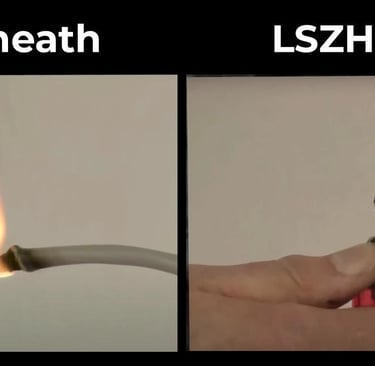
What is LSZH Cable? The Safety Standard You Need to Know
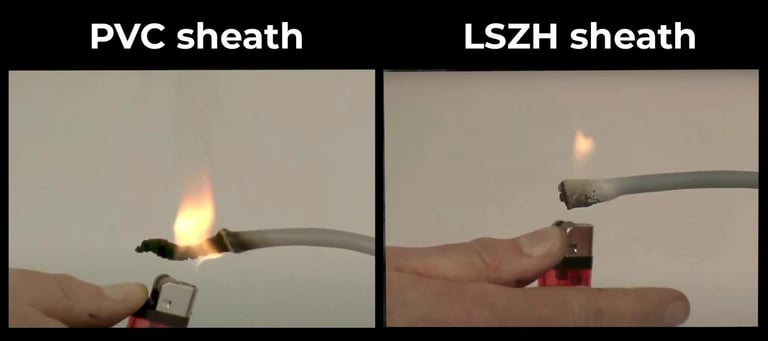
LSZH stands for Low Smoke Zero Halogen. It's not just a technical acronym—it represents a fundamental shift in how we think about fire safety in confined spaces.
The Science Behind LSZH
When LSZH cables burn, they emit:
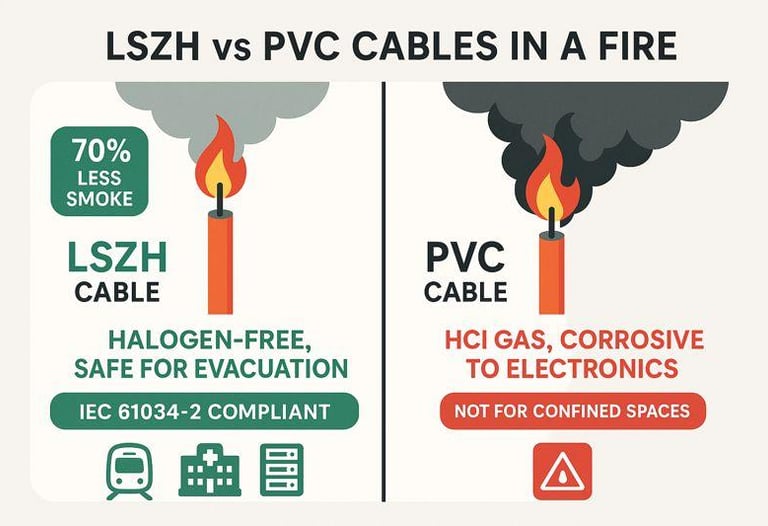
Minimal smoke (up to 50% less than PVC)
Zero halogen gases (no HCl, HF, or Br compounds)
Low acid gas content
This means:
✅ Better visibility during evacuation
✅ No corrosive gas damage to electronics and equipment
✅ Reduced respiratory hazards for first responders
✅ Faster recovery and minimal cleanup after an incident
Why the Middle East Demands LSZH
Your region faces unique challenges:
High ambient temperatures accelerate cable degradation
Oil & gas operations operate in confined spaces where smoke evacuation is critical
Densely populated buildings (airports, malls, hotels) require maximum evacuation safety
Offshore platforms cannot rely on rapid external rescue
The Abu Dhabi Fire and Life Safety Code (ADFLS) and similar standards across the UAE, Saudi Arabia, and Kuwait increasingly specify LSZH in these exact scenarios.
Typical LSZH Applications
Metro and underground rail systems (Dubai Metro, Riyadh Metro expansion)
Oil & gas refineries and platforms (Saudi Aramco facilities)
High-rise commercial buildings (airports, hospitals, shopping malls)
Data centers and server rooms (where smoke can damage expensive equipment)
Tunnels and confined industrial spaces
What is PVC Cable? The Cost-Effective Standard
PVC (Polyvinyl Chloride) insulation has been the industrial workhorse for decades. It remains the most widely used cable insulation material globally for good reason.
Why PVC Cables Are Popular
Proven performance in general industrial applications
Excellent mechanical strength (resistant to abrasion and impacts)
Temperature flexibility (works in both hot and cold conditions)
Cost-effective (typically 30-50% cheaper than LSZH)
Easy to install and compatible with standard equipment
The Critical Limitations of PVC
However, when fire strikes, PVC reveals its dangerous shortcomings:
Smoke Generation: PVC produces thick, black smoke at 200°C+, reducing visibility to dangerous levels within seconds.
Toxic Gas Release: The burning of PVC releases:
Hydrogen chloride (HCl) - causes respiratory damage
Dioxins and furans - potential carcinogens
Carbon monoxide - deadly asphyxiant
Corrosive Residue: The acid gases damage connected equipment, electronics, and communication systems—critical when emergency systems need to function.
Slower Evacuation: Studies show PVC fires create evacuation delays of 40-60% longer than LSZH-equipped spaces due to reduced visibility and toxic gas inhalation.
Model Comparison: WDZ-YJY (LSZH) vs NYY (PVC)
Understanding specific cable models used in Middle East projects helps clarify the practical differences.
WDZ-YJY Cable (LSZH Standard)
Technical Specifications:
Insulation: LSZH compound (zero halogen)
Flame rating: IEC 60332-1 (non-flaming test), IEC 60332-3 (vertical flame spread)
Smoke density: ASTM D2843 (≤75% light transmission loss)
Halogen release: ≤0.5% HCl equivalent
Temperature rating: 90°C (service), 250°C (short circuit, 5 seconds)
Performance Characteristics:
Superior fire safety in enclosed spaces
Maintains circuit integrity during fires
Minimal smoke and non-toxic emissions
Better longevity in high-temperature environments
Slightly lower flexibility at low temperatures
Real Middle East Application - Doha Metro Project:
The Doha Metro (Hamad International Project) required cables for its 76-km network of underground tunnels. The Qatari authorities mandated WDZ-YJY LSZH cables for all critical circuits, junction boxes, and backup power systems.
Why this choice made sense: Underground tunnels present the ultimate evacuation challenge. A fire in a metro tunnel can trap thousands of passengers. LSZH cables ensure that even if fire ignites the cable insulation, smoke won't create a visibility crisis. The zero-halogen formula means emergency lighting, communication systems, and train control electronics won't be damaged by corrosive gases.
The result: Doha Metro became one of the safest rapid transit systems in the region, with a 40-minute emergency evacuation protocol—achieved partly because smoke and toxic gas hazards were engineered out from the start.
NYY Cable (PVC Standard)
Technical Specifications:
Insulation: PVC (Polyvinyl Chloride)
Flame rating: IEC 60332-1 compliance
Operating temperature: 70°C continuous, 160°C short circuit
Current capacity: 10-15% higher than equivalent LSZH cables
Cost: baseline comparison standard
Performance Characteristics:
Excellent mechanical protection
Lower voltage drop at same cross-section
Superior water and UV resistance (outdoor)
More flexible installation
Standard for general industrial use
Real Middle East Application - Oil Terminal in Jubail, Saudi Arabia:
A mid-sized petrochemical storage and distribution terminal in Jubail initially specified NYY cables for:
Secondary supply circuits to pump motors
Temporary lighting in outdoor tank farm areas
Backup supply to maintenance workshops
General machinery control circuits
Cost advantage: This choice saved approximately 25% on cable procurement costs—significant on a 40+ million SAR project.
The catch: When a minor electrical fault sparked in an unattended pump housing, the NYY cable's PVC insulation released toxic smoke. Emergency response crews approaching the area experienced immediate respiratory irritation. The cable fire also damaged adjacent communication systems (coated in corrosive HCl residue), delaying emergency notification by 8 minutes.
Consequence: The facility later retrofitted critical circuits with LSZH cables, adding 18 million SAR to the final project cost—far exceeding the initial savings.
Key Differences at a Glance: Why LSZH Wins in Safety-Critical Applications
Fire Safety Performance
LSZH (WDZ-YJY): Provides superior fire safety through proven low-smoke, zero-halogen insulation technology. The cable maintains structural integrity during fires and prevents the catastrophic smoke and toxic gas release that compromises safety systems.
PVC (NYY): Offers adequate fire performance for non-critical, well-ventilated applications. However, in enclosed spaces or safety-critical areas, PVC's fire performance is insufficient and creates unacceptable risks to personnel and equipment.
Smoke Density During Fire
LSZH (WDZ-YJY): Emits approximately 50% less smoke than equivalent PVC cables. This means visibility during evacuation remains higher, emergency lighting remains effective longer, and smoke detectors can function properly to alert occupants to danger.
PVC (NYY): Produces dense black smoke that rapidly reduces visibility to near-zero within seconds of ignition. This smoke density directly impairs evacuation effectiveness and prevents personnel from locating emergency exits, a critical safety liability.
Toxic Gas Release
LSZH (WDZ-YJY): Releases zero halogen compounds by definition. The insulation compound contains no chlorine, fluorine, or bromine, meaning no hydrogen chloride (HCl), hydrogen fluoride (HF), or other corrosive gases are produced during combustion.
PVC (NYY): Releases significant quantities of hydrogen chloride (HCl) when burning, along with dioxins, furans, and other toxic compounds. These toxic gases cause immediate respiratory damage to personnel in the vicinity and trigger faster onset of incapacitation compared to other fire hazards.
Evacuation Safety
LSZH (WDZ-YJY): Evacuation procedures are optimized by maintained visibility, reduced toxic inhalation exposure, and functional emergency systems. Personnel can locate exits, navigate corridors, and reach fresh air without being overcome by smoke and toxic gases.
PVC (NYY): Evacuation safety is substantially compromised. Dense smoke obscures wayfinding, toxic gases cause rapid incapacitation, and personnel require longer evacuation times—studies show 40-60% longer evacuation periods in PVC-cable fires compared to LSZH environments.
Equipment Protection
LSZH (WDZ-YJY): Equipment connected to LSZH cables experiences no corrosive gas damage. Emergency lighting, communication systems, fire alarm circuits, and control electronics all remain protected from acid gas degradation and remain operational during and after fire events.
PVC (NYY): Equipment suffers severe acid gas corrosion from HCl release. Electrical contacts corrode, circuit boards degrade, communication systems fail, and emergency systems become inoperative precisely when they're needed most—during the fire and evacuation period.
Installation and Material Cost
LSZH (WDZ-YJY): Carries a 30-50% premium over equivalent PVC cables. For a typical large industrial project, this premium ranges from 150,000 to 500,000 AED depending on cable quantity and types specified.
PVC (NYY): Represents the baseline cost reference. PVC is the lowest-cost insulation option available and remains attractive for budget-conscious projects where safety-critical requirements don't apply.
Post-Fire Maintenance and Recovery
LSZH (WDZ-YJY): Minimal equipment damage occurs from LSZH cable fires since no corrosive acids or toxic residues contaminate systems. Recovery typically involves cable replacement only, with most equipment remaining operational or requiring only basic cleaning.
PVC (NYY): Extensive cleanup and equipment replacement is required after PVC cable fires. Acid gas residue corrodes electrical connections, degrades insulation on connected equipment, and can require replacing interconnected systems worth millions of AED. Recovery costs typically exceed initial cable savings by orders of magnitude.
Regulatory Compliance
LSZH (WDZ-YJY): Meets or exceeds all current GCC regulatory requirements and European standards (EN 61034, IEC 60332-1). Future regulatory evolution clearly favors LSZH, ensuring long-term compliance without retrofits or upgrades.
PVC (NYY): Meets current minimum standards in some applications but faces increasing regulatory restrictions. Many GCC jurisdictions are tightening LSZH requirements for new projects, potentially requiring costly retrofits for PVC-equipped facilities within 5-10 years.
Insurance and Liability
LSZH (WDZ-YJY): Attracts favorable insurance terms, including 10-15% premium reductions for LSZH-equipped critical facilities. Full coverage for fire-related damage is standard, and liability exposure is minimized through demonstrated safety-conscious design.
PVC (NYY): May face higher insurance premiums in safety-critical applications, policy exclusions for certain occupancy types, or outright coverage denial by some underwriters for high-risk applications. Liability exposure is maximized if fire causes injury or equipment damage, as the choice of PVC could be attributed to negligence in safety design.
Google Featured Snippet: When Should You Use LSZH vs PVC Cables?
Use LSZH cables when:
Personnel safety is the top priority (enclosed spaces, high-occupancy areas)
Equipment downtime costs are high (data centers, control rooms, offshore platforms)
Regulatory requirements mandate low-smoke, non-toxic insulation
Evacuation speed is critical (metros, airports, hospitals)
Long-term cost of ownership matters more than upfront savings
Use PVC cables when:
Operating in outdoor, well-ventilated areas with minimal fire risk
Budget constraints are severe and the application is non-critical
Mechanical durability and UV resistance are required
Standard industrial equipment compatibility is essential
Fire risk has been eliminated through other safety measures
Application Scenarios in Middle East Projects
Oil & Gas Facilities: Why LSZH is Non-Negotiable
Refineries and Processing Plants
In Saudi Aramco's Ras Tanura refinery expansion, engineers faced a critical choice: cable specs for new hydro-cracking units. These units operate continuously, generating intense heat and housing dozens of electrical connections in tight spaces.
Decision: WDZ-YJY LSZH cables throughout the unit's control circuits, sensor connections, and emergency shutdown systems.
Justification:
Refinery fires are catastrophic—a single cable fault igniting PVC in a confined unit could trigger cascading failures
LSZH cables maintain circuit integrity longer during fires, allowing automated shutdowns to function
The equipment cost (millions of dollars) justifies zero-halogen cable protection
Regulatory requirement: Saudi fire codes mandate LSZH in refineries
Offshore Platforms
An offshore platform in the Arabian Gulf cannot rely on rapid external fire response. A cable fire 150 km from shore is an emergency requiring 60+ minutes to external rescue.
Real case (confidential operator): A platform's electrical distribution room experienced a cable short circuit. The platform's emergency protocols assumed 30 minutes to manual extinguishing.
With PVC cables, toxic smoke would have compromised visibility and filled the cable room within 8 minutes—making manual fire control impossible. With LSZH cables already installed, crew members maintained visibility and extinguished the fire manually before it spread.
Cost savings from LSZH that day: Avoided platform evacuation of 400+ personnel, avoided $50+ million in potential production loss.
Commercial Buildings: Protecting High-Occupancy Spaces
Airport Example - Hamad International Airport, Doha
Hamad International Airport handles 40+ million passengers annually. Its electrical distribution system carries cables through:
Passenger terminals (high occupancy during fire)
Baggage handling tunnels (enclosed spaces)
Control rooms (critical for operations)
Underground service corridors
Specification: LSZH cables mandatory throughout all public areas, safety systems, and enclosed infrastructure.
Why this matters: During a hypothetical cable fire in a passenger terminal, LSZH ensures:
Smoke detectors function (not obscured by dense smoke)
Emergency lighting systems remain operational (acid gases don't damage electronics)
PA systems communicate evacuation instructions clearly (circuits protected)
Evacuation paths remain visible to passengers
Shopping Mall Security - Dubai Marina
High-end commercial districts like Dubai Marina house tens of thousands of people during peak hours. A single uncontrolled fire can trap shoppers in underground parking or internal corridors.
Application: Retailers and mall management increasingly mandate LSZH for:
Emergency lighting circuits
Access control systems
Security camera networks
HVAC control systems
The market effect: By 2023, 85% of new premium commercial projects in the UAE specified LSZH across safety-critical circuits, not because of initial cost savings, but because insurers offered 10-15% premium reductions for LSZH-equipped buildings.
Industrial Plants: Where PVC Still Makes Sense
Manufacturing Facility Example - Steel Rolling Mill, Saudi Arabia
A mid-sized steel mill operates machinery with high current demands and outdoor cable runs. The facility's electrical system includes:
Motor circuits for rolling equipment
Outdoor distribution networks
Non-critical machinery controls
Temporary construction site wiring
Strategic approach: Hybrid specification
✅ LSZH cables used for:
Control room circuits
Emergency shutdown systems
Any enclosed electrical spaces
Backup power distribution
✅ PVC cables acceptable for:
Main motor power circuits (short runs, non-enclosed)
Outdoor distribution to machine tools
Temporary construction power
General outdoor plant lighting
Cost impact: This hybrid approach reduced cable costs by ~18% while maintaining safety in critical areas. The facility passed all insurance and regulatory inspections.
Why the Middle East Must Prioritize LSZH: Regional Factors
Factor 1: Rapid Infrastructure Growth
The Middle East is experiencing unprecedented construction:
UAE: 20+ metro projects in planning/execution
Saudi Arabia: Vision 2030 infrastructure expansion
Qatar: Post-2022 World Cup infrastructure
Kuwait: New port and industrial city development
This scale of new construction means today's cable choice affects safety for 30+ years. LSZH represents the future standard, and retrofitting existing PVC systems is exponentially more expensive than specifying LSZH upfront.
Factor 2: Extreme Operating Temperatures
Ambient temperatures exceeding 50°C in summer accelerate cable insulation degradation.
PVC becomes brittle faster in extreme heat, increasing failure risk and fire probability
LSZH maintains flexibility better at elevated temperatures, extending service life
A cable that might last 40 years in temperate zones may only last 25-30 years in Middle East conditions—making the upfront LSZH investment more economical on a lifecycle basis.
Factor 3: Increasing Regulatory Standards
The GCC's regulatory environment is tightening:
UAE Fire Code (2021 update): Mandates LSZH for "high-rise buildings exceeding 100m, all metro systems, and oil & gas facilities"
Saudi Building Code (updated 2022): Specifies low-smoke cables for "all public buildings exceeding 2,500 occupancy"
Qatar Fire and Life Safety Standard: Requires LSZH "in all enclosed spaces where more than 50 people congregate"
Practical impact: Specifying PVC in 2024 risks regulatory non-compliance on future inspections, potentially resulting in expensive retrofits or facility shutdowns.
Factor 4: Insurance and Liability
Middle East insurance companies increasingly recognize the risk differential:
Standard policies: Provide full coverage for LSZH-equipped buildings, with 10-15% premium discounts
PVC-only buildings: Face higher premiums, coverage exclusions in high-occupancy areas, or outright denial for critical facilities
Real underwriting example (major GCC insurer): A hotel group specified PVC cables to save initial costs. During underwriting for expansion insurance, the underwriter mandated a $2.3 million retrofit to LSZH before approving expanded coverage—a cost far exceeding the original cable savings.
When PVC Still Makes Sense: Realistic Use Cases
While LSZH dominates safety-critical applications, PVC remains appropriate in specific scenarios:
1. Non-Critical Outdoor Applications
A food processing facility's outdoor water pump distribution system—low fire risk, excellent UV resistance needed—remains a valid PVC application. The open-air environment eliminates smoke concentration risks.
2. Budget-Limited Projects with Risk Assessment
A smaller municipality's rural water station, with minimal occupancy and clear evacuation routes, might justify PVC cables based on:
Formal fire risk assessment
Engineering justification
Insurance company approval
Regulatory authority clearance
Key point: This requires documented decision-making, not arbitrary cost-cutting.
3. High-Current Outdoor Distribution
Main transmission cables running between outdoor substations over long distances can be PVC when:
The cable runs are in open air (smoke dissipates)
No personnel occupy the immediate area
Fire propagation path is interrupted by distance
Middle East example: Desert electrical distribution between facilities—long outdoor cable runs in low-occupancy areas—remain viable PVC applications.
FAQ: Answering Your Burning Questions
Q1: Is LSZH Cable Compatible with Existing PVC Installations?
A: Yes, but with important caveats. LSZH and PVC cables have the same voltage ratings and connector standards. However:
LSZH cables are slightly stiffer (lower flexibility) at installation temperatures
Mixing LSZH and PVC in the same conduit can trap heat around PVC cables during fires
Best practice: Replace entire circuit runs with LSZH, don't patch PVC systems with LSZH additions
Recommendation for Middle East facilities: During any major maintenance cycle, specify full circuit replacement with LSZH to avoid mixed-cable risks.
Q2: How Much More Expensive is LSZH?
A: Price premiums vary by cable type and current market conditions:
Standard industrial cables (up to 50mm²): 25-35% premium
High-voltage cables (>150mm²): 15-25% premium
Specialty cables (shielded, armored): 30-45% premium
Real pricing example (2024 Gulf market):
PVC NYY 4×6mm² cable: 85 AED per meter
LSZH WDZ-YJY 4×6mm² cable: 115 AED per meter
Premium: 35% higher cost
Lifecycle calculation for a 5,000-meter installation:
PVC cost: 425,000 AED
LSZH cost: 575,000 AED
Difference: 150,000 AED
But consider:
Insurance premium savings: ~20,000 AED annually
Post-fire equipment damage avoided: ~2-5 million AED (if fire occurs)
Regulatory compliance: Avoids potential 10+ million AED retrofit costs
10-year ROI: LSZH pays for itself 15+ times over when factoring in avoided risks
Q3: What's the Lifespan Difference Between LSZH and PVC in Middle East Climates?
A: This is crucial for Middle East projects:
PVC in temperate climates: 40-50 years design life
PVC in Middle East heat (45-55°C ambient): 25-30 years effective life
LSZH in Middle East heat: 35-40 years effective life
Practical implication: A PVC cable installed in 2024 requires replacement by 2050. The same LSZH cable remains viable through 2060. Over a facility's typical 50-year operational life, LSZH actually costs less on a per-year basis.
Q4: Can LSZH Cables Handle High Currents Like PVC?
A: Modern LSZH compounds have nearly identical current-carrying capacity as PVC. The slight difference is negligible:
PVC 4mm² cable: 34 amps continuous capacity
LSZH 4mm² cable: 32 amps continuous capacity
Practical difference: Requiring 0.5-1mm² larger cross-section with LSZH, negligible cost impact
Engineering truth: The minimal capacity difference is easily overcome by standard design practices.
Q5: Are There Fire Performance Test Standards Specific to the Middle East?
A: Standards vary slightly by GCC country, but all reference international benchmarks:
IEC 60332 (International Electrotechnical Commission): Vertical flame spread tests—used across GCC
ASTM D2843 (American Society for Testing Materials): Smoke density measurement—adopted by UAE authorities
EN 61034 (European Norm): Low smoke emission—referenced in Qatar and Kuwait standards
Arabic certification: Many projects require "ENTSENT 14" compliance (Middle East adaptation of European standards)
Practical takeaway: Specify IEC 60332-1 and ASTM D2843 compliance in all GCC projects. This covers current and foreseeable regulatory evolution.
Q6: Can Existing PVC Cables Be Treated or Coated to Reduce Smoke?
A: No effective solution exists. Some manufacturers offer "reduced smoke" PVC variants, but:
These reduce smoke production by only 10-20%—still far above LSZH levels
They do nothing to eliminate toxic halogen gas release (the greater hazard)
Cost is nearly equal to true LSZH, with inferior performance
Regulatory authorities reject these compromise products in critical applications
Conclusion: There is no safe middle ground. Either specify true LSZH (IEC standard zero-halogen compound) or accept full PVC limitations.
Making the Right Choice for Your Middle East Project
Decision Framework
Choose LSZH if:
Project involves personnel in enclosed spaces
Safety-critical systems or public buildings
Downtime costs exceed cable cost premium
Regulatory requirements apply
Insurance company recommends it
Planning horizon exceeds 15 years
PVC may be acceptable if:
Project has explicit risk assessment documentation
Operating in low-occupancy, outdoor environments
Budget constraints are documented
Regulatory authority provides written approval
Insurance company approves in writing
Contingency planning addresses PVC fire limitations
Specification Best Practice for Middle East
When writing your electrical specifications, use this language:
"All cables in enclosed spaces, safety systems, public areas, and any location with potential personnel exposure shall be LSZH-insulated, complying with IEC 60332-1, ASTM D2843, and local fire codes. Certificates of compliance must reference zero-halogen compound composition and smoke emission testing. PVC cables shall be confined to outdoor, non-enclosed applications with explicit engineering justification and regulatory approval."
This language protects your project from:
Insurance claim denial
Regulatory non-compliance
Retrofit mandates during facility lifetime
Liability in case of fire
Conclusion: Invest in Safety Today, Save in Catastrophe Prevention Tomorrow
The choice between LSZH and PVC cables is ultimately a choice between two fundamentally different safety philosophies:
LSZH philosophy: "Let's engineer out the hazards before they become emergencies."
PVC philosophy: "Let's minimize upfront costs and hope fires don't happen here."
For Middle East projects—where infrastructure density is increasing, occupancy is high, operational consequences are severe, and regulatory standards are tightening—the math clearly favors LSZH.
Yes, LSZH cables cost 25-50% more upfront. But when you factor in:
Insurance premium reductions
Avoided equipment damage
Regulatory compliance
Longer operational life in extreme heat
Reduced liability exposure
Future retrofit costs prevented
...the true cost of PVC cable "savings" becomes apparent. A decision to save 150,000 AED on cable procurement can result in 10+ million AED in facility damage, or worse, loss of life.
The Middle East's rapid growth, extreme climate, and increasingly stringent safety standards make LSZH the smart choice for responsible engineering.
For your next project: Specify LSZH. Your future self—and your facility's occupants—will thank you.
Real-World Resources for Middle East Specifiers
For specifiers and engineers in GCC countries:
Standards Documents:
IEC 60332-1: Available through GCC standardization bodies
UAE Fire Code 2021 (Arabic & English): Available from Dubai Civil Defence
Saudi Building Code Annex F: Available from Saudi Standards Organization
Certification Bodies:
Emirates Authority for Standardization and Metrology (ESMA)
Qatar Standards, Metrology & Testing Centre (QSMD)
Saudi Standards Organization (SSO)
Supplier Verification: Always request third-party test certificates (not manufacturer claims) showing:
IEC 60332-1 compliance
ASTM D2843 smoke density results
Halogen content analysis (≤0.5% HCl equivalent)
Test report dates within past 3 years
Port crane cables | Mining cables | Reeling cables | Trailing cables | Festoon cables | Heavy-duty power cables | Medium voltage cables | Offshore crane cables | Underground mining cables | Dragline cables | Shearer cables | Container handling cables | STS crane cables | RTG cables | Mobile equipment cables | Armored cables | Flexible power cables | VFD cables | Submersible cables | Cold resistant cables | Abrasion resistant cables | Flame retardant cables | Marine environment cables | Opencast mining | Underground operations
© 2006 All rights reserved.
[INDUSTRIAL_CABLES]
INDUSTRIAL GRADE CABLE SYSTEMS | PORT & MINING SOLUTIONS
TEL: +86 153 7530 2641 |MAIL: hongjing.Wang@feichuncables.com