Medium Voltage Flexible Mining Cables: Demystifying NTSCGEWÖU for Mobile Equipment
Learn how NTSCGEWÖU medium voltage mining cable delivers shielded performance, flexibility, and mechanical strength for draglines, shovels, crushers, and other mobile mining equipment.
hongjing.Wang@Feichun
7/13/202611 min read
In modern heavy extraction industries, electrical performance and mechanical durability must work together seamlessly to maintain operational uptime. Open-cast mining operations feature massive infrastructure assets that run continuously under demanding environmental conditions. Within these deep pits and surface mines, large heavy-duty machines require stable, high-capacity electrical power feeds while in constant motion. Connecting stationary distribution substations to dynamic, tracking equipment requires a specialized class of cable engineering.
The Feichun NTSCGEWÖU medium voltage mining cable is engineered specifically for these rigorous operational demands. Unlike standard industrial or standard low voltage flexible cables, this medium voltage flexible mining cable is built to handle the intense physical stress and electrical loads of heavy machinery. It is widely used in trailing applications for large machines, including massive draglines, electric shovels, dredges, heavy rotary drills, and tracking excavators. By blending advanced electrical shielding with rugged mechanical protection, the NTSCGEWÖU cable keeps high-movement mining operations running reliably without unexpected electrical failures.
1. Introduction

2. What Is NTSCGEWÖU?
The NTSCGEWÖU cable is a highly engineered, shielded mining cable designed to supply electrical energy to heavy mobile equipment operating under extreme abrasion and mechanical stress. Developed specifically for open-cast mines, this flexible mining cable functions as a continuous, high-capacity power line that trailing operations can pull across rough terrain behind moving machinery.
The NTSCGEWÖU construction is versatile and fully suited for both indoor and outdoor heavy-duty applications, showing excellent resistance to weather variations, UV radiation, and ozone exposure. Open-cast mining operations subject cables to harsh conditions, including sharp rocks, jagged pits, high tensile pull, and frequent twisting. The NTSCGEWÖU design handles these challenges by combining internal copper wire screens and semi-conductive layers with a heavy-duty, halogen-free polyurethane jacket system. This creates a mobile mining equipment cable that maintains its shape and electrical safety even under continuous movement.
3. Voltage Ratings
As modern extraction machinery grows in size and power consumption, standard low voltage distribution cables become impractical due to excessive conductor cross-sections and large voltage drops. To combat this, mobile mining equipment operates on medium voltage distribution lines, requiring specialized medium voltage mining cables.
The Feichun NTSCGEWÖU cable family is engineered for two primary medium voltage ratings:
8.7/15 kV System Class: Rated for 8.7 kV between any individual insulated conductor and the screen/earth, and 15 kV between phase conductors.
12/20 kV System Class: Rated for 12 kV between an insulated conductor and screen/earth, and 20 kV between phase conductors.
These medium voltage ratings are common in heavy mining power networks and mobile equipment feeds. The choice between the 8.7/15 kV and 12/20 kV families depends on system design, site distribution requirements, and specific short-circuit capacities. Higher operating voltages allow these cables to efficiently deliver megawatts of electrical energy down long trailing lines directly to the equipment motors while minimizing resistive line drops.
4. Name Breakdown
The complex designation NTSCGEWÖU follows a commonly understood construction logic based on traditional German VDE design standards. While exact letter interpretations can vary slightly depending on manufacturer setups and country-specific standards, the naming convention generally outlines the technical architecture of the cable:
N: Indicates a standardized cable family designed in accordance with established European VDE engineering frameworks.
T: Refers to mining service use, marking the cable for subterranean or open-cast applications.
S: Points to heavy-duty rubber insulation or mining-service construction optimized for high mechanical stress.
C: Highlights the inclusion of an individual copper screen wrapped around the insulated cores.
G: Denotes the presence of a resilient rubber compound insulation layer surrounding the conductors.
E: Identifies the inclusion of integrated, heavy-duty earth conductors within the overall cable assembly.
WÖU: Refers to the robust outer sheath concept designed to resist weather, tearing, abrasion, and oil exposure.
Understanding this nomenclature helps project engineers confirm that the cable includes individual phase screening, rubber core insulation, and a heavy-duty outer jacket suited for harsh mining environments.
5. Conductor Construction
The high flexibility and fatigue resistance of the NTSCGEWÖU cable begin at its core with the phase and earth conductors. Feichun uses Class 5 tinned copper conductors for both phase lines and earth conductors to achieve maximum mechanical and electrical durability.
The Class 5 Flexible Architecture
Unlike rigid solid or coarse stranded conductors, Class 5 conductors are formed by bundling hundreds of fine-stranded, precision-drawn copper wires. This fine-stranded construction is vital for mobile mining equipment like draglines and shovels, which experience continuous cable movement and repetitive bending. As the trailing cable is dragged or spooled, the tiny copper strands slide slightly past each other, distributing physical stress across the bundle and reducing conductor fatigue over millions of operational cycles.
The Role of Tinned Surfaces
Every individual copper filament in the conductor bundle features a thin tin coating. Tinned copper provides excellent protection against surface oxidation and corrosion. In open-cast mining, cables are exposed to acidic mineral runoff, sulfurous soils, and persistent moisture. Uncoated copper oxidizes rapidly under these conditions, forming a resistive surface layer that generates localized heat spots. Tinning prevents this degradation, ensuring low contact resistance, high electrical conductivity, and long-term flexibility throughout the cable's lifespan.
6. Phase Screen Design
The phase screen structure is the technical heart of the Feichun NTSCGEWÖU cable, giving it a major advantage over basic low voltage or unshielded flexible mining cables. In medium voltage service (8.7/15 kV and 12/20 kV), high electrical field stress requires advanced management to prevent insulation breakdown and ensure operator safety.
The technical layout of the phase screen system follows a precise sequence from the inside out:
Conductor: Class 5 flexible tinned copper core.
Inner Semi-Conductive Layer: Semi-conductive tape wrapped over the conductor to smooth out surface unevenness.
Insulation: High-grade rubber compound.
Outer Semi-Conductive Layer: An extruded semi-conductive rubber layer over the insulation.
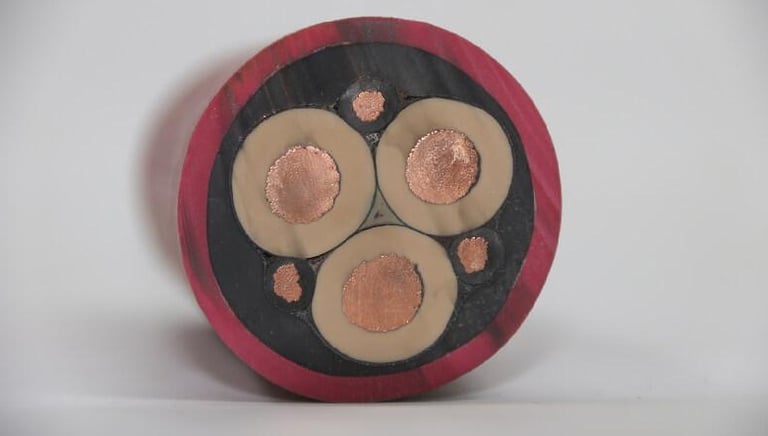
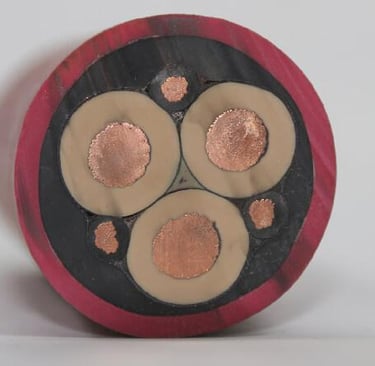
Copper Wire Screen: A high-density copper screen wrapped individually around each core assembly.
Earth Conductor: Integrated Class 5 tinned copper ground wires arranged in the internal spaces.
Outer Sheath: A halogen-free polyurethane protective jacket.
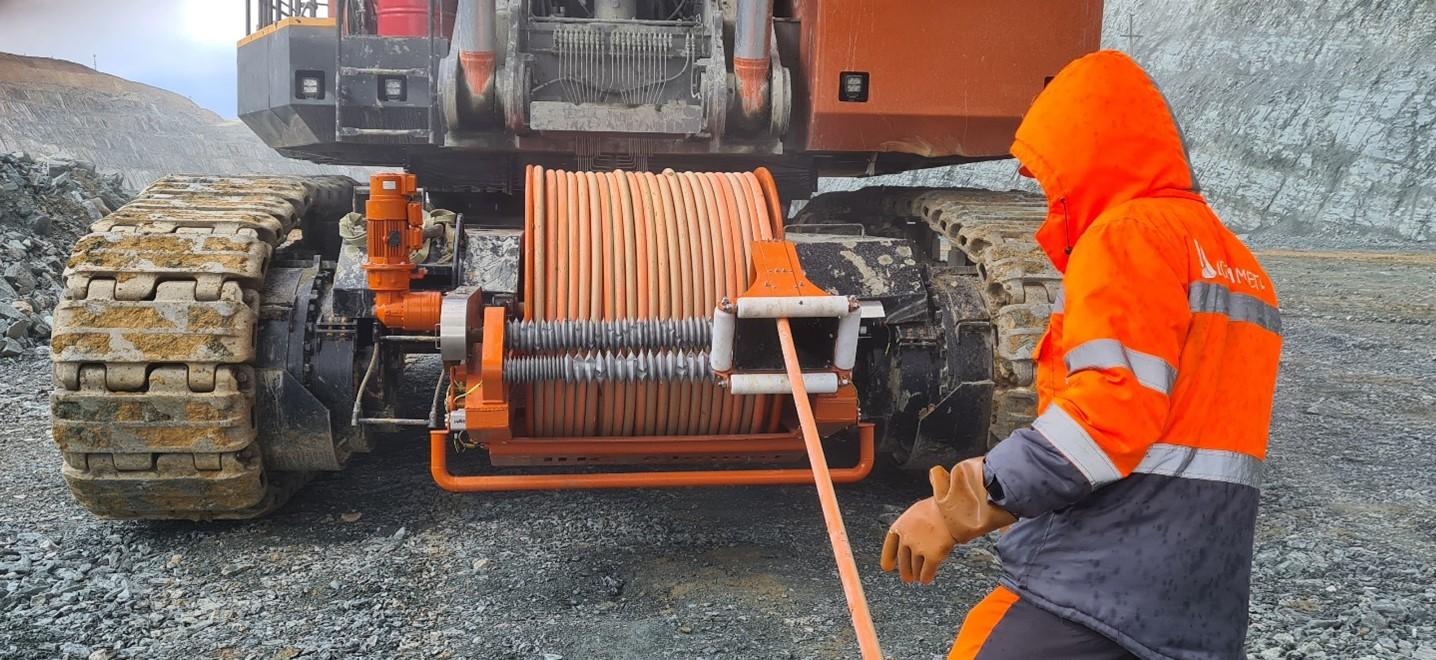
By screening each core independently, the cable achieves a perfectly uniform radial electric field around the conductor, eliminating localized electrical stress points in the rubber insulation. The high-density copper screen also provides a low-resistance path for fault currents back to the system's ground protections. If a sharp object punctures the cable, it hits the grounded copper screen first, tripping circuit breakers instantly to protect operators and prevent phase-to-phase short circuits. This phase-screen design also acts as an electromagnetic shield, containing electrical noise and improving overall electromagnetic compatibility (EMC) with nearby mining sensors and telemetry equipment.
7. Insulation and Sheath
The internal layers and jacket system of the Feichun NTSCGEWÖU cable are engineered to handle severe mechanical wear and harsh environmental elements.
Core Insulation: A specialized rubber compound provides high dielectric strength and thermal endurance. This elastomeric insulation handles high medium voltage field stresses while remaining flexible enough to bend without cracking.
Inner Sheath: Extruded from a high-grade, halogen-free polyurethane compound. This layer locks the internal components into place and provides a protective barrier against moisture and physical impacts.
Anti-Torsion Braid: A high-tensile polyester braid layered between the inner and outer sheaths. This structural braid acts as an anti-torsion system, absorbing rotational forces when the cable is pulled, reeled, or twisted behind mining equipment, which prevents internal corkscrewing.
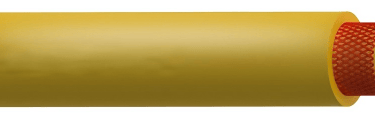
Outer Sheath: Made from a tough, yellow, halogen-free polyurethane compound. Polyurethane offers exceptional resistance to abrasion, tearing, and cutting compared to standard rubber or PVC jackets. It also meets halogen-free standards (IEC/EN 60754-1/2), ensuring that if the cable encounters extreme heat or fire, it will not release toxic halogen gases, protecting visibility and safety around the mine site.
8. Mechanical Performance
The technical limits of the Feichun NTSCGEWÖU cable demonstrate its suitability for demanding mobile operations:
Minimum Bending Radius (Fixed): 6 x overall diameter. In static setups, such as junctions or structural trays, the cable can take tight turns, saving space in compact equipment enclosures.
Minimum Bending Radius (Flexed): 10 x overall diameter. When used as a dynamic trailing line or on motorized reeling drums, the cable flexes safely at ten times its overall diameter, preventing mechanical stress on the inner insulation.
Ambient Temperature Range (Fixed): -50 deg C to +80 deg C. The cable maintains its structural integrity without cracking or shrinking in extreme freezing conditions or high surface heat.
Ambient Temperature Range (Flexed): -25 deg C to +80 deg C. During active movement and continuous trailing, the polyurethane jacket retains its elasticity down to -25 deg C.
Maximum Torsional Stress: Plus or minus 25 degrees per meter. This high tolerance allows the cable to twist up to 25 degrees along any single meter of length without damaging the internal copper screens or phase conductors.
These specifications are vital for mobile mining equipment that constantly tracks, swivels, and changes direction across rough surfaces. The combination of anti-torsion braiding, cold-weather flexibility, and high twisting tolerance keeps the cable functional during rapid machinery adjustments.
9. Applications
The technical design of the NTSCGEWÖU cable makes it an ideal fit for high-amperage, medium voltage mobile machinery operating in harsh environments:
Draglines: These massive excavation machines pull cables over long distances across blasted rock faces. The cable's high tensile strength and polyurethane jacket protect it from severe friction during trailing operations.
Electric Shovels: Operating at the pit face, electric shovels make repetitive forward and backward movements. The Class 5 fine-stranded conductors handle this continuous flexing without suffering material fatigue.
Excavators: Track-mounted excavators rotate their main chassis frequently, creating complex twisting forces on the power line. The integrated anti-torsion braid handles these rotational stresses safely.
Crushers: Heavy mobile crushing plants generate severe, high-frequency structural vibrations. The rubber insulation and polyurethane sheathing cushion the inner conductors from these persistent mechanical impacts.
Mobile Conveyors: As mining faces shift, mobile conveyor sections are repositioned across uneven pit floors. The NTSCGEWÖU cable provides a reliable medium voltage link that safely accommodates these frequent changes in layout.
10. Typical Mining Challenges
Using standard, non-shielded utility cables in a surface mining pit often leads to rapid cable failure and safety hazards. The NTSCGEWÖU shielded mining cable is engineered to directly solve these common mining challenges:
Continuous Vibration and Shock Waves
Heavy digging machinery generates continuous structural vibrations that travel straight down the power cable. In standard cables, this vibration causes the copper strands to work-harden and break. The Class 5 tinned copper construction in the NTSCGEWÖU cable absorbs this kinetic energy, preventing micro-fractures.
Ground Abrasion and Sharp Edges
Open-cast mining floors are filled with sharp granite shards, flint dust, and discarded metal fragments. Trailing cables are continuously dragged across these surfaces, exposing them to cuts and notches. The polyurethane sheathing resists notch propagation, stopping minor surface scratches from turning into large tears that expose the internal conductors.
Twisting and Complex Reeling Forces
Cables running on motorized drums often twist axially as equipment turns. Without built-in protection, this twisting forces the internal cores out of alignment, causing the cable to buckle. The NTSCGEWÖU cable uses a polyester anti-torsion braid to counter these rotational forces, keeping the internal architecture stable.
Medium Voltage Field Stress
Operating at voltages up to 20 kV requires careful electrical field management. Unshielded cables can experience dangerous surface corona discharges and localized insulation breakdown. The NTSCGEWÖU's dual semi-conductive layers and high-density copper wire screens contain the electrical field within each core, ensuring safe operation and protecting field personnel.
11. Current Carrying Capability
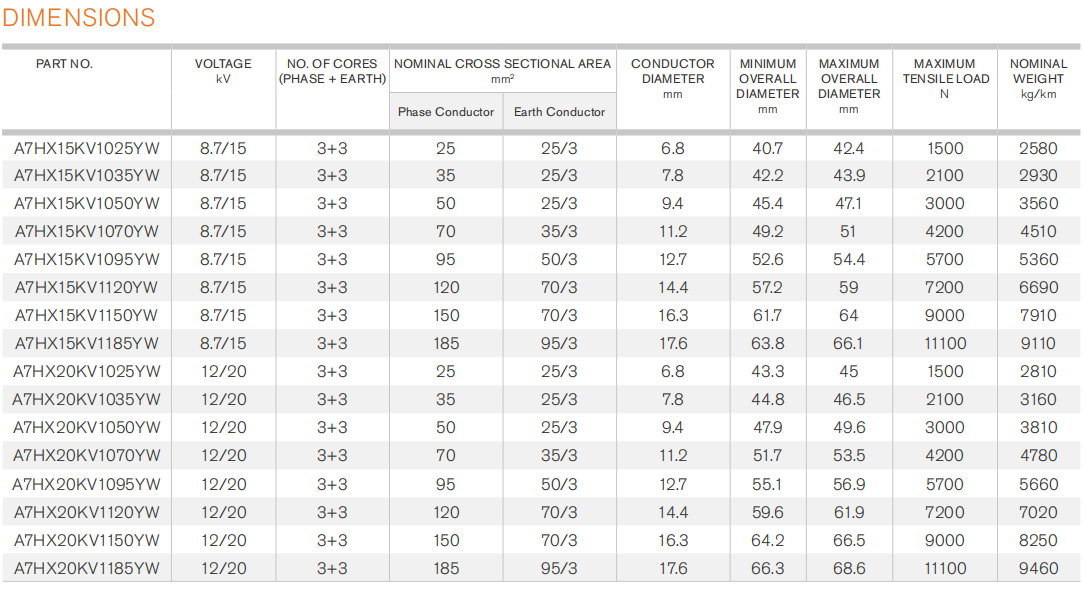
The Feichun NTSCGEWÖU datasheet provides detailed current-carrying capacities for cross-sections ranging from 25 mm2 up to 185 mm2. These ratings help project engineers select the correct conductor size based on load demands and installation styles.
A cable's ampacity changes significantly depending on how it is deployed:
Floor-Laying Conditions: When laid flat along a pit floor or open tray, the cable has excellent heat dissipation to the surrounding air. This allows the copper conductors to run at their maximum rated current capacity without overheating.
Reeled Conditions: When spooled onto a motorized cable drum, the cable is wrapped in multiple layers. This layering traps thermal energy within the inner wraps, significantly reducing the cable's current-carrying capacity.
Engineers must apply specific de-rating factors based on the number of layers on the drum to prevent heat buildup from damaging the rubber insulation. The datasheet provides these thermal de-rating factors across various ambient temperatures (from 10 deg C up to 80 deg C), allowing designers to accurately plan for peak summer operation without risking thermal failure.
12. Why Shielding Matters
The advanced shielding system is the main feature that separates the NTSCGEWÖU cable from basic low voltage power lines. In medium voltage operations (up to 20 kV), electrical fields cannot be left unmanaged.
The independent phase screening system provides three primary benefits:
Electrical Field Stabilization: By placing an inner semi-conductive layer, a rubber insulation compound, an outer semi-conductive layer, and a copper wire screen around each conductor, the electrical stress is distributed evenly. This eliminates high-voltage stress points, extending the life of the insulation.
Reliable Ground Fault Path: The copper wire screens form a low-resistance path back to the station's ground monitoring relays. If the cable is accidentally crushed or cut by heavy equipment, the fault current flows safely through the screen to trip safety breakers instantly, minimizing the risk of arc flashes or electrical shock.
Electromagnetic Noise Reduction: The high-density copper shields block electromagnetic interference (EMI) from escaping the high-power lines, protecting nearby automated mining controls, digital telemetry, and wireless communication networks from data corruption.
13. Middle East Relevance
The rugged design of the Feichun NTSCGEWÖU medium voltage mining cable makes it highly relevant for large-scale infrastructure and industrial expansions across the Middle East. The Gulf Cooperation Council (GCC) region is investing heavily in massive civil engineering initiatives, transport networks, and mining operations that require heavy-duty equipment and ultra-reliable power networks.
Supporting Mega-Infrastructure Operations
Ambitious projects like Saudi Arabia's NEOM involve extensive underground work, deep rock cutting, and massive material handling logistics. Similarly, major urban rail projects, such as the Riyadh and Dubai metro expansions, require large mobile excavation equipment, high-capacity rock crushers, and mobile conveyor networks to handle millions of tons of excavated material. These heavy machines operate on medium voltage lines and require trailing cables that can survive demanding physical handling.
Withstanding Extreme Environmental Heat
The Middle East presents severe climate challenges, with summer surface temperatures frequently exceeding 50 deg C. Cables laid out in open pits or desert environments must handle intense ambient heat alongside the thermal energy generated by high electrical current loads. The NTSCGEWÖU cable is built to handle these conditions, with an upper operating limit of +80 deg C and specific thermal de-rating guidelines. This enables engineering teams across the GCC to design reliable power delivery systems that keep critical excavation machinery moving safely, even in extreme desert heat.
14. Feichun Brand Positioning
As a premier manufacturer of high-performance industrial cables, Feichun focuses on advanced material science and application-led engineering. The NTSCGEWÖU medium voltage flexible mining cable highlights Feichun's commitment to delivering reliable power solutions for the world's toughest operational environments.
Feichun uses advanced manufacturing processes to ensure every layer of the NTSCGEWÖU cable—from the Class 5 tinned copper conductor strands to the specialized anti-torsion polyester braid and the halogen-free polyurethane jacket—is built to exact engineering tolerances. By prioritizing structural stability, chemical resistance, and electrical safety, Feichun provides heavy industries with durable, field-tested products that reduce downtime and maintain workplace safety in demanding open-cast mining and tunnel construction projects worldwide.
15. Technical Visual Overviews
To help visualize how these components connect in the field, the following block diagrams outline the system layout and the internal architecture of the cable:
[System Power Flow Diagram]
Substation Power Supply (8.7/15kV or 12/20kV Distribution Point)
↓
NTSCGEWÖU MV Shielded Mining Trailing Cable (Flexible Power Link)
↓
Mobile Mining Equipment (Dragline, Electric Shovel, or Heavy Drill)
↓
Continuous Extraction & Surface Mining Operation
[Phase-Screen Cross-Section Architecture]
[Conductor: Class 5 Flexible Tinned Copper Core]
↓
[Inner Semi-Conductive Tape Layer]
↓
[Core Insulation: High-Grade Rubber Compound]
↓
[Outer Semi-Conductive Rubber Layer]
↓
[Individual Phase Screen: High-Density Copper Wire Braid]
↓
[Internal Cavity: Class 5 Tinned Copper Earth Conductors]
↓
[Structural Layer: High-Tensile Polyester Anti-Torsion Braid]
↓
[Outer Jacket: Tough, Yellow, Halogen-Free Polyurethane Sheath]
16. Summary
The Feichun NTSCGEWÖU cable represents an advanced engineering solution for high-movement industrial machinery operating in challenging environments. By combining Class 5 flexible tinned copper strands with independent copper wire screens, a built-in anti-torsion braid, and a rugged, halogen-free polyurethane outer jacket, this cable delivers an ideal balance of electrical safety and mechanical durability. It stands out as an exceptionally tough, high-performance medium voltage mining cable built for mobile equipment, where reliable electrical shielding, high flexibility, and mechanical toughness must all be present in one single construction.
Port crane cables | Mining cables | Reeling cables | Trailing cables | Festoon cables | Heavy-duty power cables | Medium voltage cables | Offshore crane cables | Underground mining cables | Dragline cables | Shearer cables | Container handling cables | STS crane cables | RTG cables | Mobile equipment cables | Armored cables | Flexible power cables | VFD cables | Submersible cables | Cold resistant cables | Abrasion resistant cables | Flame retardant cables | Marine environment cables | Opencast mining | Underground operations
© 2006 All rights reserved.
[INDUSTRIAL_CABLES]
INDUSTRIAL GRADE CABLE SYSTEMS | PORT & MINING SOLUTIONS
TEL: +86 153 7530 2641 |MAIL: hongjing.Wang@feichuncables.com