Medium Voltage Flexible Power Supply Cable for Reeling Applications (N)TSCGEWOEU-SR PLUS
Discover the medium voltage, flexible power supply cable for reeling applications (N)TSCGEWOEU-SR PLUS, designed for high mechanical stress, harsh environments, and reliable power supply in crane and mining operations.
hongjing.Wang@Feichun
3/12/20269 min read
Introduction
When a stacker-reclaimer at a bulk material terminal travels hundreds of metres in a single automated cycle, or when a harbour crane performs thousands of reeling operations per shift, the cable that powers those machines is under relentless mechanical and electrical stress. Standard medium voltage cables — designed primarily for fixed installation — are simply not engineered to survive that environment. The (N)TSCGEWOEU-SR PLUS is. It is a medium voltage, flexible power supply cable developed specifically for reeling applications, built to conform to DIN VDE 0250-813 and designed around the real-world demands of continuous dynamic operation.
This article explains in detail why that distinction matters: how the cable is constructed, what materials are used and why, which crane types and motion profiles it is suited for, and how its engineering translates into measurable value over the lifetime of an installation.
1. Cable Construction: Every Layer Has a Purpose
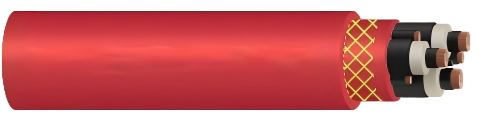
Understanding the (N)TSCGEWOEU-SR PLUS begins with its cross-section. The design is not a series of independent layers stacked on top of one another — it is an integrated mechanical and electrical system in which each element supports the others.
Main Conductors
The main power conductors are plain copper wires, finely stranded to class 5 in accordance with IEC 60228. Class 5 is the highest flexibility class defined in the standard. By using a much larger number of thinner individual wires rather than fewer, thicker ones, the conductor can bend and re-straighten repeatedly without work-hardening or wire fatigue. This is the foundation of the cable's flexibility — and flexibility, in a reeling cable, is not a comfort feature. It is a structural requirement that directly determines service life.
Insulation System — Three Distinct Layers
Each main core carries a three-layer insulation system. The innermost layer is a semi-conductive stress control compound. Its role is to eliminate air voids and micro-gaps between the conductor surface and the EPR insulation above it. In medium voltage systems, any discontinuity at that interface becomes a site of partial discharge — an electrochemical erosion process that silently degrades insulation from the inside. By conforming intimately to the conductor surface, the inner semi-conductive layer removes those initiation sites entirely.
The central insulation layer is EPR — ethylene propylene rubber — compounded to an improved grade as defined by DIN VDE 0207-20. EPR is chosen for reeling applications over XLPE for a specific reason: it maintains its flexibility at low temperatures far better than crosslinked polyethylene. In open-pit mines and harbour operations in cold climates, where the cable may be exposed to temperatures as low as -35°C during reeling or -50°C during fixed storage, EPR retains its mechanical properties and does not become brittle. Beyond thermal performance, EPR also exhibits excellent resistance to ozone, moisture, and UV radiation — all of which are present in open outdoor industrial environments.
The outermost insulation layer is again a semi-conductive compound, this time functioning as an insulation shield. It provides a defined, uniform equipotential surface around each core, which is essential for reliable electric field control in medium voltage cables operating up to 30 kV. Without this layer, the electric field gradient at the core surface would be irregular and difficult to manage, especially under the mechanical deformation that occurs during reeling.
Ground Conductor
The ground conductor is also made from finely stranded class 5 copper wires, and it too carries a semi-conductive layer. Critically, the ground conductor cross-section is split into three equal parts, placed symmetrically in the outer interstices between the three main cores. This arrangement is not arbitrary — it gives the cable a rotationally symmetrical cross-section, distributing ground fault current equally around the cable's circumference and ensuring that no single point in the structure bears a disproportionate mechanical load during bending or twisting.
Inner Sheath and Anti-Twist Reinforcement
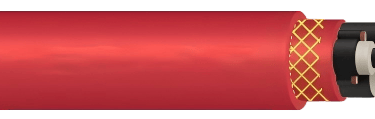
The inner sheath is an extra heavy duty rubber compound to quality grade 5GM5 per DIN VDE 0207-21. It fills the interstices between the cores and the outer structure, creating a unified, solid cross-section that resists collapse under tension and supports the cores evenly during bending cycles. The red colour serves as a clear visual identifier for medium voltage applications.
Between the inner and outer sheaths lies a braid of synthetic threads that performs a single but critical function: anti-twist protection. In reeling systems where the reel axis is not perfectly aligned with the direction of cable travel — or where the cable undergoes S-type directional changes — torsional forces are introduced into the cable. If those forces are allowed to accumulate, they cause the cable to rotate axially, which can lead to core migration, insulation damage, and premature failure. The synthetic braid resists that rotation. Crucially, the inner and outer sheaths are bonded inseparably around this braid, meaning the reinforcement cannot migrate or delaminate over time. The braid does its job for the life of the cable.
Outer Sheath
The outer sheath matches the inner sheath in material quality — extra heavy duty rubber compound, 5GM5, red, with inkjet marking. The double heavy-duty rubber system is specifically selected for reeling cables because the outer sheath must simultaneously resist abrasion from guidance systems and cable drums, withstand oil and chemical contamination common in industrial environments, maintain flexibility at low temperatures, and recover its shape after repeated bending without surface cracking. Conventional thermoplastic sheaths cannot reliably meet all of those requirements together. Heavy-duty rubber can.
2. Materials and Performance Advantages
The material selections described above are not default choices — they represent deliberate engineering decisions driven by the specific failure modes of reeling cables.
EPR insulation, as noted, retains flexibility at temperatures well below zero. But it also has a substantially higher resistance to partial discharge erosion than many alternative compounds. In a medium voltage cable subject to constant mechanical movement, micro-deformations at the insulation layer are inevitable. EPR's molecular structure is more forgiving of those deformations than harder, more crystalline polymers.
The 5GM5 rubber sheath compound is formulated for exceptional elongation at break and high resistance to mechanical impact. When a cable passes over the edge of a cable drum or through a guidance roller under tension, the outer surface experiences a concentrated contact stress. A sheath that lacks sufficient elongation reserve will crack at those contact points. 5GM5 is specified precisely because it has the mechanical reserves to absorb those stresses repeatedly without permanent damage.
Oil resistance per EN/IEC 60811-404 means the sheath compound has been tested against immersion in standard reference oils and shown to retain its mechanical properties within defined limits. In harbour terminals and mining operations, diesel fuel, hydraulic fluid, and lubricating grease are routine contaminants. A cable sheath that swells or softens in contact with those substances will rapidly lose its protective function.
The cable's weather resistance is not limited to a service life rating — it permits unrestricted outdoor use without additional protection, because the EPR insulation and rubber sheath are inherently resistant to UV radiation, ozone, and moisture absorption. That eliminates the need for conduit or weatherproofing systems in most outdoor installations, simplifying installation and reducing total system cost.
3. Applicable Crane Types and Motion Profiles
The (N)TSCGEWOEU-SR PLUS is designed to serve a specific category of application: large mobile machinery that requires a continuous, flexible medium voltage power supply while executing repetitive travel cycles over long distances.
In harbour and shipyard environments, ship-to-shore container cranes, rubber-tyred gantry cranes, rail-mounted gantry cranes, and bulk handling bridge cranes all fit this profile. These machines travel repeatedly along fixed paths, paying out and recovering cable from a reel as they move. The cable must survive not only the bending cycles at the drum but also the tension loading that occurs when the machine accelerates, and the torsional stress that occurs when the reel axis is not perfectly parallel to the direction of travel.
In open-pit mining, cable shovels, bucket wheel excavators, and large draglines represent the extreme end of the reeling cable application spectrum. These machines are among the heaviest mobile equipment in existence. They operate continuously, often around the clock, in environments with abrasive dust, temperature extremes, and concentrated mechanical loads on the cable system. The cable may be subject to tensile loads approaching the rated maximum of 20 N/mm² on the conductor cross-section during machine start-up and acceleration.
Stacker-reclaimers in bulk material stockyards operate in a different motion profile — typically slower travel speeds but very high cycle counts over the machine's working life. The cable reeling system must accommodate not only linear travel but also the slewing motion of the machine boom, which introduces compound bending and torsional loads simultaneously.
For all of these applications, the rated reeling speed of up to 240 m/min defines the upper boundary of the dynamic operating envelope. The torsional stress specification of ±25°/m covers the twisting loads imposed by non-ideal cable guidance systems, and the minimum S-type directional change distance of 20 times the outer diameter provides the geometric constraint for guidance system design.
4. Comparison with Standard Medium Voltage Cable
To appreciate what the (N)TSCGEWOEU-SR PLUS delivers, it is useful to compare it directly with a conventional medium voltage cable designed for fixed or lightly flexible installation.
A standard medium voltage cable — for example, a XLPE-insulated, PVC-sheathed construction to IEC 60502 — is optimised for electrical performance and current-carrying capacity in a static or semi-static installation. Its conductor stranding may be class 2 (stranded but not fine-stranded), its insulation will be stiffer at low temperatures, and its outer sheath may have adequate resistance to occasional mechanical contact but not to the continuous mechanical loading of a reeling system. It will typically carry no anti-twist reinforcement, because torsional forces are not anticipated in its design basis.
Applying such a cable to a reeling application will produce predictable results: conductor wire fatigue and breakage beginning at the first bending points, sheath cracking at drum contact surfaces within months, and potential insulation damage at the semi-conductive interfaces due to mechanical deformation of the cross-section under tension. The electrical system may continue to function for a period — voltage withstand tests may still be passed — but the cable is degrading invisibly on every cycle.
The (N)TSCGEWOEU-SR PLUS addresses each of these failure modes directly. Class 5 stranding eliminates conductor fatigue at the design bending radius. The EPR/5GM5 material system maintains its mechanical properties under the combined thermal, chemical, and mechanical loads of the application. The anti-twist reinforcement prevents the insidious torsional damage that standard cables have no mechanism to resist. And the three-layer insulation system ensures that electrical field control is maintained even as the cable deforms mechanically during operation.
The result is not merely that the (N)TSCGEWOEU-SR PLUS lasts longer — it is that it fails in fundamentally different and more predictable ways, allowing maintenance planning based on cycle counts and inspection rather than emergency response to unexpected outages.
5. Engineering Value: Lifespan, Reliability, and Safety
From an engineering economics perspective, a medium voltage reeling cable is not a consumable — or rather, it should not be treated as one. Cable replacement on a large crane or mining machine is a significant maintenance event. It requires the machine to be taken out of service, often for multiple shifts. It requires specialised personnel and equipment for cable handling, termination, and testing. And it introduces risk: an improperly terminated medium voltage cable is a serious electrical safety hazard.
The (N)TSCGEWOEU-SR PLUS is designed to maximise the interval between those events. Every design choice — from the class 5 conductors to the anti-twist braid to the double heavy-duty rubber sheath — extends service life by addressing a specific degradation mechanism.
On the safety dimension, the semi-conductive field control layers are not simply good electrical practice — they are a safety-critical design element. A medium voltage cable without proper field control can develop partial discharge activity that progressively destroys the insulation from within, with no external visible symptom, until the insulation fails catastrophically. The inner and outer semi-conductive layers ensure that the electric field is distributed uniformly around each core at all times, including when the core is deformed under bending load. This is a non-negotiable requirement for personnel safety in an environment where the cable is accessible and frequently inspected.
Fire behaviour conformance to DIN EN/IEC 60332-1-2 ensures that the cable does not propagate flame along its length in the event of a localised fire event. In the enclosed cable galleries of harbour cranes or the confined spaces around reeling systems in underground applications, this characteristic is essential for limiting fire spread.
The cable is also compliant with the RoHS Directive 2015/863/EU, confirming that it is free from restricted hazardous substances, and with the Construction Products Regulation CPR 305/2011. These compliance markers matter not only for environmental responsibility but also for regulatory approval in markets where such certification is required for installation permits.
The rated voltage range covers six standard levels from 3.6/6 kV through 18/30 kV, and the cross-section range from 3×25+3×25/3 mm² to 3×240+3×120/3 mm² means that a single product family can serve the full spectrum of machine sizes from medium-capacity harbour cranes through to the largest mining excavators. The availability of multiple rated voltage versions within a single design family simplifies procurement, spares holding, and engineering documentation for operators managing diverse fleets.
For applications with higher tensile loads than those covered by the standard range, or with non-standard core configurations, alternative designs are available on request — a recognition that reeling cable applications are rarely entirely standard, and that the engineering solution must ultimately conform to the application, not the other way around.
Conclusion
The (N)TSCGEWOEU-SR PLUS is the product of a clear engineering philosophy: that a medium voltage cable for reeling applications must be designed from first principles around the actual mechanical, thermal, and electrical loads it will experience in service, rather than adapted from a static cable design with incremental modifications. Its three-layer insulation system, class 5 copper conductors, anti-twist reinforcement, and double heavy-duty rubber sheath are not add-ons — they are integral to a design that has been engineered to deliver reliable medium voltage power supply through hundreds of thousands of reeling cycles, in some of the harshest industrial environments in the world.
For engineers specifying cable systems for new crane installations or replacement programmes, the selection of a purpose-designed reeling cable over a general-purpose medium voltage alternative is not a matter of preference. It is a matter of understanding the failure modes, quantifying the maintenance cost of premature replacement, and recognising that the most expensive cable is the one that fails in service.
Technical specifications referenced in this article are based on DIN VDE 0250-813, IEC 60228, DIN VDE 0207-20, DIN VDE 0207-21, DIN VDE 0298-3, DIN VDE 0298-4, EN/IEC 60811-404, and DIN EN/IEC 60332-1-2. For project-specific dimensioning and selection, consult current product documentation and technical support.
Port crane cables | Mining cables | Reeling cables | Trailing cables | Festoon cables | Heavy-duty power cables | Medium voltage cables | Offshore crane cables | Underground mining cables | Dragline cables | Shearer cables | Container handling cables | STS crane cables | RTG cables | Mobile equipment cables | Armored cables | Flexible power cables | VFD cables | Submersible cables | Cold resistant cables | Abrasion resistant cables | Flame retardant cables | Marine environment cables | Opencast mining | Underground operations
© 2006 All rights reserved.
[INDUSTRIAL_CABLES]
INDUSTRIAL GRADE CABLE SYSTEMS | PORT & MINING SOLUTIONS
TEL: +86 153 7530 2641 |MAIL: hongjing.Wang@feichuncables.com