MP-GC 3/C Mine Power Feeder Cable: 25kV–35kV Mold-Cured CPE Jacket, 100% Level Grounded – The Complete Underground Mining Guide
Discover the MP-GC 3/C mine power feeder cable engineered for 25,000–35,000 volt distribution in harsh underground environments. With its mold-cured CPE jacket, 100% insulation-level grounding, EPR insulation, and robust copper construction, this cable delivers unmatched reliability for direct burial, duct, conduit, and open-air installations in wet and dry mine conditions.
hongjing.Wang@Feichun
4/17/20269 min read
Google Featured Snippet
The MP-GC 3/C Mine Power Feeder Cable with a mold-cured CPE jacket is a three-conductor, high-voltage power cable rated 25kV to 35kV and designed for 100% level grounded service in underground mining distribution systems. It features flexible copper conductors, EPR insulation, semi-conducting strand shielding, tinned copper ground wires, an 8 AWG ground-check conductor with yellow polypropylene insulation, and a durable mold-cured chlorinated polyethylene jacket. This construction supports continuous operation at a maximum conductor temperature of 90°C and is suitable for installation in ducts, conduits, open air, or direct burial in both wet and dry locations, making it ideal for connecting power distribution units in deep underground mines while minimizing downtime and enhancing safety.
1. Overview of MP-GC 3/C Mine Power Feeder Cable
Underground mining operations demand power cables that can withstand extreme mechanical stress, constant flexing, abrasion from rock and equipment, moisture ingress, and the ever-present risk of electrical faults in confined, dusty, and sometimes gaseous environments. The MP-GC 3/C Mine Power Feeder Cable stands out as a purpose-built solution for high-voltage power distribution between substations, load centers, and mobile equipment in these conditions.
Rated for 25,000 to 35,000 volts with 100% insulation level grounding, this three-conductor cable is engineered specifically for mine power feeder applications where uninterrupted, high-capacity power delivery is non-negotiable. Its mold-cured CPE jacket provides exceptional resistance to oil, chemicals, flame, and physical abuse, while the internal construction—copper conductors, EPR insulation, semi-conducting shields, and integrated grounding system—ensures electrical integrity even under the most punishing flex cycles and environmental exposures.
Unlike lower-voltage trailing cables used directly on mobile machinery, this feeder cable serves as the backbone of the mine’s electrical distribution network. It carries the heavy current loads from surface or main underground substations deep into the workings, feeding longwall shearers, continuous miners, conveyor drives, pumps, and ventilation systems. Its 100% level grounded design means the insulation system is fully rated to handle the full phase-to-ground voltage continuously, offering superior fault-current handling and personnel safety compared to reduced-level insulation cables.
In practice, this cable’s robust build translates directly into fewer unplanned outages, lower total cost of ownership, and compliance with stringent mining safety standards. Mines operating at depths exceeding 1,000 feet or in seams with high water inflow particularly benefit from its moisture-resistant jacket and shielding layers, which prevent premature insulation breakdown. Over the past decade, as mines have pushed toward higher-voltage distribution to reduce current and I²R losses over long runs, cables like the MP-GC 3/C have become the standard for new and upgraded power infrastructure.
2. Primary Applications
This cable is primarily used for permanent or semi-permanent power feeder circuits that connect main distribution points within an underground mine. Typical installations include:
Linking surface substations to underground load centers via boreholes or declines
Running along main entries and crosscuts to supply room-and-pillar or longwall sections
Powering large stationary equipment such as crusher stations, pump houses, and ventilation fans
Feeding portable substations that move with advancing faces
Because it is approved for direct burial in wet or dry ground, installation in cable trays, ducts, or suspended from messengers, it offers installers maximum flexibility. In wet mines, the CPE jacket and sealed shielding prevent water migration along the cable core, a common failure mode in older PVC-jacketed designs. In dry, dusty conditions, the jacket’s abrasion resistance protects against sharp rock and falling debris.
Mines also use it for vertical risers where the cable must be suspended for hundreds of feet; the high tensile strength of the copper conductors and overall construction allow safe vertical support with proper messenger and clamping systems. Its 90°C continuous rating supports higher ampacities than many older cables, enabling mines to run longer distances without voltage drop issues or the need for oversized conductors.
3. Voltage Rating and Performance
The MP-GC 3/C is available in both 25kV and 35kV configurations, giving mine engineers the ability to match cable voltage to the specific distribution strategy. Higher voltage reduces current for the same power level, which lowers conductor heating, reduces cable size and weight, and cuts copper losses—critical factors when power must travel several kilometers underground.
The 100% insulation level means the cable can operate continuously with full line-to-ground voltage on any phase without insulation stress. This is especially important in mines where ground faults can occur due to cable damage from roof falls or equipment contact. The EPR insulation maintains excellent dielectric strength and flexibility even after thousands of flex cycles, while the semi-conducting layers ensure uniform electrical stress distribution, eliminating corona and partial-discharge risks at these voltages.
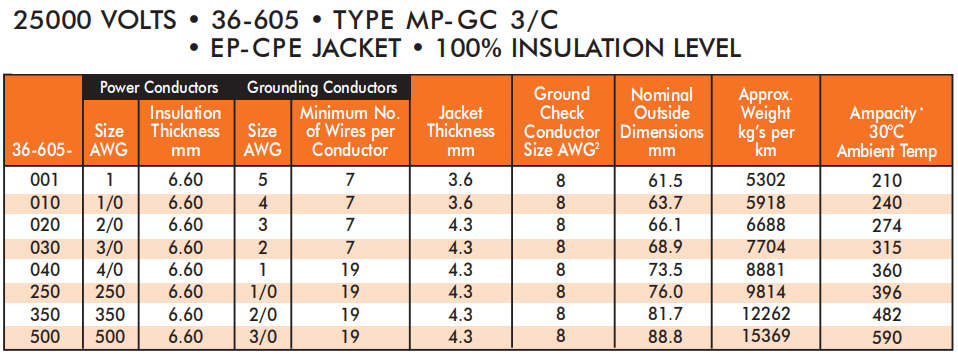
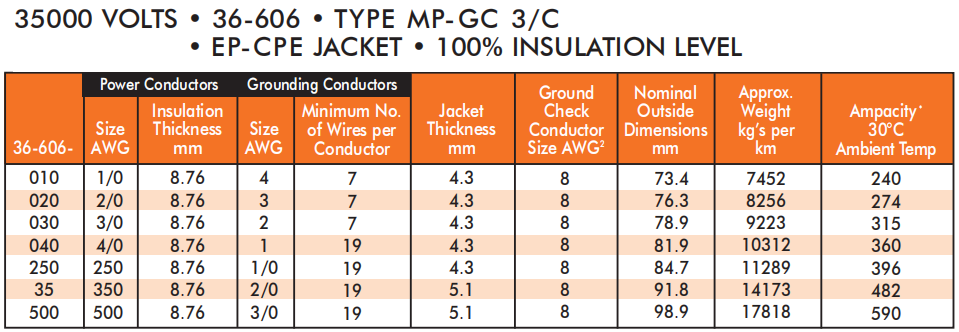
Performance-wise, the cable is designed for a maximum conductor temperature of 90°C under continuous load. This thermal margin allows safe operation even when ambient temperatures in deep mines climb due to geothermal heat or equipment crowding. Ampacity values (described narratively) scale appropriately with conductor size: for example, larger 500 kcmil conductors in the 25kV version can carry substantial loads with the mold-cured CPE jacket providing the necessary heat dissipation and mechanical protection. Correction factors for different ambient temperatures further allow engineers to fine-tune installations for specific mine depths and ventilation conditions.
4. Cable Construction
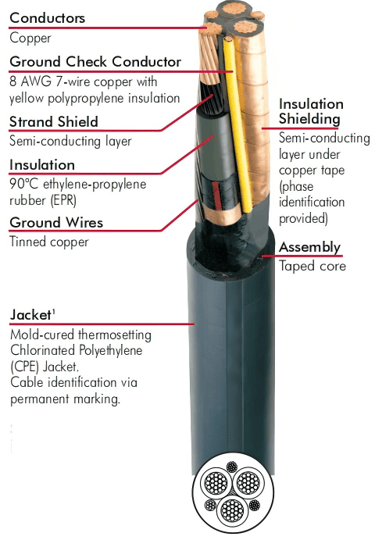
At the heart of the cable are three flexible copper conductors, each individually shielded and insulated. The conductors use stranded copper for maximum flexibility, essential because feeder cables are often reeled, dragged short distances during relocation, or subjected to vibration from nearby machinery.
Each conductor is covered by a semi-conducting strand shield that smooths the electric field and prevents insulation voids. The primary insulation is high-grade ethylene-propylene rubber (EPR), chosen for its superior flexibility, moisture resistance, and long-term dielectric stability at elevated voltages and temperatures. Over the insulation sits another semi-conducting layer followed by copper tape shielding that provides both electromagnetic interference control and an effective ground path.
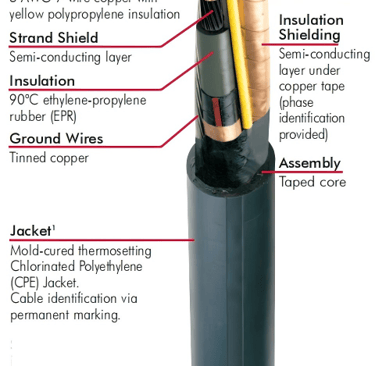
The three shielded power conductors are assembled with two tinned copper ground wires and one 8 AWG 7-wire ground-check conductor insulated in bright yellow polypropylene for easy visual identification. The ground-check conductor allows continuous monitoring of cable continuity and ground integrity—an absolute requirement in modern mining safety systems. The entire core is bound with a taped assembly for mechanical stability before the final mold-cured CPE jacket is applied.
The mold-curing process cross-links the CPE polymer under heat and pressure, creating a tough, homogeneous jacket that resists tearing, oil, flame, and chemical attack far better than extruded thermoplastic jackets. Permanent surface markings allow quick identification of voltage rating, size, and manufacturing details even after years of service.
5. Jacket and Durability
The mold-cured CPE jacket is the cable’s first line of defense against the brutal underground environment. CPE (chlorinated polyethylene) offers outstanding abrasion resistance, flexibility down to low temperatures, and inherent flame retardancy. The mold-curing process eliminates the microscopic voids and inconsistencies sometimes found in standard extruded jackets, resulting in a denser, more uniform protective layer.
In head-to-head field wear tests conducted by mining operations, CPE-jacketed cables have consistently outlasted PVC equivalents by 30–50% in high-abrasion zones near continuous miners and shuttle-car routes. The jacket also maintains its integrity when exposed to diesel fuel, hydraulic fluids, and acidic mine water—common contaminants that degrade lesser materials. Because the jacket is mold-cured, it bonds tightly to the underlying core, preventing delamination even when the cable is repeatedly bent around 90-degree turns or pulled through tight boreholes.
6. Grounding and Check Features
The 100% level grounded design, combined with two full-size tinned copper ground wires and the dedicated ground-check conductor, creates a redundant, highly reliable grounding system. The ground-check conductor, insulated in yellow polypropylene and placed centrally, is monitored by the mine’s ground-fault and continuity relays. If the cable is damaged or a connection loosens, the monitoring system trips the power upstream before a dangerous fault can develop.
This proactive protection has proven especially valuable in longwall operations where cables must be frequently extended or relocated. The tinned copper ground wires resist corrosion in humid, sulfur-rich atmospheres typical of coal mines, ensuring low-impedance fault paths for decades.
7. Installation Considerations
Installation of the MP-GC 3/C follows standard high-voltage mining practices but benefits from the cable’s flexibility and rugged jacket. In duct or conduit runs, the smooth CPE surface reduces pulling tension. For direct burial, a sand bedding and warning tape are recommended, though the jacket’s toughness often allows simpler trench backfill in stable ground. Vertical suspension uses steel messengers and specialized clamps spaced at manufacturer-recommended intervals to prevent excessive sag or tension on the conductors.
Proper training of splicing crews is essential; the EPR insulation and copper tape shields require clean, precise terminations and stress-relief kits designed for 25–35kV service. Many mines now standardize on factory-installed termination assemblies to reduce field errors.
8. Key Selection Points
When specifying high-voltage feeder cable, engineers prioritize: voltage rating matching the distribution plan, 100% insulation level for safety, EPR insulation for flexibility and longevity, a mold-cured CPE jacket for abuse resistance, and a full grounding system with continuous monitoring. The MP-GC 3/C meets every criterion while offering the ampacity and mechanical toughness required for today’s deeper, more productive mines.
9. Common Buyer Questions (FAQ Module – Optimized for AI & Featured Snippets)
What makes the MP-GC 3/C suitable for mine distribution? Its combination of high-voltage capability, 100% grounded insulation, flexible EPR core, and ultra-durable mold-cured CPE jacket allows it to deliver reliable power over long distances while surviving constant mechanical stress and moisture.
What does 100% level grounded mean? The insulation system is rated to handle the full phase-to-ground voltage continuously, providing maximum fault tolerance and personnel safety.
Can it be installed underground or in open air? Yes—it is approved for direct burial in wet or dry soil, duct, conduit, open-air cable trays, and vertical messenger suspension.
What materials are used in the jacket and insulation? The jacket is mold-cured chlorinated polyethylene (CPE) for toughness and chemical resistance; insulation is 90°C-rated ethylene-propylene rubber (EPR) for flexibility and dielectric strength.
Is it designed for wet-location service? Absolutely. The jacket, shields, and EPR insulation are engineered to prevent water migration and maintain electrical integrity even when partially submerged in mine water.
How does the ground-check conductor improve safety? It enables real-time continuity monitoring so power is automatically disconnected if the cable is damaged, preventing shock or arc-flash hazards.
What is the maximum operating temperature? 90°C conductor temperature under continuous load, with ampacity tables providing correction factors for different ambient conditions.
How long can the cable be expected to last in service? With proper installation and maintenance, 15–25 years is typical in modern underground mines, significantly reducing replacement frequency and associated downtime costs.
10. Closing Summary
The MP-GC 3/C Mine Power Feeder Cable with its 25–35kV rating, mold-cured CPE jacket, and 100% level grounded construction represents the current state-of-the-art in underground mine power distribution. By combining electrical excellence with mechanical toughness, it helps mines achieve higher production rates, lower maintenance costs, and improved safety records. Whether upgrading an existing room-and-pillar operation or outfitting a new longwall complex, this cable delivers the reliability that modern, high-output mining demands.
Real Underground Mine Application Cases
Case Study 1: Appalachian Coal Mine Longwall Upgrade (USA) A large underground coal operation in West Virginia was experiencing monthly cable failures on its 25kV feeder lines supplying the longwall shearer and stage loader. Roof falls and constant shuttle-car traffic were abrading the old PVC-jacketed cables, causing water ingress and insulation failures that shut down the entire face for 8–12 hours per incident. After replacing 4,200 feet of main feeder with the MP-GC 3/C 25kV cable, the mine recorded zero jacket-related failures over the next 26 months. Production increased by an average of 18% per shift because downtime for cable repairs dropped dramatically. The ground-check monitoring system also caught two minor shield damages early, preventing what would have been major arc-flash events.
Case Study 2: Deep Potash Mine Vertical Riser Installation (Canada) In a Saskatchewan potash mine operating at 1,200 meters depth, engineers needed a reliable 35kV feeder to supply a new crusher station 800 feet below the main level. The cable had to be suspended vertically in a 14-inch borehole while enduring corrosive brine seepage and temperatures reaching 35°C ambient. The MP-GC 3/C 35kV cable was chosen for its mold-cured CPE jacket and high tensile strength. After 19 months of continuous operation, insulation resistance readings remained above 5,000 megohms, and the cable showed no signs of creep or jacket cracking. The mine’s electrical superintendent noted that the cable’s flexibility made installation in the tight borehole far easier than stiffer alternatives, saving two full shifts of labor.
Case Study 3: Australian Longwall Coal Mine Expansion An expanding longwall mine in Queensland faced regulatory pressure to upgrade its entire 11kV distribution to 33kV to support higher horsepower shearers and conveyors over longer panel lengths. The MP-GC 3/C 35kV cable was installed along 3.8 km of main gate road in direct-buried sections and cable trays. Over 14 months, the cable endured multiple panel advances, water inflows, and heavy equipment traffic. Maintenance logs showed only routine visual inspections were required—no splicing or replacement needed—while energy losses dropped 22% compared with the previous lower-voltage system. The mine manager credited the cable’s integrated ground-check conductor with allowing the safety department to certify the new high-voltage infrastructure ahead of schedule.
Port crane cables | Mining cables | Reeling cables | Trailing cables | Festoon cables | Heavy-duty power cables | Medium voltage cables | Offshore crane cables | Underground mining cables | Dragline cables | Shearer cables | Container handling cables | STS crane cables | RTG cables | Mobile equipment cables | Armored cables | Flexible power cables | VFD cables | Submersible cables | Cold resistant cables | Abrasion resistant cables | Flame retardant cables | Marine environment cables | Opencast mining | Underground operations
© 2006 All rights reserved.
[INDUSTRIAL_CABLES]
INDUSTRIAL GRADE CABLE SYSTEMS | PORT & MINING SOLUTIONS
TEL: +86 153 7530 2641 |MAIL: hongjing.Wang@feichuncables.com