(N)3GHSSHCH Rubber Insulated Halogen-Free Feeder Cable: The Complete Guide for Mining and Tunneling Applications
Explore the full technical guide to (N)3GHSSHCH rubber insulated, halogen-free feeder cable — specifications, construction, fire safety, real-world mining applications, and installation best practices for 6/10 kV to 12/20 kV systems.
hongjing.Wang@Feichun
3/31/202613 min read

What Is the (N)3GHSSHCH Cable?
The (N)3GHSSHCH is a rubber insulated, halogen-free sheathed medium voltage feeder cable engineered specifically for demanding underground environments. Designed to serve mining workings, tunneling projects, and heavy industrial applications, this cable combines high mechanical flexibility with superior fire safety performance — two qualities that are rarely easy to achieve together in the same product.
Operating at rated voltages of 6/10 kV, 8.7/15 kV, and 12/20 kV, the (N)3GHSSHCH is built to deliver stable, uninterrupted power in conditions where standard PVC-sheathed cables fall short: corrosive atmospheres, confined underground spaces, extreme temperature fluctuations, and environments where a cable fire could be catastrophic.
In modern mining electrification strategies, the choice of feeder cable is not merely a technical decision — it is a safety-critical one. The (N)3GHSSHCH reflects that reality in every layer of its construction.
Featured Snippet — What does (N)3GHSSHCH cable mean? The (N)3GHSSHCH is a rubber insulated, halogen-free medium voltage feeder cable rated for 6/10 kV to 12/20 kV systems. It features EPR insulation, finely stranded Class 5 copper conductors, a galvanized steel wire braid armour, and a halogen-free outer sheath (HM4 compound). It is designed for stationary and non-stationary use in mining tunnels, on gratings, planks, and cable trays, and is compliant with CPR 305/2011 and RoHS 2015/863/EU standards. Its halogen-free, low-smoke construction reduces toxic gas emission during fire events, making it critical for safe underground evacuation.
Key Technical Specifications of (N)3GHSSHCH Cable
Electrical Performance
The (N)3GHSSHCH supports three rated voltage levels to match a broad range of mining power distribution architectures:
6/10 kV — max AC operating voltage 6.9/12 kV; max DC operating voltage 9/18 kV
8.7/15 kV — max AC operating voltage 10.4/18 kV; max DC operating voltage 13.5/27 kV
12/20 kV — max AC operating voltage 13.9/24 kV; max DC operating voltage 18/36 kV
The maximum continuous conductor temperature is 90 °C, ensuring reliable performance even under sustained heavy loads. In the event of a fault, the cable withstands short-circuit temperatures up to 250 °C at the conductor — a critical safety margin in mine power systems where fault currents can be significant.
General electrical testing is conducted in accordance with DIN VDE 0250-1, DIN VDE 0250-813, and DIN VDE 0250-605. Current-carrying capacity and de-rating factors are specified per DIN VDE 0298-4.
Mechanical Properties
The cable's mechanical design directly addresses the physical realities of underground deployment:
Maximum tensile load per conductor: 15 N/mm²
Bending radius for fixed installation: 6 × outer diameter (D)
Bending radius for flexible operation: 10 × D
Minimum distance for S-type directional changes: 20 × D
These figures reflect a balance between the cable's structural robustness and the routing demands of irregular tunnel profiles, where cables must navigate corners, transitions, and mechanical stress points without degrading the insulation or conductors.
Thermal and Environmental Range
Fixed installation surface temperature: −40 °C to +80 °C
Flexible operation surface temperature: −5 °C to +80 °C
This range accommodates both the frigid conditions found in deep alpine tunnels and the elevated ambient temperatures of tropical or deep underground mines. The cable is rated for unrestricted use indoors and in mine environments, with full weather resistance confirmed by the manufacturer.
Cable Construction and Material Design
The (N)3GHSSHCH achieves its performance through a multi-layer construction where each component is precisely specified.
Conductor and Core Structure
The main power conductors are plain copper wires, finely stranded to Class 5 per IEC 60228. Class 5 stranding means a higher number of finer individual wires per conductor — this is what gives the cable its characteristic flexibility and resistance to conductor fatigue under repeated bending cycles. For installations that require semi-dynamic movement, such as cables routed along conveyor systems or equipment that shifts between operating positions, this stranding class is essential.
Pilot (control) cores share the same Class 5 stranding and are insulated with a special EPR compound. The three screened main cores are laid up together with control cores filling the interstices, creating a compact and mechanically stable cross-section.
The protective conductor is symmetrically split and distributed over the insulation of the three power cores — a design that ensures consistent earth fault protection regardless of the bending state of the cable.
Insulation System
The main core insulation is a three-layer system:
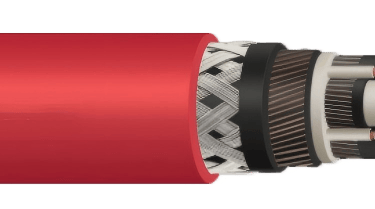
An inner semi-conductive stress control layer smooths out electrical field concentrations at the conductor surface, extending insulation life under medium voltage stress. The central layer is an EPR (Ethylene Propylene Rubber) compound — lead-free, with improved electrical and mechanical characteristics per DIN VDE 0207-20. EPR is specifically valued in mining cable applications for its resistance to moisture, oxidation, and thermal aging, which makes it more durable than XLPE in many underground conditions. An outer semi-conductive insulation shield layer provides the complementary function at the insulation-to-earth boundary.
Sheath and Protection System
Moving outward from the insulated cores, the cable's protection builds in layers:
Inner sheath 1 is a special halogen-free compound (HM4, per DIN VDE 0207-24), providing the first mechanical and chemical barrier around the stranded assembly. Over this sits the ÜL concentrical monitoring conductor — a plain copper wire layer with DC resistance ≤ 3.30 Ω/km at 20 °C, designed to enable continuous insulation monitoring systems as commonly required by mining safety regulations.
Inner sheath 2 is a second HM4 halogen-free layer that mechanically protects the monitoring conductor. The armour consists of a galvanized steel wire braid covering a minimum of 75% of the cable surface — providing mechanical protection against impact, abrasion, and rodent damage without sacrificing the cable's flexibility.
The outer sheath is the same HM4 halogen-free compound in a distinctive red colour, which provides immediate visual identification of the cable type in complex underground cable routes. Red is the industry-standard colour designation for medium voltage mining feeder cables, aiding technicians during maintenance and fault-finding in low-light conditions.
Fire Safety and Environmental Compliance
In underground environments, fire is the most feared hazard — and cable fires are one of the most common ignition sources. The (N)3GHSSHCH addresses this through multiple independently verified fire safety properties.
Halogen-free construction means the outer sheath, both inner sheaths, and all non-insulation components are free of chlorine, bromine, fluorine, and other halogens. When conventional PVC cables burn, they release hydrogen chloride gas — a corrosive, toxic compound that damages lungs, impairs vision, and destroys electrical equipment. In a tunnel with limited ventilation, this can be fatal within minutes of ignition. The (N)3GHSSHCH eliminates this risk by design. Halogen-free compliance is verified per EN 60754.
Low smoke emission is the companion property. During combustion, halogen-free cables produce significantly lower volumes of dense opaque smoke. In confined tunnel spaces where evacuation routes may extend for hundreds of metres, reduced smoke density directly increases the distance at which workers can safely navigate to exits. Smoke testing is conducted per EN 61034.
Flame retardancy per DIN EN / IEC 60332-1-2 ensures the cable does not propagate flame along its length after an external ignition source is removed — a critical property that limits the spread of fire from an ignition point.
The cable also carries CPR 305/2011 (Construction Products Regulation) and RoHS 2015/863/EU compliance, addressing both the European construction materials market and restrictions on hazardous substances in electrical equipment.


Real-World Application Cases in Mining and Tunneling
Copper Mine Shaft Power Distribution — Zambian Copperbelt
In large copper mine operations in the Zambian Copperbelt region, underground power distribution systems must supply high-capacity crushers, conveyors, and ventilation fans at depths exceeding 800 metres. The combination of high humidity, mechanical vibration from blasting, and long cable runs through irregular shaft profiles demands precisely the performance profile of the (N)3GHSSHCH. Cables in the 3×95 mm² to 3×150 mm² range are typically deployed on steel cable trays along shaft walls and headings, where the 6/10 kV rating matches the distribution voltage of the mine's main underground substation network.
The halogen-free requirement is enforced by Zambian Mines Safety Department regulations, which mandate low-smoke, halogen-free cable throughout areas below the surface. The cable's EPR insulation also resists the dilute acid mist that can accumulate in oxide ore zones — a known failure mechanism for PVC-insulated alternatives.
Hard Rock Tunneling — Alpine Railway Infrastructure
Major Alpine tunneling projects, including segments of the Swiss and Austrian rail corridor expansions, involve cable installations that must remain operational through the full construction phase and then transition to permanent service. The (N)3GHSSHCH is used in these applications for temporary and permanent medium voltage distribution along the tunnel bore, supplying tunnel boring machine (TBM) auxiliary systems, ventilation, lighting transformers, and safety installations.
The cable's operating temperature range down to −40 °C for fixed installation is particularly relevant in Alpine portal areas where above-ground cable sections are exposed to winter conditions, while the 80 °C upper limit handles the elevated temperatures generated by TBM electrical rooms during intensive boring operations. For these projects, cross-sections in the 3×50 mm² to 3×120 mm² range at 8.7/15 kV are most commonly specified.
Coal Mine Feeder Systems — Polish Silesian Coal Basin
The Silesian coal basin in southern Poland operates under some of Europe's most stringent underground electrical safety standards, requiring all cables in methane risk zones to meet specific fire performance thresholds. Mining operations at depths of 600–1,000 metres use the (N)3GHSSHCH at 6/10 kV for main feeder runs from underground transformer stations to longwall and development headings.
In this environment, the steel wire braid armour provides essential protection against mechanical damage from roof falls and moving equipment, while the dual inner sheath structure with integrated monitoring conductor supports the continuous insulation monitoring systems required by Polish mining law. The 24-month manufacturer warranty provides additional assurance for infrastructure that cannot be easily replaced mid-operation.
Gold Mine Remote Sub-Distribution — Western Australian Hard Rock
Western Australian gold mines operating in remote locations under extreme heat conditions — with ambient temperatures sometimes exceeding 45 °C surface-level and underground levels regularly above 35 °C — rely on cables that maintain rated performance without accelerated thermal aging. EPR insulation outperforms XLPE and PVC in sustained high-temperature service, making the (N)3GHSSHCH a preferred choice for sub-distribution feeders in these operations.
The red outer sheath colour also aids rapid visual identification in the compressed cable trays common in decline tunnels, where multiple cable types are routed in parallel and clear identification is critical for maintenance safety.
Advantages of (N)3GHSSHCH Cable
The (N)3GHSSHCH earns its position in medium voltage mining cable specifications through a combination of properties that no single-purpose cable can replicate:
High flexibility from Class 5 stranded copper conductors enables routing through tight bends, irregular tunnel profiles, and installations requiring periodic repositioning — without the conductor fatigue that affects less finely stranded alternatives.
Halogen-free, low-smoke fire behavior directly addresses the primary life-safety risk in underground environments, meeting the requirements of both European standards and mine safety regulations worldwide.
Armoured mechanical protection through a galvanized steel wire braid makes the cable robust against the physical hazards of active mine environments — falling debris, equipment contact, and rodent activity — without sacrificing the flexibility of the rubber construction.
Insulation monitoring capability through the integrated concentrical ÜL monitoring conductor supports predictive maintenance programs, enabling early detection of insulation degradation before it leads to failure or fire.
Broad voltage range compatibility across 6/10 kV, 8.7/15 kV, and 12/20 kV allows the same cable family to serve different distribution levels within the same mine, simplifying procurement, training, and spare stock management.
Lead-free, RoHS-compliant materials throughout the construction address environmental compliance requirements in jurisdictions that regulate the handling, recycling, and disposal of electrical equipment.
Installation Considerations and Best Practices
Correct installation is as important as correct cable selection. Violating bending radius requirements or applying excessive tension during pulling can damage EPR insulation or the concentrical monitoring conductor — degrading the very properties the cable was specified to provide.
Observe rated bending radii strictly. For fixed installation, the minimum bending radius is 6 × D. For flexible operation — any installation where the cable will be moved or vibrated after laying — the minimum is 10 × D. These are not suggestions; they represent the tested limits below which the insulation system may be permanently stressed.
S-type directional changes require 20 × D spacing. Where the cable must reverse direction in a horizontal or vertical S-curve, the straight section between the two bends must be at least 20 times the cable outer diameter. This prevents cumulative mechanical stress concentration at closely spaced bend points.
Temperature-sensitive pulling. Below −5 °C the cable must not be flexed or bent (fixed installation limit −40 °C applies only to static service, not handling). In cold conditions, cables should be warmed to above −5 °C before installation bending or pulling operations.
Support spacing on trays and gratings should follow DIN VDE 0250-1 recommendations for the specific cable cross-section. Inadequate support can cause the cable to sag and accumulate mechanical stress at support edges over time.
Mark and label immediately on installation. The red sheath aids identification, but cable tags with voltage rating, circuit reference, and installation date should be attached at both ends and at regular intervals along the run.
Comparison with Conventional Mining Cables
Understanding how the (N)3GHSSHCH compares to standard alternatives helps clarify when it is the right specification.
Versus PVC-sheathed medium voltage cables: PVC cables release toxic hydrogen chloride and dense black smoke when burned. In tunnels and confined mine workings, this creates immediately dangerous atmospheres. The (N)3GHSSHCH's halogen-free construction eliminates these combustion products. PVC also becomes brittle at low temperatures and softens at elevated temperatures, narrowing its effective service range compared to the (N)3GHSSHCH's −40 °C to +80 °C envelope.
Versus XLPE-insulated mining cables: XLPE (Cross-Linked Polyethylene) offers excellent electrical performance but is generally less flexible than EPR and more susceptible to moisture-related insulation degradation in wet mine environments. EPR maintains its dielectric properties in humid and wet conditions better than XLPE, making it the preferred insulation for cables exposed to water ingress in mine workings.
Versus unarmoured flexible mining cables: While unarmoured cables offer greater flexibility and lighter weight, they lack the mechanical protection of the steel braid armour. In environments with roof falls, blasting operations, or high equipment traffic, armoured construction significantly extends service life and reduces failure rates.
Common Selection Criteria for Mining Feeder Cables
Selecting the correct feeder cable for a mining project requires a systematic evaluation across several dimensions:
Rated voltage must match the mine's distribution system. The (N)3GHSSHCH covers 6/10 kV, 8.7/15 kV, and 12/20 kV — the three most common medium voltage levels in modern mine electrification systems.
Cross-section is determined by the load current and the acceptable voltage drop over the cable length. The available range from 3×25 mm² to 3×240 mm² covers most medium voltage mining feeder applications. Current-carrying capacity ratings per DIN VDE 0298-4 should be applied with appropriate de-rating for installation method and ambient temperature.
Flexibility requirements depend on whether the cable serves a fixed sub-station connection, a semi-static feeder along a development heading, or a cable that will be repositioned as mining advances. The operating temperature minimum (−5 °C for flexible operation vs −40 °C for fixed) is a key differentiator.
Regulatory environment governs which fire performance tests are mandatory. EU tunnel and mining regulations increasingly mandate EN 60332 flame retardancy, EN 60754 halogen-free performance, and EN 61034 smoke density compliance — all of which the (N)3GHSSHCH satisfies.
Monitoring requirements in mines that mandate continuous insulation monitoring (common in European gassy mines) require cables with an integrated ÜL monitoring conductor — a standard feature of the (N)3GHSSHCH.
Conclusion: Why (N)3GHSSHCH Is Ideal for Modern Mining Infrastructure
The (N)3GHSSHCH represents a mature engineering response to the demands of modern underground electrification. As mines go deeper, tunneling projects grow longer, and safety regulations become more rigorous, the baseline for acceptable cable specification rises accordingly.
Its combination of EPR insulation, Class 5 flexibility, halogen-free HM4 sheathing, steel wire braid armour, and integrated monitoring conductor addresses not just the power transmission function, but the full lifecycle of a cable in service: installation under mechanical stress, operation in demanding thermal and chemical environments, early warning of degradation, and safe behaviour in the event of fire.
The increasing adoption of halogen-free cables across European mining regulation frameworks, and the growing influence of European standards in mining projects globally, means that cables meeting the (N)3GHSSHCH specification are becoming the expected baseline rather than the premium option. For project engineers, procurement teams, and mine safety officers evaluating medium voltage feeder cable options, this cable family deserves serious consideration as the default choice for underground applications.
Frequently Asked Questions
What does halogen-free mean in the context of (N)3GHSSHCH cable? Halogen-free means the cable's sheath and non-insulation materials contain no chlorine, bromine, fluorine, or other halogen compounds. When a halogen-free cable catches fire, it does not release hydrogen chloride or other toxic acid gases. This is verified by EN 60754 testing. In underground mine environments with limited ventilation, the absence of toxic combustion gases is a critical safety requirement that directly affects worker survival time during a cable fire event.
Is the (N)3GHSSHCH cable suitable for flexible mining equipment? Yes, but with specific limitations. The cable is rated for flexible operation at surface temperatures from −5 °C to +80 °C, with a minimum bending radius of 10 × D. It is suitable for semi-dynamic installations where the cable is periodically repositioned — for example, as a heading advances. It is not designed for continuous dynamic flexing such as a trailing cable on a continuously moving machine, which would require a purpose-built trailing cable with greater bending cycle resistance.
What is the difference between fixed and flexible installation ratings? Fixed installation allows the cable surface to operate down to −40 °C and requires a minimum bending radius of only 6 × D. Flexible operation — any use case where the cable will be bent or moved after initial installation — has a higher temperature minimum of −5 °C (because cold rubber becomes less compliant and more prone to cracking when bent) and a larger minimum bending radius of 10 × D. The S-type directional change minimum of 20 × D applies in both cases.
Can (N)3GHSSHCH cable be used in high-temperature underground environments? Yes. The maximum conductor temperature is 90 °C, and the cable surface can reach 80 °C in both fixed and flexible service. For installations near heat sources such as transformers, compressors, or in deep hot mines with elevated rock temperatures, de-rating of current-carrying capacity per DIN VDE 0298-4 should be applied to ensure the conductor does not exceed its 90 °C limit. EPR insulation retains its properties well at elevated temperatures compared to PVC or XLPE alternatives.
Why is low smoke emission important in mine tunnels? In a tunnel fire, dense smoke is often more immediately dangerous than the fire itself. Smoke reduces visibility to near zero within seconds, making evacuation along even familiar routes extremely difficult. Low-smoke cables per EN 61034 maintain significantly higher light transmittance during combustion, giving evacuating workers more time and better visibility to reach exits. In tunnels that may extend for several kilometres between refuge chambers, this difference can be decisive.
What cross-sections are available for the (N)3GHSSHCH at 6/10 kV? At 6/10 kV, the available cross-sections range from 3×25 mm² up to 3×240 mm² for the main power cores, each paired with corresponding protective conductor and control core sizes. The 8.7/15 kV and 12/20 kV variants share the same cross-section range, allowing upward voltage reclassification with the same physical cable size where project requirements change.
Does the (N)3GHSSHCH include an insulation monitoring conductor? Yes. The cable includes a concentrical ÜL monitoring conductor between the two inner sheaths. This is a plain copper wire layer with a DC resistance of ≤ 3.30 Ω/km at 20 °C, designed to work with standard mine insulation monitoring relay systems. Continuous insulation monitoring is a regulatory requirement in many gassy mine classifications and is considered best practice in all underground medium voltage installations.
Technical data sourced from official product documentation. Specifications are subject to change; always confirm with current datasheet for procurement decisions.
Port crane cables | Mining cables | Reeling cables | Trailing cables | Festoon cables | Heavy-duty power cables | Medium voltage cables | Offshore crane cables | Underground mining cables | Dragline cables | Shearer cables | Container handling cables | STS crane cables | RTG cables | Mobile equipment cables | Armored cables | Flexible power cables | VFD cables | Submersible cables | Cold resistant cables | Abrasion resistant cables | Flame retardant cables | Marine environment cables | Opencast mining | Underground operations
© 2006 All rights reserved.
[INDUSTRIAL_CABLES]
INDUSTRIAL GRADE CABLE SYSTEMS | PORT & MINING SOLUTIONS
TEL: +86 153 7530 2641 |MAIL: hongjing.Wang@feichuncables.com