(N)3GRDC5G-J/O Flexible Festoon Cable – DIN VDE Certified Rubber Insulated 0.6/1kV Cable for Trolley Systems and Crane Applications
(N)3GRDC5G-J/O flexible festoon cable, DIN VDE compliant 0.6/1kV rubber insulated crane cable for trolley systems, drag chains, and conveyor facilities. Oil-resistant, UV-resistant industrial power and control cable for indoor and outdoor applications.
CRANE CABLE
hongjing.Wang@Feichun
3/2/202612 min read

1. Why the Right Festoon Cable Makes All the Difference
In the world of industrial crane installations, automated conveyor systems, and trolley-driven machinery, the power and control cable is far more than a passive conductor. It is a dynamic, load-bearing component that must endure thousands of bending cycles, mechanical tension, environmental exposure, and high reeling speeds — often simultaneously. Selecting the wrong cable in these applications does not merely risk premature failure; it risks production shutdowns, costly re-cabling, and, most critically, safety incidents.
The (N)3GRDC5G-J/O flexible festoon cable is purpose-engineered to address precisely these demands. Designed as a 0.6/1 kV rubber insulated crane cable, it represents a category of industrial flexible power and control cables that goes well beyond the specification envelope of general-purpose wiring. This article offers a comprehensive technical examination of the cable's construction, materials, performance characteristics, and application suitability — drawing on the perspective of cable engineering specialists.
2. Understanding the (N)3GRDC5G-J/O: Classification and Design Intent
The designation (N)3GRDC5G identifies a round flexible cable constructed with rubber insulation and a heavy-duty rubber outer sheath, rated at 0.6/1 kV. The J/O suffix indicates the dual variant of the product — (N)3GRDC5G-J for screened multi-core configurations and (N)3GRDC5G-O for single-core designs — allowing engineers to select the appropriate construction based on whether electromagnetic screening or higher individual conductor cross-sections are the priority.
This cable is classified as a power and control cable designed for high mechanical requirements with repeated, unidirectional bending. The design intent is specific: it is not a general-purpose flexible cable adapted for festoon duty. It is, by engineering philosophy, a festoon-first cable. The entire material selection, conductor geometry, and sheathing technology are optimised for use in trolley systems, drag chains on moving parts of machines, and conveyor facilities — in both indoor and outdoor environments.
Typical industries include ports and container yards, heavy manufacturing plants, automated warehousing systems, steel processing facilities, and any application where a moving machine element must maintain a continuous and reliable power or control connection over its operational service life.

3. Cable Construction: Engineering from the Inside Out
3.1 Conductor Design — The Foundation of Flexibility
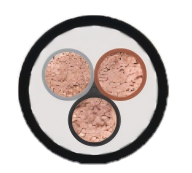
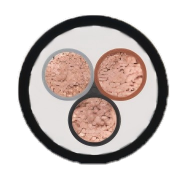
The conductor is the starting point of any cable's mechanical and electrical performance. In the (N)3GRDC5G-J/O, bare copper wires are drawn to fine strands and assembled to Class 5 flexibility in accordance with DIN EN/IEC 60228. Class 5 represents the highest standard of fine-stranded conductor classification for flexible cables, ensuring that individual wire breakage under repeated bending is minimised and that the conductor pack maintains low resistance even as the cable flexes throughout its working cycle.
In practical terms, this means each conductor within the cable is composed of a large number of very fine copper wires, each individually capable of micro-displacement relative to its neighbours as the cable bends. This architecture distributes bending stress across thousands of contact points rather than concentrating it at any single wire, dramatically extending fatigue life compared to coarser-stranded or solid conductors.
3.2 Insulation — HEPR Compound for Thermal and Mechanical Stability
Each conductor is insulated with a Halogen-free Ethylene Propylene Rubber (HEPR) compound conforming to IEC 60502-1. HEPR is selected for its excellent combination of electrical insulation properties, thermal stability, and mechanical toughness. Core identification follows DIN VDE 0293-308: up to five cores are colour-coded; from six cores onward, cores are natural-coloured and numbered, with the green/yellow protective conductor included where specified.
HEPR insulation maintains its dielectric integrity at the cable's rated maximum conductor temperature of 90°C under continuous operation, and retains performance characteristics down to the flexible operation lower limit of -30°C. This broad thermal window is essential in outdoor crane environments where ambient temperatures can vary sharply between seasons and shifts.
3.3 Core Arrangement and Inner Sheath
Cores are assembled in concentric layers around a central element, a geometry specifically chosen to ensure symmetrical distribution of mechanical stress during bending. The interstices between cores are filled with a synthetic rubber compound of type GM1b/EPDM in accordance with DIN VDE 0207-21. This filling serves two purposes: it prevents core migration — the lateral movement of individual cores that can cause premature insulation abrasion — and it provides the round profile geometry that is essential for consistent bending performance in festoon systems.
3.4 Screen — Tinned Copper Braid for Signal Integrity
In the (N)3GRDC5G-J variant, a screen of tinned copper wires interwoven with synthetic threads forms a braid around the inner core assembly. This screen provides electromagnetic shielding for control signals travelling within the cable, preventing interference from adjacent electrical systems — a critical performance requirement in environments where variable frequency drives, motor starters, and high-current switching equipment operate in close proximity to sensitive control circuits. Tinning of the copper screen wires protects against oxidation, maintaining screen continuity and low transfer impedance throughout the cable's service life.
3.5 Outer Sheath — Heavy-Duty Rubber Compound Type 5GM5
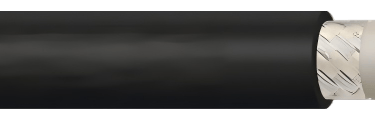
The outer sheath is the cable's primary defence against the mechanical and environmental stresses of industrial service. Formulated as a heavy-duty rubber compound, type 5GM5 per DIN VDE 0207-21, this sheath resists oil contamination in accordance with DIN EN/IEC 60811-404, withstands UV radiation and ozone exposure without cracking or degrading, and maintains elasticity at low temperatures for flexible operation from -30°C. The sheath colour is black, with inkjet marking for identification and traceability. Its flame retardant performance is certified to EN 60332-1-2, limiting fire propagation in the event of an electrical fault.
4. Key Technical Specifications
The cable carries a rated voltage of 0.6/1 kV, with maximum permissible operating voltages of 0.7/1.2 kV in AC systems and 0.9/1.8 kV in DC systems. The AC test voltage is 2.5 kV. The maximum permissible conductor temperature under continuous operation is 90°C, rising to 250°C under short-circuit conditions. For ambient temperature, the cable is rated for fixed installation from -40°C to +80°C, and for flexible operation from -30°C to +80°C.
On the mechanical side, the maximum tensile load per conductor is 15 N/mm², and the reeling speed is limited to 240 m/min. Minimum bending radii per DIN VDE 0298-3 are specified as four times the outer diameter for fixed installation runs and five times the outer diameter for festoon applications. Current-carrying capacities are determined in accordance with DIN VDE 0298-4, varying by conductor cross-section and installation conditions.
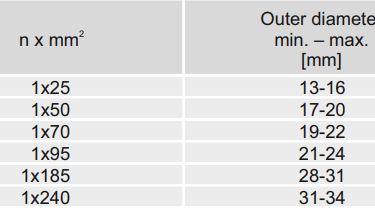
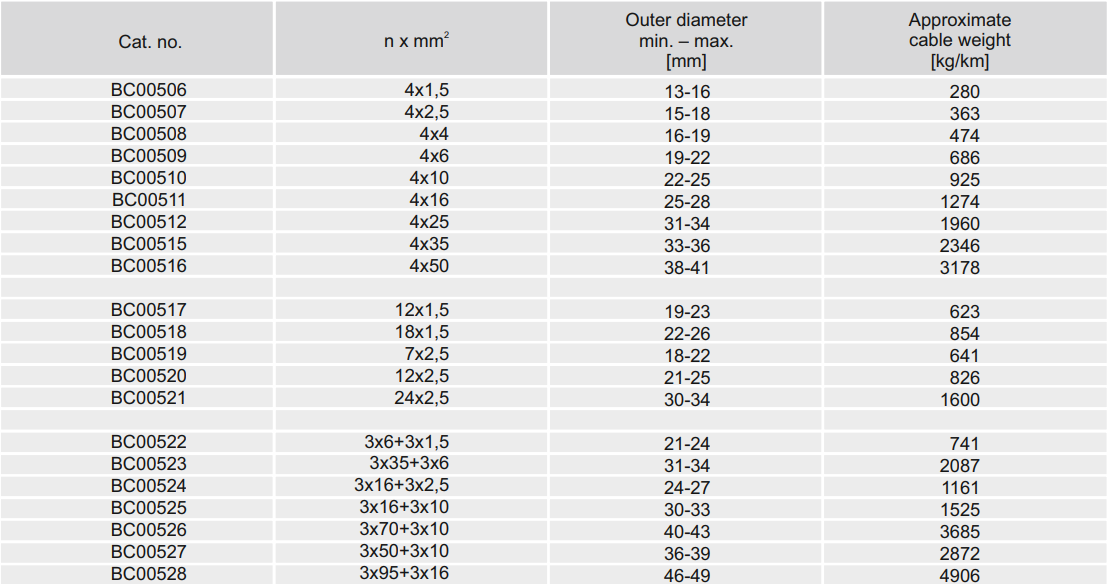
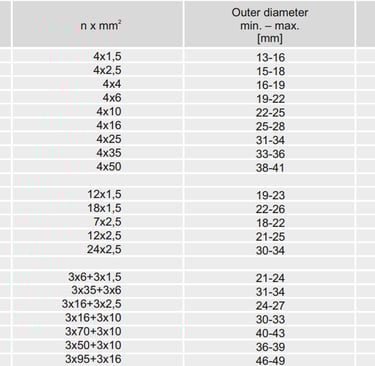
The multi-core (N)3GRDC5G-J range covers configurations from 4×1.5 mm² through to combined layouts such as 3×95+3×16 mm², with outer diameters from approximately 13 mm to 49 mm. The single-core (N)3GRDC5G-O variant spans from 1×25 mm² to 1×240 mm², with cable weights from 403 kg/km to 2,796 kg/km across this range.
5. Applicable Crane Types and Motion Profiles
Overhead Bridge Cranes. In overhead bridge crane installations, the cable connects fixed power supply points to the crane's end carriage or trolley as the carriage traverses along the runway. The cable hangs in a festoon loop — a series of drooping catenary curves supported at intervals by festoon trolleys — and must repeatedly form and relax these curves as the carriage moves. Bending in one direction, at the specified minimum festoon radius of five times the outer diameter, occurs thousands of times over the crane's operational life. The Class 5 copper conductor and rubber outer sheath are both essential to sustaining this duty cycle without fatigue failure or sheath cracking.
Gantry and Portal Cranes. Gantry cranes in port and yard environments face the additional challenge of outdoor exposure. UV radiation, salt-laden air, ozone, and moisture are all present simultaneously, while the cable must continue to perform across extreme temperature ranges. The UV-resistant and ozone-resistant outer sheath of the (N)3GRDC5G-J/O addresses these conditions directly, qualifying the cable for unrestricted outdoor service without additional protective conduit where festoon mounting geometry is appropriate.
Drag Chain Applications. Beyond crane trolley systems, the cable's design also makes it well suited to drag chain (energy chain) installations, where the cable must negotiate a tight bend radius at the chain's reversal point and travel through the chain structure at speed. The tensile load rating of 15 N/mm² per conductor ensures the conductor itself can carry a portion of the mechanical load, reducing the risk of conductor pull-out or insulation distortion under dynamic tension. The EPDM inner filling prevents core separation within the chain, maintaining the cable's round cross-section and consistent bending geometry cycle after cycle.
Conveyor and Transfer System Connections. Automated conveyor facilities require continuous, reliable power and control connectivity to moving transfer cars, shuttle systems, and traversing equipment. The (N)3GRDC5G-J/O is equally applicable here, providing the oil resistance essential near lubricated conveyor drives and the flame retardant performance required in enclosed plant environments.
6. (N)3GRDC5G-J/O vs. Standard Industrial Cables: Why Ordinary Cables Fail in Festoon Duty
A common engineering error in festoon cable selection is specifying a standard flexible industrial cable — such as a general-purpose H07RN-F rubber cable or a PVC-sheathed flexible cord — for festoon or drag chain service. While such cables may superficially appear suitable, they will fail prematurely in dynamic applications for several interconnected reasons.
Standard flexible cables are rated for occasional flexing during installation and repositioning, not for continuous dynamic bending cycles at defined radii and reeling speeds. Their overall cable construction — including core filling geometry, sheath compound stiffness, and the absence of a rated tensile load per conductor — is not optimised for unidirectional repetitive bending. PVC sheaths in particular become brittle at low temperatures and crack under sustained UV exposure, both conditions that the 5GM5 rubber outer sheath of the (N)3GRDC5G-J/O is specifically formulated to resist.
Furthermore, standard cables lack the DIN VDE 0298-3 certified bending radius for festoon application that the (N)3GRDC5G-J/O carries as a verified design parameter. This certification-backed specification gives engineers a quantified, standardised minimum bend radius they can design around with confidence, rather than applying unverified engineering judgement. The reeling speed limit of 240 m/min is similarly a specification that general-purpose cables do not carry — at high traverse velocities, cables experience impact-type mechanical loading at the festoon loop inversion point that will rapidly degrade an unrated sheath.
7. Engineering Value: Service Life, Reliability, and Safety
From an engineering investment perspective, the (N)3GRDC5G-J/O delivers value that extends well beyond its initial cable cost. Consider the total cost of a premature cable failure in a crane system: downtime costs, replacement labour, production loss during re-cabling, and the consequential costs of any equipment damage caused by the crane's unavailability. Against this backdrop, specifying a certified festoon cable from the outset represents sound engineering economics.
Reliability in festoon service is primarily a function of fatigue resistance — the cable's ability to sustain its electrical and mechanical properties across the full population of bending cycles it will experience over the crane's design life. The fine-stranded Class 5 conductor, HEPR insulation, EPDM core filling, and 5GM5 outer sheath are each selected to maximise fatigue resistance at their respective positions within the cable structure. The result is a cable whose service life is substantially longer than that of a standard industrial flexible cable in the same application, reducing the frequency of planned replacement interventions and associated maintenance costs.
Safety forms the third pillar of engineering value. Flame retardant performance to EN 60332-1-2 ensures that in the event of an electrical fault, the cable does not actively propagate fire along its length — a fundamental requirement for crane systems operating in enclosed plant areas or above personnel. The rated voltage of 0.6/1 kV and AC test voltage of 2.5 kV provide the dielectric safety margin required for reliable operation even where voltage transients from switching operations may be present.


8. Questions and Answers from the Field
Q: Can I use the (N)3GRDC5G-O single-core variant in a multi-conductor festoon system by running several cables in parallel?
Yes, this is a recognised installation approach where very high individual conductor cross-sections are required — for instance, in main hoist power circuits on large gantry cranes — and a single multi-core cable of adequate cross-section is unavailable or impractical. However, the installer must ensure that the festoon trolley spacing and clip arrangement adequately support each cable individually, and that the festoon geometry respects the minimum bending radius of five times the outer diameter for each cable. Cable management in parallel single-core festoon installations is more complex than with a single multi-core cable, and this should be factored into the installation design from the outset.
Q: Is the (N)3GRDC5G-J/O suitable for drag chain use, or only for open festoon installations?
The cable is rated for drag chain (energy chain) applications as well as open festoon systems. The key parameter to verify for drag chain use is that the chain's internal bend radius at the reversal point must be equal to or greater than five times the cable's outer diameter. The cable should also be selected to fit within the chain's usable cross-sectional space without being compressed or forced into a non-round configuration, as this would compromise its intended bending geometry. The tensile load rating of 15 N/mm² per conductor provides a meaningful safety margin for drag chain runs where the cable may carry a portion of the chain's self-weight.
Q: How does the tensile load rating of 15 N/mm² translate to an actual working load limit?
Multiply the conductor cross-sectional area in mm² by 15 N/mm² to obtain the maximum permissible tensile load for that conductor. For example, a 16 mm² conductor can sustain up to 240 N before reaching the specification limit. In festoon system design, this figure is used to size trolley spacing and cable sag geometry such that dynamic tension during traverse — including acceleration, deceleration, and wind loading for outdoor systems — remains within this envelope throughout the operating cycle.
Q: Is this cable appropriate for outdoor crane installations in coastal environments?
Yes. The weather resistance specification for the (N)3GRDC5G-J/O explicitly covers unrestricted outdoor use with resistance to ozone, UV radiation, and moisture. In coastal environments, salt spray is an additional risk factor that can accelerate degradation of PVC or poorly formulated rubber sheaths; the 5GM5 heavy-duty rubber outer sheath is formulated to withstand these conditions. However, for submerged or direct water-immersion installations, a separate cable specification would be appropriate, as this product is rated for outdoor atmospheric exposure rather than underwater service.
Q: What should I check when specifying a UV-resistant round festoon cable for an outdoor conveyor facility with oil contamination risk?
The three parameters to verify in combination are: oil resistance to DIN EN/IEC 60811-404 (confirmed for this cable), UV and ozone resistance of the outer sheath (confirmed), and the minimum bending radius in relation to the festoon or drag chain geometry of the specific conveyor installation. Additionally, confirm that the ambient temperature range of the installation falls within the cable's flexible operation window of -30°C to +80°C, and that the traverse speed of the conveyor system does not exceed the 240 m/min reeling speed limit.
9. Selection Guidelines for Engineers and Procurement Managers
When specifying a rubber insulated flexible festoon cable for crane trolley, drag chain, or conveyor applications, a structured approach ensures the selected cable is correctly matched to the application. Engineers should begin by confirming the rated voltage is appropriate for the system supply and motor drive voltages involved. The required conductor cross-section should then be calculated based on current-carrying capacity per DIN VDE 0298-4, accounting for cable grouping, ambient temperature correction, and installation method.
The tightest bend radius the cable will experience in service must be measured or calculated and confirmed to be at least five times the cable's outer diameter for festoon applications. The crane or trolley traverse speed must be verified not to exceed 240 m/min, and dynamic tension at the worst-case point of the festoon loop or drag chain must be confirmed to remain within the 15 N/mm² per-conductor tensile load limit. Environmental exposure — including oil mist, UV, ozone, temperature extremes, and moisture — should be systematically evaluated against the cable's certified chemical and weather resistance parameters. Finally, the choice between multi-core screened (N)3GRDC5G-J and single-core (N)3GRDC5G-O should be made based on whether EMC screening of co-routed control signals is required.
10. Conclusion: A Purpose-Built Solution for Demanding Dynamic Applications
The (N)3GRDC5G-J/O flexible festoon cable is the product of a coherent engineering philosophy: every material, every compound specification, and every certified parameter exists because festoon and drag chain applications demand it. From the fine-stranded Class 5 copper conductor that distributes bending stress across thousands of individual wires, to the 5GM5 heavy-duty rubber outer sheath that resists oil, UV, ozone, and mechanical abrasion in the most demanding outdoor crane environments, the cable's construction is optimised end-to-end for dynamic service.
For engineers specifying power and control cable for overhead bridge cranes, gantry cranes, automated conveyor systems, or moving machine drag chains, the (N)3GRDC5G-J/O offers a technically validated, standards-certified solution that eliminates the guesswork involved in adapting general-purpose cables to dynamic duty. Its DIN VDE 0298-3 certified bending radius, rated reeling speed, and tensile load parameters provide quantified design inputs that translate directly into safe, reliable, and long-lived festoon system designs.
Selecting the right 0.6/1 kV oil-resistant crane power cable at the specification stage is invariably less costly — in time, in maintenance, and in risk — than discovering the wrong choice through premature failure in service. The (N)3GRDC5G-J/O is designed to be the right choice, and to stay that way across the full service life of the crane and system it powers.
Technical specification data sourced from product datasheet (N)3GRDC5G-J/O. All parameters are subject to confirmation at the time of order.
Port crane cables | Mining cables | Reeling cables | Trailing cables | Festoon cables | Heavy-duty power cables | Medium voltage cables | Offshore crane cables | Underground mining cables | Dragline cables | Shearer cables | Container handling cables | STS crane cables | RTG cables | Mobile equipment cables | Armored cables | Flexible power cables | VFD cables | Submersible cables | Cold resistant cables | Abrasion resistant cables | Flame retardant cables | Marine environment cables | Opencast mining | Underground operations
© 2006 All rights reserved.
[INDUSTRIAL_CABLES]
INDUSTRIAL GRADE CABLE SYSTEMS | PORT & MINING SOLUTIONS
TEL: +86 153 7530 2641 |MAIL: hongjing.Wang@feichuncables.com