NSHTOEU-J Reeling Cable: A Technical Engineering Guide for Heavy-Duty Crane and Mobile Equipment Applications
Cable Type: Low Voltage Reeling Power / Control Cable Standard: DIN VDE 0250-814 Rated Voltage: 0.6/1 kV Max. Reeling Speed: 120 m/min Torsion Tolerance: ±25°/m
hongjing.Wang@Feichun
3/9/202615 min read

1. What Is NSHTOEU-J Reeling Cable?
In industrial environments where cables must move continuously — unspooling, retracting, twisting, and bearing mechanical load cycle after cycle — standard flexible cables fail prematurely. Conductor wires work-harden and fracture. Sheaths crack. Insulation breaks down. The result is unplanned downtime, safety risk, and recurring replacement cost.
The NSHTOEU-J is a low voltage, heavy-duty rubber reeling cable engineered specifically to endure these conditions over extended service life. Designed and manufactured in compliance with DIN VDE 0250-814, it is built for power supply and control applications in mobile machinery, where cables must withstand simultaneous tensile and torsional stress during normal operation.
Rated at 0.6/1 kV with a maximum continuous conductor temperature of 90°C and short-circuit tolerance of 200°C, the NSHTOEU-J is deployed across crane systems, stacker-reclaimers, container handling terminals, mining machinery, and other heavy industrial equipment where cable reliability under dynamic movement is non-negotiable.
This guide provides a comprehensive technical breakdown of the cable's construction, performance parameters, application suitability, and engineering value — written from the perspective of the engineering team that designs and produces it.
2. Cable Construction: Engineered Layer by Layer for Dynamic Stress
Understanding why the NSHTOEU-J performs reliably in demanding reeling applications begins with its structure. Every layer serves a specific mechanical or electrical purpose. There is no redundant material in the design.
2.1 Conductors: Finely Stranded Tinned Copper
At the core of the NSHTOEU-J are finely stranded tinned copper conductors meeting IEC 60228 Class 5 — the highest flexibility class defined for industrial cable conductors. Each conductor is composed of a large number of very fine copper wires twisted together, which dramatically increases flexibility and resistance to fatigue fracture compared to conductors with fewer, thicker strands.
Class 5 stranding is not simply a quality designation. It is a direct engineering response to the fatigue mechanism that destroys standard cable conductors in reeling applications. When a cable bends and twists repeatedly, individual wire strands must slide slightly relative to each other to accommodate the deformation. Coarser strands cannot do this without generating stress concentrations that lead to fracture. Fine stranding distributes this movement across a greater number of smaller wires, extending cycle life by orders of magnitude.
Tinning the copper wires adds two further benefits. It improves solderability and termination quality, and it protects the copper from oxidation and corrosion in humid, saline, or otherwise aggressive environments — conditions routinely encountered in port terminals, open-cut mining sites, and outdoor industrial installations.
2.2 Insulation: EPR Rubber Compound Type 3GI3
Each conductor is insulated with Ethylene Propylene Rubber (EPR), specifically type 3GI3 per DIN VDE 0207-20. EPR is selected over PVC or XLPE for reeling applications because of its unique combination of mechanical and electrical properties under dynamic conditions.
EPR remains flexible and crack-resistant at temperatures down to -40°C for fixed installations and -30°C under active reeling conditions. This cold-temperature flexibility is critical for cables used in Arctic port operations, cold-climate mining, or refrigerated storage facilities. PVC insulation at these temperatures becomes brittle and will crack under bending — a common failure mode in reeling applications where the cable must flex at low ambient temperatures.
At the upper end, EPR sustains continuous operation up to 90°C conductor temperature with stable electrical insulation properties. Its resistance to ozone and ultraviolet degradation makes it suitable for unrestricted outdoor use without additional protective measures. Core colours comply with DIN VDE 0293-308. The ground conductor (green-yellow) uses the same EPR type 3GI3 compound and Class 5 stranded tinned copper construction as the main cores.
2.3 Inner Sheath: Heavy-Duty Rubber Compound Quality 5GM3
Over the insulated conductor bundle lies the inner sheath, produced from heavy-duty rubber compound quality 5GM3 per DIN VDE 0207-21. This layer fills the interstices between the conductors, performing three functions simultaneously.
First, it locks the relative positions of the conductors within the cable cross-section. Under torsional loading, a cable without a filled inner structure will see the conductors migrate and bunch asymmetrically, creating uneven load distribution and accelerating fatigue. The filled inner sheath prevents this. Second, it acts as a barrier against contaminant ingress into the conductor bundle. Third, it provides a mechanically consistent base layer for the reinforcement braid applied above it.
2.4 Reinforcement Braid: Synthetic Thread in Vulcanized Bond
The most structurally significant feature that distinguishes the NSHTOEU-J from standard flexible cables is the synthetic thread reinforcement braid applied between the inner and outer sheath. Critically, this braid is not simply laid between the two rubber layers — it is bonded into the cable structure through a vulcanization process.
Vulcanization chemically bonds the reinforcement into the surrounding rubber matrix, making it a structural component of the cable assembly rather than a loose intermediate layer. A loose reinforcement braid would delaminate under repeated bending and torsion, losing its load-bearing function and potentially creating internal mechanical interference. The vulcanized bond ensures the braid remains integrated with the cable structure throughout its service life.
This reinforcement layer absorbs tensile loads and limits cable elongation during dynamic reeling. It is the primary structural reason the cable can be rated to a static tensile load of 15 N/mm² and a dynamic tensile load of 20 N/mm². Without it, cables in high-travel reel systems would progressively stretch, causing conductor migration, increased resistance, and ultimately conductor fracture.
2.5 Outer Sheath: Heavy-Duty Rubber Quality 5GM3
The outer sheath uses the same 5GM3 heavy-duty rubber compound as the inner sheath, per DIN VDE 0207-21. The outer surface is black — providing intrinsic UV resistance — and carries inkjet marking for cable identification and traceability. The outer sheath delivers the final layer of mechanical protection and environmental sealing, and serves as the primary abrasion-resistance surface when cables trail along cable trays, ground tracks, or guide rollers.
The complete cross-section — from fine-stranded tinned copper conductors through EPR insulation, filled inner sheath, vulcanized reinforcement braid, and heavy-duty outer sheath — creates a cable that responds to dynamic stress as a coherent, integrated unit, with no internal weak points susceptible to delamination or relative layer movement.


3. Electrical and Thermal Performance Parameters
The NSHTOEU-J is rated at 0.6/1 kV (U₀/U), with a maximum permissible operating voltage of 0.7/1.2 kV in AC systems and 0.9/1.8 kV in DC systems. The AC test voltage is 2.5 kV, which provides a substantial safety margin above the rated operating voltage and validates the integrity of the EPR insulation system at the point of manufacture.
Maximum continuous conductor temperature is 90°C. Under short-circuit conditions, the conductor can tolerate up to 200°C without permanent damage to the insulation system. Current-carrying capacities are determined per DIN VDE 0298-4 Table 15, and de-rating factors for both thermal and reeling conditions are applied per DIN VDE 0298-4. These de-rating provisions are important: cables wound on drum reels cannot dissipate heat as effectively as cables in free air, and the appropriate de-rating factor must be applied when sizing conductor cross-sections for reel-installed cables.
The rated voltage of 0.6/1 kV places the NSHTOEU-J within the low voltage category, making it applicable to the majority of industrial crane drive circuits, control panels, and mobile equipment power distribution systems.
4. Mechanical Performance: The Engineering Core of the NSHTOEU-J
The mechanical specifications of the NSHTOEU-J define its operational capability in reeling applications and represent the parameters for which the cable has been purpose-designed. These are not safety margins applied to a general-purpose cable — they are validated performance limits of a reeling-specific design.
4.1 Tensile Load Capacity
Reeling cables must resist elongation under the tensile pull applied by cable reel mechanisms. This pull varies depending on travel distance, reel tension setting, and the unsupported weight of the cable catenary. The NSHTOEU-J is rated for a static tensile load of 15 N/mm² and a dynamic tensile load of 20 N/mm².
The distinction between static and dynamic ratings is meaningful. Static tensile load applies to sustained conditions such as long unsupported cable drops or extended horizontal travel where the cable weight generates a continuous pull. Dynamic tensile load applies during active reeling, where acceleration and deceleration of the reel mechanism creates momentary peak loads above the static steady-state value. The NSHTOEU-J's reinforced construction handles both without permanent deformation of the conductor bundle.
4.2 Torsional Stress Tolerance
Torsion is among the most destructive forces acting on cable conductors in mobile equipment. As a cable reel extends and retracts, the cable can rotate along its own axis — particularly in spring-operated reels where cable tension varies across the travel range, and in motor-driven systems where the cable entry point to the reel changes geometry with drum rotation.
The NSHTOEU-J tolerates torsional stresses of ±25° per metre of cable length. This means that for every metre of deployed cable, up to 25° of rotational twist in either direction can occur without causing conductor fatigue or insulation damage. This rating is specifically validated for motor-driven mono-spiral cable reels, cylindrical drum reel systems, and spring-operated cable reels — the three principal reel types used in crane and mobile equipment applications.
Torsion resistance in the NSHTOEU-J results from two complementary design elements. The fine-stranded Class 5 conductors can flex and rotate without generating brittle fracture in individual wires. The reinforced rubber sheath construction maintains the cable's geometric integrity under torsional loading, preventing the internal twisting and conductor migration that would otherwise occur.
4.3 Reeling Speed
Maximum rated reeling speed is 120 m/min. This accommodates the operating velocities of high-performance gantry cranes, automated container handling systems, and high-speed stockyard conveyor drives. Operating above this speed increases the risk of mechanical shock loading on the cable at the reel entry point and can cause dynamic bending radius violations if the cable path geometry is not precisely controlled.
4.4 Minimum Bending Radius
Correct bending radius management is fundamental to cable service life in all reeling applications. Bending a cable tighter than its rated minimum radius causes permanent deformation of the conductor bundle and insulation, initiating fatigue failure at the over-bent location. The NSHTOEU-J minimum bending radii per DIN VDE 0298-3 are as follows.
For fixed installation, the minimum bending radius is 4 times the cable outer diameter. For reeling applications under normal dynamic operation, the minimum is 6 times the cable diameter. On deflection pulleys — where the cable changes direction under tension — the minimum is 7.5 times the cable diameter. For S-type directional changes, where the cable reverses curvature direction in a short distance, the minimum distance is 20 times the cable diameter.
The S-type requirement of 20× diameter deserves particular attention during system design. This value is frequently underestimated when routing cables through tensioning mechanisms, compensating sheaves, or multi-pulley redirect systems. Violating this radius in S-type geometries is one of the most common root causes of premature reeling cable failure encountered in the field.
5. Environmental and Chemical Resistance
The NSHTOEU-J is engineered for unrestricted use in the full range of environmental conditions encountered in its target applications. Its environmental resistance profile is not additive — each resistance characteristic is inherent to the material system and does not degrade the others.
Oil resistance complies with DIN EN / IEC 60811-404, covering exposure to hydraulic fluids, lubricants, and incidental fuel contact that occurs routinely in crane machinery rooms and on active mining equipment. Flame behaviour per DIN EN / IEC 60332-1-2 ensures the cable does not propagate flame along its length in the event of a fire — an essential safety characteristic for cables routed through crane structures, cable trenches, and enclosed equipment compartments.
Weather resistance is unrestricted for both indoor and outdoor use. The EPR compound and heavy-duty rubber sheaths resist ozone cracking under prolonged atmospheric exposure, resist ultraviolet degradation without protective additives, and maintain sealing integrity against moisture ingress across the full operating temperature range.
The cable complies with EU RoHS Directive 2015/863/EU, EU Low Voltage Directive 2014/35/EU, and EU Construction Products Regulation 305/2011, facilitating regulatory compliance for equipment deployed or sold within European markets.
The combination of oil resistance, UV resistance, and full weather resistance in a single cable makes the NSHTOEU-J suitable for applications where cables are simultaneously exposed to multiple environmental stresses — a common condition in port terminals, open-pit mining, and steel plant environments.
6. Applicable Crane Types and Motion Profiles
The mechanical and environmental specification envelope of the NSHTOEU-J maps directly to the operational requirements of the following crane and mobile equipment categories.
Ship-to-Shore (STS) Container Cranes impose large cable travel distances as the trolley traverses the full boom length. The 20 N/mm² dynamic tensile rating and 120 m/min reeling speed accommodate the drum reel systems powering hoist, trolley, and gantry travel drives on high-throughput STS installations.
Rubber Tyre Gantry (RTG) Cranes move laterally under electric power with the supply cable trailing on ground-level reels. RTG systems impose simultaneous tensile and torsional loads as the reel extends and retracts at varying geometric angles. The ±25°/m torsion tolerance and oil resistance from machinery compartment exposure are the primary performance criteria for this application.
Rail-Mounted Gantry (RMG) Cranes travel on fixed rails using cable festoon or drum reel systems, and must endure tens of thousands of travel cycles over their service life. The combination of fine-stranded Class 5 conductors and reinforced rubber construction provides the fatigue resistance required for high-cycle RMG duty.
Stacker-Reclaimers and Bucket Wheel Excavators operate in stockyard and mining environments with very long cable travel distances and constant exposure to dust, moisture, UV radiation, and abrasive particulate. The full environmental resistance package of the NSHTOEU-J is directly applicable, and the static tensile rating supports the long unsupported cable catenary lengths common on these machines.
Ship Loaders and Unloaders impose high-cycle reeling duty in port environments with exposure to salt-laden air, high humidity, and risk of chemical or fuel spills on working surfaces. The combination of weather and oil resistance addresses the specific degradation mechanisms most common in this application.
Automated Conveyor and Stockyard Machinery in steel plants and bulk terminals use powered cable reels to supply mobile drive systems. High reeling speed and long service intervals between maintenance windows are the primary selection drivers. The NSHTOEU-J's 120 m/min rated speed and mechanical durability address both.
7. NSHTOEU-J vs. Standard Flexible Cable: A Technical Comparison
Specifying a standard flexible industrial cable in a reeling application is not a cost-neutral substitution — it is an engineering risk with predictable consequences. The following comparison illustrates why a purpose-built reeling cable is a technically distinct product from a general-purpose flexible cable, even when both share similar conductor cross-sections and voltage ratings.
Conductor stranding. Both the NSHTOEU-J and quality standard flexible cables use IEC 60228 Class 5 stranding. However, the NSHTOEU-J uses ultra-fine stranding optimised for maximum flexibility and fatigue resistance, whereas standard cables meet the Class 5 minimum specification without optimisation for dynamic duty.
Conductor tinning. The NSHTOEU-J uses tinned copper conductors as standard, providing corrosion protection and consistent termination quality over the cable's service life. Standard flexible cables such as H07RN-F typically use bare copper, which is more susceptible to oxidation in high-humidity or chemically aggressive environments.
Tensile load rating. The NSHTOEU-J carries defined static (15 N/mm²) and dynamic (20 N/mm²) tensile ratings. Standard flexible cables have no defined dynamic tensile rating and are not designed to resist sustained or cyclic tensile loading. Applying them in tensioned reel systems results in progressive conductor elongation and migration.
Torsion resistance. The NSHTOEU-J is rated for ±25°/m torsional stress — a defined, tested specification. Standard flexible cables carry no torsion rating and have no structural provision for torsional load absorption. Repeated torsional cycling causes conductor twist-locking, insulation cracking, and premature failure.
Reinforcement layer. The vulcanized synthetic braid reinforcement is unique to purpose-built reeling cables. Standard flexible cables have a single sheath with no internal reinforcement, providing no resistance to tensile elongation or torsional deformation of the cable geometry.
Temperature range in reeling duty. The NSHTOEU-J is rated for reeling operation from -30°C to +80°C. Standard H07RN-F type cables are typically rated to -25°C static, with no defined reeling temperature range. In cold-climate outdoor applications, standard cables will experience insulation embrittlement that causes cracking under bending.
Service life under reeling duty. Under equivalent reeling duty cycles — defined travel distance, speed, and reel type — the NSHTOEU-J is designed for substantially longer service life than standard flexible cables. The exact ratio depends on application parameters, but the structural differences are directly reflected in mean cycles to failure. In high-throughput port operations, this difference can represent the gap between annual cable replacement and multi-year service intervals.
The conclusion for engineers is straightforward. The cost premium of a purpose-built reeling cable over a standard flexible cable is recovered within the first replacement cycle that is avoided — and avoided replacements also mean avoided equipment downtime, avoided termination labour, and avoided safety risk from in-service cable failure.
8. Engineering Value: Service Life, Reliability, and Safety
8.1 Extended Service Life Under Dynamic Duty
Every structural element of the NSHTOEU-J is oriented toward maximising cycle life under dynamic loading. Fine-stranded conductors resist work-hardening. EPR insulation retains flexibility without embrittlement through decades of temperature cycling. The reinforcement braid prevents stretch-induced conductor damage. The double-sheath construction absorbs surface abrasion before it reaches the insulated core.
For maintenance engineers, extended cable service life translates to fewer unplanned shutdowns, lower cable replacement frequency, and reduced termination labour cost. In port and mining applications, cable replacement typically requires equipment downtime. Every extension of cable service life has a direct, calculable operational value that significantly exceeds the cost differential between reeling-grade and standard flexible cable.
8.2 Reliability in Extreme Environments
The NSHTOEU-J is not rated for moderate industrial environments — it is engineered for the most demanding conditions encountered in its target applications. The -40°C fixed installation rating accommodates Arctic port operations and cold-climate mining extraction. The +80°C upper limit handles desert environments and proximity to hot industrial processes such as steel casting and hot rolling. Oil resistance ensures performance continuity even after contamination events from hydraulic circuit failures or routine equipment maintenance.
These are not exceptional margins that are rarely invoked. In real-world port operations and open-cut mining, cables regularly operate at the extremes of this envelope. The NSHTOEU-J is designed so that these extremes are normal operating conditions, not failure-inducing exceptions.
8.3 Safety Performance
Flame-retardant performance per IEC 60332-1-2 is an essential safety requirement for cables routed through crane structures, cable trenches, and enclosed equipment rooms. A cable that propagates flame in a fire event can transform an isolated electrical fault into a catastrophic equipment loss or structural fire. The NSHTOEU-J's flame retardancy limits fire propagation along the cable route, containing the consequences of fault events.
Compliance with EU LVD (2014/35/EU) and RoHS (2015/863/EU) ensures the cable meets European safety and environmental standards, simplifying compliance documentation for equipment manufacturers and operators within the EU regulatory framework.
8.4 Predictable Performance Under Load
Because the NSHTOEU-J is designed and tested against defined tensile, torsional, and speed specifications, engineers can design reel systems with confidence in the cable's behaviour under load. There is no need to apply large, uncertain safety factors to compensate for undefined cable response to dynamic stress. The specifications are deterministic: the cable will perform to its ratings within its defined operating envelope, and that envelope covers the full range of conditions encountered in its application domain.
9. Selection Guide: Key Engineering Parameters
Selecting the correct NSHTOEU-J configuration for a specific application requires defining the following parameters at the system design stage.
Travel distance determines the required cable length, the weight of the deployed cable catenary, and the effective tensile load generated on the reel system. Longer travel distances require careful tensile load calculation to confirm the cable rating is not exceeded at maximum extension.
Reeling speed must be confirmed to remain within the 120 m/min maximum. Applications approaching this limit should also verify that the reel control system prevents overspeed conditions during emergency stopping cycles, which can generate transient mechanical loads significantly above steady-state values.
Cable reel type — motor-driven mono-spiral, cylindrical drum, or spring-operated — determines the torsional load profile the cable will experience. Spring-operated reels typically impose higher torsional stress than motor-driven systems because tension varies more significantly across the travel range.
Bending radius constraints must be verified at every point in the cable routing, particularly at reel entry, deflection pulleys, and any location where the cable reverses curvature direction. The S-type bending radius requirement of 20× cable diameter is the most frequently underestimated value in system design.
Conductor cross-section is determined by current load, cable length (voltage drop calculation), and the applicable de-rating factors per DIN VDE 0298-4 for the installed configuration. Cables wound on drum reels carry a thermal de-rating that must be applied to the tabulated current capacity.
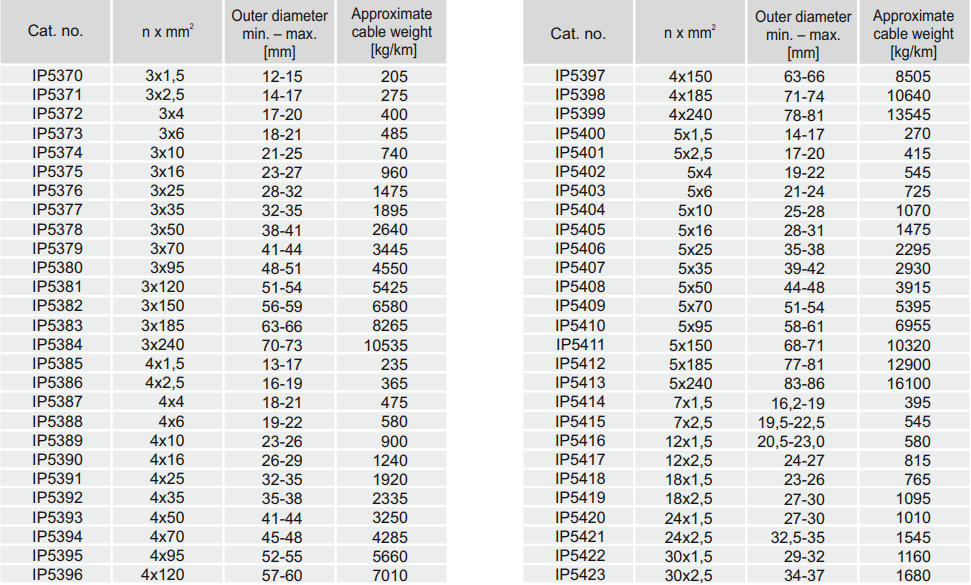
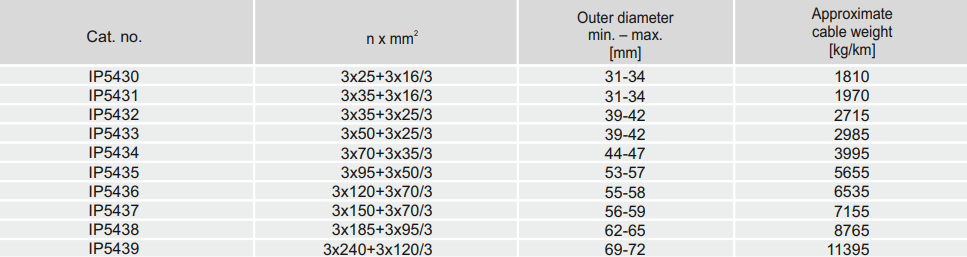
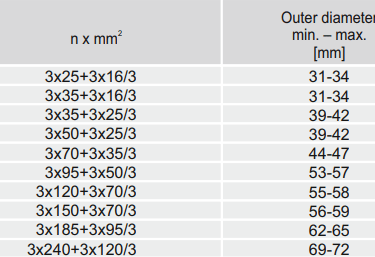
Number of cores is available from 3 to 30, accommodating power-only configurations and combined power plus control cable arrangements. Combined configurations such as 3×35+3×25/3 allow a single cable to carry both main drive power and control signals, reducing the number of cable paths on the reel and simplifying installation.
Ambient temperature range defines the operating extremes to be expected at the installation site. Cold-climate installations should confirm compliance with the -30°C reeling operation rating, and installations near hot industrial processes should verify the +80°C upper limit is not exceeded.
Environmental exposure should be assessed for all relevant hazards: oil and hydraulic fluid, UV radiation, ozone, moisture, mechanical abrasion from cable guides and ground contact, and any specific chemical exposures particular to the installation site.
10. Conclusion
The NSHTOEU-J is a precision-engineered reeling cable designed to solve a specific and demanding engineering problem: delivering reliable power and control to mobile industrial machinery under continuous dynamic mechanical stress, across a wide range of environmental conditions, over an extended service life.
Its design is not a modification or adaptation of a general-purpose flexible cable. It is a purpose-built solution in which every structural layer — from the ultra-fine Class 5 tinned copper conductors and EPR insulation, through the filled rubber inner sheath, vulcanized synthetic reinforcement braid, and heavy-duty outer sheath — is optimised for the reeling application.
The cable's validated mechanical ratings for tensile load, torsional stress, and reeling speed provide engineers with a defined, reliable performance envelope for system design. Its environmental resistance profile covers the full range of stresses encountered in crane systems, port terminals, open-cut mining, and heavy material handling operations. And its compliance with DIN VDE 0250-814 and applicable EU directives ensures regulatory conformity across its intended markets.
For engineers specifying cables for new crane installations, reel system upgrades, or replacement programmes, the NSHTOEU-J represents the technically appropriate choice for the full spectrum of industrial reeling applications.
Port crane cables | Mining cables | Reeling cables | Trailing cables | Festoon cables | Heavy-duty power cables | Medium voltage cables | Offshore crane cables | Underground mining cables | Dragline cables | Shearer cables | Container handling cables | STS crane cables | RTG cables | Mobile equipment cables | Armored cables | Flexible power cables | VFD cables | Submersible cables | Cold resistant cables | Abrasion resistant cables | Flame retardant cables | Marine environment cables | Opencast mining | Underground operations
© 2006 All rights reserved.
[INDUSTRIAL_CABLES]
INDUSTRIAL GRADE CABLE SYSTEMS | PORT & MINING SOLUTIONS
TEL: +86 153 7530 2641 |MAIL: hongjing.Wang@feichuncables.com