NSHTOEU-J Reeling Cable: The Complete Engineering Guide for Cranes, Ports, and Heavy Material-Handling Equipment
A complete technical guide to NSHTOEU-J heavy-duty reeling cable: construction, voltage and temperature ratings, torsion and bending performance, crane applications, and selection tips for harsh port and industrial environments.
hongjing.Wang@Feichun
6/24/202618 min read
Introduction
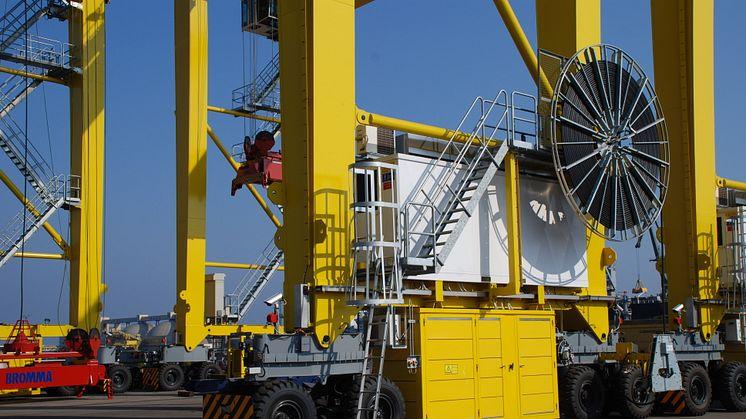
In ports, container terminals, steel mills, mining operations, and large logistics facilities across the Middle East, one challenge appears again and again: how do you deliver reliable electrical power to a machine that never stops moving? Cranes travel along rails for hundreds of meters. Reels wind and unwind cable thousands of times each week. Conveyor gantries shift back and forth under brutal sun, dust, and heat. In every one of these systems, there is a cable working quietly in the background, flexing and twisting through millions of cycles, carrying the power that keeps the operation alive.
The NSHTOEU-J reeling cable is engineered specifically for this kind of duty. It is a heavy-duty rubber-sheathed reeling cable built to supply power and control signals to mobile equipment that experiences high mechanical stress, particularly the simultaneous combination of pulling (tensile) and twisting (torsional) forces that destroys ordinary cables in a matter of months.
For engineers, procurement managers, and maintenance teams responsible for cranes and material-handling systems in demanding regional climates, choosing the right reeling cable is not a small decision. The wrong cable means unplanned downtime, repeated replacements, safety risks, and lost productivity at the worst possible moments. The right cable runs for years, absorbing punishing mechanical abuse while keeping equipment energized and operators safe.
This guide explains, in clear and practical terms, what the NSHTOEU-J cable is, what its name actually means, how it is built, how it performs electrically and mechanically, where it is used, and how to select the correct version for your application. Whether you are specifying cable for a new ship-to-shore crane at a Gulf container terminal or replacing worn reeling cable on an existing rubber-tyred gantry crane, this article will give you the technical foundation you need.
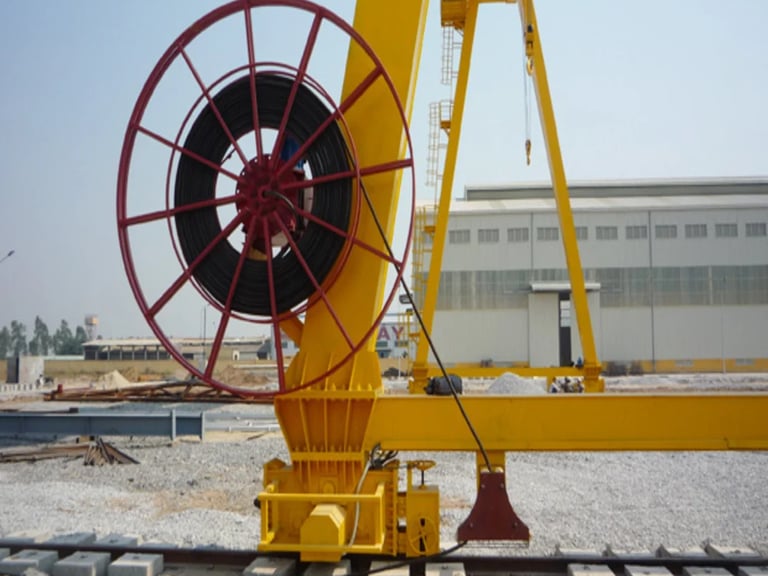
Why do reeling cables matter so much in cranes and port equipment? Because in these machines the cable is not a passive component bolted to a wall. It is a moving, working part of the machine itself. Every time the crane travels, the reel rotates, pulling cable off the drum or winding it back on. The cable bends around the reel core, twists along its length, drags across guide rollers, and is exposed continuously to mechanical, thermal, and environmental stress. A standard fixed-installation power cable placed in this role would crack, fatigue, and fail almost immediately. Reeling cables like the NSHTOEU-J are a fundamentally different product class designed from the conductor outward to survive constant motion.
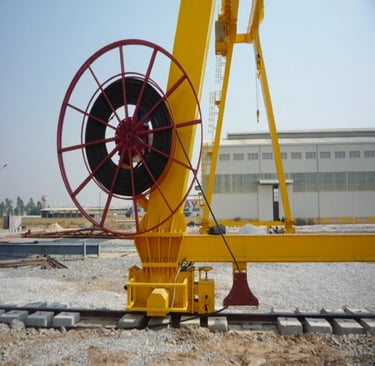
Common applications for this cable family include port cranes, rubber-tyred gantry (RTG) and rail-mounted gantry (RMG) yard cranes, ship-to-shore (STS) container cranes, stackers and reclaimers in bulk terminals and stockyards, cable reel and drum systems, hoists, conveyors, and a wide range of other mobile industrial machinery. If a machine moves and needs power delivered through a reel, this is the category of cable that does the job.
What Does NSHTOEU-J Mean? Decoding the Cable Designation
One of the most useful things an engineer can do is learn to read a cable's type designation. These names are not random. They follow harmonized German and international (VDE/DIN) coding conventions, and each letter tells you something specific about the construction, materials, and intended use. Once you understand the system, you can identify a cable's core function at a glance, compare products from different manufacturers, and avoid costly specification errors.
Let us break down NSHTOEU-J letter by letter.
N — This indicates a cable manufactured according to the relevant harmonized national and VDE standard. It signals that the product conforms to a recognized German/European specification framework rather than being a non-standard or proprietary construction.
SH — This points to special heavy-duty construction. The "H" in particular is associated with high mechanical strength and reinforcement. In reeling cables, this is where the anti-torsion and reinforcement features live, the structural elements that let the cable survive twisting and pulling.
T — This relates to the load-bearing and supporting element of the construction. In reeling applications, the cable must carry tensile loads as it is pulled off and wound onto the reel, and this designation reflects construction that distributes and withstands those forces.
OE — This refers to the rubber insulation and sheathing system based on elastomer compounds. Rubber-based compounds such as EPR (ethylene propylene rubber) for insulation and heavy-duty rubber for sheathing are what give the cable its extraordinary flexibility across a wide temperature range, along with resistance to weather, ozone, UV, and abrasion.
U — This denotes the cable's suitability for reeling and the specific construction features that support repeated winding and unwinding.
-J — This suffix is one of the most important practical markers on the entire designation. The "J" indicates that the cable includes a dedicated protective earth (ground) conductor identified by the standard green-and-yellow colour combination. In a power cable, this green/yellow conductor is the safety grounding core. It provides the protective earthing path that carries fault current safely away in the event of an insulation failure, protecting both equipment and, critically, the people working around it.
The opposite of "-J" is "-O", which designates a cable without a dedicated green/yellow protective conductor. For almost all power supply applications on cranes and mobile equipment, the "-J" version is required because protective earthing is a fundamental safety requirement. This single suffix is a quick visual confirmation that a grounding conductor is present.
Why does understanding the naming matter for engineers and buyers? Because procurement and specification errors are expensive. A purchasing manager who knows that "-J" guarantees a green/yellow earth core will not accidentally order a cable that lacks one. An engineer who recognizes the heavy-duty reeling designation will not mistakenly substitute a cheaper fixed-installation cable that would fail under reeling stress. The designation is a compact technical language, and fluency in it prevents the kind of mistakes that lead to failures, safety incidents, and warranty disputes.
In short: NSHTOEU-J tells you that this is a standards-compliant, special heavy-duty, tension-bearing, rubber-insulated and rubber-sheathed reeling cable with a protective green/yellow earth conductor. That is a remarkable amount of engineering information packed into a handful of letters.
Cable Construction: How the NSHTOEU-J Is Built to Survive
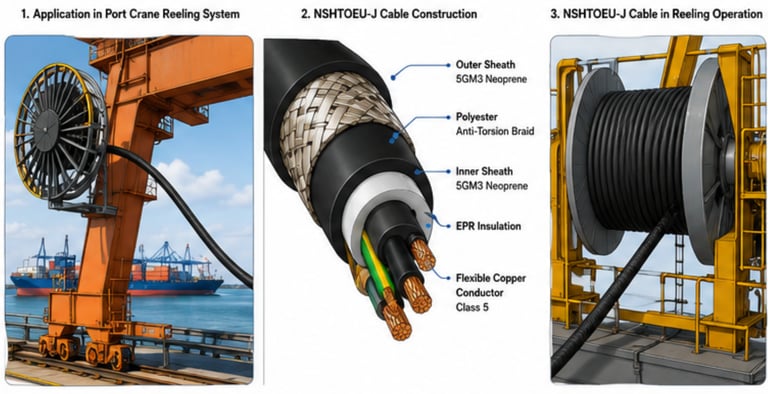
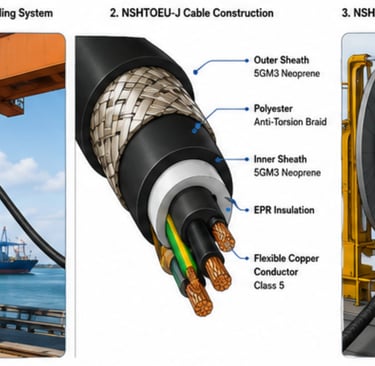
The performance of any reeling cable comes directly from its construction. Every layer has a job, and in a cable designed for continuous motion, the layers must work together as an integrated mechanical system, not just as a stack of insulating materials. Let us walk through the construction from the inside out.
Fine-Stranded Tinned Copper Conductors
At the heart of the cable are the current-carrying conductors. In the NSHTOEU-J, these are made of finely stranded tinned copper wires conforming to IEC 60228 Class 5, the flexibility class. This is one of the most important construction features for any reeling application, and it is worth understanding why.
A solid or coarsely stranded conductor is rigid. When you bend it repeatedly, the copper work-hardens, develops fatigue cracks, and eventually breaks. A conductor made of many very fine individual copper strands behaves completely differently. The fine strands can slide and flex relative to one another, distributing the bending stress across hundreds of tiny wires instead of concentrating it. This dramatically extends fatigue life, which is exactly what you need in a cable that may bend and straighten millions of times over its service life.
The tinning of the copper, a thin protective coating of tin over each strand, serves two purposes. First, it protects the copper from corrosion and oxidation, which is especially valuable in humid coastal and marine port environments common throughout the Middle East's major container terminals. Salt-laden air is aggressive toward bare copper, and tinning provides a meaningful defense. Second, tinning improves long-term contact reliability at terminations and makes the conductor easier to solder and connect.
EPR Rubber Insulation
Each conductor is insulated with an EPR (ethylene propylene rubber) compound, specifically a type 3GI3 compound to the relevant VDE specification. EPR is the workhorse insulation material for flexible and reeling cables, and for good reason.
EPR remains flexible across a very wide temperature range, staying pliable even in cold conditions while withstanding high operating temperatures. It has excellent electrical properties, strong resistance to moisture and partial discharge, and outstanding ozone and weathering resistance. Unlike some thermoplastic insulations that stiffen in the cold and soften excessively in the heat, EPR maintains its mechanical and electrical character across the demanding range these cables encounter. The insulated cores are colour-coded according to the relevant VDE colour standard so that installers can identify each conductor correctly.
The Inner Sheath and Bedding
Above the insulated cores sits a heavy-duty rubber inner sheath that fills the interstices, the gaps between the cores. This filling and bedding layer is more important than it might first appear. By filling the spaces between conductors, the inner sheath creates a compact, round, dimensionally stable cable cross-section. This prevents the cores from shifting and deforming the cable when it is bent and twisted, and it allows the whole bundle to move as a coherent unit rather than as loose individual cores rubbing against each other. The rubber compound used here is a high-quality heavy-duty grade (quality 5GM3 to the relevant VDE specification).
The Anti-Torsion Reinforcement
Here is the feature that truly separates a reeling cable from an ordinary flexible cable: the reinforcement braid. In the NSHTOEU-J construction, a braid made of synthetic threads is embedded in a vulcanized bond between the inner and outer sheath.
This is the cable's anti-torsion and anti-tension backbone. When the reel pulls the cable, this reinforcement carries the tensile load so that the copper conductors are not stretched and damaged. When the cable twists, the braid resists and controls the torsional movement, preventing the cores inside from being wrenched and broken. Because the braid is vulcanized into a single bonded structure with the surrounding rubber, the inner sheath, reinforcement, and outer sheath behave as one unified body rather than as separate sliding layers. This bonded construction is the key to surviving simultaneous pulling and twisting, the exact combination of forces present in reeling service that ordinary cables cannot tolerate.
The Outer Sheath
The outermost layer is a heavy-duty rubber outer sheath (again a high-grade 5GM3 quality compound), coloured black, with inkjet surface marking for identification. This sheath is the cable's armor against the outside world. It must resist abrasion as the cable drags across rollers and guides, resist cuts and impacts, shrug off oil and chemical contact, and stand up to continuous exposure to ozone, UV radiation, and moisture.
For Middle Eastern operating conditions, the outer sheath's resistance to UV and ozone is especially valuable. Intense, year-round sunlight degrades inferior cable jackets quickly, causing them to harden, crack, and fail. A properly formulated heavy-duty rubber sheath maintains its integrity and flexibility under sustained solar exposure, which is a major factor in achieving long service life in the region's outdoor port and industrial environments.
Construction Summary
Put together, the construction reads as a deliberately engineered mechanical system:
Fine-stranded tinned copper conductors for fatigue resistance and corrosion protection.
EPR insulation for flexibility and electrical performance across a wide temperature range.
Heavy-duty rubber inner sheath filling the interstices for a stable, compact core.
Vulcanized synthetic-thread reinforcement braid for anti-torsion and tensile strength.
Heavy-duty rubber outer sheath for abrasion, oil, UV, ozone, and moisture resistance.
Every layer contributes to a single goal: keeping power flowing reliably through a cable that is constantly in motion.
Electrical Performance: Rated for Real Crane Power Supply
A reeling cable must do more than survive mechanically. It must also deliver power safely and reliably at the voltages and currents that crane and material-handling systems require. Here are the key electrical parameters of the NSHTOEU-J and why each one matters.
Rated Voltage: 0.6/1 kV
The cable carries a rated voltage of 0.6/1 kV (U₀/U), where U₀ is the voltage between any conductor and earth and U is the voltage between phase conductors. This is the standard low-voltage rating for industrial power distribution and is precisely the rating needed for the great majority of crane motor and power supply circuits. Beyond the nominal rating, the cable's design accommodates maximum permissible operating voltages of 0.7/1.2 kV in AC systems and 0.9/1.8 kV in DC systems, and it withstands an AC test voltage of 2.5 kV, giving a healthy margin above the working voltage.
For crane power supply, a 0.6/1 kV reeling cable provides the robust low-voltage capacity required to feed travel motors, hoist motors, control panels, and auxiliary systems on mobile equipment.
Conductor Temperature: 90 °C in Service
The cable's main conductors are rated for a maximum permissible operating temperature of 90 °C. This is the temperature the conductor itself can sustain continuously during normal operation. A 90 °C conductor rating is significant because it allows the cable to carry substantial current without the insulation degrading. In crane applications, motors draw heavy currents during acceleration, hoisting, and travel, and a high conductor temperature rating provides the thermal headroom to handle these loads safely.
Short-Circuit Temperature: 200 °C
Under fault conditions, the cable can withstand a maximum short-circuit temperature of 200 °C at the conductor. When a short circuit occurs, enormous current flows for a brief period until protective devices clear the fault, and this current heats the conductor very rapidly. The 200 °C short-circuit rating means the cable can survive these fault events without the insulation melting or the cable being destroyed, provided the protection clears the fault within the rated time. This is a vital safety margin: it ensures the cable remains intact long enough for breakers and fuses to act, protecting both the installation and personnel.
Current-Carrying Capacity and De-Rating
The cable's current-carrying capacity is determined according to the relevant VDE table (DIN VDE 0298-4, table 15), with de-rating factors applied per the same standard for thermal and reeling conditions. This is an important practical point for engineers: the rated ampacity in a table assumes ideal conditions. In real installations, several factors reduce the usable current.
When cable is wound on a reel, the layers of cable sit on top of one another, and the inner layers cannot dissipate heat as easily as a single freely suspended cable. This requires a reeling de-rating factor. Similarly, high ambient temperatures, common in Middle Eastern outdoor installations where summer temperatures and direct solar heating push conditions to extremes, require a thermal de-rating factor. A competent engineer always applies both de-rating factors when sizing the cable, ensuring that the conductor cross-section chosen actually carries the load under the worst-case real conditions, not just under laboratory conditions.
Why These Values Matter
Taken together, the electrical parameters tell a clear story. The 0.6/1 kV rating matches crane power circuits. The 90 °C conductor rating provides thermal capacity for heavy motor loads. The 200 °C short-circuit rating provides a fault-survival safety margin. And the proper application of de-rating ensures the installed cable performs reliably in hot, reeled, real-world conditions. Ignoring any of these, particularly de-rating in hot climates, is one of the most common causes of premature cable overheating and failure.
Mechanical Performance: Engineered for Constant Motion
If the electrical parameters tell you the cable can carry the power, the mechanical parameters tell you it can survive the punishment. This is where the NSHTOEU-J genuinely earns its place, because the central design challenge of any reeling cable is not electrical, it is mechanical: how do you build a cable that moves constantly without fatiguing and breaking?
Reeling Speed: Up to 120 m/min
The cable is rated for reeling operation at speeds up to 120 m/min. This means the reel can wind and unwind the cable at high speed, matching the travel speed of fast-moving cranes and gantries, without damaging the cable. High-speed reeling places dynamic stress on the cable, and the rating confirms the construction can handle the acceleration, deceleration, and continuous motion of demanding duty cycles.
Torsional Resistance: ± 25 °/m
The cable is designed to withstand torsional stress of ± 25 degrees per meter. Torsion, twisting along the cable's length, is one of the most destructive forces a reeling cable faces, particularly with spiral and drum reeling systems where the cable is twisted as it winds. The ± 25 °/m rating quantifies how much twist per meter of cable length the construction can repeatedly endure. This torsional capability comes directly from the vulcanized reinforcement braid described earlier, which controls and resists twisting so the internal conductors are not torn apart.
Tensile Load
The cable is rated for static and dynamic tensile loads of 15 and 20 N/mm² respectively (referenced to the conductor cross-section). When a reel pulls cable off the drum, it applies tension along the cable. The tensile rating ensures this pulling force is carried by the cable's reinforcement and structure rather than stretching and damaging the copper conductors. The dynamic rating, higher than the static, reflects the cable's ability to handle the pulling forces of active reeling operation.
Bending Radius
Bending performance is defined by minimum bending radii, expressed as multiples of the cable's outer diameter (Ø):
Fixed installation: at least 4 × cable Ø
Reeling application: at least 6 × cable Ø
On deflection pulleys/rollers: at least 7.5 × cable Ø
Minimum distance with S-type (reverse) directional changes: 20 × cable Ø
These figures are critical for system design. If a reel core, guide roller, or sheave is too small, the cable is forced into a tighter bend than it can tolerate, accelerating fatigue and causing early failure. Engineers designing or retrofitting a reeling system must ensure that every point where the cable bends, the reel drum, the deflection rollers, the guide sheaves, respects these minimum radii. The larger requirement for deflection pulleys (7.5 × Ø) and the substantial spacing needed for S-type reversals (20 × Ø) reflect the extra stress these geometries impose.
Temperature Range
The cable operates across a wide ambient temperature range: -40 °C to +80 °C for fixed installation, and -30 °C to +80 °C during reeling operation. The upper limit of +80 °C ambient is particularly relevant for Middle Eastern applications. When you combine peak regional air temperatures with direct solar heating on equipment surfaces and the self-heating of a loaded cable, the ambient conditions around the cable can become extreme. An +80 °C ambient rating provides the necessary margin to operate reliably in these hot environments. The cold ratings, meanwhile, ensure the cable stays flexible and does not crack in cooler desert nights or in colder regional climates and elevated sites.
Why Repeated Movement Is the Key Design Challenge
It is worth pausing to emphasize the central engineering point. A power cable bolted permanently inside a building is a relatively simple product. It sits still. Its main enemies are heat and time. A reeling cable lives in a completely different world. It is in constant motion. It bends, straightens, twists, and is pulled, over and over, for years. Every cycle is a small mechanical insult, and the cable must absorb millions of these insults without failing.
This is why every aspect of the NSHTOEU-J's construction, the fine-stranded conductors, the flexible EPR insulation, the bonded vulcanized reinforcement, the tough rubber sheath, exists to answer one question: how do we keep this cable working while it never stops moving? The mechanical ratings, reeling speed, torsion, tensile load, and bending radius, are the measurable answers to that question, and they are exactly the numbers an engineer must check against the demands of a specific reeling system.
Typical Applications: Where the NSHTOEU-J Belongs
The combination of robust electrical rating and exceptional mechanical durability makes this cable family the natural choice across a wide range of heavy-duty mobile equipment. Here are the most relevant applications, with particular attention to the systems common in Middle Eastern ports, terminals, and industrial sites.
Port and Container Cranes
The flagship application is the port crane, especially ship-to-shore (STS) container cranes. These massive machines load and unload container vessels at terminals throughout the Gulf, the Red Sea, the Mediterranean coast, and beyond. STS cranes travel along the quay on rails and require continuous high-power supply delivered through cable reels. The reeling cable feeding these cranes must handle long travel distances, high reeling speeds, heavy electrical loads, and constant outdoor exposure, exactly the duty the NSHTOEU-J is built for.
RTG and RMG Yard Cranes
In the container stacking yard, rubber-tyred gantry (RTG) and rail-mounted gantry (RMG) cranes move containers between stacks and transport vehicles. These yard cranes are among the most demanding reeling applications because they travel frequently and over considerable distances, cycling their cable reels continuously throughout each shift. A reeling cable here must endure relentless winding and unwinding, day after day, while exposed to the full force of the sun, dust, and heat.
Stackers and Reclaimers
In bulk material terminals and stockyards, handling coal, iron ore, grain, aggregates, and other bulk commodities, stackers and reclaimers travel along rails to build and recover stockpiles. These large machines rely on motor-driven mono spiral, cylindrical, or spring-operated reels to manage their power cable, and the reeling cable must combine power delivery with the mechanical endurance to survive continuous travel in dusty, abrasive environments.
Cable Reel and Drum Systems
More broadly, the cable suits any cable reel or drum system, whether driven by a motor-powered mono spiral reel, a cylindrical reel, or a spring-operated reel. These reeling mechanisms are the heart of mobile power delivery, and the NSHTOEU-J is specifically designed to be compatible with all of them.
Hoists, Conveyors, and Gantry Systems
Beyond cranes, the cable serves hoists, conveyor systems, and gantry systems of many kinds, wherever equipment moves and power must follow it through a reel or festoon arrangement. Material-handling machinery across manufacturing, logistics, mining, and processing industries depends on exactly this kind of flexible, durable reeling cable.
General Material-Handling Equipment
Finally, the cable is appropriate for the wide universe of mobile material-handling equipment found in industrial facilities: any machine that travels, swivels, or reels while drawing power. If the application involves motion and electrical supply through a flexible connection, this cable family deserves consideration.
Why Choose the NSHTOEU-J: The Core Advantages
When you weigh up the cable's characteristics, several clear advantages emerge that make it a strong choice for crane and material-handling power supply.
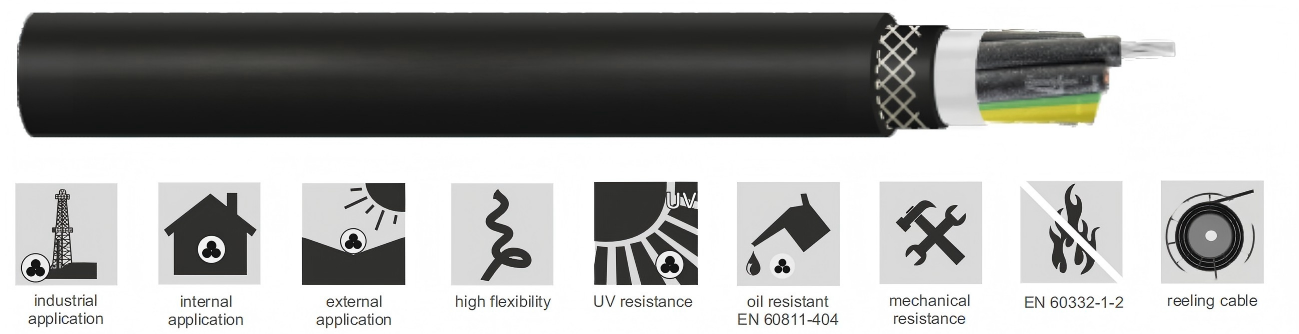
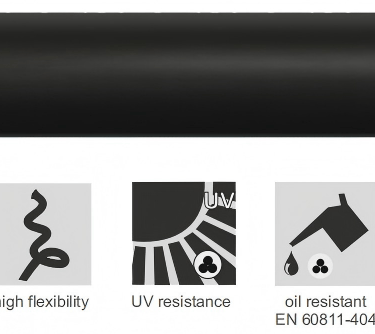
High flexibility. The fine-stranded tinned copper conductors combined with EPR insulation and rubber sheathing produce a genuinely flexible cable that bends and moves easily without fighting the reel or fatiguing prematurely. Flexibility is not a luxury in reeling service, it is the foundation of long cable life.
Strong mechanical durability. The vulcanized synthetic-thread reinforcement, the bonded sheath construction, and the heavy-duty rubber jacket give the cable outstanding resistance to the tensile and torsional forces that define reeling duty. This is a cable built to absorb mechanical punishment for years.
Reliable grounding safety. The "-J" designation guarantees a dedicated green/yellow protective earth conductor, providing the essential safety earthing path that protects equipment and personnel. In any power application, and especially in high-power crane systems, this grounding integrity is non-negotiable.
Suitability for harsh industrial environments. With resistance to oil, ozone, UV, and moisture, an +80 °C ambient capability, and unrestricted indoor and outdoor use, the cable is engineered to thrive in exactly the punishing conditions found in Middle Eastern ports, terminals, and industrial sites. Sun, salt air, dust, heat, and continuous mechanical stress are the cable's normal operating environment, not its limits.
Together, these advantages translate into the outcome operators care about most: dependable power delivery, fewer failures, less downtime, and a longer, safer service life.
Selection Tips: How to Specify the Right Cable
Choosing the correct reeling cable for a specific application requires checking several key parameters against the demands of your system. Use the following checklist to guide your selection.
1. Check the Voltage Rating
Confirm that the cable's rated voltage (0.6/1 kV) meets or exceeds the system voltage of your crane or equipment power supply. For standard low-voltage crane circuits, this rating is appropriate. Always verify against the actual operating voltage of your installation and ensure adequate margin.
2. Check the Reeling Speed
Match the cable's reeling speed rating (up to 120 m/min) to the travel and reeling speed of your equipment. Fast-moving cranes and gantries cycle their reels rapidly, and the cable must be rated for at least the maximum reeling speed of the system. Specifying a cable rated below your reel's operating speed invites accelerated wear and early failure.
3. Check the Bending Radius
Verify that every bend point in your reeling system, the reel drum core, the deflection rollers, and the guide sheaves, respects the cable's minimum bending radius requirements (6 × Ø for reeling, 7.5 × Ø on deflection pulleys, and 20 × Ø spacing for S-type reversals). This is one of the most commonly overlooked specification points, and getting it wrong is a frequent cause of premature failure. If your existing equipment has small-diameter reel cores or rollers, you must confirm the cable can tolerate the resulting bend, or modify the equipment.
4. Check the Torsion Requirement
Assess the torsional stress your reeling system imposes and confirm it falls within the cable's ± 25 °/m rating. Spiral reels and certain drum configurations impose significant twist on the cable, and the torsion rating must cover your system's actual demands. Torsion is a silent killer of underspecified reeling cables, so this check matters.
5. Check the Environmental Exposure
Finally, evaluate the environmental conditions: oil and chemical contact, abrasion against rollers and guides, moisture and humidity, UV and ozone exposure, and ambient temperature extremes. The NSHTOEU-J's resistance to oil, ozone, UV, and moisture, together with its wide temperature range, makes it well suited to harsh conditions, but you should always confirm that the specific exposures at your site, particularly the high ambient temperatures and intense solar radiation typical of the region, are within the cable's ratings. Remember to apply the appropriate thermal and reeling de-rating factors when sizing the conductor cross-section.
A Practical Note on Sizing and Cross-Sections
The cable is available in a wide range of cross-sections and core counts, from smaller control cables with many cores (for example multi-core 1.5 mm² and 2.5 mm² control versions) up to large power conductors of 240 mm² and beyond, including combined constructions that pair main power cores with reduced-size protective conductors. This breadth means you can specify a single cable family across both the power and control circuits of a crane system. When sizing, base your conductor cross-section on the de-rated current-carrying capacity for your actual installation conditions, not on idealized table values, and consult the manufacturer where custom cross-sections or core counts are required, as bespoke configurations are typically available on request.
Conclusion
In the demanding world of cranes, ports, and heavy material-handling equipment, the cable that delivers power to moving machinery is one of the most critical, and most stressed, components in the entire system. The NSHTOEU-J reeling cable is purpose-built for this role. It is a standards-compliant, heavy-duty rubber-sheathed reeling cable engineered specifically for the simultaneous tensile and torsional stresses that define reeling service, and it is rated to deliver low-voltage power safely and reliably while in constant motion.
Its construction, fine-stranded tinned copper conductors, flexible EPR insulation, a stable rubber inner sheath, a vulcanized anti-torsion reinforcement braid, and a tough weather-resistant outer sheath, forms an integrated mechanical system designed to survive millions of bending and twisting cycles. Its electrical ratings, 0.6/1 kV operating voltage, 90 °C conductor temperature, and 200 °C short-circuit capability, match the real demands of crane power supply. And its mechanical ratings, reeling speeds up to 120 m/min, ± 25 °/m torsional resistance, defined bending radii, and a wide temperature range up to +80 °C ambient, confirm its ability to perform in the hottest, most punishing industrial environments.
For engineers and procurement teams across the Middle East specifying cable for STS cranes, RTG and RMG yard cranes, stackers and reclaimers, drum and reel systems, and material-handling machinery, the NSHTOEU-J represents a sound, durable, and safe choice. It combines high flexibility, strong mechanical durability, reliable grounding safety through its green/yellow protective conductor, and proven suitability for harsh, hot, outdoor industrial conditions.
When the application involves dynamic crane duty, repeated reeling, and the relentless combination of mechanical stress and environmental exposure, the NSHTOEU-J is the cable engineered to keep the power flowing, the equipment running, and the people working around it safe. In an operation where downtime is measured in lost revenue and where safety can never be compromised, that reliability is exactly what matters most.
Port crane cables | Mining cables | Reeling cables | Trailing cables | Festoon cables | Heavy-duty power cables | Medium voltage cables | Offshore crane cables | Underground mining cables | Dragline cables | Shearer cables | Container handling cables | STS crane cables | RTG cables | Mobile equipment cables | Armored cables | Flexible power cables | VFD cables | Submersible cables | Cold resistant cables | Abrasion resistant cables | Flame retardant cables | Marine environment cables | Opencast mining | Underground operations
© 2006 All rights reserved.
[INDUSTRIAL_CABLES]
INDUSTRIAL GRADE CABLE SYSTEMS | PORT & MINING SOLUTIONS
TEL: +86 153 7530 2641 |MAIL: hongjing.Wang@feichuncables.com