NSHTOEU-J vs (N)TSCGEWOEU: Which Reeling Cable Is Better for Your Port Crane?
A practical engineering comparison of NSHTOEU-J and (N)TSCGEWOEU reeling cables for port cranes: construction, mechanical performance, voltage, applications, cost logic, and a clear selection guide to match the right cable to your duty cycle.
hongjing.Wang@Feichun
6/24/202613 min read
Introduction
In ports and terminals across the Middle East, the cranes that load and unload vessels, stack containers, and move bulk cargo never stop moving, and neither do the cables that power them. These reeling cables are not passive components bolted to a wall. They are working, moving parts of the machine, flexing, twisting, and winding onto drums thousands of times every day under brutal sun, salt-laden humidity, and abrasive dust. When the cable is right, the crane runs reliably for years. When the cable is wrong, the crane stops, the vessel waits, and the terminal loses money by the hour.
This is why port crane cable selection matters so much. The cable feeding a crane is one of the most mechanically stressed and operationally critical components in the entire system, yet it is often chosen on price alone or specified from habit rather than from a careful matching of cable to duty cycle. That mismatch is one of the most common, and most expensive, mistakes in crane procurement.
Two cable families come up again and again when engineers and buyers evaluate options for crane and material-handling reeling applications: the NSHTOEU-J low-voltage heavy-duty reeling cable and the (N)TSCGEWOEU medium-voltage high-dynamic reeling cable. They are often compared directly because they occupy adjacent but distinct positions in the reeling cable landscape. One is the robust, practical workhorse for standard heavy-duty reeling; the other is the premium, high-performance choice for the most severe dynamic and higher-voltage applications. Buyers naturally want to know: which one is right for my equipment?
The goal of this article is to answer that question clearly and practically. We will define each cable, examine how they differ at the structural level, compare their mechanical performance, map out where each one belongs, work through the cost and procurement logic, and finish with a concrete selection guide. By the end, you will be able to match the right cable to your specific crane, your specific duty cycle, and your specific operating environment, rather than guessing or over-paying or, worse, under-specifying.
A note on philosophy before we begin: the central theme running through this entire comparison is that reeling cables are selected by their mechanical limits, not just their electrical rating. Both of these cable families are engineered first and foremost around bending, torsion, travel speed, tensile load, and environmental exposure. The voltage rating tells you only part of the story. The duty cycle tells you the rest, and it is usually the deciding factor.
What Is NSHTOEU-J?
NSHTOEU-J is a heavy-duty, low-voltage rubber reeling cable designed for demanding crane and material-handling applications. It is built for use under high mechanical stress, especially the simultaneous combination of tensile (pulling) and torsional (twisting) stress that defines reeling service, and it is suitable for all types of mobile equipment such as stackers, reclaimers, and container handling equipment in ports and stockyards served by motor-driven mono spiral, cylindrical, or spring-operated reels.
Voltage Rating: 0.6/1 kV
The cable carries a rated voltage of 0.6/1 kV, the standard low-voltage rating for industrial power distribution. This is precisely the rating needed for the great majority of crane motor and power supply circuits operating at low voltage. It supports a maximum permissible operating voltage of 0.7/1.2 kV in AC systems and 0.9/1.8 kV in DC systems, and withstands an AC test voltage of 2.5 kV, giving a healthy margin above the working voltage.
Typical Construction
The NSHTOEU-J is built from the conductor outward as an integrated mechanical system:
Conductors: finely stranded tinned copper wires to IEC 60228 Class 5 (the flexibility class), providing the fatigue resistance needed for repeated bending and corrosion protection valuable in humid coastal air.
Insulation: EPR (ethylene propylene rubber) compound, type 3GI3, flexible across a wide temperature range with strong electrical and weathering performance.
Inner sheath: heavy-duty rubber compound (quality 5GM3) filling the interstices between cores, creating a compact, stable, round cross-section.
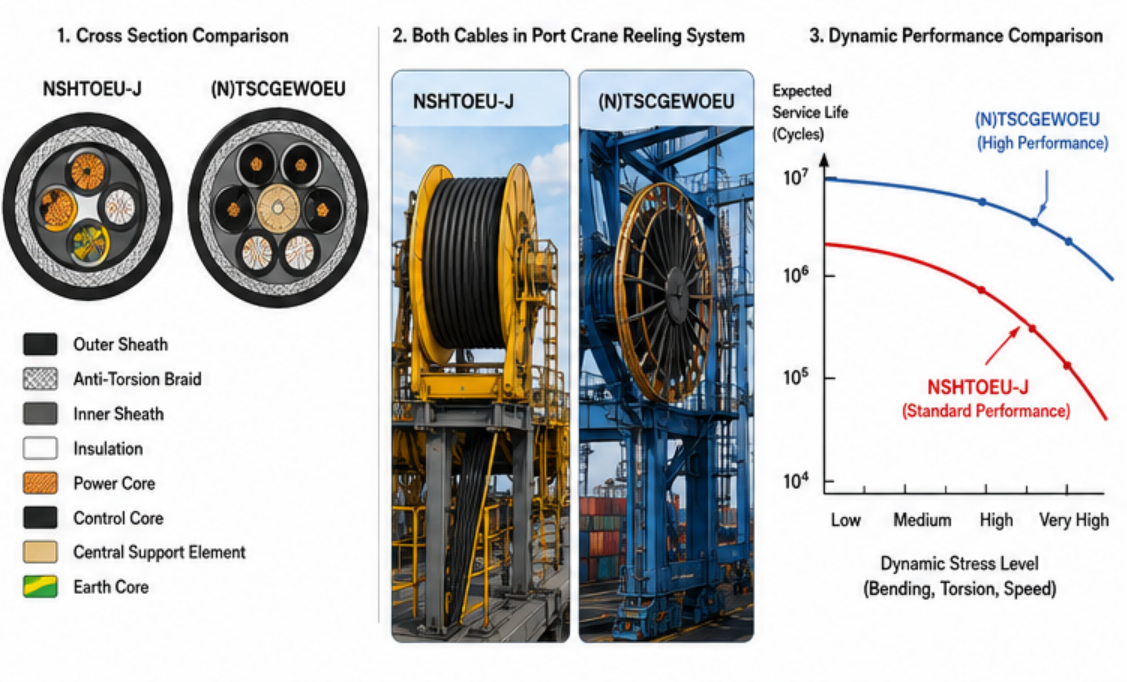
Reinforcement: a braid of synthetic threads in a vulcanized bond between the inner and outer sheath, the anti-torsion backbone that carries tensile and torsional loads so the conductors are protected.
Outer sheath: heavy-duty rubber compound (quality 5GM3), black, resistant to abrasion, oil, ozone, UV, and moisture.
Grounding core: a dedicated green/yellow protective earth conductor (the "-J" designation) of the same tinned, finely stranded Class 5 copper, providing the essential safety earthing path.
Main Strengths
The NSHTOEU-J's strengths are flexibility, durability, and cost efficiency. It is genuinely flexible thanks to its fine-stranded conductors and rubber construction, durable thanks to its vulcanized reinforcement and tough rubber sheath, and cost-effective because it delivers robust heavy-duty reeling performance without the added complexity and expense of medium-voltage construction. It operates across a wide temperature range (down to -40 °C in fixed installation, -30 °C during reeling, up to +80 °C ambient), handles a conductor temperature of 90 °C and a short-circuit temperature of 200 °C, and reels at speeds up to 120 m/min. For standard heavy-duty crane reeling, it is a proven, practical, dependable choice.
What Is (N)TSCGEWOEU?
(N)TSCGEWOEU is a medium-voltage, high-dynamic reeling cable family engineered for severe dynamic duty: high travel speeds, dynamic tensile loads, multiple changes of direction across different planes, churning over rollers, and continuous torsional stress. Where the NSHTOEU-J serves low-voltage applications, this cable steps up to medium voltage and to the most demanding mechanical conditions, making it suitable for large material-handling machines, advanced and automated port systems, and heavy mobile equipment such as draglines, shovels, dredges, and drills in the most extreme trailing and reeling operations.
Voltage Ratings: Medium Voltage
This is a medium-voltage family spanning multiple voltage classes, with available ratings extending across the medium-voltage spectrum, commonly including classes such as 3.6/6 kV, 6/10 kV, 8.7/15 kV, and 12/20 kV, with higher classes available in the broader family. Each class carries a correspondingly higher test voltage; for example, the 8.7/15 kV class is tested at 24 kV and the 12/20 kV class at 29 kV. This medium-voltage capability is the cable's defining electrical advantage, enabling it to deliver high power at lower current over longer feasible runs than any low-voltage cable could manage.
Typical Construction
The (N)TSCGEWOEU is a more complex, more heavily engineered construction reflecting its medium-voltage, high-dynamic role:
Phase conductors: Class 5 tinned copper, very finely stranded for maximum flexibility and fatigue resistance.
Insulation: high-grade rubber (EPR-based) compound providing dielectric strength and flexibility.
Semiconductive layers: an inner semiconductive layer over the conductor and an outer semiconductive layer over the insulation (plus a semiconductive tape), the electrical field-control system that is essential at medium voltage and entirely absent in low-voltage cables.
Earth conductor: Class 5 tinned copper, often split and distributed in the interstices for symmetry and compactness, with a semiconductive central filler on a textile support.
Inner sheath: a tough rubber or, in halogen-free variants, polyurethane compound, sometimes serving additionally as a water barrier.
Anti-torsion braid: a reinforced polyester braid in a vulcanized bond between the inner and outer sheaths, delivering very high mechanical strength.
Outer sheath: a tough, abrasion- and tear-resistant compound (heavy-duty chloroprene/PCP rubber, or halogen-free polyurethane in ZH versions), resistant to oil, UV, ozone, and moisture.
Main Strengths
The (N)TSCGEWOEU's strengths are higher voltage capacity, superior dynamic performance, and a stronger anti-torsion design. The medium-voltage capability opens the door to high-power crane electrification. The semiconductive field control and heavily reinforced sheath system give it the endurance to survive the most severe, fastest, most aggressive reeling duty cycles, verified by demanding tests such as reversed bending and torsional stress testing. It operates across a wide temperature range (down to -50 °C in fixed installation, -25 to -35 °C in flexed operation depending on variant, up to +80 °C ambient) and handles very high reeling speeds. This is the premium tier of reeling cable, built for applications where performance and uptime matter more than initial cost.
Structure-Level Difference: Why the Construction Sets Them Apart
To understand which cable to choose, it helps to understand why their internal structures differ, because the structure is the real source of the performance difference.
NSHTOEU-J: The Standard Heavy-Duty Reeling Cable
The NSHTOEU-J is a well-engineered but relatively straightforward heavy-duty reeling construction. It has the essential elements every good reeling cable needs: fine-stranded flexible conductors, flexible EPR insulation, a stabilizing inner sheath, a vulcanized anti-torsion reinforcement braid, and a tough outer sheath, plus a protective earth core. This is a complete, capable mechanical system designed to survive repeated bending and twisting at low voltage. For the duty it is designed for, it lacks nothing.
(N)TSCGEWOEU: The Enhanced Cable for Severe Dynamic Use
The (N)TSCGEWOEU adds several layers of sophistication on top of that foundation. The most important addition is the semiconductive field-control system, the inner and outer semiconductive layers (and tape) that manage the intense electrical field present at medium voltage. A low-voltage cable does not need these; a medium-voltage cable cannot function reliably without them. Beyond the electrical additions, the medium-voltage cable typically employs an even more robust multi-layer sheath system, a heavier-duty reinforcement braid, a more sophisticated split-earth arrangement with a semiconductive central filler, and outer compounds (chloroprene or polyurethane) chosen for the most extreme abrasion and environmental resistance.
Why Internal Layers and Reinforcement Matter for Cable Life
Here is the simple engineering principle that ties it together: in a cable that moves constantly, more sophisticated internal structure and stronger mechanical reinforcement generally mean better endurance under repeated motion. Every bend and twist is a small mechanical insult, and the cable must absorb millions of them. A heavier reinforcement braid distributes tensile and torsional loads more effectively, protecting the conductors. A more robust multi-layer sheath better resists abrasion and the churning of rollers. The semiconductive layers, beyond their electrical role, are part of a more controlled, more uniform internal structure that resists the stress concentrations that initiate failure.
This does not mean the more complex cable is always the right answer. It means that as the duty cycle becomes more severe, faster, more torsionally demanding, higher voltage, the value of the enhanced construction grows. For moderate duty, the simpler cable's robustness is entirely sufficient and far more economical. For extreme duty, the enhanced construction's endurance becomes essential. The structure should match the stress.
Mechanical Performance Comparison
Because reeling cables live or die by their mechanical performance, this is where the comparison becomes most decision-relevant. Notably, both cables share the same headline torsional rating of ± 25 °/m, which tells you that both are serious anti-torsion designs. The differences emerge in the severity and speed of the duty each is built to sustain.
Bending Life
Both cables are designed for repeated bending, with defined minimum bending radii expressed as multiples of cable diameter. The NSHTOEU-J specifies, for reeling applications, a minimum bending radius of at least 6 times the cable diameter, rising to 7.5 times on deflection pulleys, with a 20 × diameter spacing for S-type reverse bends. The (N)TSCGEWOEU family, built for more severe service, similarly defines flexed bending radii (commonly around 10 times the overall diameter in flexed operation for some medium-voltage variants) and the same 20 × diameter spacing for S-type reversals, reflecting the heavier construction.
In practice, the more heavily reinforced medium-voltage cable is better suited to severe, high-cycle repeated bending over the long term. Its enhanced sheath and reinforcement system are engineered to endure the most aggressive bending regimes. The NSHTOEU-J performs very well under normal crane reeling bending duty, but for the harshest, highest-cycle bending applications, the (N)TSCGEWOEU has the structural edge.
Anti-Torsion Ability
Both cables are rated at ± 25 °/m torsional stress, and both achieve this through a vulcanized anti-torsion braid bonded between the sheaths. However, the (N)TSCGEWOEU's heavier reinforcement and more sophisticated bonded sheath system give it the stronger overall anti-torsion robustness for sustained extreme twisting, and its design is verified by dedicated torsional stress testing for the most demanding applications. For systems that impose severe, continuous torsion, particularly spiral reels on fast, large cranes, the medium-voltage cable is the stronger option.
Speed Adaptation
This is one of the clearest differentiators. The NSHTOEU-J is rated for reeling speeds up to 120 m/min, which comfortably covers conventional and moderately fast crane reeling. The (N)TSCGEWOEU family is built for far higher speeds, with some medium-voltage variants rated for effectively unrestricted gantry reeling speed (with manufacturer consultation recommended only at very high speeds well beyond 120 m/min). For fast and aggressive reel systems, especially high-speed ship-to-shore cranes and automated terminals, the medium-voltage cable is specifically engineered to keep up.
Tensile Load
Both cables carry substantial tensile loads through their reinforcement systems, with dynamic ratings reflecting the higher forces of active acceleration. The NSHTOEU-J is rated for static/dynamic tensile loads of 15/20 N/mm². The medium-voltage family carries comparable or higher tensile ratings, with dynamic acceleration loads rated even higher in the most demanding designs, reflecting the larger, faster machines it serves.
The Bottom Line on Mechanics
The NSHTOEU-J still performs well, indeed excellently, for normal crane reeling duty. It is a capable, durable, proven reeling cable. But it is not the first choice for the harshest dynamic systems. When the application pushes into very high speeds, extreme repeated bending, sustained severe torsion, and the largest machines, the (N)TSCGEWOEU's enhanced construction is purpose-built to deliver the endurance that those conditions demand.
Application Scenarios: Where Each Cable Belongs
The cleanest way to choose is to match the cable to the application, because application severity, more than any single specification, should guide the decision.
Where NSHTOEU-J Fits
The NSHTOEU-J is the natural choice for conventional, moderate-duty, low-voltage reeling applications:
Conventional port cranes operating at low voltage and moderate speeds.
Moderate-duty material-handling equipment.
Cable drum and reel systems on standard machines.
Stackers and reclaimers in bulk terminals and stockyards.
Shiploaders and similar bulk-handling equipment.
In all of these, the duty is genuinely heavy but not extreme: the speeds are moderate, the voltage is low, and the bending and torsion, while real, fall well within the cable's robust capabilities. Here, the NSHTOEU-J delivers exactly the right balance of performance and value.
Where (N)TSCGEWOEU Fits
The (N)TSCGEWOEU is the choice for severe, high-dynamic, or medium-voltage applications:
Automated container terminals running continuously at high speed.
High-speed ship-to-shore (STS) crane systems.
Continuous-duty drum reeling power systems operating around the clock.
Long-travel and high-demand crane equipment where medium voltage enables longer runs.
The heaviest mobile equipment, draglines, shovels, dredges, and large material-handling machines, under extreme mechanical stress.
In all of these, the duty is at the extreme end: very high speeds, sustained severe mechanical stress, medium-voltage power demands, or all three at once. Here, the enhanced construction is not a luxury, it is a necessity.
Let Severity, Not Price, Lead
The key principle is that application severity should guide the cable choice more than price alone. A buyer who selects the cheaper cable for an application that genuinely demands the premium one is not saving money; they are deferring a much larger cost. Conversely, a buyer who specifies the premium medium-voltage cable for a moderate low-voltage application is over-engineering and over-paying. The right move is to honestly assess the severity of the duty cycle, the voltage requirement, the speed, the bending and torsion demands, the environment, and let that assessment lead.
Cost and Procurement Logic
Price matters in every procurement decision, but in reeling cable it must be understood through the lens of total cost of ownership, not just the purchase price.
NSHTOEU-J: Better Value for Standard Heavy-Duty Use
For standard heavy-duty, low-voltage reeling applications, the NSHTOEU-J offers better value for money. Its construction is robust but not over-complex, its materials are appropriate to its duty, and its price reflects that. When the application genuinely falls within its capabilities, paying more for a premium medium-voltage cable would deliver no operational benefit, the extra capability would simply sit unused. In this zone, the NSHTOEU-J is the economically rational choice.
(N)TSCGEWOEU: Higher Price, Justified by Performance and Uptime
The (N)TSCGEWOEU carries a higher price, reflecting its medium-voltage construction, semiconductive layers, heavier reinforcement, and more demanding manufacturing. But that higher price is justified when performance and uptime are the priority. In a high-speed automated terminal, the cost of the cable is trivial compared to the cost of an unplanned crane stoppage. When the application demands the premium cable's performance, paying for it is the economically rational choice.
Total Cost of Ownership
The crucial concept here is total cost of ownership, which includes far more than the purchase price:
Replacement downtime: the cost of stopping a crane to change a failed cable, often far exceeding the cable's price, especially when a vessel is waiting.
Maintenance risk: the operational and safety risks of cable failure under load.
Service life: a cable matched to its duty lasts far longer, spreading its cost over many more operating hours.
Spare and inventory costs: frequent failures drive up spare-holding and labor costs.
When all of these are accounted for, the calculus often shifts. A cable that costs more up front but runs reliably for years in a demanding application is usually far cheaper over its life than a cheaper cable that fails repeatedly under stress it was never designed to handle.
The Core Procurement Truth
This leads to the single most important procurement insight in this entire comparison: choosing the wrong cable can be more expensive than buying the higher-spec one. Under-specifying to save money on the purchase price is a false economy when the application is severe, because the savings are quickly erased by downtime, replacements, and risk. The goal is not to buy the cheapest cable, nor the most expensive, but the one correctly matched to the duty, which delivers the lowest total cost of ownership.
Selection Guide
Here is a practical, decision-oriented guide to choosing between the two.
Choose NSHTOEU-J If:
The project is moderate-duty heavy reeling, within the capabilities of a robust low-voltage cable.
The project is budget-sensitive and the application does not demand premium performance.
The voltage demand is low (0.6/1 kV class), with no medium-voltage requirement.
Reeling speeds are moderate (up to around 120 m/min).
The equipment is conventional: standard cranes, stackers, reclaimers, shiploaders, drum systems.
Choose (N)TSCGEWOEU If:
The project is high-speed, with fast, aggressive reel systems.
The project is high-dynamic, with severe repeated bending, sustained torsion, and extreme mechanical stress.
The project requires medium voltage (3.6/6 kV, 6/10 kV, 8.7/15 kV, 12/20 kV, or higher).
The application is an automated terminal, high-speed STS crane, continuous-duty system, or long-travel installation.
The equipment is the largest and most demanding: heavy mobile machines under extreme duty.
Always Check These Parameters Before Final Selection
Regardless of which way you are leaning, verify the following against your actual system:
Bending radius: confirm that every bend point, the reel core, deflection rollers, and guide sheaves, respects the cable's minimum bending radius. Too-tight bends are a leading cause of premature failure.
Torsion: assess the torsional stress your reel system imposes and confirm it falls within the ± 25 °/m rating (shared by both cables).
Travel speed: match the cable's reeling-speed rating to your equipment's maximum speed. This is often the clearest differentiator between the two cables.
Environmental exposure: confirm resistance to the specific conditions at your site, UV, ozone, moisture, oil, salt humidity, and high ambient temperature (both rate to +80 °C ambient, with proper thermal and reeling de-rating applied when sizing).
Installation layout: consider the routing, the direction changes, and the overall mechanical demands of the specific installation.
Don't Forget the Reel System
One frequently overlooked point: the cable and the reel system must be considered together. The reel design and drum parameters, the drum core diameter, the reeling mechanism (mono spiral, cylindrical, spring-operated, or motor-driven), and the guide geometry, directly determine the bending and torsional demands placed on the cable. A cable can only perform to its rating if the reel system respects its limits. Checking the cable against the reel system, not in isolation, is essential to a sound final selection.
Conclusion
The difference between these two cables can be summarized in a single sentence: NSHTOEU-J is the practical, robust choice for standard heavy-duty port crane reeling applications, while (N)TSCGEWOEU is the premium choice for higher dynamic performance, faster motion, medium-voltage power, and more demanding operating conditions.
The NSHTOEU-J earns its place as the practical workhorse. It is a genuinely heavy-duty, flexible, durable, low-voltage reeling cable that handles conventional crane reeling, stackers, reclaimers, shiploaders, and moderate-duty material handling with reliability and cost efficiency. For the large majority of standard low-voltage reeling applications, it is exactly the right tool, robust where it needs to be, economical where it can be.
The (N)TSCGEWOEU stands as the premium, high-performance option. With its medium-voltage capability, semiconductive field control, heavier reinforcement, and superior dynamic endurance, it is engineered for the most severe applications: automated terminals, high-speed ship-to-shore cranes, continuous-duty and long-travel systems, and the largest, most demanding mobile equipment. Where performance, speed, voltage, and uptime are paramount, it delivers the endurance that lesser cables cannot.
The buyer-oriented takeaway is this: match the cable to the duty cycle, not just to the crane nameplate. The crane's size and rating are only the starting point. The real determinants are how fast the reel moves, how severely the cable bends and twists, what voltage the system demands, and how harsh the environment is. Assess those honestly, account for total cost of ownership rather than purchase price alone, and the right choice becomes clear. Choose the NSHTOEU-J when the duty is standard and the value matters; choose the (N)TSCGEWOEU when the duty is severe and the performance is worth it. Get that match right, and the cable will keep your cranes moving, your terminal productive, and your operation safe for years to come.
Port crane cables | Mining cables | Reeling cables | Trailing cables | Festoon cables | Heavy-duty power cables | Medium voltage cables | Offshore crane cables | Underground mining cables | Dragline cables | Shearer cables | Container handling cables | STS crane cables | RTG cables | Mobile equipment cables | Armored cables | Flexible power cables | VFD cables | Submersible cables | Cold resistant cables | Abrasion resistant cables | Flame retardant cables | Marine environment cables | Opencast mining | Underground operations
© 2006 All rights reserved.
[INDUSTRIAL_CABLES]
INDUSTRIAL GRADE CABLE SYSTEMS | PORT & MINING SOLUTIONS
TEL: +86 153 7530 2641 |MAIL: hongjing.Wang@feichuncables.com