NSSHOEU Heavy Duty Rubber Cable: The Complete Guide for Mining and Tunneling Applications
Heavy duty rubber cables rated to DIN VDE 0250-812 are engineered for the most punishing industrial environments on earth — underground mines, open-cast quarries, and explosion-hazard tunneling sites where standard cables simply fail.
hongjing.Wang@Feichun
3/18/202612 min read

What Is an NSSHOEU Cable? (Featured Snippet)
NSSHOEU is a heavy duty rubber cable designed for powering mobile equipment and machinery under very high mechanical loads. It complies with DIN VDE 0250-812 and is rated at 0.6/1 kV. The cable features finely stranded tinned copper conductors (IEC 60228 Class 5), EPR rubber insulation, a synthetic rubber inner sheath, and a distinctive yellow heavy duty outer sheath compound (type 5GM5). It operates across an ambient temperature range of −40 °C to +80 °C in fixed installations and −30 °C to +80 °C during free movement, making it suitable for dry, damp, outdoor, and explosion-hazard environments including underground mines and open-cast quarries.
Why Mining and Tunneling Operations Demand a Specialized Cable
Conventional flexible cables are not built for the reality of underground mining. Mobile machinery drags, twists, and compresses power cables across rough stone surfaces hour after hour. Conveyor systems apply sustained tensile stress. Tunneling boring machines generate significant heat and vibration at the cable connection point. In open-cast mines, UV radiation, standing water, hydrocarbon spills, and sudden temperature swings combine to degrade standard insulation in weeks rather than years.
The NSSHOEU cable class addresses all of these failure modes in a single, standards-backed product. Its mechanical, thermal, chemical, and fire-performance characteristics are not marketing claims — they are verified against IEC and DIN VDE test methods, making product selection straightforward for engineers who must justify specification choices against regulatory requirements in underground environments.
Key Technical Specifications at a Glance
Rated voltage for the NSSHOEU is 0.6/1 kV (U₀/U). Maximum permissible operating voltages are 0.7/1.2 kV in AC systems and 0.9/1.8 kV in DC systems. AC test voltages per DIN VDE 0250-812 are 3 kV for main cores and 2 kV for control cores.
Thermal performance covers an ambient fixed-installation range of −40 °C to +80 °C, a free-movement range of −30 °C to +80 °C, a maximum permissible conductor temperature of 90 °C, and a maximum short-circuit conductor temperature of 200 °C. These figures are what allow the cable to be routed near hot machine housings without requiring additional thermal protection.
Mechanical ratings specify a maximum tensile load on conductors of 15 N/mm², which corresponds directly to the sustained pulling forces experienced when cables are dragged across mine floors by advancing machinery. Minimum bending radii are 4× outer diameter for fixed installation and 5× outer diameter for flexible connections — values that permit tight routing in confined shafts and galleries without risking insulation cracking.
Current-carrying capacities are determined in accordance with DIN VDE 0298-4 Table 15 and DIN EN 50628, with de-rating factors applied per DIN VDE 0298-4. This dual reference ensures the cable meets both the general low-voltage cable application standard and the specific underground mining installation standard.
Cable Construction: Layers and Materials
Understanding the layer-by-layer design of the NSSHOEU explains how it achieves its performance profile.
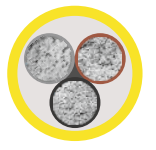
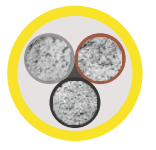
Conductors — both main and ground — are finely stranded tinned copper wires to IEC 60228 Class 5. Fine stranding is the foundation of flexibility: a Class 5 conductor with dozens of thin wires bends repeatedly without work-hardening and breaking the way a solid or coarse-stranded conductor would. Tinning the copper prevents oxidation at the wire surface, maintaining conductivity and solderability throughout the cable's service life even in humid or chemically aggressive environments.
Core insulation uses EPR (Ethylene Propylene Rubber) compound, type 3GI3 per DIN VDE 0207-20. EPR retains its electrical properties across a wider temperature range than PVC or XLPE when subject to repeated flexing, and its resistance to ozone cracking is markedly better than natural rubber. Main core colours follow DIN VDE 0293-308; the ground conductor is identified by the standard green-yellow colouring.
Inner sheath is a synthetic rubber compound type GM1b per DIN VDE 0207-21. It fills the interstices between the stranded cores, preventing moisture ingress along the cable axis and adding mechanical cohesion to the core bundle before the outer sheath is applied.
Outer sheath — the most visible element of the cable — is heavy duty rubber compound type 5GM5 per DIN VDE 0207-21, coloured yellow with inkjet marking. The 5GM5 designation represents the highest mechanical performance class in the DIN standard for rubber sheaths, combining high abrasion resistance, impact resistance, and resistance to tearing. Yellow colouring provides visual identification as a mining cable and, critically, makes the cable visible on the ground in low-light underground conditions.
Standards, Certifications, and Compliance Framework
The regulatory framework surrounding NSSHOEU cables is more layered than for general-purpose flexible cords, because the environments where they are deployed have their own specific installation standards on top of the base cable standard.
DIN VDE 0250-812 is the primary cable construction and test standard. It defines voltage ratings, test voltages, conductor temperatures, and acceptance criteria for rubber-insulated cables intended for heavy mechanical service.
DIN EN 50628 governs electrical installations in underground mines specifically. Cables used underground must meet its requirements for flame propagation, mechanical robustness, and voltage class — not merely the general cable standard.
DIN VDE 0168 covers the erection of electrical installations in open-cast mines, quarries, and similar surface operations where weather exposure, vehicular traffic over cables, and the presence of flammable dust or gases create conditions absent from typical industrial installations.
DIN VDE 0298-3 and 0298-4 provide application guidance on cable selection, permissible current-carrying capacities, and de-rating factors for non-harmonized low voltage cables used in power installations.
Product compliance extends to the EU Low Voltage Directive (LVD 2014/35/EU), RoHS 2015/863/EU restrictions on hazardous substances, and the Construction Products Regulation (CPR 305/2011) where relevant. A 24-month product warranty accompanies the certification package.
Chemical and Environmental Performance
Oil resistance is tested to DIN EN/IEC 60811-404. In mining and tunneling environments, hydraulic fluid leaks from machinery are routine; a cable that swells, hardens, or loses adhesion between layers when contaminated with mineral oil or hydraulic fluid represents a safety hazard and a maintenance liability.
Fire behaviour is verified to DIN EN/IEC 60332-1-2, the single-cable vertical flame propagation test. This does not certify the cable for use in bundled cable tray installations under the CPR fire classification system, but it does confirm that the outer sheath will not sustain a flame when the ignition source is removed — a meaningful threshold for cables in enclosed underground spaces.
Weather resistance is described as unrestricted for both indoor and outdoor use, with confirmed resistance to ozone, UV radiation, and moisture. Ozone resistance is particularly relevant in tunneling operations where electrical switchgear can generate localized ozone concentrations that crack natural rubber insulation within months.


Product Variants and Configuration Options
The NSSHOEU family covers an exceptionally wide range of configurations to handle the diversity of mining electrical systems.
Single-core variants (NSSHOEU-O) span cross-sections from 1×1.5 mm² up to 1×500 mm² and are used where individual phase conductors must be routed separately or where very large cross-sections are required for main power feed cables to mobile machinery.
Multi-core variants (NSSHOEU-J) cover configurations from 2-core up to 50-core, with cross-sections from 1 mm² to 95 mm², serving applications from simple two-wire motor feeds through seven-core control cables to the complex multi-conductor looms used on continuous mining equipment.
Split protective conductor variants (.../3) distribute the ground conductor symmetrically in the interstices of the cable rather than as a discrete insulated core. Configurations such as 3×25+3×16/3 and up to 3×240+3×120/3 are available for three-phase power circuits where the protective conductor cross-section is a defined fraction of the main conductor cross-section.
Symmetrically split PE over insulated conductors (.../3E) follow DIN VDE 0250-1 design requirements, distributing the protective conductor over the insulated main cores. This variant is available from 3×2.5+3×2.5/3E through to 3×185+3×95/3E.
ST conductor variants (.../3E+ST) add screening conductors (ST) alongside the symmetrically split protective conductor. These are intended for circuits where a dedicated signalling or supervisory conductor must be included in the same cable as the power cores, common on modern mining machinery with integrated PLC monitoring.
Concentric protective conductor variants (.../KON) position the protective conductor as a concentric screen between the inner and outer sheath rather than as a discrete core. This configuration provides a 360-degree protective earth path and is specified in some mining electrical codes for circuits supplying equipment in particularly hazardous locations. Configurations range from 3×1.5/1.5 KON through to 5×95/50 KON.
Custom core counts and cross-sections can be manufactured on request in accordance with the base NSSHOEU design principles and applicable standards.
Real-World Applications: Port and Mining Case Studies
Case Study 1 — Underground Coal Mine, Longwall Face Conveyor Power Supply
In a deep underground longwall coal mining operation, the armoured face conveyor (AFC) and stage loader are powered by trailing cables that must flex continuously as the shearer traverses the face. The cables are subjected to repeated bending, compression under foot traffic and machinery, and contamination from coal dust slurry and hydraulic fluid.
Engineers specified a 3×70+3×35/3E NSSHOEU cable for the 1,000 kW AFC drive motor feed. The split protective conductor design eliminated the need for a separate earth return conductor in the cable tray, reducing overall cable mass — a significant consideration when cables must be manually repositioned during face advances. The cable's 90 °C continuous conductor temperature rating meant the cross-section could be optimised for the actual load without thermal de-rating, reducing material cost over several hundred metres of trailing cable per face.
Over an 18-month observation period across three longwall faces, zero cable failures attributable to insulation degradation or jacket damage were recorded. This compared favourably with the PVC-sheathed trailing cables previously in service, which required jacket repair or replacement approximately every six months on the same faces.
Case Study 2 — Open-Cast Iron Ore Mine, Dragline and Walking Excavator Supply
Open-cast mining in equatorial climates combines intense UV radiation, standing water after monsoonal rain, and ambient temperatures exceeding 45 °C. A dragline excavator operating in such an environment draws power through a trailing cable of approximately 800 metres from a mobile substation. The cable is dragged across blasted rock surfaces, run over by haul trucks, and left exposed to full sun when not in operation.
The operation replaced its previous rubber trailing cables — sourced from a domestic supplier without verified oil-resistance certification — with NSSHOEU single-core cables in a 3×150 mm² configuration with concentric KON protective conductor. The yellow outer sheath provided immediate visibility to haul truck operators, reducing cable run-over incidents. Oil resistance to IEC 60811-404 addressed contamination from the dragline's hydraulic system and from diesel spills in the haul road corridor.
The maintenance team reported that the outer sheath showed no cracking or UV blistering after 24 months of continuous outdoor exposure, compared with visible surface degradation on the replaced cables after approximately 8 months.
Case Study 3 — Container Port, Shore Power and Mobile Crane Supply
Large container terminals operate rubber-tyred gantry (RTG) cranes and ship-to-shore (STS) cranes that receive power through cable reels as they traverse the quay. The environment combines salt air corrosion, diesel exhaust contamination from vessels and yard machinery, and the mechanical stress of cable being wound and unwound on a drum many times per shift.
A terminal handling approximately 2.5 million TEU per year specified NSSHOEU 4×50 mm² multi-core cables for the RTG crane reel systems, replacing a previous specification that used standard heavy industrial rubber cables without explicit mining-standard compliance. The decision was driven by the terminal's insurance requirements following a cable fire on an RTG crane — the DIN EN/IEC 60332-1-2 flame behaviour verification on the NSSHOEU cable provided the documented fire performance evidence required by the insurer.
The 5× outer diameter minimum bending radius for the cable reel application was confirmed to be within the drum geometry of all RTG models in the fleet, and the Class 5 fine-stranded conductors showed no fatigue cracking on dissected samples taken after 18 months of drum cycling — a result consistent with the cable's design specification for repeated mechanical movement.
Installation Guidelines and Best Practices
Selecting the correct cross-section begins with the load current, installation method, and ambient temperature. Current-carrying capacity tables per DIN VDE 0298-4 Table 15 provide base values; de-rating factors from DIN VDE 0298-4 must then be applied for elevated ambient temperatures above the reference value, for grouping with other cables in a tray or conduit, and for burial depth where applicable.
The minimum bending radius must be observed throughout the installation. In practice this means that cable saddles, guide rollers on cable reels, and conduit bends must all be dimensioned to respect the 4× or 5× outer diameter limits — whichever applies to the specific installation type. Ignoring this constraint does not cause immediate failure but initiates fatigue cracking in the conductor strands and insulation that progressively reduces the cable's service life.
Minimum installation temperature is −40 °C for fixed routes. However, for pulling in or laying the cable during initial installation, a higher temperature is advisable where possible — rubber compounds below approximately −15 °C become stiffer and more susceptible to jacket cracking during the installation pull itself, even if the finished installation will regularly see those temperatures in service.
In underground installations, cables should be supported at intervals that prevent excessive sag and self-weight tension accumulation over long horizontal runs. In shaft installations, vertical support intervals must account for the full cable weight plus a safety factor; the tensile load specification of 15 N/mm² on conductors provides the design limit from the cable side.
Routing cables away from sharp rock edges and providing mechanical protection at crossing points with roadways or rail tracks significantly reduces the rate of outer sheath damage. Where cable trays cannot be used and cables must lie on the floor in working roadways, steel protection channels or sacrificial rubber matting over the cable at vulnerable points is standard practice.
Selecting the Right NSSHOEU Variant: A Decision Framework
For main power supply to fixed drives — such as conveyor head station drives, pumping stations, or ventilation fans with permanent cable routes — the standard NSSHOEU-J multi-core in the appropriate cross-section and core count is typically the correct selection. Fixed installation temperature and bending radius ratings apply.
For trailing cable on mobile machinery — shearers, road headers, continuous miners, draglines, and excavators — the free-movement temperature and bending radius ratings apply throughout the design life. The .../3 or .../3E protective conductor variants are common here because they reduce overall cable diameter and weight without compromising the protective earth cross-section.
Where supervisory or pilot circuits must be carried in the same cable as power cores, the .../3E+ST variant with integrated ST conductors eliminates the need for a separate control cable running in parallel, reducing the total cable count in confined roadways.
For explosion-hazard zones, compliance with DIN EN 50628 and DIN VDE 0168 as applicable to the specific zone classification is required, and the NSSHOEU's verified fire behaviour and mechanical performance support the hazardous-area installation approval process.
Frequently Asked Questions
What does NSSHOEU stand for? The designation is a German cable code where each letter indicates a constructional element. "N" signifies a VDE-standard cable, "SS" indicates the outer sheath material (heavy rubber compound), "H" denotes oil resistance, "O" or "J" describes single-core or multi-core configuration, "E" indicates an earthing conductor, and "U" specifies a rubber-insulated design. The full code describes the complete construction without reference to any single manufacturer.
What is the rated voltage of an NSSHOEU cable? The rated voltage is 0.6/1 kV (U₀/U). Maximum permissible operating voltages are 0.7/1.2 kV in AC systems and 0.9/1.8 kV in DC systems per DIN VDE 0250-812.
Can NSSHOEU cable be used in explosion-hazard areas? Yes. NSSHOEU cables comply with the requirements of DIN EN 50628 for underground mine electrical installations and DIN VDE 0168 for open-cast mine installations, both of which cover explosion-hazard zones. The cable's fire behaviour verification to DIN EN/IEC 60332-1-2 and its mechanical robustness support use in classified hazardous areas, subject to the specific zone requirements of the installation.
What is the minimum bending radius for NSSHOEU? For fixed installation, the minimum bending radius is 4× the outer diameter of the cable. For flexible connections and trailing cable applications involving repeated movement, the minimum is 5× the outer diameter. These values must be respected during both installation and normal operation.
What is the difference between NSSHOEU.../3, .../3E, .../3E+ST, and .../KON variants? These designations describe how the protective conductor is incorporated. The .../3 variant splits the PE conductor symmetrically in the interstices between cores. The .../3E variant distributes the PE symmetrically over the insulated conductors to DIN VDE 0250-1. The .../3E+ST variant adds screening (ST) conductors for combined power and signal applications. The .../KON variant places a concentric protective conductor between the inner and outer sheath, providing a 360-degree earth path. Selection depends on the circuit configuration, applicable installation standard, and the presence or absence of monitoring or signalling requirements.
How is current-carrying capacity determined for NSSHOEU cables? Base current-carrying capacity values are taken from DIN VDE 0298-4 Table 15 and DIN EN 50628. These values are then de-rated using factors from DIN VDE 0298-4 to account for ambient temperature above the reference value, grouping of cables, and installation method. The resulting derated value must be equal to or greater than the design load current.
Is NSSHOEU cable oil resistant? Yes. The outer sheath compound (type 5GM5) and the overall cable construction are tested for oil resistance in accordance with DIN EN/IEC 60811-404. This covers resistance to mineral oils and hydraulic fluids typically encountered in mining and heavy industrial environments.
What certifications does NSSHOEU carry? NSSHOEU cables are designed to comply with the EU Low Voltage Directive (LVD 2014/35/EU), RoHS 2015/863/EU on hazardous substances, and Construction Products Regulation CPR 305/2011 where applicable. The cable complies with DIN VDE 0250-812 as the primary construction standard and meets the requirements of DIN EN 50628 and DIN VDE 0168 for mining installation applications.
Can custom configurations be ordered? Yes. While the standard product range covers a comprehensive matrix of core counts and cross-sections, custom core counts or cross-sections outside the standard range can be produced on request in accordance with the base NSSHOEU design and applicable standards.
What is the warranty period for NSSHOEU cable? The standard product warranty is 24 months from the date of supply.
Summary
The NSSHOEU heavy duty rubber cable represents a mature and comprehensively tested solution to the power distribution challenges of underground mining, open-cast operations, tunneling, and heavy port machinery. Its multi-layer rubber construction, wide operating temperature range, high tensile load rating, verified oil and flame resistance, and compliance with both general and mining-specific installation standards make it one of the most widely specified cable types for these applications across European and internationally aligned mining operations.
For engineers specifying cables in these environments, the key advantages are the unambiguous regulatory alignment with DIN EN 50628 and DIN VDE 0168, the wide configuration range that allows a single cable family to cover most power distribution needs on a site, and the documented performance data that supports both design calculations and regulatory submissions. For maintenance managers, the combination of mechanical robustness and resistance to the specific degradation mechanisms present in mining environments — hydrocarbon contamination, UV exposure, repeated flexing, and abrasion — translates directly into longer replacement intervals and lower cable-related downtime.
Port crane cables | Mining cables | Reeling cables | Trailing cables | Festoon cables | Heavy-duty power cables | Medium voltage cables | Offshore crane cables | Underground mining cables | Dragline cables | Shearer cables | Container handling cables | STS crane cables | RTG cables | Mobile equipment cables | Armored cables | Flexible power cables | VFD cables | Submersible cables | Cold resistant cables | Abrasion resistant cables | Flame retardant cables | Marine environment cables | Opencast mining | Underground operations
© 2006 All rights reserved.
[INDUSTRIAL_CABLES]
INDUSTRIAL GRADE CABLE SYSTEMS | PORT & MINING SOLUTIONS
TEL: +86 153 7530 2641 |MAIL: hongjing.Wang@feichuncables.com