(N)TMCGCWOEU Medium Voltage Crane Cable: The Complete Guide for Shore Power and Energy Chain Applications
Discover how (N)TMCGCWOEU high-flexible medium voltage crane cables deliver reliable power for shore power systems, energy chains, and heavy-duty port cranes. Full technical specs, real Middle East port case studies, and installation best practices included.
hongjing.Wang@Feichun
3/19/202612 min read

Introduction: Why Flexible Medium Voltage Power Cables Are Now Mission-Critical
Modern ports are undergoing one of the most significant transformations in their history. Driven by decarbonization targets, automation mandates, and the rapid electrification of container handling equipment, port operators across the globe — and particularly across the Middle East — are replacing diesel-driven machinery with high-powered electric alternatives. With that shift comes an engineering challenge that is easy to underestimate: how do you reliably deliver medium voltage power to equipment that never stops moving?
Traditional rigid cables simply cannot meet this demand. Fixed cables crack under repeated flexing. Standard industrial cables lack the mechanical resilience to survive inside high-speed energy chain systems. And when a cable fails on a quayside container crane at 3:00 AM during peak vessel turnaround, the financial consequences are immediate and severe.
This is precisely the problem that the (N)TMCGCWOEU high-flexible medium voltage screened single-core cable was engineered to solve. Based on DIN VDE 0250-813, this cable is purpose-built for dynamic medium voltage applications — from slow-moving shore power systems to high-speed energy chains running on automated port cranes. In this guide, we cover everything engineers, procurement specialists, and port electrical engineers need to know: design principles, full technical specifications, real-world case studies from Middle Eastern port projects, and installation best practices.
What Is an (N)TMCGCWOEU Medium Voltage Crane Cable?
Featured Snippet Answer: An (N)TMCGCWOEU cable is a high-flexible, screened, single-core medium voltage power cable based on DIN VDE 0250-813, designed for dynamic industrial applications such as shore power systems, energy chains, and crane cable carrier systems. It features a Class 5 tinned copper conductor, EPR insulation, semi-conductive stress control layers, a concentric ground conductor, and a heavy-duty rubber outer sheath. It is rated for voltages between 3.6/6 kV and 18/30 kV and can operate in temperatures from −50 °C (fixed) or −35 °C (flexible) up to +80 °C ambient.
The designation breaks down systematically:
(N) — Indicates a standardized industrial cable design under German DIN VDE norms
T — Rubber insulated
MC — Medium voltage crane cable construction
GC — Concentric ground conductor (grounding layer)
W — Rubber outer sheath
OEU — Oil-resistant, UV-resistant, suitable for EU markets and CPR compliance
At its core, this is a cable engineered for movement. Unlike standard MV cables that tolerate only static installation or occasional repositioning, the (N)TMCGCWOEU is designed for tens of thousands of flex cycles across its service life — making it uniquely suited for the kinetic realities of port infrastructure.
Key Technical Specifications
Thermal Performance
The (N)TMCGCWOEU is rated for the full spectrum of industrial operating environments. For fixed installations, the ambient temperature range extends from −50 °C to +80 °C — covering arctic port facilities and desert-adjacent logistics hubs alike. For flexible operation (energy chains, reeling systems), the lower limit rises to −35 °C, still more than adequate for the vast majority of global port environments. Maximum permissible conductor temperature is 90 °C under continuous load, rising to 200 °C during short-circuit conditions — a critical safety margin in fault scenarios.
Mechanical Ratings
The cable is rated for a maximum tensile load of 15 N/mm² per conductor, reflecting its suitability for cable carrier and reeling drum systems where mechanical tension is a constant operational variable. Bending radius requirements are:
Fixed installation: minimum 6 × outer diameter
Free moving (energy chains, reeling): minimum 8 × outer diameter
These figures must be strictly respected during both installation and operation to preserve insulation integrity across the cable's service life.
Movement Speed Capabilities
Movement speed is where the (N)TMCGCWOEU truly differentiates itself from conventional MV cables. Typical operational speeds are:
Shore power cable systems: approximately 6 m/min (slow, controlled movement during vessel connection and disconnection cycles)
Energy chains on port cranes: 70 to 240 m/min (high-cycle, high-speed operation in fully automated crane environments)
The 240 m/min upper rating is particularly significant: this covers the fastest automated stacking crane energy chain systems currently deployed in tier-one container terminals worldwide.
Voltage Ratings
The cable is available in multiple voltage classes to match the electrical architecture of different facilities:
3.6/6 kV (smaller cross-sections, secondary distribution)
6/10 kV
8.7/15 kV
12/20 kV
14/25 kV
18/30 kV (largest cross-sections, primary crane supply)
Each voltage class carries its own AC test voltage per DIN VDE 0250-813, and de-rating factors apply according to DIN VDE 0298-4.
Cable Construction: Engineering Behind the Performance
Conductor
The conductor consists of tinned copper wires, finely stranded to Class 5 flexibility per DIN EN / IEC 60228. Class 5 is the highest flexibility classification in the IEC standard, specifically defined for applications with frequent movement. Tinning the copper wires provides two additional benefits: resistance to oxidation over decades of service, and improved solderability during termination — an important consideration in the humid marine environments where these cables are most commonly deployed.
Insulation System
The insulation system is a three-layer construction around the conductor:
The inner semi-conductive stress control layer smooths the electric field gradient at the conductor surface, eliminating local stress concentrations that could initiate partial discharge and eventual insulation breakdown.
The EPR (Ethylene Propylene Rubber) compound forms the primary dielectric layer, engineered to DIN VDE 0207-20 with improved electrical and mechanical characteristics over standard EPR. EPR is preferred over XLPE for dynamic applications because it maintains greater flexibility across wide temperature ranges and is more resistant to mechanical fatigue from repeated bending.
The outer semi-conductive insulation shield layer provides field uniformity at the insulation surface, reducing the electrical stress on the protective conductor and outer sheath.
Concentric Ground Conductor
The protective conductor is formed by spinning tinned copper wire strands concentrically around the insulated core, achieving approximately 85% coverage per DIN VDE 0250-1. This concentric geometry ensures that the grounding layer flexes uniformly with the cable — unlike braided or taped screens, which can develop stress concentration points in high-cycle applications.
The approximately 85% coverage figure is deliberately chosen: it provides effective screening against electromagnetic interference and a robust ground fault return path, while preserving flexibility that full coverage would compromise.
Outer Sheath
The outer sheath is a heavy-duty rubber compound, type 5GM5 per DIN VDE 0207-21. Its properties are specified to meet the demands of outdoor industrial environments:
Flame retardant: per EN 60332-1-2, limiting fire propagation along cable runs
Oil resistant: per EN 60811-404, resisting hydraulic fluids, lubricants, and diesel fuel common in crane machinery spaces
UV and ozone resistant: enabling unrestricted outdoor installation without protective conduit
Moisture resistant: suitable for direct exposure and water submersion to 10 bar (protection class AD8)
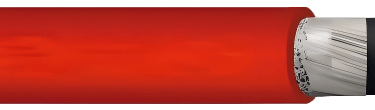
Color: Red — the internationally recognized identification color for medium voltage cables
The red sheath is not merely aesthetic. In the dense cable management environments of a modern crane pedestal or shore power umbilical rack, immediate visual identification of medium voltage circuits is a fundamental safety requirement.
Environmental and Chemical Resistance
The operational environments of port cranes and shore power systems are among the most chemically aggressive in any industrial setting. Salt-laden marine air accelerates surface degradation. Hydraulic oil and diesel contamination is routine in machinery spaces. Outdoor installations face decades of UV exposure in some of the world's highest solar irradiance environments — particularly in the Arabian Gulf and Red Sea coastal ports.
The (N)TMCGCWOEU addresses each of these hazards systematically. Oil resistance is tested and certified per DIN EN / IEC 60811-404. Weather resistance — covering ozone, UV, and moisture — is rated for unrestricted indoor and outdoor use without qualification. Water resistance extends to full submersion at pressures up to 10 bar, meeting protection class AD8.
For the Middle East specifically, the combination of UV resistance, high-temperature operation to +80 °C ambient, and oil resistance against the petroleum-based lubricants common in port machinery represents a compelling operational fit.
Real-World Applications: Middle East Port Case Studies
Case Study 1 — Khalifa Port Automated Container Terminal, Abu Dhabi, UAE
Khalifa Port is home to one of the most advanced automated container terminals in the Middle East. The terminal deploys a fleet of automated rail-mounted gantry cranes (ARMGs) operating in fully driverless mode across multiple parallel crane aisles. Each ARMG is powered through an energy chain system running along its rail, carrying medium voltage supply cables through continuous high-speed traversal cycles at movement speeds well within the 70–240 m/min range typical of automated crane energy chains.
The electrical design challenge at Khalifa Port was representative of next-generation port electrification: high conductor cross-sections were required to minimize I²R losses across long crane rail runs, while the mechanical demands of a 24/7 automated cycle precluded any cable that could not sustain tens of millions of flex cycles across a target service life of 20+ years. Medium voltage flexible crane cables meeting DIN VDE 0250-813 were selected specifically because no low-voltage alternative could deliver the required power at acceptable current densities without conductor cross-sections that would themselves become mechanically unworkable inside the energy chain.
Case Study 2 — Jebel Ali Port (Mina Jebel Ali), Dubai, UAE
Jebel Ali Port — the largest port in the Middle East and one of the busiest container facilities globally — has progressively electrified its fleet of super post-Panamax quay cranes and automated stacking cranes across multiple terminal expansions over the past decade. Shore power infrastructure was integrated into the quay design at several berths to enable vessels equipped for cold ironing to receive grid power while alongside, reducing auxiliary engine emissions in the port environment.
Shore power umbilical systems at Jebel Ali operate at medium voltage with cable management systems designed to accommodate the slow-movement cycle (approximately 6 m/min) of vessel connection and disconnection. The high ambient temperatures in the Arabian Gulf summer — regularly exceeding 45 °C air temperature, with radiated heat from quay concrete surfaces pushing effective cable surface temperatures significantly higher — made the +80 °C ambient rating and 90 °C conductor temperature rating of (N)TMCGCWOEU-class cables a practical minimum specification rather than a conservative safety margin.
Case Study 3 — King Abdullah Port, Rabigh, Saudi Arabia
King Abdullah Port on the Red Sea coast represents Saudi Arabia's newest major container terminal and one of the flagship projects of the Kingdom's Vision 2030 logistics investment program. From its design phase, the terminal was planned around automated quay cranes and remote-controlled stacking cranes, with electrification as the standard for all major material handling equipment.
The terminal's location on the Red Sea coast — combining high solar UV exposure, salt spray, elevated temperatures, and the sand-laden Shamal winds characteristic of the region — created a demanding specification baseline for all outdoor electrical infrastructure. Medium voltage crane cables were evaluated against their resistance to UV degradation, ozone cracking, and mechanical abrasion from wind-driven particulate. The concentric ground conductor design and rubber outer sheath of the (N)TMCGCWOEU class cables were specified in part because the concentric construction is inherently more resistant to the sheath distortion and wear that can occur in braided-screen cables subjected to repeated mechanical contact with energy chain link surfaces over extended operating cycles.
Why Flexible MV Cables Are Driving Port Electrification Forward
The demand for flexible medium voltage cables in ports is not a niche procurement consideration. It sits at the intersection of four major infrastructure trends reshaping the global container shipping industry.
Shore-to-ship power (cold ironing) is expanding from optional sustainability initiative to regulatory requirement. The International Maritime Organization's Carbon Intensity Indicator framework, combined with EU port regulations requiring shore power availability at major European berths, is creating a global market pull for shore power infrastructure. Every shore power installation requires a medium voltage umbilical capable of the slow, repeated movement of vessel connection cycles.
Crane automation is accelerating. The economic argument for automated quay cranes and automated stacking cranes now closes at lower throughput volumes than a decade ago, driven by falling automation technology costs and rising labor costs. Every automated crane is a new energy chain application requiring flexible MV cable.
Capacity expansion at Middle Eastern mega-ports — Jebel Ali, Khalifa Port, King Abdullah Port, Hamad Port in Qatar, and Sohar Port in Oman — is occurring at a scale and pace that places significant demand on qualified medium voltage flexible cable supply chains.
Grid quality requirements are tightening. As port electrical grids grow larger and crane loads grow heavier, harmonic management and ground fault detection systems become more sophisticated. The screened concentric ground construction of (N)TMCGCWOEU cables supports both functions — the continuous concentric screen provides a low-impedance ground fault return path, and the semi-conductive layers reduce radiated electromagnetic interference from the medium voltage circuit into adjacent control cable systems.
Installation Best Practices for Medium Voltage Flexible Cables
The performance advantages of high-flexible MV crane cables can be significantly undermined by improper installation. Engineers should pay particular attention to the following:
Bending radius compliance is the single most critical installation parameter. The minimum free-moving bending radius of 8 × outer diameter must be maintained throughout the cable's operational range of motion, not just at its resting position. Energy chain systems must be dimensioned such that the innermost layer of cables at the chain's minimum radius still satisfies this requirement at every point in the travel cycle.
Cable routing in energy chains requires attention to the cable's position within the chain. Medium voltage cables should occupy dedicated lanes or dividers that prevent contact with lower-voltage control cables. In multi-cable energy chain installations, physical separation between MV power cables and signal cables prevents capacitive coupling and provides the necessary clearance for the concentric screen to function as an effective electromagnetic barrier.
Tensile load management during installation is critical, particularly for large cross-section cables (240 mm² and above) where cable weight per meter is significant. The maximum tensile load of 15 N/mm² must not be exceeded during cable pulling operations or when the cable hangs vertically in reel drum systems. Proper cable pulling grips and tensile swivels should be used to distribute load across the conductor cross-section rather than concentrating it at termination points.
Termination and jointing in medium voltage cables requires certified MV jointing technology. The three-layer insulation system — including the semi-conductive stress control layers — must be properly prepared at each termination point using appropriate cutting tools and geometric techniques. Improper removal of semi-conductive layers is a leading cause of partial discharge activity at terminations, which can progress to insulation failure over months or years of service.
Grounding of the concentric screen requires attention at both ends of each cable length. The tinned copper concentric screen should be connected to the system earth at both termination points in solidly earthed systems, ensuring a complete low-impedance ground fault return path. Single-point grounding arrangements are applicable in specific system earthing configurations and should be determined by the system earthing design, not by installation convenience.
FAQ: (N)TMCGCWOEU Medium Voltage Crane Cable
Q: What does (N)TMCGCWOEU stand for, and what standard governs its design? A: (N)TMCGCWOEU is a cable designation under German industrial cable nomenclature. It describes a medium voltage, screened, single-core cable with rubber insulation and a heavy-duty rubber outer sheath, incorporating a concentric ground conductor. Its design is governed by DIN VDE 0250-813, the German standard for medium voltage crane and industrial flexible cables.
Q: What voltage ratings are available for (N)TMCGCWOEU cables? A: The cable is available in rated voltages of 3.6/6 kV, 6/10 kV, 8.7/15 kV, 12/20 kV, 14/25 kV, and 18/30 kV. Each voltage rating corresponds to specific AC test voltages and de-rating factors per DIN VDE 0298-4.
Q: What conductor cross-sections are available? A: Standard cross-sections range from 1×25/16 mm² (25 mm² conductor, 16 mm² ground) to 1×400/35 mm². Common sizes for crane main supply applications are 1×95/16 through 1×240/25, covering the majority of quay crane and stacking crane power requirements at medium voltage.
Q: How does (N)TMCGCWOEU differ from standard XLPE-insulated MV cable? A: Standard XLPE MV cables are designed primarily for fixed installation. Their insulation becomes stiffer at low temperatures and under repeated bending cycles. The (N)TMCGCWOEU uses EPR (Ethylene Propylene Rubber) insulation, which maintains flexibility across a much wider temperature range and is specifically rated for the continuous flex cycles required in energy chain and reeling applications. The concentric ground conductor construction also provides superior performance in dynamic applications compared to the tape-wrapped or braid screens used in many fixed-installation MV cables.
Q: Can (N)TMCGCWOEU cables be used underwater? A: Yes. The cable is rated for locations where it is completely covered with water and permanently subjected to pressures of up to 10 bar, which corresponds to protection class AD8. This makes it suitable for submerged cable runs at quay structures, dock installations, and offshore platform power applications.
Q: What is the typical service life of a medium voltage crane cable in an energy chain application? A: Service life in energy chain applications depends heavily on the number of flex cycles, movement speed, bending radius compliance, and environmental conditions. With correct installation, compliant bending radius, and properly dimensioned energy chain hardware, high-quality flexible MV cables of this class are designed to achieve service lives of 15 to 25 years in port crane applications.
Q: Are (N)TMCGCWOEU cables compliant with EU Construction Products Regulation (CPR)? A: Yes. The cable carries CPR (Construction Products Regulation 305/2011) compliance, as well as RoHS compliance per Directive 2015/863/EU, and UL certification (Certificate no. UL-US-2322574-2 / E524140-20230601).
Q: What is the maximum permissible ambient temperature for operation in the Arabian Gulf region? A: The cable is rated for ambient temperatures up to +80 °C in both fixed and flexible operation. The maximum conductor temperature is 90 °C under continuous load. For installations in the Arabian Gulf where summer air temperatures can exceed 45 °C, a thermal de-rating calculation per DIN VDE 0298-4 should be performed to confirm the appropriate conductor cross-section for the required continuous current.
Conclusion
The (N)TMCGCWOEU medium voltage crane cable represents the engineering response to a clear infrastructure imperative: the need to deliver reliable, high-power medium voltage electricity to equipment that moves continuously, in some of the world's most demanding thermal and chemical environments.
Its design — Class 5 tinned copper conductors, EPR insulation with semi-conductive stress control layers, concentric ground conductor, and heavy-duty rubber outer sheath — addresses the specific failure modes that eliminate conventional MV cables from dynamic applications. Its performance specifications, covering everything from −50 °C cold-bend resilience to 240 m/min energy chain speeds, map directly onto the operational requirements of the automated ports being built across the Middle East and beyond.
For electrical engineers specifying medium voltage cables for shore power systems, automated crane energy chains, or offshore power applications, the (N)TMCGCWOEU provides a technically defensible, standards-compliant, and field-proven solution — one that is backed by real operating experience in some of the highest-throughput container terminals on the planet.
For full technical specifications including cross-section-specific dimensional data, current carrying capacities, and conductor resistance values, refer to the manufacturer's product datasheet for BiTflex (N)TMCGCWOEU.
Port crane cables | Mining cables | Reeling cables | Trailing cables | Festoon cables | Heavy-duty power cables | Medium voltage cables | Offshore crane cables | Underground mining cables | Dragline cables | Shearer cables | Container handling cables | STS crane cables | RTG cables | Mobile equipment cables | Armored cables | Flexible power cables | VFD cables | Submersible cables | Cold resistant cables | Abrasion resistant cables | Flame retardant cables | Marine environment cables | Opencast mining | Underground operations
© 2006 All rights reserved.
[INDUSTRIAL_CABLES]
INDUSTRIAL GRADE CABLE SYSTEMS | PORT & MINING SOLUTIONS
TEL: +86 153 7530 2641 |MAIL: hongjing.Wang@feichuncables.com