NTSCGEWOEU Medium Voltage Reeling Cable Engineering Guide for Port Cranes in the UAE
Discover how NTSCGEWOEU medium voltage reeling cables provide reliable power supply solutions for UAE port cranes. Learn cable construction, voltage ratings, applications, and selection factors for STS, RTG, and heavy-duty crane systems.
hongjing.Wang@Feichun
7/28/202614 min read
Introduction
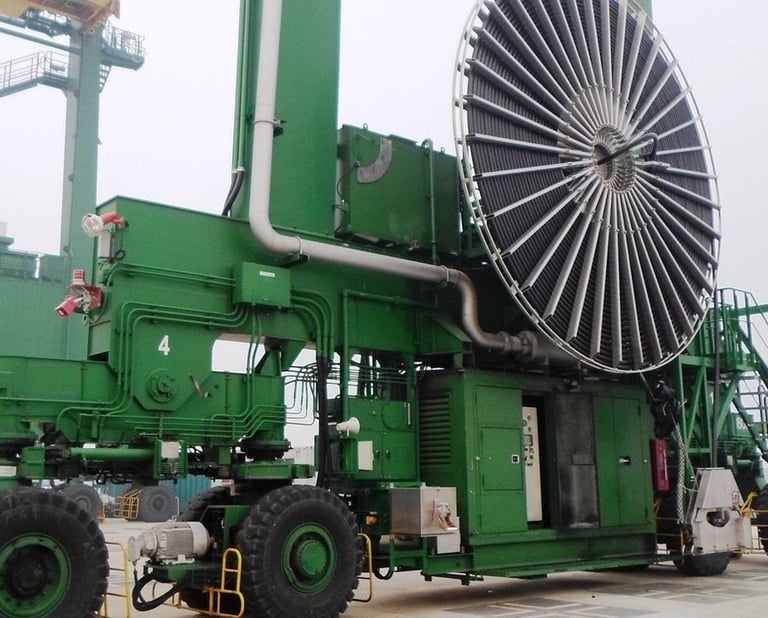
Container handling operations across the United Arab Emirates, including major hubs like Jebel Ali Port in Dubai, Khalifa Port in Abu Dhabi, and Fujairah Port, represent some of the most intensive logistics environments in the world. Ship-to-shore cranes, ship unloaders, stacker-reclaimers, and automated stacking cranes operate nearly continuously to keep global trade flowing smoothly.
Operating dynamic heavy machinery along the Arabian Gulf and Gulf of Oman exposes equipment to severe environmental and mechanical stress. Marine equipment in the UAE routinely faces ambient air temperatures exceeding 45 ℃ to 50 ℃, intense ultraviolet radiation, high humidity, salt-laden fog, abrasive silica sand dust, and potential oil contamination. At the same time, motorized reel systems subjected to fast travel speeds, rapid acceleration, directional reversals, and complex roller bending put constant dynamic mechanical strain on electrical cables.
Standard flexible power cables or conventional industrial rubber cords are not built to survive these combined environmental and mechanical demands. When standard cables are subjected to continuous reeling under harsh Middle Eastern weather, they quickly experience outer jacket cracking, structural twisting, insulation breakdown, and catastrophic electrical failure.
To ensure uninterrupted quay operations, terminal engineers require heavy-duty power lines designed specifically for dynamic, high-stress applications. The NTSCGEWOEU medium voltage reeling cable, manufactured according to DIN VDE 0250-813 standards, provides the necessary mechanical toughness, electrical reliability, and weather resistance for modern port equipment.
UAE PORT OPERATING ENVIRONMENT STRESSES [ Solar UV Radiation & Heat ] │ ▼ [ Dynamic Reeling Tension ] ───> CABLE <─── [ Salt Fog & High Humidity ] ▲ │ [ Fine Desert Sand & Oils ]
What Is NTSCGEWOEU Cable?
NTSCGEWOEU is a heavy-duty medium voltage rubber reeling cable designed according to German VDE standards. It is specifically engineered to power heavy mobile equipment under high to extreme dynamic mechanical stress.
Unlike stationary power cables or basic flexible trailing cables, NTSCGEWOEU is built from the ground up for continuous movement on motorized spooling reels, tender systems, and heavy cable drums. It handles high travel speeds, continuous dynamic tensile forces during startup and braking, repeated direction changes across multiple planes, crushing forces from guide rollers, and severe axial torsional twisting.
For port electrical engineers, technical procurement specialists, and maintenance directors in the UAE, the NTSCGEWOEU cable family—such as the high-performance medium voltage reeling series manufactured by Feichun—serves as a primary specification for medium voltage crane cables, dynamic reeling lines, and heavy-duty port power installations.
How To Understand The NTSCGEWOEU Designation
Understanding complex German cable designation codes can sometimes cause confusion during technical procurement. While every letter in the VDE naming convention refers to a specific structural feature or compound classification, technical teams should focus on the overall functional performance of the cable rather than relying strictly on literal letter-by-letter translations.
From an engineering perspective, the NTSCGEWOEU designation identifies a standardized German VDE industrial rubber cable engineered for heavy-duty reeling service:
N Classification: Denotes a standardized cable structure built according to VDE norms, ensuring complete structural uniformity and interchangeability for international machinery.
TSC Element: Signifies a medium voltage construction featuring specialized rubber insulation and dedicated semiconductive electrical field shielding layers over both the conductor and insulation.
Reeling Specification: Indicates that the internal stranded conductors, core layout, and braiding reinforcement are optimized for continuous winding, unwinding, and directional change over guide sheaves.
GEWOEU Heavy-Duty Rubber Sheathing: Highlights an advanced multi-layer synthetic rubber jacket system formulated for oil, water, ozone, weather, and severe mechanical abrasion resistance.
When reviewing project specifications or sourcing replacement stock for container cranes, engineers can trust the NTSCGEWOEU designation as a mark of proven mechanical strength and electrical reliability.
Why UAE Port Cranes Need This Cable
Modern ship-to-shore container cranes and large quayside bulk handling equipment operate under demanding electrical and mechanical cycles. As container ships grow larger, STS cranes require higher operating voltages, faster trolley travel speeds, and longer gantry runs.
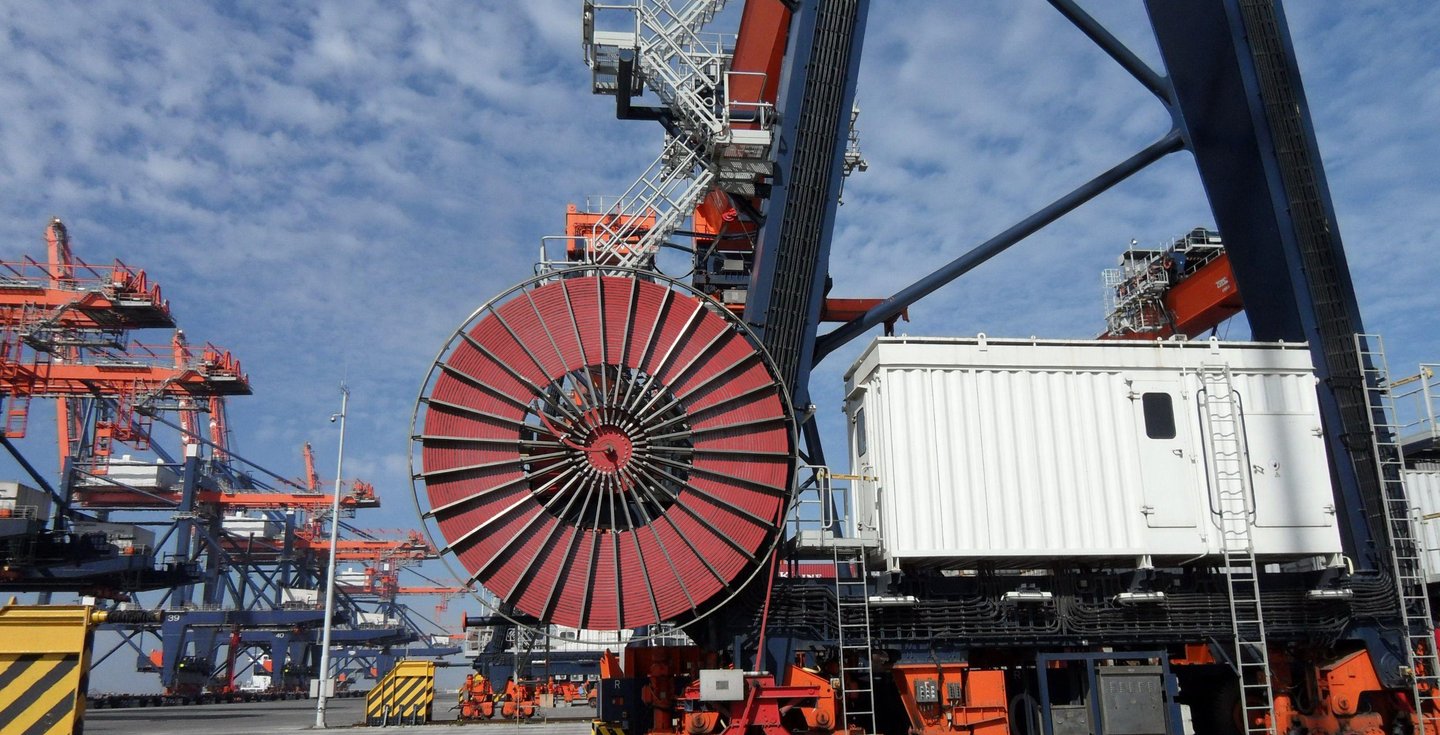
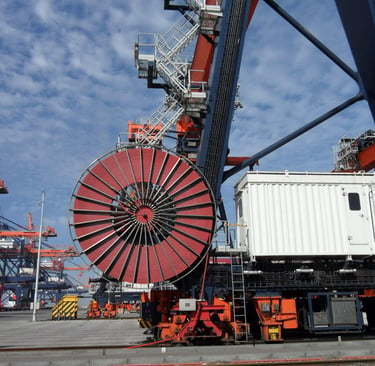
TYPICAL STS CRANE REELING MECHANISM ┌──────────────────┐ │ Motorized Cable │ │ Reeling Drum │ └────────┬─────────┘ │ <-- Dynamic Tensile Load & Torsional Torque │ [ Guide Sheaves ] │ ═══════════════════════╧═══════════════════════ Quay Deck
Equipment like ship-to-shore cranes, ship unloaders, rail-mounted gantry cranes, and yard stacker-reclaimers require dynamic power cables that can endure:
Fast Travel Speeds and Rapid Acceleration: Trolley and gantry movements require cables that can accelerate quickly without excessive internal stretching, core displacement, or jacket slippage.
Heavy Cable Mass and Tensile Pull: Long travel distances require hundreds of meters of heavy medium-voltage cable suspended under continuous motor torque.
Complex Multi-Plane Bending: As the cable pays out off the main drum, it routinely passes through S-bend guide rollers, gravity feed loops, and turnover sheaves, placing continuous reverse bending stress on internal components.
Torsional Stress: High speeds and multi-plane guide assemblies introduce severe axial twisting along the cable length. Without proper structural stabilization, this twisting can cause internal core dislocation, structural buckling, or "corkscrewing."
NTSCGEWOEU cables are specifically constructed to absorb these forces simultaneously. Using standard flexible power cables for these duty cycles often leads to premature jacket tearing, phase-to-phase short circuits, and unscheduled terminal downtime.
Cable Construction And Materials
The durability of NTSCGEWOEU medium voltage reeling cable stems from its specialized multi-layer construction. Every layer is engineered to perform a distinct mechanical or electrical role while working together as a cohesive system.
NTSCGEWOEU CROSS-SECTION LAYOUT .───────────────. / Main Power \ . Conductor 1 . / ───────────────────── \ │ Split Earth Interstice │ │ Conductor 1 │ .────────. │ │ .────────. / Main \│ Anti-Torsion │/ Main \ . Power . Braided Reinforcement . Power . / Conductor 2 \ & Outer PCP / Conductor 3 \ │ Split Earth │ Rubber Sheath │ Split Earth │ │ Interstice 2 │ │ Interstice 3 │ \ / ───────────────────── \ / ' . . ' ' . . ' ' .──. ' ' .──. '
High-Flexibility Tinned Copper Conductors
The main power conductors and ground wires are constructed using electrolytic tinned copper wires, finely stranded according to Class FS flexibility requirements under DIN VDE 0295. Tinning the copper strands prevents chemical oxidation caused by high temperatures and ambient moisture, while the extra-fine strand diameter maintains flexibility over thousands of bending cycles.
Advanced EPR Rubber Insulation
The primary conductor insulation consists of a high-grade Ethylene Propylene Rubber compound (quality 3G13 under DIN VDE 0207 Part 20). This EPR formulation provides exceptional dielectric strength, low electrical losses, superior thermal endurance, and high resistance to structural deformation under mechanical pressure.
Inner and Outer Semiconductive Field Control Layers
To handle medium voltage stress safely, an inner semiconductive layer of EPR is extruded directly over the flexible conductor, while an outer semiconductive layer of cold-strippable modified NBR is applied over the EPR insulation.
Symmetrical Three-Core Interstitial Layout
The cable uses a balanced three-core layout. Rather than using a single large ground conductor, the protective earth conductor is split into three equal parts and positioned in the outer gaps between the main insulated cores. This symmetrical design balances cable weight, lowers the total outer diameter, and minimizes internal electromagnetic interference.
Multi-Layer Protective Sheath System
The sheathing architecture uses a multi-layer design to maximize strength and weather protection:
Inner Sheath: A special EPR-based rubber inner sheath (quality 5GM3) in a high-visibility red finish acts as a flexible cushion and internal water barrier.
Anti-Torsion Braid: A high-strength reinforcement braid made of woven polyester threads is embedded directly into a vulcanized bond between the inner and outer sheaths. This braided layer converts axial twisting forces into longitudinal stability, preventing corkscrewing.
Outer Sheath: The exterior protective jacket is made from a heavy-duty Chloroprene Rubber compound (PCP, quality 5GM5). Colored bright red, this outer sheath offers exceptional resistance to surface abrasion, tearing, weather, UV exposure, and chemical attack.
Why Medium Voltage Cables Need Semiconductive Screens
In low-voltage electrical systems, insulation can directly touch the metallic conductor. However, at medium voltages (1.8/3 kV and above), electrical field distribution becomes a critical factor in cable design.
High voltages create strong, uneven electrical stresses at the boundaries between metallic conductors, insulation, and surrounding air pockets. Without electrical field control, micro-voids between fine copper strands and extruded insulation experience localized electrical discharges, known as partial discharge. Over time, partial discharge erodes the insulation, creating tree-like carbon tracks that eventually cause phase-to-ground electrical breakdowns.
NTSCGEWOEU cables eliminate this risk using a dual semiconductive screening system:
ELECTRICAL FIELD CONTROL LAYER STRUCTURE ┌──────────────────────────────────────────────┐ │ Finely Stranded Tinned Copper Conductor │ ├──────────────────────────────────────────────┤ │ Inner Semiconductive Layer (EPR Compound) │ <-- Smooths conductor stress ├──────────────────────────────────────────────┤ │ High-Grade EPR Primary Insulation │ <-- Contains high voltage ├──────────────────────────────────────────────┤ │ Outer Semiconductive Layer (Modified NBR) │ <-- Distributes ground potential └──────────────────────────────────────────────┘
Inner Semiconductive Layer: Extruded directly over the stranded conductor, this layer creates a smooth, perfectly circular outer boundary. It fills all micro-gaps between individual copper strands, ensuring a uniform electrical field across the entire inner surface of the EPR insulation.
Outer Semiconductive Layer: Extruded directly over the primary insulation, this layer creates a smooth, continuous ground potential boundary around the insulation core. Made from a specialized cold-strippable NBR compound, it enables field technicians to easily strip the shield during termination without damaging the underlying insulation.
In dynamic port crane applications, where cables constantly bend, flex, and experience minor radial compression, these bonded semiconductive layers maintain intimate contact with the insulation surface. This ensures long-term partial discharge protection even under continuous reeling motion.
Why EPR Insulation Works Well in Dynamic Crane Service
Selecting the right insulation material is critical for medium-voltage dynamic reeling cables. While rigid thermoplastic compounds like XLPE (Cross-Linked Polyethylene) are widely used in fixed underground power cables, they are too stiff for high-speed reeling drums. XLPE insulation tends to harden, lose flexibility, and crack under continuous reverse bending.
Ethylene Propylene Rubber (EPR) insulation provides clear operational advantages for dynamic crane power cables:
KEY ADVANTAGES OF EPR INSULATION ┌──────────────────────────────────────────────────┐ │ High Dynamic Flexibility & Bend Endurance │ ├──────────────────────────────────────────────────┤ │ Continuous Conductor Operation at 90 ℃ │ ├──────────────────────────────────────────────────┤ │ Short-Circuit Peak Endurance up to 250 ℃ │ ├──────────────────────────────────────────────────┤ │ Excellent Thermal Stability in Hot Climates │ └──────────────────────────────────────────────────┘
Superior Dynamic Flexing: EPR retains its elasticity across broad temperature ranges. It allows the cable to bend around tight spooling drums without developing internal structural stress or micro-fissures.
High Operating Temperature Capability: NTSCGEWOEU EPR insulation is rated for continuous operation at conductor temperatures up to 90 ℃ and short-circuit peak temperatures up to 250 ℃. This high thermal threshold provides a crucial safety margin when cranes operate under heavy electrical loads in ambient air temperatures exceeding 45 ℃ in the UAE.
Thermal Aging Resistance: Unlike lower-grade rubbers that dry out, become brittle, and crack when exposed to heat, EPR maintains its mechanical toughness and dielectric properties over many years of continuous service.
Moisture and Water Resistance: EPR inherently resists water absorption, preventing moisture ingress from degrading electrical performance in humid coastal terminals.
Outer Jacket Formulated for UAE Environmental Conditions
The exterior sheath of a port crane cable serves as its primary defense against severe outdoor environments. In UAE maritime terminals, the outer jacket must withstand direct sunlight, scorching deck surfaces, airborne marine salts, fine sand dust, and occasional leaks of hydraulic oil or grease.
The NTSCGEWOEU outer sheath uses a specialized heavy-duty Chloroprene Rubber compound (quality 5GM5 under VDE norms). This outer jacket is engineered specifically to survive harsh port environments:
OUTER SHEATH ENVIRONMENTAL RESISTANCE ┌─────────────────────────────────────────────────────────────┐ │ UV & Ozone Shielding: Prevents surface cracking │ ├─────────────────────────────────────────────────────────────┤ │ Tear & Abrasion Resistance: Resists silica sand wear │ ├─────────────────────────────────────────────────────────────┤ │ Oil & Chemical Stability: Resists hydraulic fluid leaks │ ├─────────────────────────────────────────────────────────────┤ │ High Temperature Tolerance: Operates up to 80 ℃ ambient │ └─────────────────────────────────────────────────────────────┘
Sunlight, UV, and Ozone Protection: The 5GM5 compound includes carbon black matrices and specialized anti-ozonant additives. It meets DIN EN 60811-404 weather resistance standards, preventing surface degradation and cracking under intense tropical sunlight.
High Abrasion and Tear Resistance: Moving across guide rollers, turnover sheaves, and concrete quay decks exposes cables to severe surface wear. Fine desert sand acts like an abrasive powder, quickly grinding down softer jacket materials. The high tensile strength and tear resistance of the PCP outer jacket shield the internal cores from physical damage.
Oil and Chemical Resistance: The outer jacket complies with DIN EN 60811-404 and DIN VDE 0473-811-404 oil resistance standards, ensuring it won't swell, soften, or lose mechanical strength when exposed to industrial lubricants or hydraulic fluids on crane decks.
Broad Operating Temperature Limits: NTSCGEWOEU sheathing remains fully flexible down to minus 35 ℃ and operates continuously in ambient temperatures up to 80 ℃. This thermal range comfortably accommodates both summer deck temperatures in the Arabian Gulf and cold night conditions in desert industrial zones.
Available Voltage Ratings
Medium voltage port equipment operates across different power levels depending on machinery size, travel distance, and electrical distribution design. Feichun manufactures NTSCGEWOEU cables across five distinct VDE voltage classes to match various equipment requirements:
AVAILABLE VOLTAGE CLASSES (AC RATINGS) ┌─────────────┐ ┌─────────────┐ ┌─────────────┐ ┌─────────────┐ ┌─────────────┐ │ 1.8/3 kV │ │ 3.6/6 kV │ │ 6/10 kV │ │ 8.7/15 kV │ │ 12/20 kV │ └─────────────┘ └─────────────┘ └─────────────┘ └─────────────┘ └─────────────┘
Complete Electrical Parameter Specifications
Rated Voltage Class: 1.8/3 kV
Maximum Permissible Operating AC Voltage: 2.1/3.6 kV
Maximum Permissible Operating DC Voltage: 2.7/5.4 kV
AC Factory Test Voltage: 6 kV
Rated Voltage Class: 3.6/6 kV
Maximum Permissible Operating AC Voltage: 4.2/7.2 kV
Maximum Permissible Operating DC Voltage: 5.4/10.8 kV
AC Factory Test Voltage: 11 kV
Rated Voltage Class: 6/10 kV
Maximum Permissible Operating AC Voltage: 6.9/12 kV
Maximum Permissible Operating DC Voltage: 9/18 kV
AC Factory Test Voltage: 17 kV
Rated Voltage Class: 8.7/15 kV
Maximum Permissible Operating AC Voltage: 10.4/18 kV
Maximum Permissible Operating DC Voltage: 13.5/27 kV
AC Factory Test Voltage: 24 kV
Rated Voltage Class: 12/20 kV
Maximum Permissible Operating AC Voltage: 13.9/24 kV
Maximum Permissible Operating DC Voltage: 18/36 kV
AC Factory Test Voltage: 29 kV
Supporting this broad range of voltage classes allows port authorities and crane OEMs to standardize on a single high-performance cable architecture across their entire terminal fleet.
Typical Application Match by Voltage Class
Selecting the correct voltage rating depends on the electrical feed design of the crane, total power demand, voltage drop calculations, and equipment drive specifications.
APPLICATION MATCHING BY VOLTAGE RATING Voltage Rating Primary Equipment Match ───────────────────────────────────────────────────────────────── 3.6/6 kV Class Lighter RMG cranes, mobile hoists, and auxiliary machinery 6/10 kV Class Standard STS container cranes, yard stackers, and rubber-tyred gantries 8.7/15 kV & 12/20 kV Ultra-large STS mega-cranes, long-travel ship unloaders, and bulk systems
6kV Crane Cable Applications (3.6/6 kV Class)
The 6kV voltage class is commonly used for medium-duty crane power systems, smaller rubber-tyred gantry cranes, rail-mounted container stackers, and specialized shipyard hoists. It provides an ideal balance between current capacity and cable diameter, making it easy to spool on compact motorized reels.
10kV Crane Cable Applications (6/10 kV Class)
The 10kV voltage rating (6/10 kV) is the primary medium-voltage standard for container handling cranes in major Middle Eastern ports. It powers large ship-to-shore cranes, high-capacity container stackers, and automated quayside handling equipment. Operating at 10kV allows cranes to draw high power while keeping conductor sizes reasonable, reducing total cable weight on the reel.
20kV Class Applications (8.7/15 kV and 12/20 kV Classes)
Higher voltage classes, such as 15kV and 20kV, are selected for ultra-large STS mega-cranes, continuous bulk ship unloaders, and long-distance stacker-reclaimers operating in bulk material terminals. Operating at higher voltages reduces current draw, minimizes voltage drop across long quayside travels, and improves overall electrical efficiency.
Final voltage selection must always align with the crane's electrical single-line diagram, transformer tap ratios, and original equipment manufacturer (OEM) requirements.
Mechanical Selection Criteria for Reeling Duty
Selecting a dynamic reeling cable requires thorough evaluation of its mechanical ratings. NTSCGEWOEU cables are rigorously tested to ensure long service life under high dynamic loads.
KEY MECHANICAL DESIGN PARAMETERS Parameter Standard Specification ───────────────────────────────────────────────────────────── Max Continuous Tensile Force 20 N/mm² on copper Dynamic Acceleration Tensile Load Up to 30 N/mm² Permissible Torsional Stress ±25 °/m Minimum Dynamic Bending Radius 20 × Cable Outer Diameter Maximum Standard Gantry Travel Speed 240 m/min
Maximum Tensile Loading
During standard spooling operations, the maximum static tensile stress on the main conductors should not exceed 20 N per square millimeter of total copper cross-section. During rapid acceleration, emergency stopping, or directional changes, the cable can handle peak dynamic tensions up to 30 N per square millimeter.
Torsional Resistance
NTSCGEWOEU cables are built to withstand severe axial twisting up to plus or minus 25 degrees per meter. The internal polyester anti-torsion braid keeps the core assembly aligned, preventing corkscrewing even on high-speed reels.
Minimum Bending Radius
For free-moving dynamic reeling applications, the minimum bending radius is fixed at 20 times the total outer cable diameter (20 × D), adhering to DIN VDE 0298 Part 3 standards. Maintaining this minimum radius prevents severe structural fatigue on internal copper strands and insulation layers.
Directional Change Spacing
When routing cables through reverse bending configurations (S-type directional changes), guide rollers must be spaced to avoid high local shear stress. Following standardized distance guidelines preserves internal core geometry.
High Travel Speeds
NTSCGEWOEU cables operate reliably at standard gantry travel speeds without speed restrictions. For high-speed applications exceeding 240 meters per minute, engineering consultation with Feichun is recommended to optimize spooling tension and reel control dynamics.
Recommended Port Crane Applications
The mechanical strength, electrical field control, and weather resistance of NTSCGEWOEU medium voltage reeling cables make them suitable for a wide range of heavy port equipment:
PORT EQUIPMENT APPLICATIONS ┌─────────────────────────────────────────────────────────┐ │ Ship-to-Shore (STS) Container Cranes │ ├─────────────────────────────────────────────────────────┤ │ Rubber-Tyred Gantry (RTG) Cranes │ ├─────────────────────────────────────────────────────────┤ │ Automated Stacking Cranes (ASC) & RMG Systems │ ├─────────────────────────────────────────────────────────┤ │ Continuous Bulk Ship Unloaders │ ├─────────────────────────────────────────────────────────┤ │ Quayside Stacker-Reclaimers & Conveyor Trippers │ └─────────────────────────────────────────────────────────┘
Ship-to-Shore (STS) Cranes
Mounted on main motorized reels, these cables supply 6kV to 20kV power from quayside trenches to moving cranes. They withstand continuous reeling, high acceleration, and constant marine salt exposure without loss of power.
Rubber-Tyred Gantry (RTG) Cranes
For diesel-to-electric converted RTG fleets operating on high-voltage reel systems, NTSCGEWOEU cables provide flexible power delivery while standing up to heat, sand dust, and frequent yard relocations.
Automated Stacking Cranes (ASC) and Rail-Mounted Gantries (RMG)
Automated container yards rely on predictable cable movement. NTSCGEWOEU cables deliver steady power and can be equipped with integrated control cores or fiber optic elements to support automated positioning systems.
Continuous Ship Unloaders and Stacker-Reclaimers
In dry bulk terminals handling iron ore, coal, or sulfur, long-travel unloaders and stacker-reclaimers require cables that resist severe mechanical wear. The heavy PCP outer jacket protects internal components against abrasive dust and outdoor weather.
How To Select The Right Cable Specification
To select the optimal NTSCGEWOEU cable for a specific port crane project, engineering teams should follow a structured step-by-step review process:
PROCUREMENT SELECTION STEPS [1. Match System Voltage & Current Requirements] │ ▼ [2. Apply Thermal Derating for UAE Ambient Temps] │ ▼ [3. Check Reel Diameter & Minimum Bending Radius] │ ▼ [4. Verify Acceleration Profile & Dynamic Tensile Pull] │ ▼ [5. Confirm Outer Sheath Resistance to UV & Oils] │ ▼ [6. Decide If Fiber Optics / Control Elements Needed]
Step 1: Match Electrical System Requirements
Select the voltage class (1.8/3 kV, 3.6/6 kV, 6/10 kV, 8.7/15 kV, or 12/20 kV) based on the crane's electrical supply system. Calculate the continuous running current under full load.
Step 2: Apply Ambient Temperature Derating
Standard cable ampacity tables assume a 30 ℃ ambient air temperature. In UAE ports, where summer ambient temperatures reach 45 ℃ to 50 ℃ and steel drum surfaces get even hotter, apply thermal derating factors according to VDE 0298-4 guidelines to prevent conductor overheating.
Step 3: Check Drum Geometry and Bending Radius
Measure the inner drum barrel diameter and the dimensions of all guide sheaves. Ensure that all bending points satisfy the minimum bending radius requirement of 20 times the total cable outer diameter (20 × D).
Step 4: Evaluate Speed and Dynamic Pull
Verify travel speeds and acceleration profiles. Confirm that peak dynamic pulling forces during startup stay well within the allowable limits for the selected conductor cross-section.
Step 5: Verify Environmental Exposure Requirements
Ensure that the outer sheathing material meets UV, ozone, and oil resistance standards for outdoor marine environments.
Step 6: Determine Integrated Signal Needs
Decide whether the application requires auxiliary control elements or integrated fiber optic cores for high-speed data transmission and remote monitoring.
Why NTSCGEWOEU Fits UAE Port Requirements
Port terminals in the United Arab Emirates operate in demanding environmental and operational conditions. Equipment must withstand high heat, solar radiation, airborne marine salt, and silica sand dust while operating at high capacity.
The NTSCGEWOEU medium voltage reeling cable is ideal for UAE port operations:
Built for High Ambient Heat: High-grade EPR insulation rated at 90 ℃ continuous operating temperature, combined with an 80 ℃ rated outer rubber jacket, ensures reliable thermal performance during summer months.
Weather and UV Shielding: The compound matrices in the PCP outer jacket shield the cable from intense solar radiation and ozone degradation[cite: 2].
Salt and Oil Resistance: The multi-layer sheathing system resists marine salt mist and industrial lubricants, keeping the core assembly dry and protected[cite: 2].
High Dynamic Mechanical Endurance: The combination of fine-stranded conductors, EPR insulation, anti-torsion polyester braiding, and tough PCP sheathing provides long service life on high-speed motorized reels[cite: 2].
Choosing NTSCGEWOEU cables manufactured by Feichun provides UAE port operators with a reliable, VDE-compliant solution designed for long-term performance in demanding container terminal applications.
Recommended Cable Documentation Visuals
To complement technical documentation, engineering submittals, or blog articles, consider including the following visual diagrams:
STS Crane Motorized Cable Reel Visual: A detailed diagram showing a high-speed cable drum, guide rollers, turnover sheaves, and the cable payout path along a quayside trench.
Medium Voltage Cable Structural Cross-Section: An annotated cross-sectional diagram showing the main power cores, split interstitial earth conductors, inner and outer semiconductive layers, EPR insulation, inner sheath, anti-torsion polyester braid, and heavy-duty outer rubber jacket[cite: 2].
Port Electrical System Overview: A single-line diagram illustrating power distribution from the main quayside sub-station through medium-voltage reeling cables to crane transformers and variable frequency drives[cite: 1, 2].
Conclusion
The NTSCGEWOEU medium voltage rubber reeling cable is a high-reliability power delivery solution engineered for heavy industrial equipment under dynamic mechanical stress[cite: 2]. Built according to DIN VDE 0250-813 standards, it provides the flexibility, electrical field control, tensile strength, and weather resistance needed for port equipment in the UAE[cite: 1, 2].
Whether powering new Ship-to-Shore cranes, replacing worn cables on quayside unloaders, or upgrading automated stacking crane fleets, specifying NTSCGEWOEU cable ensures uninterrupted power delivery, low maintenance costs, and maximum terminal productivity[cite: 1, 2].
For detailed technical specifications, custom core designs, or procurement guidance tailored to Middle Eastern port projects, contact Feichun's cable engineering team today to review your project requirements.
Single-Sentence Follow-Up Question
Would you like me to generate a detailed technical submittal datasheet or a thermal ampacity derating calculation table tailored specifically for your target UAE port crane installation?
Port crane cables | Mining cables | Reeling cables | Trailing cables | Festoon cables | Heavy-duty power cables | Medium voltage cables | Offshore crane cables | Underground mining cables | Dragline cables | Shearer cables | Container handling cables | STS crane cables | RTG cables | Mobile equipment cables | Armored cables | Flexible power cables | VFD cables | Submersible cables | Cold resistant cables | Abrasion resistant cables | Flame retardant cables | Marine environment cables | Opencast mining | Underground operations
© 2006 All rights reserved.
[INDUSTRIAL_CABLES]
INDUSTRIAL GRADE CABLE SYSTEMS | PORT & MINING SOLUTIONS
TEL: +86 153 7530 2641 |MAIL: hongjing.Wang@feichuncables.com