(N)TSCGEWOEU-SR PLUS FO to DIN VDE 0250-813 – EPR Rubber Insulated Medium Voltage Reeling Cable with Fiber Optic for Crane, Harbour and Mining Applications
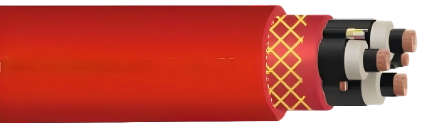
(N)TSCGEWOEU-SR PLUS FO medium voltage reeling cable compliant with DIN VDE 0250-813. EPR rubber insulated flexible power cable with integrated fiber optic for harbour cranes, open-pit mining equipment, stacker reclaimers and high mechanical stress drum systems.
CRANE CABLE
hongjing.Wang@Feichun
3/3/20266 min read
Introduction: Why Modern Reeling Systems Demand More Than Conventional Power Cables
In today’s heavy industries—particularly open-pit mining, harbour container terminals, bulk material stockyards and shipyards—medium voltage reeling cables are exposed to mechanical loads that were uncommon just a decade ago.
Higher travelling speeds.
Longer reeling distances.
Increased automation.
Greater electrical power requirements.
At the same time, operators are demanding integrated data transmission, improved operational safety and longer service life under harsh environmental conditions.
This is where (N)TSCGEWOEU-SR PLUS FO, a medium voltage flexible reeling cable with integrated fiber optic, plays a critical role.
Designed in accordance with DIN VDE 0250-813, this heavy-duty rubber insulated crane cable combines:
Medium voltage power transmission up to 18/30 kV
Extreme mechanical resistance
Anti-twist reinforcement
High tensile capacity
Integrated optical fibers for control and monitoring
It is not simply a power cable. It is a structural component of high-performance reeling systems in mining and port infrastructure.
Understanding the Application Environment: Where Reeling Cables Fail First
Before analyzing the cable design, it is important to understand the real mechanical stress conditions in reeling applications.
1. Multi-Level Cable Guidance
In many crane and mining systems, the reel axis runs in the travel direction. The cable is not simply wound and unwound vertically; it is guided through:
S-type directional changes
Multi-plane routing systems
Roller assemblies
High-speed drums
This creates continuous torsional and bending stress.
2. High Reeling Speeds
Modern container cranes and stacker reclaimers can operate at reeling speeds of up to 240 m/min, generating dynamic tensile forces far beyond static load calculations.
3. Harsh Environmental Exposure
Applications often involve:
UV radiation
Ozone exposure
Moisture and heavy rainfall
Oil contamination
Abrasive dust (especially in open-pit mining)
Extreme temperature variations
A standard flexible power cable is simply not designed to survive these combined stresses.
Electrical Design: Medium Voltage Stability Under Dynamic Conditions
(N)TSCGEWOEU-SR PLUS FO is engineered for medium voltage systems requiring high reliability under mechanical movement.
Rated Voltage Options
Available voltage classes include:
3.6/6 kV
6/10 kV
8.7/15 kV
12/20 kV
14/25 kV
18/30 kV
This wide voltage range makes it suitable for:
Harbour crane power supply
Mining excavator systems
Ship unloader installations
Stacker and reclaimer drives
For operators searching for:
6/10 kV reeling cable for crane
12/20 kV flexible mining power cable
18/30 kV drum cable for harbour systems
this construction offers scalable performance.
Thermal Performance
Electrical reliability depends on thermal stability. Key parameters include:
Fixed installation: -50°C to +80°C
Reeling operation: -35°C to +80°C
Maximum permissible conductor temperature: 90°C
Short-circuit temperature: 250°C
This makes it suitable for cold climate ports and high-load mining operations alike.
Current-Carrying Capacity
Current ratings are calculated in accordance with DIN VDE 0298-4, including defined de-rating factors depending on installation and grouping conditions.
In dynamic systems, thermal design margins are essential to prevent insulation aging and conductor fatigue.
Conductor System: Flexibility Meets Electrical Efficiency
The conductor system uses:
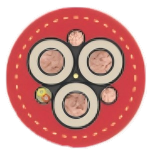
Plain copper wires
Finely stranded
Class 5 according to IEC 60228
Why is Class 5 important?
Because fine stranding increases flexibility, reduces bending stress concentration and improves dynamic performance during continuous drum reeling.
In high-speed crane applications, conductor fatigue often becomes the first failure point. Fine stranding significantly extends mechanical lifespan.
Advanced EPR Insulation System: Field Control Under Medium Voltage
Medium voltage cables require controlled electric field distribution to prevent partial discharge and insulation breakdown.
This cable features a triple-layer insulation design:
Inner semi-conductive stress control layer
EPR compound insulation (DIN VDE 0207-20)
Outer semi-conductive insulation shield
Why EPR?
Ethylene Propylene Rubber (EPR) offers:
Excellent dielectric properties
High thermal endurance
Strong mechanical resilience
Superior flexibility compared to XLPE in dynamic applications
For medium voltage reeling cable with EPR insulation, the advantage is clear:
It tolerates repeated bending without compromising insulation integrity.
Mechanical Engineering: Designed for Extreme Tensile and Torsional Loads
The mechanical structure defines whether a reeling cable survives years—or fails within months.
Maximum Tensile Load
Maximum tensile load on conductor: 20 N/mm²
Depending on cross-section, permissible static/dynamic tensile forces are defined.
In mining and harbour cranes, dynamic loads during acceleration and deceleration can exceed static estimates. Proper tensile design is therefore critical.
Torsional Resistance
Torsional stress tolerance: ±25° per meter
In multi-level cable guidance systems, torsional resistance prevents core distortion and premature conductor breakage.
Anti-Twist Reinforcement
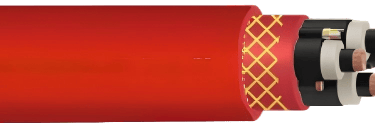
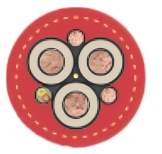
Between inner and outer sheath layers, a synthetic braid reinforcement is applied.
This reinforcement:
Acts as anti-twist protection
Stabilizes cable geometry
Distributes mechanical stress
Reduces internal movement
In high mechanical resistance crane cable design, anti-twist protection is often the key differentiator between industrial-grade and heavy-duty solutions.
Heavy-Duty Rubber Sheath System: Environmental Protection in Harsh Conditions
Inner Sheath
Extra heavy-duty rubber compound
Quality 5GM5 based on DIN VDE 0207-21
Completely fills interstices
Color: red
Outer Sheath
Extra heavy-duty 5GM5 rubber
UV resistant
Ozone resistant
Moisture resistant
Oil resistant (EN 60811-404)
Flame retardant (EN 60332-1-2)
For operators seeking:
UV resistant medium voltage crane cable
Oil resistant rubber sheathed reeling cable
Flame retardant mining power cable
this construction addresses all key environmental risks.
In open-pit mining, oil contamination and abrasive dust are common. In harbour applications, salt air and UV radiation dominate. The sheath must resist both chemical and weathering degradation.
Integrated Fiber Optic System: Enabling Smart Crane Infrastructure
Modern cranes are no longer purely mechanical machines. They are digital systems requiring high-speed data transmission.
(N)TSCGEWOEU-SR PLUS FO integrates fiber optics directly into the power cable.
Available Fiber Configurations
12 FO
2 × 12 FO
Fiber Types
Single-mode E9/125 (ITU-T G.652D)
Multimode G50/125 (OM2–OM4)
Multimode G62.5/125
Typical Attenuation Values
0.5 dB/km @ 1310 nm (single-mode)
0.3 dB/km @ 1550 nm (single-mode)
3.0 dB/km @ 850 nm (multimode)
Why Integrated Fiber Matters
Instead of installing separate power and communication cables, operators gain:
Reduced cable management complexity
Lower installation costs
Simplified drum design
Improved system reliability
Real-time monitoring and automation capability
For applications searching for:
medium voltage reeling cable with 12 fiber optic
crane power cable with integrated single-mode fiber
mining reeling cable with data transmission
this integrated approach improves both mechanical and operational efficiency.
Cross-Section Range and Physical Dimensions
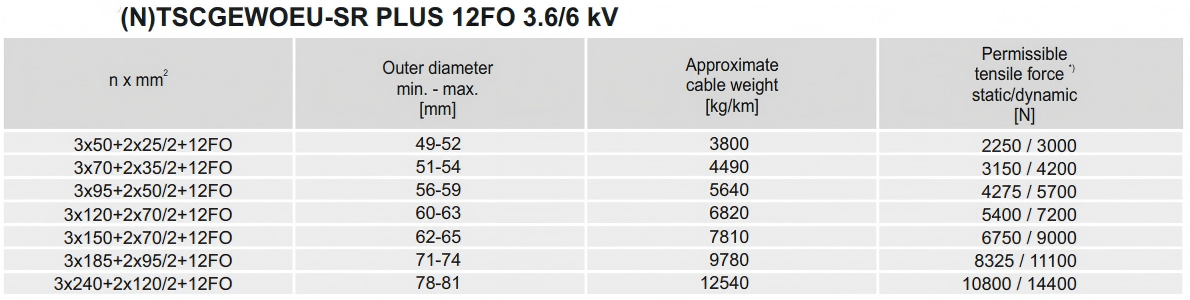
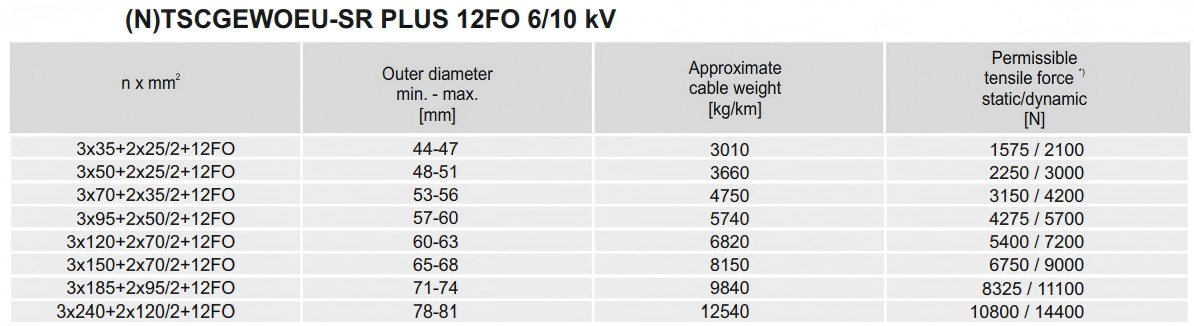
Available main core sizes range from:
3 × 25 mm²
up to3 × 240 mm²
Ground conductor is split into two parts and positioned in outer interstices for optimal balance.
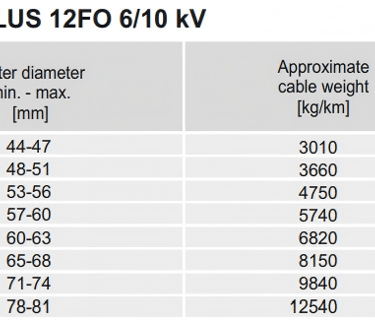
Outer Diameter
Approximately 44 mm to 86 mm, depending on design and voltage class.
Approximate Cable Weight
Up to 13,350 kg/km in larger cross-sections.
Proper drum design must account for:
Cable weight
Minimum bending radius (DIN VDE 0298-3)
Minimum distance for S-type directional changes: 20 × O.D.
These parameters are essential for long-term reeling reliability.
Compliance and Regulatory Framework
This cable complies with:
DIN VDE 0250-813
DIN VDE 0298-3
DIN VDE 0298-4
EN 60332-1-2
EN 60811-404
RoHS 2015/863/EU
CPR 305/2011
For international port and mining projects, compliance ensures:
Engineering acceptance
Safety approval
Insurance compliance
Reduced project risk
Installation Considerations for Maximum Service Life
Even the best medium voltage reeling cable can fail prematurely if installation rules are ignored.
Key considerations:
Maintain proper bending radius according to DIN VDE 0298-3
Respect minimum S-type directional spacing (20 × O.D.)
Verify tensile load during dynamic operation
Ensure drum diameter compatibility
Consider de-rating factors under continuous load
Proper system design extends service life significantly.
Why Selecting the Correct Medium Voltage Reeling Cable Is Critical
Using an underspecified cable can lead to:
Conductor fatigue failure
Insulation breakdown
Optical fiber damage
Increased downtime
Expensive crane shutdowns
In large container terminals or mining operations, even one hour of downtime can represent substantial financial loss.
Selecting a high tensile, anti-twist, EPR insulated medium voltage reeling cable with integrated fiber optic is therefore not a cost issue—it is a reliability decision.


Conclusion: Engineered for Extreme Industrial Reeling Systems
(N)TSCGEWOEU-SR PLUS FO is engineered to meet the demands of:
Harbour container cranes
Shipyard gantry systems
Open-pit mining excavators
Stacker reclaimers
Heavy industrial material handling equipment
It combines:
✔ Medium voltage capability up to 18/30 kV
✔ EPR rubber insulation system
✔ High tensile strength (20 N/mm²)
✔ Anti-twist braid reinforcement
✔ Extra heavy-duty rubber sheath
✔ UV, oil and weather resistance
✔ Integrated fiber optic solutions
✔ High-speed reeling up to 240 m/min
For operators seeking a DIN VDE 0250-813 compliant medium voltage flexible reeling cable for crane and mining applications, this design provides a balanced solution of electrical performance, mechanical resilience and digital integration.
In demanding reeling environments, durability is not optional. It is engineered.
Port crane cables | Mining cables | Reeling cables | Trailing cables | Festoon cables | Heavy-duty power cables | Medium voltage cables | Offshore crane cables | Underground mining cables | Dragline cables | Shearer cables | Container handling cables | STS crane cables | RTG cables | Mobile equipment cables | Armored cables | Flexible power cables | VFD cables | Submersible cables | Cold resistant cables | Abrasion resistant cables | Flame retardant cables | Marine environment cables | Opencast mining | Underground operations
© 2006 All rights reserved.
[INDUSTRIAL_CABLES]
INDUSTRIAL GRADE CABLE SYSTEMS | PORT & MINING SOLUTIONS
TEL: +86 153 7530 2641 |MAIL: hongjing.Wang@feichuncables.com