(N)TSCGEWÖU ES3 Medium Voltage Reeling Cable: Reduced-Weight, Anti-Torsion Solution for High-Speed Port Crane Applications
Reduced-weight (N)TSCGEWÖU ES3 medium voltage reeling cable with LSZH option, anti-torsion design and 200 m/min reel speed for monospiral end-feed port cranes.
REELING CABLE
hongjing.Wang@Feichun
1/14/20269 min read
Introduction: The Growing Demand for Reliable MV Reeling Cables in Port Crane Systems
Modern port infrastructure is undergoing rapid electrification. Ship-to-shore cranes, rail-mounted gantry cranes, and rubber-tyred gantry cranes are now routinely powered through medium voltage reeling systems — replacing diesel drives with cleaner, more efficient electrical supply chains. As crane travel speeds and duty cycles intensify, the mechanical demands placed on medium voltage reeling cable have never been greater.
A reeling cable in active crane service is not a static component. It endures repeated cycles of tensile loading, high-speed spooling, multi-layer drum compression, and torsional stress — simultaneously, and across a service life measured in millions of cycles. Conventional medium voltage crane cables were not engineered with this combination of stresses in mind. The result, too often, is premature insulation fatigue, jacket cracking, and costly unplanned downtime.
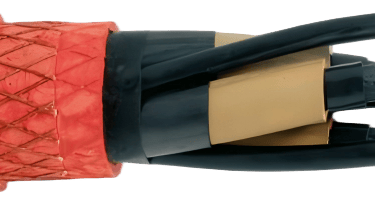
The (N)TSCGEWÖU ES3 crane reeling cable was developed specifically to address these failure modes. It represents a significant engineering advance over the classical (N)TSCGEWOU cable family, incorporating a reduced-weight, reduced-diameter construction, an extruded semiconducting screen design, an integrated anti-torsion reinforcement system, and an optional low smoke zero halogen outer sheath. The result is a purpose-optimized medium voltage cable for monospiral end-feed reeling systems operating at up to 200 m/min travel speed.
What Is the (N)TSCGEWÖU ES3? Understanding the Cable Classification and Design Philosophy
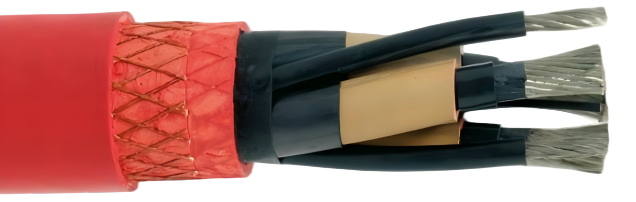
The designation (N)TSCGEWÖU ES3 follows the DIN VDE 0250-813 classification framework for heavy-duty flexible cables used in crane and reeling applications. The "ES3" suffix identifies the key structural innovation: an extruded semiconducting screen applied over the HEPR insulation of each phase conductor, replacing the conventional lapped tape screen used in earlier (N)TSCGEWOU designs. This seemingly subtle change has profound consequences for both electrical performance and physical cable geometry.
By eliminating the tape layer and replacing it with a continuous extruded screen, the cable achieves a measurably smaller overall diameter for a given conductor cross-section and voltage rating. Smaller diameter directly translates to reduced mass per meter — a critical parameter in monospiral reel end-feed systems where cable weight directly governs reel motor torque demand, winding tension uniformity, and drum geometry stability. For engineers specifying crane reeling cables, the reduced weight of the ES3 design means less mechanical load on the reel, more cable accommodated on a drum of given dimensions, and reduced inertia during high-speed start-stop cycles.
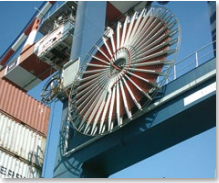
The cable is engineered primarily for monospiral reel end-feed applications, where the cable exits the drum at one end and must maintain consistent geometric behaviour as the reel pays out and retrieves cable over long travel distances. This application demands a cable that resists corkscrew deformation, maintains its circular cross-section under repeated bending, and does not accumulate residual torsion — all qualities that the ES3 structural architecture is specifically designed to provide.
Structural Engineering: How the (N)TSCGEWÖU ES3 Achieves Mechanical Endurance
The long service life of the (N)TSCGEWÖU ES3 in demanding reeling environments is not incidental — it results from a carefully coordinated set of structural design choices, each addressing a specific failure mechanism observed in conventional medium voltage crane cable.
The conductor at the core of each phase is manufactured to exceed the flexibility requirements of DIN VDE EN 60228 Class 5. Extra-fine wire bundles are laid with a geometry optimized for cyclic bending, ensuring that individual wires experience minimal differential strain during reel rotation. In high-speed crane reeling applications, where a cable may complete thousands of full spool cycles per operating day, conductor fatigue is a primary failure driver. The enhanced flexibility of the ES3 conductor significantly extends the number of bending cycles the cable can sustain before any sign of conductor wire breakage.
Insulation integrity under dynamic bending conditions is maintained through the use of high-elongation EPR — commonly referred to as HEPR — compound applied over each conductor. HEPR maintains its elastic properties across a wide temperature range and resists the micro-cracking that thermoplastic and standard rubber insulations can develop under repeated flexing. In combination with the extruded semiconducting screen layers applied both beneath and over the HEPR insulation, a stable and continuous electric field is maintained around each conductor. This eliminates the localised field concentration that lapped tape screens can introduce, particularly once the tape begins to lift or shift under repeated mechanical stress.
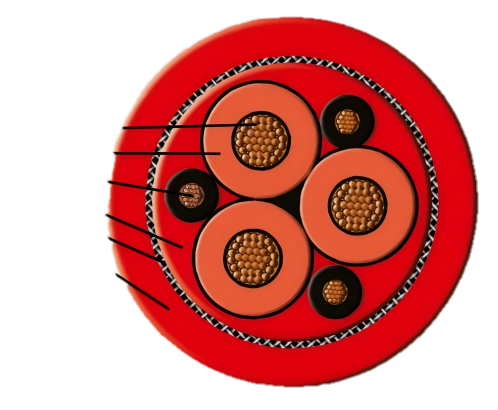
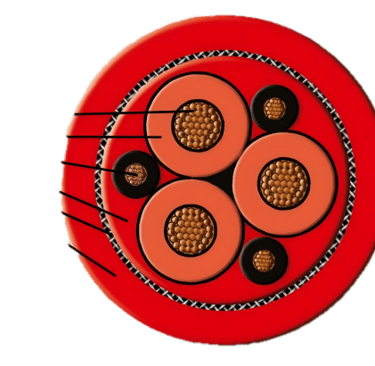
The anti-torsion reinforcement system is arguably the most consequential structural feature of the ES3 design for end-feed reeling service. The internal architecture of the cable is engineered with a tightened lay geometry and reinforcement elements that resist the tendency of a cable to rotate about its own axis when subjected to tensile load. In a monospiral reel, the cable experiences both tensile pull and a rotational moment as it pays off the drum. Without effective anti-torsion design, this combination causes the cable to develop a corkscrew deformation pattern that progressively worsens with each operating cycle, ultimately causing sheath splitting, core displacement, and electrical failure. The ES3's tightened internal structure neutralises this torsional moment, maintaining cable geometry stability throughout service life.
The sheath system of the (N)TSCGEWÖU ES3 reflects the severity of port crane operating environments. An inner sheath meeting and exceeding the GM1b compound specification provides mechanical separation between the insulated cores and the outer covering while contributing to the cable's resistance to drum pressure during multilayer winding. The outer sheath is manufactured from polychloroprene compound equivalent to the 5GM3 or 5GM5 specification — a material well proven for its resistance to abrasion, ozone, ultraviolet radiation, oil contamination, chemical splash, and continuous weathering exposure. These are the conditions that exist on crane rails, in cable trays, and on cable drums at active bulk handling and container terminals around the world.
The LSZH Fire-Safe Variant: (N)TSCGEWÖU ES3-FO for Enclosed Crane Structures
Where crane structures incorporate enclosed machine rooms, operator cabins, or cable management channels in which ventilation is limited, fire safety regulations frequently mandate the use of low smoke zero halogen cable materials. The (N)TSCGEWÖU ES3-FO variant addresses this requirement directly, substituting the standard PCP outer sheath with an LSZH compound that suppresses both flame propagation and the generation of dense, toxic smoke in a fire event.
The LSZH medium voltage crane cable variant retains the identical internal architecture as the standard ES3 — the same extra-flexible conductors, HEPR insulation, extruded semiconducting screens, and anti-torsion reinforcement — ensuring that no mechanical performance is sacrificed in exchange for improved fire safety. For crane designers and terminal operators working within IEC 60332-series compliance frameworks or port authority fire safety specifications, the ES3-FO provides a technically complete solution that meets both dynamic reeling performance and fire-safe reeling cable requirements without compromise.
Electrical Ratings and Standards: Compliance Across Medium Voltage Classes
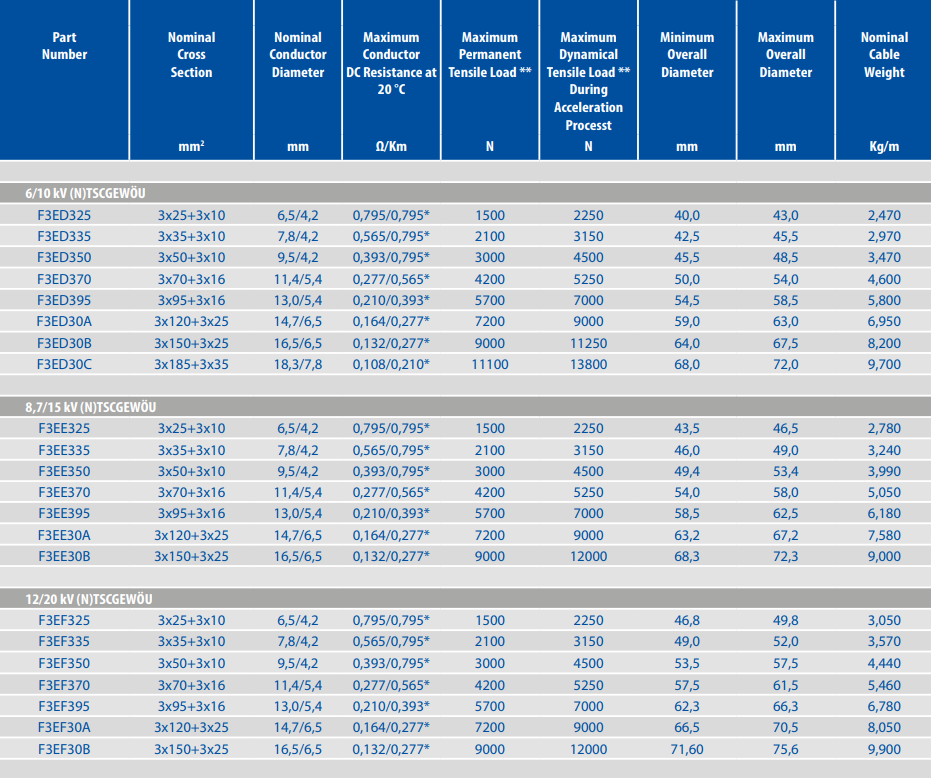
The (N)TSCGEWÖU ES3 is available across four standard voltage ratings to accommodate the varying medium voltage distribution architectures found in modern port facilities: 3.6/6 kV, 6/10 kV, 8.7/15 kV, and 12/20 kV. This range covers the majority of STS crane and RMG crane power supply systems currently in service globally, and positions the cable for compatibility with utility interconnection voltages in multiple markets.
Standards compliance spans DIN VDE 0250-813 as the primary product standard, DIN VDE EN 60228 for conductor classification, HD 620 S2 for harmonised European cable construction requirements, and VDE 0298-4 for current-carrying capacity guidance. For engineers conducting cable selection calculations or preparing technical specifications for procurement, this multi-standard compliance framework ensures that the ES3 can be adopted into both German national and broader European project specifications without modification.
Temperature Performance and Environmental Resistance
The (N)TSCGEWÖU ES3 is rated for fixed installation service across an ambient temperature range of −40 °C to +80 °C. In active flexing service — the condition most relevant to crane reeling — the minimum operating temperature is −35 °C, which encompasses the winter operating conditions of ports in northern Europe, Scandinavia, Baltic states, and northern Asia without requiring cable pre-heating or speed restriction. This cold-resistant MV cable capability is particularly valuable for terminals that operate continuously through arctic winters, where alternative cable constructions would suffer from insulation and sheath embrittlement leading to cracking during reel operation.
At the upper end of the temperature range, the HEPR insulation system retains its mechanical and dielectric properties at sustained +80 °C conductor temperature, accommodating the thermal loading associated with high current crane power supply cables operating near their rated capacity in warm climates.
The minimum bending radius in flexing service is specified at 12 times the overall cable diameter — a value consistent with monospiral reel geometries across the conductor cross-sections and voltage classes for which the ES3 is manufactured. This parameter, combined with the cable's resistance to abrasion, ozone degradation, UV exposure, oil, and general weathering, defines a product engineered for the full environmental severity of port terminal operation.
Application Scope: Crane Types and Reeling Geometries
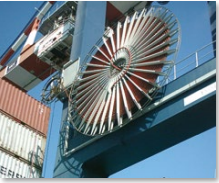
The primary application target for the (N)TSCGEWÖU ES3 is the monospiral reel end-feed system, in which cable is wound in a single-layer spiral on a large-diameter drum and fed from one end of the drum axis. This geometry is prevalent on ship-to-shore cranes and rail-mounted gantry cranes where travel distances are long, travel speeds are high, and the cable must pay in and out with consistent tension across the full length of travel. The cable's maximum rated operating speed of 200 m/min in end-feed reeling service aligns directly with the travel speed requirements of modern high-productivity STS cranes.
Beyond container handling, the ES3 is equally suited to rubber-tyred gantry cranes operating on cable reel systems, stacker-reclaimer machines at coal and ore terminals, bulk handling cranes at grain and fertiliser facilities, and other heavy industrial reeling applications where medium voltage power delivery and high mechanical cable endurance are simultaneously required.
Comparative Advantages Over Conventional (N)TSCGEWOU Crane Cables
Engineers transitioning from standard (N)TSCGEWOU cables to the ES3 design gain measurable advantages across multiple performance dimensions. The reduced weight and smaller diameter of the ES3 lower the rotational inertia of the loaded reel, reducing peak torque demand on reel drive motors and extending their service intervals. The greater cable length achievable on a drum of given size reduces the need for drum changes or cable splices in long-travel installations. The anti-torsion architecture eliminates the corkscrew deformation that is the most common cause of premature failure in conventional end-feed reeling cable, directly extending service life. The LSZH crane cable option addresses fire safety compliance requirements that are increasingly mandatory in new port crane specifications. And the 200 m/min speed capability supports crane designs optimised for maximum throughput productivity.
Engineering Selection Guidelines for End-Feed Reeling Cable Applications
Selecting the appropriate medium voltage reeling cable for a monospiral end-feed crane system requires evaluation of several interdependent parameters. The end-feed reel geometry imposes specific requirements on anti-torsion performance that differ from centre-feed designs — the ES3 is optimised for end-feed geometry and should not be substituted with centre-feed cable constructions in this application. Travel speed must be matched against cable mass per meter to ensure that reel motor and braking system sizing remains within equipment ratings. Ambient temperature range at the installation site determines whether standard or enhanced cold flexibility is required. Enclosed crane structural environments dictate the choice between PCP and LSZH outer sheath. Finally, the site MV distribution voltage determines the appropriate rated voltage class from the available 3.6/6 kV through 12/20 kV options.
Expert Q&A: Common Engineering Questions on the (N)TSCGEWÖU ES3
Q: What is the key difference between the ES3 and the standard (N)TSCGEWOU in terms of screen design? A: The ES3 uses an extruded semiconducting screen applied directly over the HEPR insulation of each conductor, as opposed to the lapped conductive tape used in conventional designs. The extruded screen provides a continuous, mechanically stable interface that maintains uniform electric field control even under repeated bending, and contributes to the smaller overall cable diameter that defines the ES3 reduced-weight concept.
Q: Why is anti-torsion design specifically important for end-feed monospiral reels? A: In an end-feed reel, the cable exits from one end of the drum axis rather than the centre. As tension is applied during pay-out, the cable geometry inherently generates a torsional moment. Without structural anti-torsion reinforcement, this moment accumulates over cycles, causing the cable to rotate, deform into a corkscrew shape, and ultimately fail mechanically. The tightened internal structure of the ES3 neutralises this torsional tendency from the outset.
Q: Can the ES3-FO LSZH variant be used in outdoor crane applications where the cable is exposed to UV and weathering? A: Yes. The LSZH compound used in the ES3-FO outer sheath is formulated to resist UV exposure, ozone, and general weathering in addition to meeting low smoke and zero halogen fire performance requirements. It provides equivalent mechanical and environmental protection to the standard PCP sheath for outdoor reeling service.
Q: What conductor cross-sections and voltage ratings are available for the 6/10 kV reeling cable version? A: The 6/10 kV version of the ES3 is available across the standard conductor cross-section range applicable to port crane power supply requirements. For specific cross-section availability and current-carrying capacity data referenced to VDE 0298-4, the manufacturer's technical datasheet should be consulted, as configurations vary by project requirements.
Conclusion: A Purpose-Engineered MV Reeling Cable for the Modern Port
The (N)TSCGEWÖU ES3 represents the current state of the art in medium voltage reeling cable design for high-speed port crane applications. Its combination of reduced weight, compact diameter, HEPR insulation with extruded semiconducting screens, proven anti-torsion architecture, and optional LSZH fire-safe outer sheath addresses every major failure mechanism and design constraint that crane cable engineers face in monospiral end-feed reeling systems. Rated for 200 m/min operation, compliant across voltage classes from 3.6/6 kV to 12/20 kV, and capable of sustained flexing service down to −35 °C, it provides a technically complete solution for STS, RMG, RTG, and bulk handling crane installations worldwide. For terminals investing in long-term crane reliability, reduced maintenance cost, and fire-safe infrastructure, the ES3 is the engineering choice that delivers across every dimension of service performance.
Port crane cables | Mining cables | Reeling cables | Trailing cables | Festoon cables | Heavy-duty power cables | Medium voltage cables | Offshore crane cables | Underground mining cables | Dragline cables | Shearer cables | Container handling cables | STS crane cables | RTG cables | Mobile equipment cables | Armored cables | Flexible power cables | VFD cables | Submersible cables | Cold resistant cables | Abrasion resistant cables | Flame retardant cables | Marine environment cables | Opencast mining | Underground operations
© 2006 All rights reserved.
[INDUSTRIAL_CABLES]
INDUSTRIAL GRADE CABLE SYSTEMS | PORT & MINING SOLUTIONS
TEL: +86 153 7530 2641 |MAIL: hongjing.Wang@feichuncables.com