(N)TSCGEWÖU Medium Voltage Flat Power Cable | Flexible Neoprene Crane Cable for Reliable Power Reeling
Discover the performance of the (N)TSCGEWÖU medium voltage flexible flat power cable — a robust, neoprene-sheathed cable certified to VDE standards, engineered for cable reels in cranes, ports, and industrial machinery where high flexibility and durability are essential.
REELING CABLE
hongjing.Wang@Feichun
1/14/202611 min read
The Demand for Smarter Power Delivery in Motion
Modern crane and port infrastructure operates under relentless pressure. Ship-to-shore (STS) gantries, rubber-tyred gantry (RTG) cranes, and rail-mounted gantry (RMG) systems must move continuously, precisely, and safely — often under the harshest environmental conditions imaginable. At the heart of every one of these machines lies a critical but frequently overlooked component: the trailing cable that feeds power through every cycle of movement.
Conventional round cables served the industry well for decades, but as terminal throughput expectations have intensified and reel drum geometries have grown more demanding, the limitations of circular-profile cables have become impossible to ignore. A flat cable profile designed specifically for monospiral drum winding is no longer a niche preference — it is the engineering benchmark.
The Feichun (N)TSCGEWÖU medium voltage flexible flat power cable was developed precisely to meet this benchmark. Manufactured to DIN VDE 0250-813 and compliant with VDE 0298-4 guidelines, this cable has been deployed across more than 30 port terminals worldwide, delivering consistent performance in applications ranging from container terminal crane reels to mining stacker-reclaimers. This article examines the cable's construction, materials, performance characteristics, and the engineering case for specifying it over conventional alternatives.
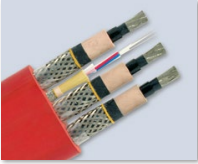
Cable Construction Design: Engineered from the Inside Out
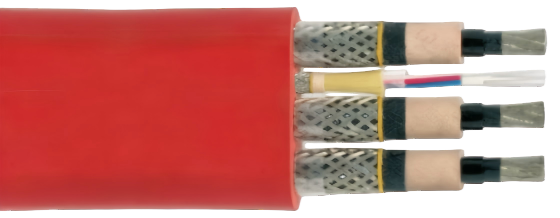
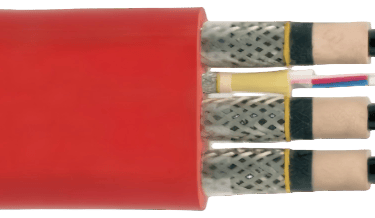
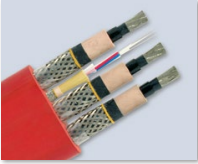
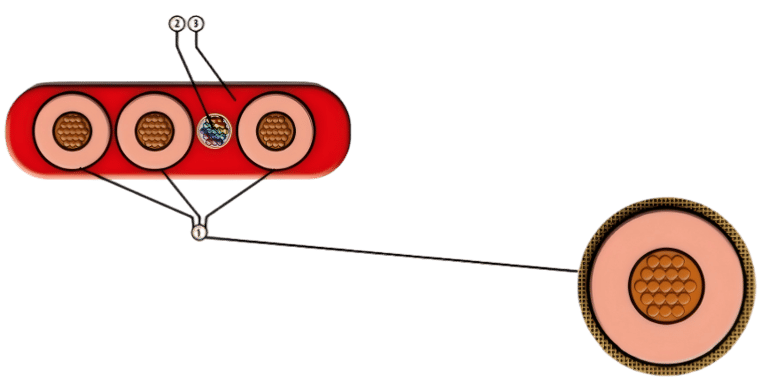
Understanding the (N)TSCGEWÖU begins with its internal architecture. The cable is built around a multi-layer geometry that balances electrical performance, mechanical resilience, and the dimensional precision required for flat-profile winding.
Conductor Layer: Each phase conductor is assembled from fine-stranded annealed copper wires. The high strand count — characteristic of Class 6 flexible conductors per IEC 60228 — delivers the tight bend radius tolerance that repetitive drum cycling demands. Unlike solid or coarser-stranded conductors, fine-wire construction distributes mechanical stress across thousands of individual filaments, dramatically reducing fatigue-related conductor fracture over the cable's service life.
Insulation Layer: Each conductor is insulated with cross-linked polyethylene (XLPE) compound, providing a stable dielectric barrier at both 3.6/6 kV and 6/10 kV rated voltages. XLPE insulation is preferred in medium voltage flexible cable design because it retains its dielectric properties across the full operating temperature range of -40°C to +80°C, resists moisture ingress, and offers a lower dielectric loss factor compared with EPR alternatives in many reel applications.
Screening Layer: Phase conductors in the (N)TSCGEWÖU are individually screened using copper tape or wire screen construction, with the option for an overall collective screen. This design choice is critical in port crane environments where variable-speed drives (VFDs) generate significant electromagnetic interference (EMI). Individual phase screening attenuates capacitive coupling between conductors and suppresses induced noise that could compromise control signal integrity — particularly where optional optical fibre bundles are integrated into the cable assembly for data transmission alongside power delivery.
Flat Assembly Geometry: The screened phase cores, along with any integrated pilot conductors or optical fibre elements, are laid in a parallel flat arrangement rather than twisted into a circular bundle. This flat geometry is the defining structural feature of the (N)TSCGEWÖU. By eliminating the round cross-section, the cable lies consistently flat against the drum surface during winding, enabling true monospiral stacking with no tendency to roll or shift between layers. The result is a more precise reel pack, reduced inter-layer friction, and a longer usable cable length on a given drum diameter compared with an equivalent round cable.
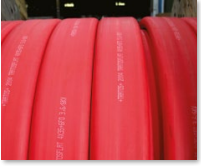
Outer Sheath: The entire assembly is encased in a robust extrusion of red polychloroprene (neoprene) compound, equivalent to 5GM5 quality as referenced in European harmonisation standards. The red colour serves as an immediate visual identifier in industrial environments — a practical safety consideration when multiple cable types are routed through the same installation.
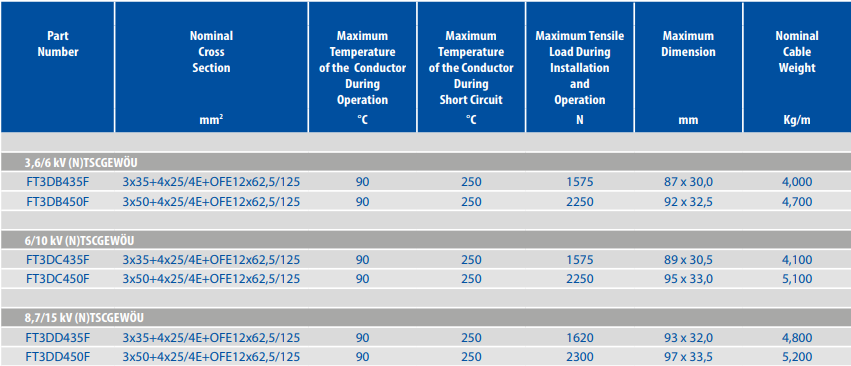
Materials and Performance Advantages
The selection of polychloroprene for the outer sheath of a medium voltage crane cable is not arbitrary. Neoprene has been the material of choice for demanding flexible cable applications for over six decades, and its combination of properties is uniquely suited to reel cable service conditions.
Oil and Chemical Resistance: Port and industrial environments routinely expose cables to hydraulic fluid, diesel exhaust condensate, lubricating oils, and cleaning solvents. Polychloroprene maintains sheath integrity under sustained contact with mineral oils and many common industrial chemicals, where PVC and standard polyurethane sheaths would soften or swell, compromising the cable's mechanical properties.
Flame Retardancy: The neoprene compound used in the (N)TSCGEWÖU sheath meets flame propagation requirements per IEC 60332, a mandatory consideration for crane cables that pass through enclosed machinery compartments and along structural steelwork.
UV and Ozone Stability: Outdoor crane applications — STS gantries, open-yard RTGs, quayside unloaders — expose trailing cables to prolonged UV radiation and ozone-rich marine atmospheres. Polychloroprene demonstrates excellent resistance to both, retaining flexibility and surface integrity without the cracking and surface degradation that UV-exposed PVC sheaths typically exhibit within a few years.
Low-Temperature Flexibility: The -40°C lower operating temperature rating is not a theoretical specification — it reflects real performance in northern port facilities, arctic mining operations, and cold-climate industrial plants where cable reels must cycle reliably in winter conditions that would render stiffer cable constructions brittle and prone to sheath cracking.
Tension and Bending Fatigue Resistance: In end-feed reel systems, the cable experiences a complex combination of tensile loading and repeated bending as it pays out and retrieves across the drum. The (N)TSCGEWÖU is specifically engineered for this stress profile, with the fine-stranded copper conductors, the flexible XLPE insulation, and the tough neoprene sheath working together to resist the cyclic fatigue that shortens the service life of cables not purpose-designed for reel duty. The cable is rated for reel travel speeds up to 200 m/min, accommodating the fast-cycle requirements of high-throughput automated terminals.
Applicable Crane Types and Movement Profiles
The (N)TSCGEWÖU is not a general-purpose medium voltage cable adapted for crane use — it is a crane cable in the most specific engineering sense, designed around the movement profiles and loading conditions that define this family of applications.
Ship-to-Shore (STS) Gantry Cranes: STS cranes are among the largest and most demanding cable reel applications in existence. The horizontal travel of the crane along the quay can exceed several hundred metres, and the cable reel must accommodate this travel continuously while maintaining constant tension. The flat profile of the (N)TSCGEWÖU ensures that drum winding remains disciplined across this extended travel range, preventing the cable overlap and bunching that can occur with round cables on large-diameter drums.
Rubber-Tyred Gantry (RTG) Cranes: RTG cranes present a particular challenge because they operate on rubber wheels across unpaved or semi-prepared yard surfaces, introducing vibration and directional variation into the cable reel system. The (N)TSCGEWÖU's high bending flexibility and resistance to torsional stress make it well-suited to the irregular motion profile of RTG operations, where cable feeding systems must compensate for lateral drift as well as longitudinal travel.
Rail-Mounted Gantry (RMG) Cranes: RMG cranes operate on fixed rails, and their predictable linear travel makes them ideal candidates for long cable reel runs. The consistent monospiral drum performance of the flat cable allows engineering teams to maximise reel capacity on a given drum size, reducing the number of reel changes required for a given crane travel range and lowering maintenance frequency.
Stacker Reclaimers and Mining Machinery: In mining and bulk material handling, stacker reclaimers follow arcuate travel paths around a central pivot, subjecting trailing cables to combined torsional and bending loads. The (N)TSCGEWÖU's flexible construction, combined with its robust neoprene sheath, tolerates the continuous flexing and occasional mechanical contact that characterise this application environment.
Port Unloaders and Mobile Power Plants: Ship unloaders, continuous ship unloaders (CSU), and mobile power generation equipment all rely on medium voltage flexible cables for reliable power feed during operation. The (N)TSCGEWÖU's compliance with 6/10 kV rating standards and its compatibility with end-feed reel systems makes it a direct fit for these applications without requiring custom adaptation.
Comparison with Standard Round Cables
Engineers evaluating crane cable specifications sometimes question whether a purpose-designed flat cable justifies the additional engineering consideration over a standard round medium voltage flexible cable. The performance data and field experience from global installations consistently support the flat cable choice on several key dimensions.
Drum Utilisation Efficiency: A flat cable wound in a monospiral pattern occupies drum width in a single, predictable layer. A round cable, even when wound carefully, tends to spiral unevenly, particularly at higher reel tensions, causing inter-layer crossovers that reduce effective drum capacity and introduce point loading on the cable sheath. Engineering studies on large STS cranes consistently demonstrate that flat cable construction allows 15–25% more cable length on an equivalent drum diameter compared with a round cable of similar electrical cross-section.
Consistent Reel Tension: Flat cables exert uniform lateral pressure across the drum flange during winding, maintaining predictable reel tension throughout the travel range. Round cables, because of their tendency to nest unevenly, can produce tension spikes as crossovers occur, contributing to sheath wear and, in extreme cases, conductor damage. For automated reeling systems operating at up to 200 m/min, consistent tension behaviour is not a convenience — it is a reliability requirement.
Thermal Management: The flat geometry exposes a greater surface area per unit length compared with a round cable of equivalent conductor cross-section, improving heat dissipation during periods of high current loading. This is particularly relevant in tropical port environments where ambient temperature alone challenges cable thermal ratings.
Maintenance and Total Cost of Ownership: Cable replacement on crane reel systems involves significant downtime, specialist rigging, and in some cases crane removal from service. Field data from installations using (N)TSCGEWÖU cables indicates extended service intervals compared with round cable alternatives, primarily due to reduced sheath abrasion and improved fatigue resistance at reel drum edges. When the cost of unplanned downtime at a container terminal — which can reach tens of thousands of dollars per hour — is factored into the calculation, the service life advantage of a purpose-designed flat cable delivers a compelling total cost of ownership case.
Engineering Value: Service Life, Reliability, and Safety
From a systems engineering perspective, the value proposition of the (N)TSCGEWÖU extends beyond its materials and geometry to encompass the broader operational and safety environment in which it functions.
Extended Service Life: The combination of fine-stranded Class 6 conductors, XLPE insulation, individual phase screening, and neoprene sheath creates a cable construction where each element contributes to longevity. There is no single weak point that dominates the failure mode. In practice, installations at major port terminals report service lives exceeding ten years under continuous high-cycle operation — a performance benchmark that round cables in comparable applications rarely achieve.
System Reliability: Medium voltage cable faults in crane systems are not minor inconveniences. A cable failure on an STS crane can halt all crane operations at a berth, causing vessel delay costs that cascade through the port's entire schedule. The (N)TSCGEWÖU's design philosophy — robust materials, precise construction tolerances, and verified compliance with DIN VDE 0250-813 — is oriented toward eliminating in-service failures rather than merely meeting minimum specification requirements.
Safety in High-Voltage Environments: Operating at up to 10 kV, a medium voltage crane cable represents a significant electrical hazard if its insulation or sheath integrity is compromised. The individual phase screening and the robust neoprene outer sheath provide multiple layers of protection between the energised conductors and the crane structure. For port safety management systems operating under international standards such as IEC 62271 and national electrical safety regulations, this multi-barrier construction supports compliance with insulation resistance and dielectric withstand requirements throughout the cable's service life.
Optional Data Integration: The option to integrate optical fibre conductors within the flat cable assembly allows crane operators to run power and data in a single cable, simplifying installation, reducing the number of cable reel systems required, and eliminating the risk of data cable damage from accidental contact with the power cable.
Why Specify Feichun Crane Cables
Feichun's engineering and manufacturing capability in the field of medium voltage flexible crane cables reflects a focused investment in understanding the specific demands of port and industrial crane applications. The (N)TSCGEWÖU has not been developed as a catalogue adaptation of an existing cable product — it represents a purpose-designed solution refined through deployment experience at more than 30 global port terminals across diverse climatic and operational environments.
The company supports custom voltage configurations beyond the standard 3.6/6 kV and 6/10 kV ratings, enabling specification of cables matched precisely to the network voltage and insulation coordination requirements of individual projects. Feichun's technical team provides full documentation support, including test reports to DIN VDE standards, construction drawings, and application-specific technical datasheets, facilitating the approval process with port authorities and engineering consultancies.
Frequently Asked Questions
Q: What is the maximum rated voltage for the (N)TSCGEWÖU, and can it be supplied for higher voltage systems?
A: The standard product range covers 3.6/6 kV and 6/10 kV rated voltages. Higher voltage configurations are available on request, subject to technical review of the application parameters. Feichun's engineering team will assess conductor cross-section, insulation thickness, and screening requirements for non-standard voltage levels.
Q: How does the flat cable perform in sub-zero operating environments?
A: The (N)TSCGEWÖU is rated for ambient temperatures as low as -40°C. The polychloroprene sheath compound and the XLPE insulation retain their flexibility and mechanical properties at this temperature, ensuring that the cable can be wound and unwound from the reel drum without risk of sheath cracking or insulation damage in cold-climate installations.
Q: Can the cable be supplied with integrated optical fibres for control and data transmission?
A: Yes. The flat assembly geometry of the (N)TSCGEWÖU accommodates the integration of optical fibre bundles alongside the power cores, enabling a single cable to carry both medium voltage power and high-bandwidth data signals. This option is particularly valuable for automated crane systems that require low-latency communication between the crane control system and the terminal operating system.
Q: What is the maximum travel speed for reel systems using this cable?
A: The (N)TSCGEWÖU is designed for monospiral reel end-feed systems with a maximum travel speed of 200 m/min. This rating is consistent with the high-cycle demands of modern automated container terminals and fast-operating bulk material handling machinery.
Q: How does the (N)TSCGEWÖU compare with a standard flexible round cable of the same conductor cross-section in terms of drum capacity?
A: Due to its flat profile and monospiral winding behaviour, the (N)TSCGEWÖU typically achieves 15–25% greater cable length on an equivalent drum compared with a round cable of the same conductor cross-section and voltage rating. The exact figure depends on drum geometry and flange dimensions, and Feichun's engineering team can provide drum capacity calculations for specific reel configurations.
Q: What certifications and standards does the cable comply with?
A: The (N)TSCGEWÖU is manufactured in compliance with DIN VDE 0250-813 and VDE 0298-4. The cable construction, insulation, and sheath materials are tested and verified against these standards, and full test documentation is available to support project approval and commissioning requirements.
Conclusion: Reliable Power for the World's Most Demanding Machinery
The (N)TSCGEWÖU medium voltage flexible flat power cable represents the convergence of material science, structural engineering, and field-validated design in a single product purpose-built for crane reel service. Its fine-stranded copper conductors, XLPE insulation, individually screened phase cores, and polychloroprene outer sheath form an integrated system that addresses the specific failure mechanisms — fatigue, abrasion, thermal cycling, and dielectric degradation — that limit the service life of conventional round cables in these applications.
For port operators, crane manufacturers, and electrical engineers specifying cable systems for STS gantries, RTG and RMG cranes, ship unloaders, and stacker reclaimers, the (N)TSCGEWÖU delivers measurable performance advantages in drum utilisation, service life, and operational reliability that translate directly into reduced maintenance costs and improved crane availability.
Contact Feichun for technical datasheets, application-specific engineering support, or product inquiries regarding the (N)TSCGEWÖU medium voltage flat power cable and the full range of Feichun crane cable solutions.
Port crane cables | Mining cables | Reeling cables | Trailing cables | Festoon cables | Heavy-duty power cables | Medium voltage cables | Offshore crane cables | Underground mining cables | Dragline cables | Shearer cables | Container handling cables | STS crane cables | RTG cables | Mobile equipment cables | Armored cables | Flexible power cables | VFD cables | Submersible cables | Cold resistant cables | Abrasion resistant cables | Flame retardant cables | Marine environment cables | Opencast mining | Underground operations
© 2006 All rights reserved.
[INDUSTRIAL_CABLES]
INDUSTRIAL GRADE CABLE SYSTEMS | PORT & MINING SOLUTIONS
TEL: +86 153 7530 2641 |MAIL: hongjing.Wang@feichuncables.com