
(N)TSFLCGEWOEU Medium Voltage Flat Reeling Cable: Engineering the Power Supply for Stacker Reclaimers at Jebel Ali Port
Learn how (N)TSFLCGEWOEU medium voltage flat reeling cable supports stacker reclaimer systems at Jebel Ali Port in the UAE. Designed for harsh Middle East environments with high tensile strength, UV resistance, and reliable monospiral reel operation.
hongjing.Wang@Feichun
3/16/20269 min read

Introduction: The Power Supply Imperative in High-Throughput Bulk Terminals
Bulk material handling ports represent some of the most mechanically intensive operating environments in the global logistics network. At Jebel Ali Port in the United Arab Emirates — one of the largest and most strategically significant port facilities in the Middle East — bulk stockyard operations run around the clock, processing coal, iron ore, sulphur, aggregates, and a wide range of dry cargo. The scale and continuity of these operations place extraordinary demands on every component in the electrical infrastructure, and none more critically than the power supply cable that feeds the stacker reclaimer.
A stacker reclaimer is a rail-mounted, high-capacity bulk handling machine. It travels along extended rail tracks while simultaneously performing stacking and reclaiming functions, requiring a continuous, uninterrupted power supply across its full travel length. In an environment defined by extreme ambient temperatures, omnipresent fine dust, mechanical vibration, coastal humidity, and relentless UV radiation, selecting the wrong cable is not merely a maintenance inconvenience — it is an operational liability. This is precisely the application domain for which the (N)TSFLCGEWOEU medium voltage flexible rubber flat power supply cable was engineered.
The Operating Environment at Jebel Ali: Why Standard Cables Fall Short
Before examining the cable itself, it is worth understanding the specific stresses that define the Jebel Ali operating environment. Ambient temperatures routinely exceed 45°C in summer months, with direct solar loading on exposed cable surfaces pushing effective temperatures even higher. Fine airborne particulate from bulk cargo handling creates persistent abrasive contact with any moving surface. The coastal location introduces elevated humidity and saline moisture. And the reeling motion of the cable drum — continuously paying out and recovering the cable as the stacker reclaimer traverses its stockyard rail — generates cyclical mechanical stress that would fatigue a lesser cable within months.
Generic power cables, even high-quality fixed-installation types, cannot meet this combination of demands. The (N)TSFLCGEWOEU cable is a purpose-built solution for exactly this class of application, and its construction reflects each of these operating challenges in deliberate engineering decisions.
Cable Architecture: A Flat Structure Purpose-Built for Monospiral Reeling
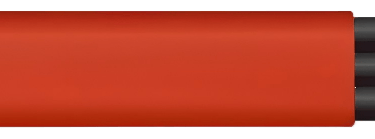
The most immediately distinctive feature of the (N)TSFLCGEWOEU is its flat cross-sectional geometry. Unlike round cables, which are appropriate for free-hanging or conduit-routed installations, a flat cable profile is specifically engineered for guided monospiral reel systems — the standard cable management method on stacker reclaimers and similar long-travel yard machinery.
On a monospiral reel, the cable winds and unwinds in a single, flat spiral layer. This geometry demands that the cable maintain dimensional stability under repeated winding cycles, resist torsional distortion, and layer consistently without overlapping or binding. A round cable, particularly at the cross-sections needed for medium voltage power transmission, would generate excessive inter-layer pressure, unpredictable lay patterns, and accelerated jacket wear. The flat cable profile addresses all of these issues: it distributes contact stress over a broader surface area, maintains a predictable orientation on the drum, and guides reliably in the single-plane movement characteristic of stacker reclaimer travel.
Available cross-sections cover a practical range from 3×25 mm² up to 3×120 mm² for the main power conductors, paired with corresponding earth conductors and control elements where required. Nominal outer dimensions scale accordingly, with the largest configurations measuring approximately 36 mm in thickness and 87 mm in width — flat geometries that remain well-suited to monospiral drum accommodation.
Conductor Design: Flexibility Without Compromise on Conductivity
The electrical conductors in the (N)TSFLCGEWOEU are manufactured from finely stranded tinned copper wire conforming to flexibility Class 5 in accordance with DIN EN/IEC 60228. This construction choice is not arbitrary. Class 5 conductors use the finest practical individual wire gauges within each stranded bundle, maximising the number of individual wires per cross-section and producing a conductor assembly that bends and flexes with minimal internal stress concentration.
Tinning the individual copper wires serves a dual purpose: it inhibits surface oxidation of the copper at the strand level, and it improves the wettability of the conductor under soldering or crimped termination. In a high-cycle reeling application where the conductor undergoes continuous bending fatigue, maintaining conductor integrity at the strand level is fundamental to long service life.
The maximum permissible tensile load on the conductor is rated at 15 N/mm². For a 120 mm² configuration, this translates to a maximum tensile force of 5,400 N — a mechanical rating that directly supports the demands of long-travel stacker reclaimers where cable self-weight and reel tension create meaningful longitudinal loading.


Insulation System: EPR Compound with Integrated Stress Control
The insulation system of the (N)TSFLCGEWOEU is a three-layer construction, and each layer performs a specific function within the medium voltage dielectric design.
The inner layer is a semi-conductive stress control layer applied directly over the conductor. In medium voltage cables, the transition between conductor and insulation creates an electrically inhomogeneous interface where field concentration can initiate partial discharge activity over time. The semi-conductive inner layer equalises the electric field at this interface, suppressing partial discharge and significantly extending the long-term dielectric stability of the insulation. This is not a feature found in low-voltage cables and reflects the technical rigour required for rated voltages of 3.6/6 kV, 6/10 kV, and 8.7/15 kV.
The main insulation body is an EPR (ethylene propylene rubber) compound, formulated to performance requirements based on DIN VDE 0207-20. EPR is selected for medium voltage reeling cables for well-established reasons: it provides excellent electrical properties across a wide temperature range, retains flexibility at low temperatures, and resists thermal ageing and oxidative degradation far more effectively than cross-linked polyethylene (XLPE) in dynamic applications. EPR does not harden or embrittle under the thermal cycling that characterises outdoor reeling service in the Gulf region.
The outer layer of the insulation system is a semi-conductive insulation shield layer. This outer screen layer serves to equalise the electric field at the insulation-to-screen interface, complementing the function of the inner stress control layer and ensuring uniform field distribution across the entire insulation thickness. Together, the three-layer insulation system provides a robust, well-screened dielectric architecture suited for reliable medium voltage service under mechanical and environmental stress.
Electromagnetic Screening: Plaited Copper Wire Construction
Each insulated core is covered by a plaited screen comprising fine tinned copper wires interwoven with synthetic threads. The plaited construction, as opposed to a simple spiral-wound tape screen, is specifically appropriate for flexible and reeling cables. A rigid screen — whether tape-wrapped or longitudinally applied — would crack, delaminate, or generate high-resistance contact faults under the repeated bending cycles of a reeling application. The plaited design flexes with the cable, maintaining low and consistent screen resistance through the operational life of the cable.
The screen performs two functions simultaneously: it provides an equipotential reference layer for the dielectric, contributing to field uniformity across the insulation, and it serves as a fault current return path in the event of an earth fault. In medium voltage systems at port facilities, the integrity of this fault current path is a fundamental safety requirement.
Outer Sheath: Heavy-Duty Rubber Compound for Harsh Stockyard Conditions
The outer sheath of the (N)TSFLCGEWOEU is a heavy-duty rubber compound conforming to type 5GM5 in accordance with DIN VDE 0207-21. This compound classification defines a specific performance tier for rubber-sheathed cables intended for heavy industrial service — and it is worth being precise about what this means in practice.
The 5GM5 compound provides high tensile strength and elongation at break, resisting tearing and splitting under the mechanical contact forces experienced during reel winding and cable laying. Its abrasion resistance is formulated for operation in environments where cable contact with steel drum flanges, cable guides, and ground surfaces would rapidly degrade a standard rubber sheath. Oil resistance is qualified to DIN EN/IEC 60811-404, addressing the hydraulic and lubricating fluids present in any heavy industrial port environment.
The sheath material also exhibits unrestricted weather resistance, including UV resistance and ozone resistance. In the intense solar radiation environment of the UAE, UV degradation is a primary failure mode for polymer-sheathed cables. The 5GM5 compound's UV resistance directly addresses this exposure risk, preventing the surface cracking and subsequent moisture ingress that characterises UV-degraded rubber sheaths. The standard red colouration with inkjet marking ensures clear identification in the field.
Voltage Ratings and Electrical Parameters
The (N)TSFLCGEWOEU is available in three rated voltage configurations, providing flexibility for the specific medium voltage distribution architecture of the host facility.
The 3.6/6 kV rating supports systems where phase-to-earth voltage is 3.6 kV and phase-to-phase voltage is 6 kV. The corresponding AC test voltage is 11 kV. Maximum permissible operating voltages are 4.2/7.2 kV for AC systems and 5.4/10.8 kV for DC systems.
The 6/10 kV rating is the most common configuration for stacker reclaimer power supply in medium-scale port terminals, with an AC test voltage of 17 kV and maximum permissible operating voltages of 6.9/12 kV (AC) and 9/18 kV (DC).
The 8.7/15 kV rating addresses high-capacity installations where larger machines or longer cable runs drive a requirement for higher distribution voltage. The AC test voltage for this configuration is 24 kV, with maximum operating voltages of 10.4/18 kV (AC) and 13.5/27 kV (DC).
Current-carrying capacities are determined in accordance with DIN VDE 0298-4, accounting for de-rating under the elevated ambient temperatures characteristic of Gulf port installations.
Thermal Performance: Engineered for the Gulf Climate
The thermal parameters of the (N)TSFLCGEWOEU are deliberately specified for the operating realities of Middle Eastern bulk terminals. For reeling operation, the cable is rated for ambient temperatures from -35°C to +80°C — a range that encompasses even the most extreme Gulf summer conditions with substantial margin. For fixed installation sections, the range extends to -40°C at the lower end.
The maximum permissible continuous conductor temperature is 90°C, and the maximum short-circuit conductor temperature is 250°C. These thermal limits, combined with the EPR insulation system's inherent thermal stability, ensure that the cable can sustain full rated current without progressive thermal degradation even in high-ambient conditions.
Mechanical Parameters: Defining Safe Operating Limits for Reel Systems
The mechanical performance specification of the (N)TSFLCGEWOEU reflects detailed understanding of the loading conditions in reeling applications. Three parameters are of particular engineering significance.
The maximum reeling speed of 120 m/min defines the upper limit for reel drive system specification. For stacker reclaimers operating at typical travel speeds, this rating provides substantial headroom and confirms suitability for automated, high-speed bulk handling operations.
The minimum S-type directional change distance of 20 times the cable thickness governs the geometry of cable guides, trough sections, and transition points on the cable management system. This parameter must be respected in the mechanical design of the cable guidance system — violations result in localised bending fatigue that accumulates rapidly under high-cycle operation.
The bending radius specification is defined in accordance with DIN VDE 0298-3 and IEC 60204-32, providing the design constraint for drum diameter selection and cable trough geometry. Correct bending radius compliance is a prerequisite for achieving the rated service life.
Fire Behaviour
The cable's fire behaviour is qualified to DIN EN/IEC 60332-1-2, confirming flame retardancy for single-cable vertical fire propagation testing. In the context of a port stockyard with large volumes of combustible bulk cargo and complex cable routing across extended distances, flame-retardant cable construction is a meaningful contribution to fire safety management.
Engineering Value: Service Life, Reliability, and Total Cost of Ownership
From an engineering perspective, specifying the (N)TSFLCGEWOEU for a stacker reclaimer application at a facility like Jebel Ali Port is a decision that should be evaluated on the basis of total cost of ownership rather than initial cable cost alone.
A cable failure on a stacker reclaimer in a high-throughput bulk terminal represents a multi-dimensional cost event: direct costs include cable replacement material and labour; indirect costs include machine downtime, stockyard throughput disruption, potential demurrage on waiting vessels, and the safety implications of an unplanned electrical fault in a live medium voltage system. The heavy-duty construction of the (N)TSFLCGEWOEU — EPR insulation, 5GM5 rubber sheath, plaited copper screen, and tinned Class 5 conductors — is specifically selected to minimise the frequency and severity of these events.
The cable carries a 24-month manufacturer warranty, reflecting confidence in its performance under the application conditions for which it is designed. In a competitive port environment where equipment utilisation targets are demanding and unplanned downtime has direct commercial consequences, the engineering reliability of the cable is not a peripheral specification — it is central to the business case for the installation.
Application Across the Wider Middle East Bulk Terminal Sector
The operating conditions at Jebel Ali Port are broadly representative of bulk terminal environments across the wider Gulf and Arabian Peninsula region. Ports including King Abdullah Port in Saudi Arabia, Sohar Port in Oman, and Hamad Port in Qatar operate equivalent stacker reclaimer systems under comparable environmental and mechanical conditions. Medium voltage flat reeling cables of the (N)TSFLCGEWOEU type are the established solution across this class of installation, with a track record in service that reflects the maturity and reliability of the design.
Conclusion
The (N)TSFLCGEWOEU medium voltage flexible rubber flat power supply cable is not a general-purpose cable adapted for reeling duty — it is a purpose-engineered product for exactly the operating conditions that define bulk material handling at major port facilities. Its flat geometry supports monospiral reel operation directly. Its EPR insulation system with integral stress control layers provides long-term dielectric stability at rated medium voltages. Its 5GM5 rubber outer sheath withstands the mechanical, chemical, and UV stresses of outdoor stockyard service. And its mechanical parameter specifications provide the engineering basis for correctly designed cable management systems.
For stacker reclaimer power supply at Jebel Ali Port and equivalent Gulf bulk terminals, the (N)TSFLCGEWOEU represents the technically correct answer to a demanding engineering requirement. Specifying it correctly, installing it within its mechanical limits, and operating the cable management system within its rated parameters are the three conditions that deliver the service life and reliability the application demands.
Port crane cables | Mining cables | Reeling cables | Trailing cables | Festoon cables | Heavy-duty power cables | Medium voltage cables | Offshore crane cables | Underground mining cables | Dragline cables | Shearer cables | Container handling cables | STS crane cables | RTG cables | Mobile equipment cables | Armored cables | Flexible power cables | VFD cables | Submersible cables | Cold resistant cables | Abrasion resistant cables | Flame retardant cables | Marine environment cables | Opencast mining | Underground operations
© 2006 All rights reserved.
[INDUSTRIAL_CABLES]
INDUSTRIAL GRADE CABLE SYSTEMS | PORT & MINING SOLUTIONS
TEL: +86 153 7530 2641 |MAIL: hongjing.Wang@feichuncables.com