Prysmian vs NSHTOEU-J: Is There a More Cost-Effective Alternative for Reeling Applications?
Comparing Prysmian NSHTOEU-J reeling cables with qualified alternatives for Middle East projects. Learn how Feichun Cable delivers comparable mechanical performance, shorter lead times, flexible MOQ, and competitive pricing for crane, port, and mining reeling applications.
hongjing.Wang@Feichun
6/15/202626 min read


Introduction
In the world of heavy industrial cabling, few names carry the recognition that Prysmian does. As one of the most established cable manufacturers on the planet, Prysmian has earned its reputation through decades of engineering excellence, particularly in demanding applications where ordinary cables simply will not survive. Among its widely specified products, the NSHTOEU-J reeling cable stands out as a workhorse solution for cranes, hoists, drum reeling systems, and a broad range of mobile equipment that operates under continuous mechanical punishment.
If you manage procurement for a port terminal, a steel mill, a cement plant, or a mining operation anywhere in the Gulf region, there is a strong chance you have encountered the NSHTOEU-J designation in your technical specifications. It appears in tender documents, in maintenance manuals, and in the original equipment drawings supplied by crane manufacturers across Europe and Asia. The cable has become something close to an industry standard for low-voltage reeling duty, and for good reason. It performs.

And yet, for all its merits, buyers across the Middle East increasingly find themselves grappling with a familiar set of frustrations. Lead times that stretch into months. Pricing that strains already tight project budgets. Minimum order quantities that force you to purchase far more cable than a maintenance job actually requires. These are not minor inconveniences. When a reeling cable fails on a quayside container crane and the replacement is twelve weeks away, the cost of waiting can dwarf the cost of the cable itself.
This article takes an honest, technically grounded look at the Prysmian NSHTOEU-J cable and asks a straightforward question that more and more buyers are quietly asking themselves: is there a more cost-effective alternative that delivers comparable performance for reeling applications? We will examine what makes this cable type work, why Prysmian's version has earned such loyalty, and where the practical realities of global supply chains create openings for qualified alternative manufacturers to serve Middle East projects more responsively.
Throughout, we will keep the discussion balanced. Prysmian builds excellent cable. The goal here is not to diminish that. The goal is to help you, as a buyer or engineer, understand your options clearly so you can make the decision that serves your project best.
It is worth setting the regional context plainly, because the Middle East is not Europe and its procurement realities differ in ways that matter enormously. The Gulf is in the middle of a sustained infrastructure boom. New ports are being commissioned, existing terminals are being expanded to handle ever-larger vessels, mining and quarrying operations are scaling up across the Arabian Peninsula, and bulk material handling capacity is being added at cement plants, steel works, and aggregate operations from one end of the region to the other. Every one of these projects consumes reeling cable, and consumes it in significant quantity. Demand is strong and growing.
At the same time, the supply chain serving this demand was largely designed around European and East Asian manufacturing, with the Gulf positioned as a destination rather than a hub. Cable specified by European crane builders flows from European factories, through European or regional distributors, and finally to the project site, accumulating lead time and cost at every stage. For the buyer at the receiving end, the result is a structural mismatch between the urgency and scale of Gulf demand and the responsiveness of the supply chain feeding it. This mismatch is the soil in which the case for alternatives grows, and understanding it is the first step toward making smarter sourcing decisions.
What Is NSHTOEU-J Cable?
Before comparing suppliers, it helps to understand exactly what the NSHTOEU-J designation describes. The naming follows the German VDE system, where each letter encodes a construction feature. Broken down, NSHTOEU identifies a specific family of rubber-sheathed, flexible reeling cables built to handle severe mechanical stress, and the "-J" suffix indicates that a green-yellow protective earth conductor is included in the design. A closely related variant, NSHTOEU-O, omits the dedicated earth core and is typically used for bus and control configurations.
At its heart, NSHTOEU-J is a reeling cable. That single word carries enormous engineering weight. A reeling cable is not simply a flexible power cable. It is a cable engineered to be wound and unwound thousands upon thousands of times around a motorized drum, often at considerable speed, while carrying full electrical load and surviving exposure to weather, abrasion, oil, and impact. Ordinary industrial cable subjected to this duty cycle would fail within weeks. A properly constructed reeling cable lasts for years.
Core Applications
The NSHTOEU-J family was developed specifically for drum applications and mobile equipment operating under high mechanical stress. The cable supplies power and control signals to machinery that moves continuously, with the cable feeding off and back onto a reel as the equipment travels along its path. This makes it indispensable wherever motion and electrical supply must coexist reliably.
In practical terms, you will find NSHTOEU-J cable serving these environments:
Port cranes. Ship-to-shore gantry cranes, rubber-tyred gantry cranes, and rail-mounted gantry cranes all depend on reeling cables to maintain power as they traverse the quay. The cable spools out as the crane moves seaward and retracts as it returns, sometimes covering hundreds of meters of travel per cycle.
Container handling equipment. Beyond the cranes themselves, the broader ecosystem of container terminals relies on reeling cables for straddle carriers, automated stacking systems, and the various pieces of mobile handling gear that keep a modern port flowing.
Bulk material handling systems. Stacker-reclaimers, ship loaders, and conveyor gantries used to move coal, ore, grain, and aggregates all require flexible reeling power. These machines often operate in dusty, abrasive, and corrosive conditions that test a cable's outer sheath to its limits.
Mining machinery. In open-pit mines and quarries, mobile crushing and screening plants, draglines, and excavators frequently use reeling cables to maintain power supply across moving connections. Mining is among the most punishing environments a cable can face, combining mechanical stress, temperature extremes, moisture, and constant exposure to abrasive material.
The common thread across all these applications is motion under load. Wherever a machine must move while staying powered, and wherever that movement involves a drum or reel, the NSHTOEU-J cable type earns its place in the specification.
Understanding the Construction Layers
To appreciate why NSHTOEU-J cable succeeds where ordinary cable fails, it helps to look inside it layer by layer, because every element of the construction exists to solve a specific problem that reeling duty creates.
At the center sits the conductor. This is not solid wire, nor even the moderately stranded conductor of a fixed-installation power cable. It is very finely stranded copper, with hundreds of thin individual strands bundled together. The reason is mechanical. When a cable bends around a drum, the copper on the outside of the bend stretches while the copper on the inside compresses. The finer the stranding, the more easily the individual strands slide and accommodate this differential, distributing the strain so that no single strand bears enough stress to fatigue and break. Coarse stranding concentrates strain and leads to progressive strand breakage, which raises resistance, generates heat, and eventually causes failure. Fine stranding is the foundation of reeling endurance.
Surrounding each conductor is the insulation. In the premium construction this is a special EPR-based compound, and in other NSHTOEU variants a rubber compound of type 3GI3. Rubber-family insulations are chosen for reeling cable because they remain flexible across a wide temperature range and tolerate repeated flexing without cracking, unlike stiffer thermoplastic insulations that can become brittle. The insulation must also withstand the conductor's operating temperature, which in this cable family reaches 90 degrees Celsius continuously and 250 degrees Celsius under short-circuit conditions.
The insulated cores are then laid up together, twisted around a central filler with a deliberately short length of lay. The short lay length is important. It means the cores spiral tightly around the cable axis, so that when the cable bends, each core's position relative to the neutral axis of the bend changes continuously along its length. This prevents any single core from sitting permanently on the outside of every bend, distributing flex stress evenly along the whole cable rather than concentrating it.
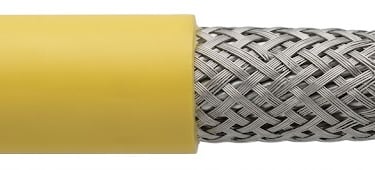
Over the laid-up cores comes the sheath system, and this is where reeling cable truly distinguishes itself. An inner sheath of rubber fills the gaps between cores and provides a stable foundation. Embedded within or over the sheath sits a reinforcement layer, a braid of polyester threads that absorbs tensile and torsional forces, preventing those forces from reaching and damaging the conductors. Finally, an outer sheath of abrasion-resistant and tear-resistant rubber provides the tough skin that contacts drums, rollers, and the ground, taking the physical punishment of the operating environment. This layered architecture, each element doing its specific job, is what allows the cable to survive years of reeling that would destroy an ordinary cable in weeks.
Why Is Prysmian NSHTOEU-J Popular?
It would be a mistake to treat Prysmian's market position as the product of marketing alone. The company's reeling cables have earned their reputation through genuine engineering substance, and any honest comparison has to begin by acknowledging what they do well. Buyers across the world specify Prysmian not out of habit, but because the product has consistently delivered. Let us look at the specific reasons engineers trust it.
Excellent Mechanical Strength
The defining challenge of any reeling cable is mechanical endurance, and this is where Prysmian's CORDAFLEX(SMK) construction shines. The cable is built around a very finely stranded electrolytic copper conductor in flexibility class FS, the highest flexibility class available, which allows the copper to flex repeatedly without fatigue cracking. Around this sits a sophisticated multi-layer sheath system.
What makes the construction remarkable is the anti-torsion braid: a reinforced braid made of polyester threads, bonded in a vulcanized union between the inner and outer sheaths. This creates a sheath system with a high mechanical strength that resists the twisting and pulling forces a reeling drum imposes. The outer sheath itself is an abrasion-resistant and tear-resistant special rubber compound based on PCP (polychloroprene), engineered to survive years of contact with drum surfaces and guide rollers.
The numbers tell the story. The CORDAFLEX(SMK) version tolerates a maximum tensile load on the conductor of 30 N/mm², the highest among the reeling cables in its class, and supports travel speeds up to 240 meters per minute in festoon operation, with no stated restriction in reeling operation. It also withstands torsional stress of plus or minus 50 degrees per meter. These are demanding specifications, and the cable meets them.
Reliable Performance in Heavy-Duty Applications
Specifications on paper are one thing; field reliability is another. Prysmian's reeling cables have built a track record of dependable service in some of the harshest industrial settings imaginable. The insulation system, a special compound based on high-quality EPR (ethylene propylene rubber) rated minimum 3GI3, provides improved mechanical and electrical characteristics that hold up under thermal cycling and mechanical flexing alike.
The cable is rated for a maximum permissible conductor temperature of 90 degrees Celsius in continuous operation, with a short-circuit conductor temperature tolerance up to 250 degrees Celsius. For fixed installation it handles an ambient range from minus 50 to plus 80 degrees Celsius, and in fully flexible operation from minus 35 to plus 80 degrees Celsius, with special low-temperature versions available down to minus 45 degrees Celsius on request. This thermal envelope means the cable performs reliably whether installed in a freezing northern port or a scorching desert terminal.
Global Brand Recognition
There is real value in specifying a globally recognized brand. When a consultant writes Prysmian into a tender, when a crane OEM ships equipment with Prysmian cable already fitted, and when a maintenance team has used the same product for fifteen years, that familiarity reduces perceived risk. The VDE registration (Reg. Nr. 7519) and GOST-R approvals provide documented third-party verification that buyers and inspectors can point to. For projects where specification compliance must be demonstrated to regulators or financiers, that paper trail carries weight.
Proven Use in Ports and Industrial Facilities
Finally, Prysmian's NSHTOEU-J cables have an extensive installed base. Walk through major container terminals, steel works, and mining operations across Europe, the Gulf, and Asia, and you will find these cables in active service. This proven deployment history gives engineers confidence. They are not betting on an unknown quantity; they are choosing a product that peers have already validated in conditions much like their own.
None of this is in dispute. Prysmian makes a genuinely strong product, and it deserves its standing. The question this article addresses is not whether the cable is good. It clearly is. The question is whether it is the only path to a good outcome for your project, or whether the practical challenges of sourcing it create room for an equally capable alternative.
Common Purchasing Challenges Faced by Buyers
Here is where the conversation shifts from the cable itself to the experience of buying it. A product can be technically excellent and still create headaches at the procurement stage, and for many Middle East buyers, that is precisely the situation with premium European cable brands. The frustrations below are not hypothetical. They surface again and again in conversations with procurement managers, maintenance supervisors, and project engineers across the region.
Long Delivery Times
The single most common complaint about premium European reeling cable is lead time. Because these cables are built to order in European factories, and because reeling cable is a specialized low-volume product rather than a mass-produced commodity, the wait between placing an order and receiving the goods can be substantial. Quoted lead times of eight, twelve, or even sixteen weeks are not unusual, and they can extend further when European factory order books are full or when shipping schedules to the Gulf face congestion.
For routine planned procurement, a long lead time is manageable. You order ahead, you stock accordingly, and the cable arrives before you need it. The problem arises when timing is not on your side, and in industrial operations, timing is frequently the enemy.
Project deadlines create the first pressure point. When a new terminal is being commissioned or a crane is being installed against a fixed handover date, a twelve-week cable lead time can become the critical path that holds up the entire project. Contractors face liquidated damages for late completion, and a single delayed cable shipment can trigger those penalties.
Shutdown maintenance creates an even sharper pressure. Major industrial facilities schedule planned shutdowns months in advance, often during brief windows when production can be safely halted. If a reeling cable is identified for replacement during a shutdown, the cable must be on site when the shutdown begins. Miss that window because the cable is still in transit, and the work either gets deferred to the next shutdown, potentially a year away, or the facility extends its costly downtime to wait for delivery. Neither outcome is acceptable to plant management.
It is worth adding that the lead-time problem in the Middle East is compounded by factors beyond the factory gate. Even after a cable leaves a European facility, it faces ocean freight transit times, port congestion that has become increasingly unpredictable in recent years, customs clearance procedures, and final inland transport to the project site. Each of these stages adds time and introduces the risk of delay. A quoted factory lead time of ten weeks can easily become a delivered lead time of fourteen or more once the full logistics chain is accounted for. For a buyer trying to plan against a fixed deadline, this uncertainty is as damaging as the length of the lead time itself, because it makes reliable planning difficult. A supply chain that originates closer to the region, or that is structured for faster and more predictable export to the Gulf, reduces both the length and the uncertainty of this exposure.
High Procurement Costs
Premium brand cable commands premium pricing, and that is simply the reality of buying from established European manufacturers. The brand carries a price that reflects not only the product quality but also the cost structure of European manufacturing, the margins of multiple distribution layers, and the value of the name itself. For some projects, that premium is justified and easily absorbed. For others, it creates genuine difficulty.
Budget pressure is a constant in industrial procurement. Maintenance budgets are scrutinized, capital projects are bid competitively, and every line item faces pressure to come down. A reeling cable that costs significantly more than a technically equivalent alternative forces a hard question: is the brand premium delivering proportional value, or is it simply consuming budget that could be deployed elsewhere?
Large projects magnify the cost impact dramatically. When a single crane might require hundreds of meters of reeling cable, and a terminal expansion might involve a dozen cranes plus material handling systems, the cable spend runs into substantial sums. At that scale, even a modest per-meter price difference compounds into a large absolute figure. A procurement manager who can deliver comparable performance at a lower total cost on a major project delivers real value to the organization, and that incentive drives serious evaluation of alternatives.
Minimum Order Quantity Restrictions
The third challenge is one that catches many buyers off guard: minimum order quantities. Because specialized reeling cable is produced in manufacturing runs, suppliers often impose minimum order lengths to make production economically viable. These minimums can be considerable, sometimes far exceeding what a particular job actually needs.
Spare parts procurement suffers acutely from MOQ restrictions. A prudent maintenance operation wants to keep a length of reeling cable in stock, ready to deploy the moment a failure occurs. But if the minimum order is several hundred meters and the immediate need is fifty, the buyer must either over-purchase and tie up capital in excess inventory, or forgo holding a spare altogether and accept the risk of extended downtime when a cable fails.
Maintenance stock management faces the same squeeze across the broader inventory. Maintenance teams typically need modest quantities of many different cable types and sizes rather than large quantities of one. Rigid MOQ requirements make it impractical to maintain a sensible spread of spares, forcing trade-offs that leave the operation exposed when an unusual cable size fails unexpectedly. Flexibility on order quantity is therefore not a trivial convenience. For a maintenance-driven operation, it can be the difference between resilient readiness and chronic vulnerability.
Prysmian vs Alternative NSHTOEU-J Suppliers
Having looked at both the strengths of Prysmian's product and the challenges of sourcing it, we can now compare the premium brand against the proposition offered by qualified alternative manufacturers. The honest summary is this: the gap is not where most people assume it is. The gap is not primarily in performance. It is in the commercial and logistical terms of supply.
On mechanical performance, a well-engineered alternative NSHTOEU-J cable delivers results that are genuinely comparable to the premium brand. The construction principles are well understood across the industry and are codified in the DIN VDE 0250 part 814 standard that governs this cable type. A capable manufacturer building to the same standard, using the same class of finely stranded copper conductor, the same EPR-based insulation chemistry, and the same multi-layer reinforced rubber sheath architecture, produces a cable that performs comparably in the field. The physics does not belong to any single company. What matters is whether the manufacturer builds to specification with proper quality control, and a qualified alternative supplier does exactly that.
On lead time, the alternative manufacturer frequently holds a decisive advantage. A supplier with production capacity oriented toward project demand and toward faster export schedules to the Middle East can compress the delivery window considerably compared to a European factory with a long order queue. When the difference is between four weeks and twelve, that advantage reshapes what is possible for a project.
On MOQ flexibility, the alternative supplier again tends to offer more room. Where the premium brand imposes rigid minimums, a flexible manufacturer can accommodate the actual quantity a job requires, whether that is a full drum or a modest length for a maintenance spare. This flexibility directly addresses one of the most persistent buyer frustrations.
On customization, alternatives often provide options that large standardized producers do not. Custom cable lengths cut to the exact reeling requirement, tailored core configurations, and project-specific adaptations are more readily available from a manufacturer organized around responsive production rather than standardized catalog output.
On cost efficiency, the alternative manufacturer competes on more competitive pricing while the premium brand commands premium pricing. A leaner cost structure and a more direct supply relationship allow qualified alternatives to deliver comparable performance at a price that eases budget pressure rather than adding to it.
To be clear about the framing: the alternative does not claim to be superior. It claims to be comparable in performance while offering meaningful advantages in lead time, order flexibility, customization, and cost. For many Middle East projects, that combination is exactly what the situation calls for.
Matching the Full Range of Configurations
One concern buyers reasonably raise is whether an alternative can match not just a single cable size but the full range of configurations a real installation requires. The NSHTOEU-J family is not a single product; it is a broad system of variants covering power, control, combined, and bus applications, and a credible alternative must address the whole range.
On the power side, the family spans three-core, four-core, and five-core designs across a wide spread of cross-sections. The three-core power designs, used where a separate split earth arrangement is required, run from modest sizes up to very large conductors of 300 square millimeters with corresponding earth conductors, carrying currents well above 600 amperes. The four-core and five-core designs cover the smaller and mid-range cross-sections common in general machine power supply, from a few square millimeters up to 25 or 35 square millimeters. A capable alternative manufacturer must be able to produce across this entire span, matching conductor count, cross-section, and the split-earth arrangement where specified.
On the control side, the family includes multicore control cables in numerous core counts, from seven cores up to fifty-six cores or more, in the standard small cross-sections used for control signaling. These cables carry the command and feedback signals that coordinate the powered machinery, and they must flex alongside the power cores with equal endurance. The NSHTOEU-O bus variant adds screened pair configurations for data and bus communication, and combined control cables integrate larger control cores with smaller signal cores in a single sheath. The premium range even extends to versions with integrated fibre-optic elements for high-bandwidth data transmission alongside the power and control conductors.
This breadth matters because a real crane or material handling machine rarely needs just one cable. It needs power, control, and often data, and a supplier who can provide the matching set across the full configuration range simplifies procurement enormously. When evaluating an alternative, confirm that the manufacturer can deliver the specific configurations your installation requires, not merely the headline power cable. A specialist manufacturer with genuine reeling-cable capability will handle the range; a supplier who can only offer a narrow selection should give you pause.
When Does an Alternative Make More Sense?
A qualified alternative is not the right answer for every situation. There are cases where specifying the established premium brand remains the prudent choice, particularly where a contract rigidly mandates a specific manufacturer or where institutional risk policies require it. But there is a substantial set of scenarios where the alternative is not merely acceptable but actively the better decision. Here are the situations where buyers most often benefit from evaluating an alternative NSHTOEU-J supplier.
Urgent Replacement Projects
When a reeling cable fails unexpectedly and the equipment it powers is down, every day of delay carries a cost. A port crane out of service can back up vessel operations and incur demurrage. A mining conveyor offline can halt an entire production chain. In these situations, the deciding factor is not brand prestige but speed of supply. A supplier who can manufacture and ship a compliant replacement in weeks rather than months solves the actual problem the buyer faces. For urgent replacement, lead time advantage is decisive, and this is precisely where alternative manufacturers shine.
Cost-Sensitive Tenders
Competitive tenders, particularly in the public sector and in price-driven private projects, reward the bidder who delivers compliant performance at the lowest responsible cost. When the cable specification calls for NSHTOEU-J performance and the evaluation hinges on price, a contractor who sources from a competitively priced alternative manufacturer improves the bid's competitiveness without sacrificing technical compliance. In tight tenders, the cost difference on cable can be the margin between winning and losing the work.
Regional Distribution in the Middle East
Geography matters in supply chains. A manufacturer with established distribution channels and export logistics oriented toward the Gulf region can serve Middle East projects more responsively than a distant European supplier routing product through multiple intermediaries. Shorter and more reliable shipping lanes, familiarity with regional documentation and customs requirements, and a supply relationship attuned to the rhythms of Middle East projects all reduce friction and delay. For buyers in the region, a supplier built around serving them is a structural advantage.
Custom Cable Requirements
Not every application fits a catalog product. A specific crane may require an unusual core combination, an exact cut length, a particular configuration of power and control conductors, or a tailored adaptation for an unusual environment. Large standardized producers are not always set up to accommodate such requests economically. A flexible manufacturer organized around project-based and customized production can deliver the exact cable the application demands rather than forcing the application to adapt to a standard product. Where customization is the requirement, the alternative supplier's flexibility becomes the deciding factor.
Recognizing which of these situations applies to your project is the practical heart of the sourcing decision. In many cases more than one applies at once. An urgent replacement on a cost-sensitive operation in the Gulf with a slightly non-standard configuration ticks every box, and in such cases the argument for a qualified alternative becomes overwhelming. The discipline is simply to assess your situation honestly against these scenarios rather than defaulting to the premium brand out of habit. Habit is comfortable, but it is not procurement strategy, and the buyers who serve their organizations best are those who match the supplier to the actual demands of each project.
Key Factors to Evaluate Before Switching Suppliers
Choosing an alternative supplier is a technical decision, and it must be made with engineering rigor rather than on price alone. A cheaper cable that fails prematurely is no bargain; it is an expensive lesson. The good news is that evaluating an alternative NSHTOEU-J cable is entirely feasible if you check the right parameters against the original specification. Here are the critical factors every buyer and engineer should verify before making the switch.
Conductor Class
The flexibility of a reeling cable depends fundamentally on its conductor construction. Genuine reeling cable uses very finely stranded copper in the highest flexibility classes, class FS in the case of the premium CORDAFLEX construction, or flexible class 5 per DIN EN 60228 / DIN VDE 0295 in other NSHTOEU variants. The fineness of the stranding determines how many flex cycles the conductor survives before fatigue. When evaluating an alternative, confirm that the conductor stranding matches the required flexibility class. A coarser conductor may carry current adequately but will fail far sooner under repeated reeling. This is non-negotiable for reeling duty.
Tensile Strength
A reeling cable must withstand the pulling forces imposed by the drum as it winds and unwinds, and the maximum tensile load on the conductor is a defining specification. The premium CORDAFLEX version rates 30 N/mm², while the standard rubber-sheathed NSHTOEU construction rates 15 N/mm². Confirm that the alternative cable's tensile rating matches the demands of your specific reeling application. The permissible tensile force, expressed in newtons for each cable size, should be checked against the actual drum forces the installation imposes. Under-specifying here leads to conductor stretching and early failure.
Bending Radius
Every reeling cable has a minimum bending radius below which it must not be flexed, and reeling drums must be sized to respect this limit. The minimum free-moving bending radius scales with cable diameter and is specified for each size. When substituting an alternative cable, verify that its minimum bending radius is compatible with the existing drum and guide geometry. A cable with a larger minimum bending radius than the drum allows will be over-stressed at every wrap, dramatically shortening its life regardless of how well it is otherwise built.
Operating Voltage
The NSHTOEU-J family is rated 0.6/1 kV (600/1000V), with a maximum permissible AC operating voltage of 0.7/1.2 kV and DC of 0.9/1.8 kV, verified by an AC test voltage applied for five minutes. Confirm that the alternative cable carries the same voltage rating and has passed the corresponding type tests. Voltage rating is a safety-critical parameter, and any substitute must meet or exceed the original specification, supported by documented test certificates.
Environmental Resistance
Reeling cables operate outdoors in punishing conditions, so environmental durability is essential. Verify the alternative cable's resistance to oil (per the relevant EN 60811-404 testing), its weather, ozone, UV, and moisture resistance, and its water resistance where the application involves wet or submerged conditions. Check the flame-retardancy rating against standards such as IEC 60332-1 where fire performance is required. Confirm the full ambient temperature range, both for fixed installation and for fully flexible operation, matches the climate the cable will face. In the Gulf, high-temperature performance is particularly important, and the cable's upper ambient rating of plus 80 degrees Celsius should be confirmed.
Verifying these five factor groups against the original specification gives you a sound technical basis for substitution. A reputable alternative manufacturer will readily provide the documentation, test certificates, and detailed datasheets needed to make these comparisons. If a supplier cannot or will not provide that evidence, that absence is itself a warning sign. Demand the data, check it against the original, and you can switch suppliers with engineering confidence rather than guesswork.
Thinking in Total Cost of Ownership
Beyond the parameter-by-parameter check, there is a broader way to evaluate a supplier switch that sophisticated buyers increasingly adopt: total cost of ownership. The purchase price of the cable is only one component of what it actually costs the operation over its service life, and focusing on purchase price alone can mislead in both directions.
On one hand, a premium cable that lasts longer can justify a higher purchase price if the extended service life reduces the frequency of costly replacement and the associated downtime. This is the genuine value argument for premium brands, and it deserves honest consideration. On the other hand, that argument only holds if the price premium is proportional to the life extension. If a premium cable costs substantially more but a properly engineered alternative delivers comparable service life, then the premium is pure cost with no offsetting benefit, and the alternative wins decisively on total cost of ownership.
The components of total cost of ownership for a reeling cable include the purchase price, the cost of installation labor, the expected service life under the actual duty cycle, the cost of downtime when the cable must be replaced, the lead time exposure that determines how long downtime lasts, and the inventory carrying cost of any spares held against failure. When you tally all of these rather than just the sticker price, the picture often shifts. A cable with a lower purchase price, comparable service life, dramatically shorter replacement lead time, and flexible spare-part availability can deliver a markedly lower total cost of ownership even if its headline price advantage is modest. For Middle East operations where downtime is expensive and lead times from distant suppliers are long, the lead-time and flexibility components of total cost of ownership frequently swing the analysis toward a qualified regional alternative.
Flexible Supply Options for Middle East Projects
This is where Feichun Cable enters the picture. As a manufacturer specializing in mine-mouth and mining cables, Feichun has built its capabilities precisely around the demanding reeling and mobile-equipment applications where cables like NSHTOEU-J are deployed. The mining environment is among the most severe any cable can face, combining mechanical stress, abrasion, moisture, temperature extremes, and constant motion, and a manufacturer that builds reliable cable for mining understands reeling duty at a deep level. That specialization translates directly into capability for port, crane, and bulk-handling reeling applications as well.
For Middle East buyers, Feichun offers a supply proposition designed to address the exact challenges discussed throughout this article.
OEM manufacturing capability means Feichun can produce reeling cable built to the NSHTOEU-J specification, matching the conductor class, tensile rating, voltage class, sheath construction, and environmental performance that the application requires. For buyers and OEMs who need a compliant product under their own requirements, this manufacturing flexibility provides a dependable foundation.
Project-based production allows Feichun to align manufacturing with the actual demands of a specific project rather than forcing buyers into standardized catalog constraints. When a terminal expansion or a mining installation requires a particular quantity, configuration, and delivery schedule, production can be organized around those project needs directly.
Customized lengths address the practical reality that reeling installations need cable cut to specific requirements. Rather than over-purchasing to meet a rigid standard length, buyers receive the lengths their drums and installations actually call for, reducing waste and tied-up capital.
Flexible MOQ directly answers one of the most persistent buyer frustrations. Whether the need is a full production run for a major project or a modest length for a critical maintenance spare, Feichun's order flexibility accommodates the real requirement rather than imposing minimums that force over-purchasing.
Faster export schedules to the Middle East compress the lead time that so often becomes the critical path on urgent projects and shutdown maintenance. By orienting production and logistics toward responsive export to the region, Feichun helps buyers solve the timing problem that premium brand lead times frequently create.
Taken together, these supply options form a coherent answer to the buyer's dilemma. Comparable mechanical performance, built to the same governing standard, paired with the commercial flexibility, customization, and delivery responsiveness that a fast-moving Middle East project genuinely needs.
Why Mining Specialization Matters for Reeling Cable
There is a particular reason Feichun's background in mine-mouth and mining cables makes it well suited to reeling applications, and it is worth drawing out, because the connection is not always obvious to buyers thinking only in terms of port or crane cable.
Mining is the proving ground for cable durability. A cable serving mobile mining equipment faces the full catalogue of stresses simultaneously: it is dragged across abrasive ground, flexed continuously as machines move, exposed to crushing impact from falling material, soaked by water and slurry, subjected to oil and hydraulic fluid, and cycled through wide temperature swings. A manufacturer that builds cable capable of surviving this environment has, by necessity, mastered every discipline that reeling cable demands. The fine-stranded flexible conductor, the tough abrasion-resistant sheath, the reinforced construction that resists tensile and torsional abuse, the environmental sealing against moisture and contaminants, these are exactly the competencies that mining cable requires and exactly the competencies that reeling cable requires.
In other words, a manufacturer who has earned its expertise in the mining sector arrives at reeling applications already fluent in the engineering that matters. The duty cycle of a port crane reeling drum, demanding as it is, draws on the same fundamental capabilities as the mining cable that Feichun specializes in. This is not a manufacturer stepping outside its competence to chase an adjacent market; it is a manufacturer applying hard-won, deeply relevant expertise to an application that rewards exactly that expertise. For the buyer, that lineage offers reassurance that the cable is built by people who understand, at a deep level, what it takes to survive in the field.
Conclusion
Let us end where honesty requires. Prysmian remains a respected brand, and its NSHTOEU-J reeling cables are genuinely excellent products with a proven record in the world's most demanding industrial applications. Any buyer who specifies Prysmian is choosing a quality product, and nothing in this article should be read as a claim otherwise.
But respect for a brand and blind allegiance to it are different things. The realities of industrial procurement in the Middle East, the long lead times, the premium pricing, and the rigid minimum order quantities, create genuine challenges that no amount of brand prestige resolves. When a crane is down and the replacement is months away, when a tender hinges on cost, when a maintenance team needs a modest spare rather than a full production run, the premium brand is not always the answer the situation demands.
For buyers seeking shorter lead times, flexible quantities, and competitive pricing, evaluating a qualified alternative NSHTOEU-J cable manufacturer is not a compromise. It is sound procurement. The performance gap that buyers fear is, for a properly engineered alternative built to the same DIN VDE standard, not the chasm they imagine. What changes is not the cable's ability to do the job. What changes is the speed, the flexibility, and the cost at which you can get it.
The prudent path is to evaluate the technical parameters carefully, demand the documentation, verify the conductor class, tensile strength, bending radius, voltage rating, and environmental resistance against the original specification, and then make a clear-eyed decision. For many Middle East reeling applications, a qualified alternative manufacturer like Feichun Cable, with its deep specialization in mining and mine-mouth cables, can deliver a complete and dependable replacement that serves the project better than the premium brand ever could on lead time, flexibility, and cost.
The brand is respected. The alternative is capable. The right choice depends on your project, and now you have the framework to make it.
Frequently Asked Questions
What is the equivalent of Prysmian NSHTOEU-J cable?
The equivalent is any reeling cable built to the same DIN VDE 0250 part 814 standard that governs the NSHTOEU-J designation, matching its key parameters: a very finely stranded flexible copper conductor, EPR-based insulation, a reinforced multi-layer rubber sheath system, a 0.6/1 kV voltage rating, and the appropriate tensile and bending specifications. A qualified manufacturer such as Feichun Cable can produce a cable matching these specifications, delivering comparable mechanical and electrical performance for crane, port, and mining reeling applications. The key is to verify that the alternative meets the same governing standard and provides documented test certificates.
Can NSHTOEU-J cables be customized?
Yes. While large standardized producers often limit customization, flexible manufacturers can tailor reeling cables to specific project requirements. This includes custom cut lengths matched to drum geometry, specific core combinations of power and control conductors, particular voltage or temperature adaptations, and configurations suited to unusual installation environments. Feichun Cable's project-based production model is built around this kind of customization, allowing the cable to be matched precisely to the application rather than forcing the application to fit a standard catalog product.
Is an alternative supplier suitable for port crane projects?
Yes, provided the alternative cable meets the full technical specification the crane requires. Port crane reeling duty is demanding, involving high travel speeds, significant tensile loads, continuous flexing, and harsh marine environmental exposure. A qualified alternative manufacturer building to the NSHTOEU-J standard, with proper conductor flexibility class, adequate tensile rating, compatible bending radius, and verified environmental resistance, produces a cable fully suitable for port crane service. Many port operators successfully use qualified alternative cables, and the key is verifying the specification match and demanding the supporting documentation before deployment.
What should be checked before replacing a Prysmian cable?
Before substituting any reeling cable, verify five critical factor groups against the original specification. First, conductor class, confirming the stranding matches the required flexibility class for reeling duty. Second, tensile strength, ensuring the maximum tensile load rating suits the drum forces. Third, bending radius, confirming the minimum bending radius is compatible with the existing drum and guide geometry. Fourth, operating voltage, verifying the 0.6/1 kV rating and supporting type tests. Fifth, environmental resistance, checking oil, weather, UV, moisture, flame, and the full temperature range against the installation conditions. A reputable alternative supplier will provide the datasheets and test certificates needed to confirm each of these, allowing you to switch with engineering confidence.
How much faster can an alternative supplier deliver compared to a premium European brand?
The exact difference depends on the specific project, the cable configuration, and current factory order books, so no single number applies universally. However, the structural advantage is real and often substantial. Premium European reeling cable is typically built to order in European factories with long production queues, and the resulting lead times frequently run from eight to sixteen weeks before the goods even begin their journey to the Gulf. A manufacturer oriented toward project-based production and faster export schedules to the Middle East can often compress this considerably. The most significant gains appear in urgent replacement and shutdown scenarios, where the difference between a multi-month wait and a delivery measured in weeks directly determines how long expensive equipment stays out of service. Always confirm the specific quoted lead time for your requirement rather than relying on general expectations.
Will using an alternative cable affect my equipment warranty or insurance?
This is an important question that buyers should address directly with the relevant parties rather than assume. Some original equipment manufacturers and some insurance policies specify particular cable brands or require that replacement components meet the original specification. The key protective step is to ensure the alternative cable genuinely meets the full original specification and carries the appropriate certifications and test documentation, which preserves technical compliance even when the brand changes. Where a contract or warranty explicitly mandates a named brand, that requirement must be respected or formally varied. In many cases, however, specifications call for performance to a standard such as DIN VDE 0250 part 814 rather than a specific brand, and a compliant alternative satisfies that requirement fully. When in doubt, confirm the exact wording of your warranty, insurance, and contract terms, and ensure your alternative supplier provides complete documentation of standard compliance.
Port crane cables | Mining cables | Reeling cables | Trailing cables | Festoon cables | Heavy-duty power cables | Medium voltage cables | Offshore crane cables | Underground mining cables | Dragline cables | Shearer cables | Container handling cables | STS crane cables | RTG cables | Mobile equipment cables | Armored cables | Flexible power cables | VFD cables | Submersible cables | Cold resistant cables | Abrasion resistant cables | Flame retardant cables | Marine environment cables | Opencast mining | Underground operations
© 2006 All rights reserved.
[INDUSTRIAL_CABLES]
INDUSTRIAL GRADE CABLE SYSTEMS | PORT & MINING SOLUTIONS
TEL: +86 153 7530 2641 |MAIL: hongjing.Wang@feichuncables.com