RMG Crane Cable Solutions for Automated Container Terminals
Power, festoon, encoder, fiber optic & VFD cables for automated RMG cranes. EMC-ready R-(N)TSCGEWÖU, NGRDGOEU and NSHTOEU solutions for unmanned terminals.
hongjing.Wang@Feichun
6/25/202625 min read
Main Power, Festoon, Encoder, Fiber Optic, and VFD Cables — An Engineering Guide for the Automated Port
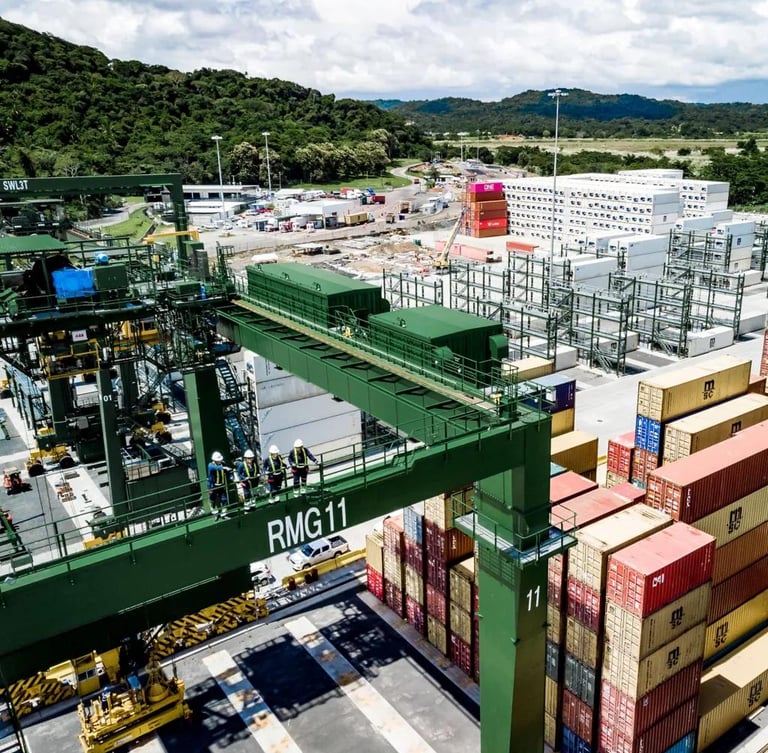
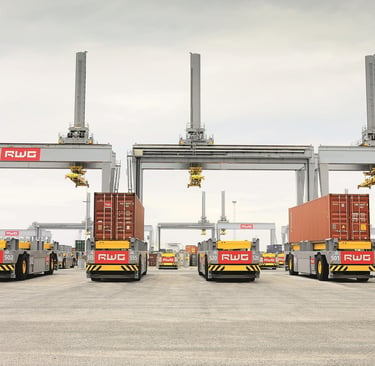
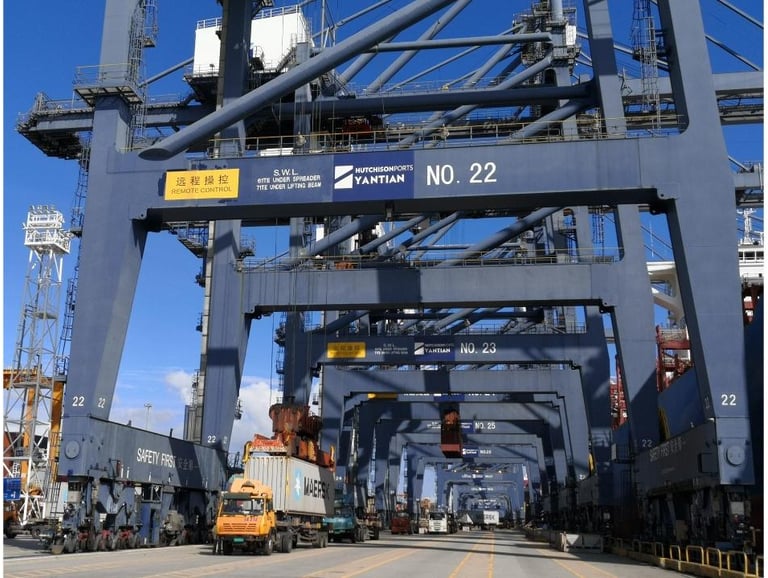
The most advanced container terminals being built across the region today share a striking quality: across vast stacking yards, enormous cranes move with quiet precision, lifting and positioning containers with almost no human hand directly involved. These are the rail-mounted gantry cranes, known throughout the industry as RMGs, and they are the machines around which the modern automated container terminal is built. Where earlier generations of yard cranes relied on operators in cabs and the flexibility of rubber tyres, the RMG runs on fixed rails with the stability and repeatability that automation demands, executing thousands of precise container moves a day under the direction of computer control systems rather than human drivers.
This shift toward automation is one of the defining trends in port development, and it places extraordinary demands on the systems that make automated operation possible. An automated terminal cannot afford the interruptions and uncertainties that a manned operation can absorb, because there is no operator on the spot to improvise around a problem. Everything must work, continuously and reliably, and the cable systems that carry power, control, data, and feedback signals to the RMG crane are central to that reliability. They are essential for power supply, for control, for data transmission, and for the automation that defines the whole operation. When these cables perform flawlessly, the automated terminal achieves the high uptime and throughput that justify its investment. When a cable fails, the consequences ripple through the entire automated handling process in ways that a manned terminal would never experience.
For this reason, correct cable selection in an RMG installation is not a routine procurement matter but a decision that directly improves uptime, safety, and terminal efficiency. The cables of an automated RMG crane must meet a standard of reliability and performance considerably higher than that demanded by older, manned cranes, because the entire automated system depends on them. This guide is written for the engineers, automation specialists, and procurement professionals who must understand and specify these cable systems. It explains what an RMG crane is and how it differs from its rubber-tyred cousin, how RMGs are powered, what automation demands of the cable system, which cable types serve which functions, what performance properties they must possess, how they fail, and how to assemble a complete cable solution suited to the automated terminal. The approach throughout is to build understanding patiently, so that by the end you can specify an RMG's cabling with full confidence.
1. Introduction: The Crane at the Heart of the Automated Terminal
The rail-mounted gantry crane is a large gantry crane that travels on fixed rails laid along the length of a container stack or a rail yard, lifting and positioning containers with its trolley and spreader. Because it runs on rails rather than tyres, the RMG follows a precise, repeatable path, and this precision is exactly what makes it the crane of choice for automated container terminals and for the rail yards where containers are transferred between trains and the terminal. The RMG is designed from the outset for fixed-path, high-precision, and high-throughput operation, executing a continuous stream of container moves with the accuracy that automation requires and the volume that a busy terminal demands.
The fixed-path nature of the RMG is fundamental to its role. An automated crane must know exactly where it is and exactly where it is going, and the rails provide a defined, predictable track that the automation system can rely upon. This predictability allows the crane to operate without a human driver, positioning itself, its trolley, and its spreader with the precision needed to handle containers automatically. The high stability of the rail-mounted structure further supports this precision, providing a steady platform that resists the sway and uncertainty that would complicate automated operation. Together, the fixed path and the stability make the RMG uniquely suited to the automated terminal in a way that more mobile cranes are not.
All of this precision and automation depends on cable systems that perform several essential functions at once. They must supply the substantial electrical power that the crane's motors require, carry the control signals that direct its operation, transmit the data that connects it to the terminal's automation systems, and convey the feedback signals that allow the crane to know its exact position and movement. Each of these functions is essential, and each depends on cables suited to the demanding conditions of crane operation. As with any complex machine, the RMG relies not on a single cable but on a coordinated family of them, and understanding each is the foundation of a sound cable solution. This guide examines them in turn, but it begins by clarifying what distinguishes the RMG from the related machines with which it is often compared.
2. What Is an RMG Crane
To understand the RMG fully, it helps to compare it directly with the rubber-tyred gantry crane, the RTG, with which it is most often contrasted, and then to consider why the RMG has become so important in modern terminals.
RMG Versus RTG
The two machines are close cousins, both gantry cranes that straddle rows of stacked containers and lift them with a trolley and spreader, but they differ in one fundamental respect that shapes everything about them. The letters RMG stand for rail-mounted gantry, while the letters RTG stand for rubber-tyred gantry, and this difference in how the crane travels is the heart of the matter. The RMG travels on fixed steel rails laid along its working path, while the RTG moves on rubber tyres that allow it to be steered freely around the yard.
This single distinction produces a cascade of consequences. Because the RMG runs on rails, it follows a fixed, precise, and repeatable path, and it enjoys the stability that a rail-guided structure provides. Because the RTG runs on tyres, it has the freedom to move between different stacks and to be repositioned around the yard, but it sacrifices some of the precision and stability that the rails confer. The result is that the RMG is more stable and considerably better suited to automation and to fixed terminal layouts, where the predictability of the rail path allows the automation system to operate with confidence. The RTG, by contrast, offers greater flexibility of movement at the cost of the fixed precision that automation favors. Neither is simply better than the other; they suit different operational philosophies. But for the automated, fixed-layout terminal that represents the cutting edge of port development, the RMG's stability and precision make it the natural choice.
Why the RMG Is Important
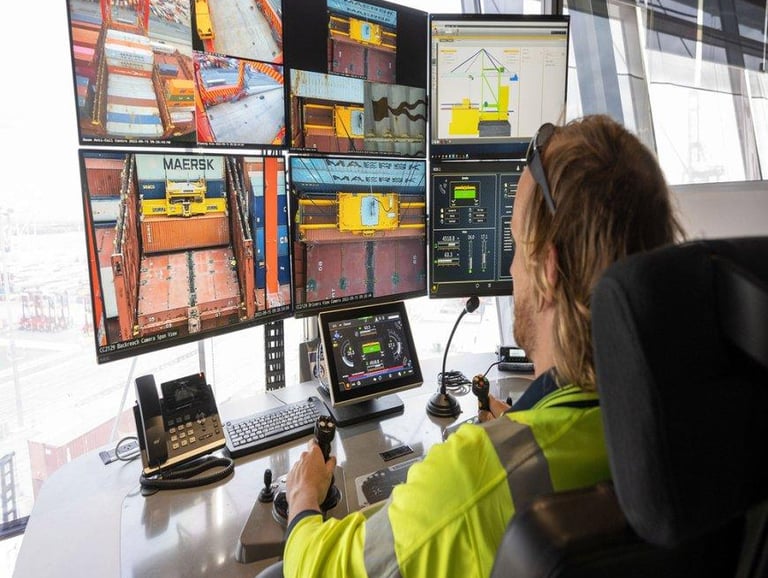
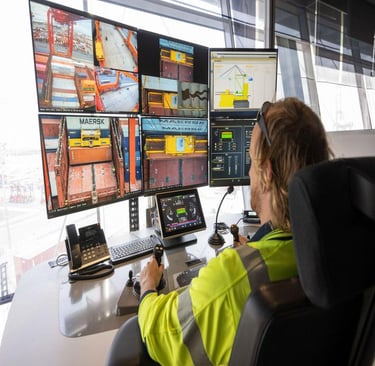
The RMG's significance flows directly from the rise of the automated container terminal. As terminals have moved toward automation to increase throughput, reduce labor costs, and improve safety and consistency, the RMG has become the workhorse of the automated yard. Its fixed path and stability make it well suited to unmanned operation, in which the crane works without a driver in a cab, directed instead by the terminal's automation systems. It supports remote control, allowing human operators to oversee and intervene from a central control room rather than from the crane itself, and it achieves the precise positioning that automated container handling requires, placing each container exactly where the system intends.
This central role in automation means that RMG systems demand reliable and durable cable solutions of the highest standard. The unmanned, automated, remotely controlled operation that the RMG enables can only be as reliable as the cables that power and connect it. A cable failure on a manned crane is a problem; a cable failure on an automated RMG can halt an entire automated process with no operator present to manage the consequences. This is why the cabling of an RMG is held to such a high standard, and why understanding and specifying it correctly is so important. The crane's automation is only as dependable as its cables allow it to be.
3. RMG Power Supply Systems: Delivering Power to the Moving Crane
For an RMG to operate, electrical power must be delivered to it as it travels along its rails. Several systems accomplish this, and the choice among them depends on the terminal's layout, its level of automation, and its operational priorities. Understanding the main power supply systems is an essential step toward understanding RMG cabling.
The cable reel system supplies power through a moving reeling cable wound onto a motorized reel mounted on the crane. As the crane travels along its rails, the reel pays the cable out and draws it back in, keeping it under controlled tension and winding it neatly while maintaining the electrical connection to a fixed supply point. The cable reel system is well suited to continuous travel and dynamic crane movement, because the motorized reel manages the cable smoothly across the full length of the crane's travel and through the many cycles of continuous operation. It is one of the most widely used solutions in crane power applications, and the reeling cable at its heart is among the most important cables on the crane.
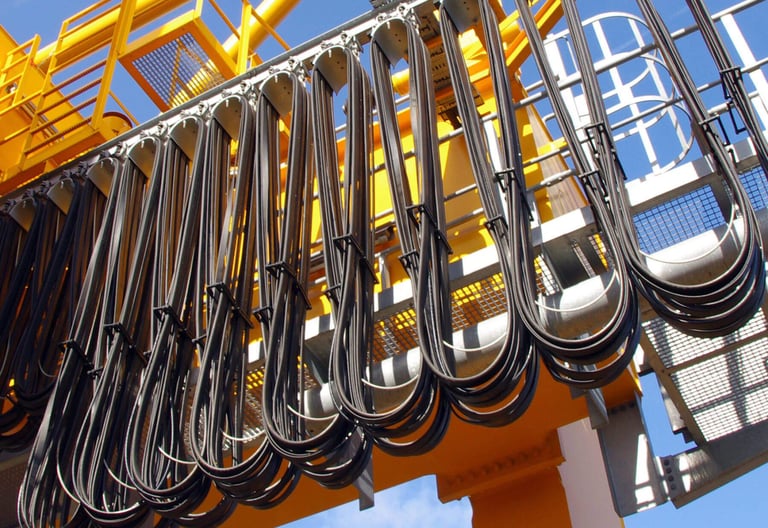
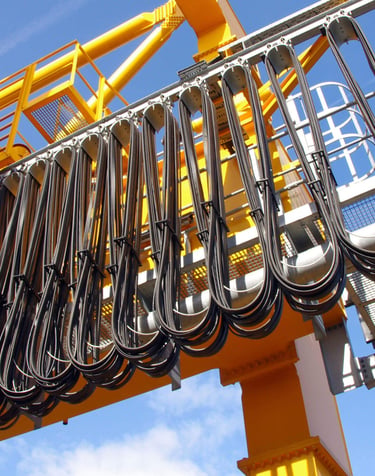
The festoon system guides suspended cables along the crane's travel path. In this arrangement, the cable hangs from a series of carriers that run on a track, gathering together and spreading apart as the crane moves, so that the cable extends and retracts in a controlled, supported manner. The festoon system is well suited to repeated horizontal movement, accommodating the back-and-forth travel of the crane while keeping the cable supported and organized. It is often used not only for power but for control and signal transmission, carrying the various circuits that must travel with the crane within a single managed system. The festoon cable must be built to endure the repeated bending and travel cycles that this arrangement imposes.
The conductor rail system takes a fundamentally different approach, supplying power through fixed conductors installed along the crane's path rather than through a moving cable. A collector mounted on the crane slides along these fixed conductor rails to draw power as the crane moves. The conductor rail system is particularly efficient for automated terminals and fixed rail layouts, where the precise, predictable path of the RMG allows the fixed conductors to be installed exactly along the crane's route. A significant advantage of this approach is that it reduces cable drag and the associated mechanical wear, because there is no long moving cable to be wound and unwound, only the sliding collector on the fixed rail. For highly automated terminals seeking maximum reliability and minimum maintenance, the conductor rail system is an attractive option, though it still relies on cabling for the connections between the collector and the crane's systems and for all the control, data, and feedback circuits.
The choice among these systems is a key decision in the design of an automated terminal, and it depends on the specific layout, the degree of automation, and the operational priorities of the installation. The cable reel system offers proven performance for continuous travel; the festoon system suits repeated horizontal movement and the carriage of multiple circuits; and the conductor rail system offers efficiency and reduced wear for fixed, automated layouts. In practice, an automated RMG terminal may employ a combination of these, with one system for main power and others for control and data, all working together to keep the crane powered and connected.
4. Automation Terminal Requirements: What the Smart Port Demands of Its Cables
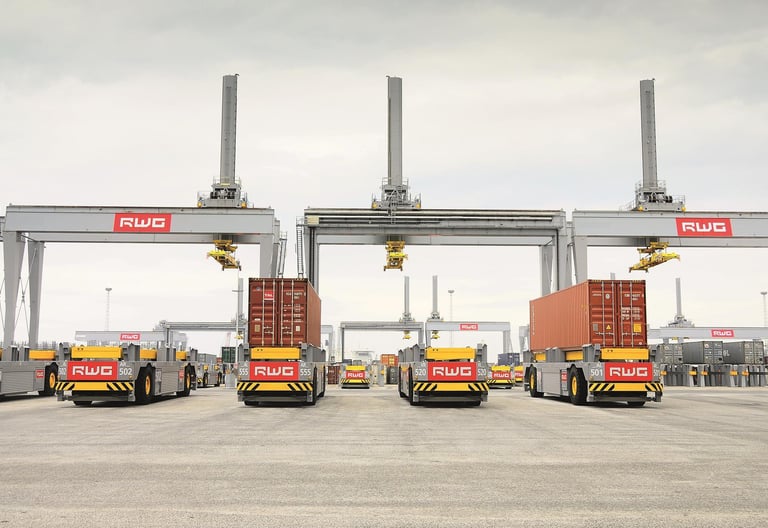
The automated container terminal imposes requirements on its cable systems that go well beyond those of a conventional manned operation. Understanding these requirements clarifies why the cabling of an RMG must be specified to such a high standard.
The automated container terminal as a whole requires continuous power and stable communication above all else. The entire premise of automation is that the terminal operates as a coordinated, computer-directed system, and that system can only function if power flows without interruption and if communication between the cranes, the control systems, and the management software remains stable at all times. The cable systems must therefore support high uptime and low maintenance, delivering power and data reliably over long periods without the failures and interventions that would disrupt the automated flow. A cable that requires frequent maintenance or that fails unpredictably undermines the very reliability that automation is meant to provide. The automated terminal, in short, demands cables that simply keep working, shift after shift, with minimal attention.
Unmanned operation raises the stakes further. When a crane operates without a driver, there is no person present to notice a developing problem, to work around a fault, or to intervene when something goes wrong. This absence of a human on the spot increases the need for reliability and fault resistance in every system, including the cables. A cable failure that a manned crane's operator might detect early and manage becomes, on an unmanned crane, a fault that can interrupt the whole handling process before anyone is even aware of it. The cables of an unmanned RMG must therefore be exceptionally reliable and resistant to faults, because the automated system depends on them completely and has no human fallback when they fail.
Remote control introduces its own specific demands. In a remotely controlled operation, human supervisors direct and monitor the cranes from a central control room, relying entirely on the signals and data that travel between the crane and the control center. This dependence on remote signals means that stable signal transmission and accurate feedback are absolutely essential. The supervisor in the control room can only control the crane well if the commands reach it reliably and if the feedback from the crane, its position, its status, its sensor readings, returns accurately and without delay. In this environment, the encoder cables that carry positional feedback and the fiber optic cables that carry high-speed data become especially important, because they are the channels through which remote control actually operates. A failure or corruption in these cables directly degrades the ability to control the crane remotely, which in an automated terminal is the ability to control it at all.
These automation requirements, continuous power and stable communication, fault resistance for unmanned operation, and reliable signal transmission for remote control, together define a standard of cable performance that the automated RMG terminal cannot compromise on. They are the reason that cable selection for these installations must be approached with such care, and they shape every aspect of the cable types and performance properties discussed in the sections that follow.
5. Main Cable Types on RMG Cranes: A Cable for Every Role
With the power systems and automation requirements understood, we can examine the main cable types that serve an RMG, considering the function of each and what it must withstand.
The main power cable supplies the crane's primary electrical load, feeding the motors and systems that drive the crane, the trolley, and the spreader. Depending on the power supply system chosen, this main power cable may be used with a cable reel system, in which case it is a reeling cable wound on the crane's reel, or with a conductor rail system, in which case it forms the connections from the collector. In either case, the main power cable is one of the most important cable categories on the RMG, because it carries the fundamental responsibility of keeping the crane powered. Where it is used as a reeling cable, it must withstand the bending, tension, abrasion, and repeated winding cycles of reel operation, and it is built accordingly, from finely stranded flexible copper conductors, special rubber insulation with semi-conductive field control where the voltage requires it, a reinforcing braid to resist tensile and torsional stress, and a tough outer sheath to resist abrasion and the elements. For medium voltage supply, a flexible medium voltage reeling cable of the heavy-duty reeling family is used; for low voltage supply, a heavy-duty low voltage reeling cable rated at 0.6/1 kilovolt serves the purpose, each matched to the electrical and mechanical demands of the application.
The festoon cable is used in suspended moving cable systems, where it must travel with the crane along the festoon track while remaining supported. It must resist the repeated bending and travel cycles that festoon operation imposes, gathering and extending continuously as the crane moves. Built from finely stranded flexible conductors with robust elastomer insulation and sheathing, and frequently incorporating a copper braid screen where it carries control or data signals, the festoon cable is designed specifically for the high mechanical stress and frequent bending of suspended moving service. In an RMG installation it commonly carries not only power but control and signal circuits, making it a versatile carrier for the various connections that must travel with the crane.
The encoder cable supports motion feedback and positioning control, carrying the signals from the encoders that measure position, speed, and rotation to the crane's control systems. In an automated RMG, the encoder cable is essential for automation accuracy, because the automation system can only position the crane precisely if it receives accurate, reliable feedback about where the crane and its parts actually are. Any corruption or interruption of the encoder signal degrades the precision of the crane's motion, which in an automated terminal directly affects the accuracy of container handling. The encoder cable must therefore be flexible enough to accompany the moving parts it serves and, critically, well screened to protect its sensitive low-level signals from the electrical noise that fills the crane's environment. Screening is not optional for encoder cables in an automated installation; it is fundamental to their function.
The fiber optic cable is used for high-speed data communication, carrying the large volumes of information that connect the automated RMG to the terminal's control and management systems. Fiber optic transmission supports remote control, monitoring, and the automation systems that direct the crane, offering the bandwidth to carry control commands, diagnostic data, sensor readings, and camera images, and the immunity to electromagnetic interference that makes it reliable in the electrically noisy crane environment. In the automated terminal, where remote control and continuous monitoring are central to operation, the fiber optic cable is the high-speed backbone of communication, and it is often integrated into the power or control cables so that data travels with power through the moving zones of the crane.
The variable frequency drive cable, commonly called the VFD cable, is used between the variable frequency drives that control the crane's motors and the motors themselves. Variable frequency drives control motor speed by rapidly switching the electrical supply, and this switching generates significant electrical noise. The VFD cable must therefore provide good electromagnetic compatibility performance and resist this electrical noise, both to protect the motor connection itself and to prevent the noise from interfering with the sensitive control and feedback signals elsewhere on the crane. A properly designed VFD cable, typically with robust screening and a construction suited to the demands of variable frequency drive output, is essential to the clean and reliable operation of the crane's motor drives, particularly in an automated terminal crowded with sensitive electronic systems.
Together, these five cable types, main power, festoon, encoder, fiber optic, and VFD, form the complete cabling system of an automated RMG crane. Each serves a distinct function, and the reliable operation of the automated crane depends on every one of them performing correctly. The main power cable keeps the crane energized, the festoon cable carries circuits with the moving structure, the encoder cable enables precise positioning, the fiber optic cable provides high-speed communication, and the VFD cable ensures clean motor control. The solution is the coordinated system, not any single cable.
6. Cable Performance Requirements: The Properties That Matter
Beyond the function of each cable type, certain performance properties are essential across the RMG cable system, particularly in the demanding context of an automated terminal. Understanding these properties helps in specifying cables that will perform reliably.
Electromagnetic compatibility, usually abbreviated as EMC, is of particular importance in automated terminals filled with electronic systems. EMC performance refers to a cable's ability to operate without generating interference that disrupts other systems and without being disrupted by interference from them. In an automated terminal, where many electronic systems, control units, drives, sensors, and communication links operate in close proximity, poor EMC performance can directly affect the reliability of control and communication. A cable that emits excessive electrical noise can corrupt the signals on neighboring cables, and a cable that is inadequately protected can have its own signals corrupted by external noise. In either case, the result is degraded control and communication reliability, which in an automated terminal can mean errors, faults, and interruptions to the automated process. This is why screening, the use of copper braid or other shielding to contain and exclude electrical noise, is so important for the control, encoder, data, and VFD cables of an automated RMG. Good EMC performance is not a luxury but a fundamental requirement for reliable automated operation.
Torsion resistance helps a cable survive the twisting and repeated motion that crane operation imposes. As cables move with the crane, particularly reeling cables winding on drums and festoon cables traveling on their tracks, they are subjected to torsional stress that twists them about their axis. A cable with good torsion resistance, achieved through reinforcing braids and carefully arranged cores, can withstand this twisting without the internal damage that would otherwise accumulate, and this directly improves its service life. Quality crane cables specify a permissible torsional stress, commonly around twenty-five degrees of twist per meter of length, reflecting the significant torsional capability that crane service requires. Torsion resistance is one of the properties that most distinguishes a true crane cable from an ordinary one.
Oil resistance is important in the industrial environment of a port and crane installation, where lubricants, hydraulic fluids, and other oils may be present and may come into contact with the cables. A cable without adequate oil resistance can have its sheath degraded by contact with these substances, leading to premature failure. Oil-resistant sheath materials, tested against recognized standards, ensure that the cable can survive the industrial environment without the oils it encounters compromising its protective layers. In and around the machinery of a crane, oil resistance is a practical necessity.
Ultraviolet resistance is essential for the outdoor cable sections that are exposed to sunlight. Crane cables that run in the open air absorb ultraviolet radiation throughout every daylight hour, and over time this radiation degrades many polymer materials, causing brittleness and cracking. Ultraviolet resistance, built into the sheath material, allows the cable to withstand this long-term sunlight exposure without degrading. It is especially important for the exposed cable sections, the festoon cables hanging in the open, the reeling cables paid out across the yard, and any other cabling that lives in the sun. For an installation in the intense sunlight common across much of the region, ultraviolet resistance is a property of considerable practical importance.
Flame retardancy improves safety in the port environment, where a cable fire could endanger people, equipment, and the continuity of operations. Flame-retardant cables are designed to resist the propagation of flame along their length, so that a fire is contained rather than spread by the cabling. This flame-retardant performance, tested against recognized standards, is important for power, control, and communication cables alike, because all of them run through the crane and all of them could otherwise contribute to the spread of a fire. In the busy, valuable, and sometimes crowded environment of a port terminal, flame retardancy is an important contribution to overall safety.
These performance properties, EMC, torsion resistance, oil resistance, ultraviolet resistance, and flame retardancy, are the qualities that distinguish a cable suited to automated RMG service from one that is not. A cable may carry the right voltage and current, but if it lacks these properties it will not perform reliably in the demanding, automated, outdoor, industrial environment of the modern container terminal. Specifying for these properties, alongside the basic electrical and mechanical ratings, is essential to a sound cable solution.
7. Common Failure Modes: How RMG Cables Fail
Understanding how RMG cables fail is the surest guide to selecting cables that will not. Each failure mode reveals a specific weakness and points toward a specific defense. Four failure modes are particularly characteristic of RMG cabling.
Cable wear is the gradual degradation of a cable through the mechanical action of repeated movement. As cables travel with the crane, winding on reels, traveling on festoon tracks, or flexing with moving parts, they rub against themselves, against guides, and against surfaces, and this rubbing wears the outer sheath over time. This wear usually reduces cable life progressively, thinning and weakening the protective sheath until it can no longer do its job. Cable wear is an inevitable consequence of moving-cable service, but it is greatly slowed by an abrasion-resistant sheath, by cable management systems that minimize unnecessary rubbing, and by respecting the cable's bending radius so that it is not over-stressed as it moves. The defense against wear is a cable built for movement and a system designed to handle it gently.
Torsion damage arises from the twisting stress that crane cables experience, and it is most common when cable guidance is poor. When a cable is not properly guided, it can twist about its own axis as it moves, and this twisting damages the internal cable structure, disturbing the arrangement of cores, screens, and sheaths and stressing the conductors in ways they were not designed for. Because torsion damage occurs inside the cable where it cannot be seen, a cable may appear sound while degrading internally, until the accumulated damage leads to failure. The defenses against torsion damage are a cable with good torsion resistance, achieved through reinforcing braids and careful core arrangement, and, just as importantly, a well-designed cable guidance system that controls the cable's movement and prevents uncontrolled twisting. Good guidance and good torsion resistance together protect the cable from this insidious form of damage.
EMC interference is a failure mode specific to signal cables, and it is particularly relevant in the electronically dense environment of an automated terminal. Signal cables may suffer interference if their shielding is not sufficient, allowing the electrical noise that fills the crane environment to corrupt the signals they carry. This interference can affect the encoder and communication systems that are so essential to automated operation, degrading the positional feedback and data transmission on which the automation depends. The result may not be a dramatic failure but a subtle degradation, errors and faults that undermine the reliability of the automated system. The defense against EMC interference is adequate shielding, copper braid screens and proper grounding, sized and applied to contain and exclude the electrical noise, together with good cable layout that keeps sensitive signal cables away from the noisiest power and drive cables. In an automated terminal, sufficient shielding is not optional; it is essential to reliable operation.
Jacket cracking is the cracking of the outer sheath, caused by the combined effects of ultraviolet exposure, flexing, and chemical contact. The sun's ultraviolet radiation embrittles the sheath over time, the repeated flexing of moving-cable service works the material, and contact with oils and other chemicals can further degrade it, until the sheath cracks. Once the jacket cracks, the protective barrier is breached, and moisture can penetrate into the cable's interior, where it attacks the insulation and can lead to insulation damage and electrical failure. Jacket cracking is thus often the beginning of a chain of failure that ends in an electrical fault. The defenses are sheath materials resistant to ultraviolet light, flexing, and chemicals, an appropriate bending regime that does not over-flex the cable, and regular inspection to catch cracking before it admits moisture. A sound, intact jacket is the cable's first line of defense, and protecting it protects the whole cable.
As with every crane discussed in this series, the common thread is that these failure modes are predominantly mechanical and environmental in origin, even when the final symptom is electrical. The cable wears, twists, suffers interference, or cracks, and only then does the electrical failure follow. The lesson is consistent: the mechanical, environmental, and EMC specification of an RMG cable deserves at least as much attention as its basic electrical rating, and in the automated terminal, where signal integrity is paramount, the EMC dimension is especially critical. A cable chosen to withstand the full reality of its service, mechanical, environmental, and electromagnetic, will deliver the reliability that automated operation requires.
8. Recommended Cable Series: Matching Cable to Application
Bringing the analysis together, we can set out the cable solutions appropriate to the main functions of an automated RMG crane. The principle throughout is to match each cable to the specific demands of its role.
For heavy-duty moving power applications, the principal recommendation is R-(N)TSCGEWÖU, a flexible medium voltage reeling cable with reduced dimensions. This cable is well suited to demanding RMG crane service, combining medium voltage electrical capability with the flexibility, fatigue resistance, torsion resistance, and abrasion resistance that heavy-duty reeling demands. Its medium voltage rating brings reduced voltage drop and improved efficiency over long travel distances, and its construction, with finely stranded flexible conductors, special rubber insulation, semi-conductive field control, an anti-torsion braid, and a tough outer sheath, is built precisely for the bending, twisting, and tension of continuous reeling. For the main power supply of a reeling-fed RMG, R-(N)TSCGEWÖU is the natural choice.
For auxiliary or low voltage applications, NSHTOEU is appropriate, a flexible low voltage cable of the heavy-duty reeling and control type, rated at 0.6/1 kilovolt and built for simultaneous tensile and torsional stress. NSHTOEU should be understood as a flexible cable suited to auxiliary and low voltage roles, and it should be used only when the actual application matches its design. It is well matched to low voltage reeling, to auxiliary power, and to control circuits, but it is not a substitute for a properly rated medium voltage reeling cable such as R-(N)TSCGEWÖU where medium voltage main power is required. Used within its proper scope, NSHTOEU provides a robust and flexible solution for the lower-voltage and auxiliary needs of the crane.
For festoon and suspended moving cable systems, NGRDGOEU is the recommended option, a festoon cable well established for material handling and crane applications, with a screened version available where electromagnetic protection of control and data signals is required. These flexible low voltage cables, rated at 0.6/1 kilovolt and built for the repeated bending and travel cycles of festoon operation, are far more practical and readily sourced than obscure or rarely searchable model designations such as N3GRDGOEU, and they are well suited to carrying the power, control, and signal circuits that travel with the crane in a festoon system. The screened version of NGRDGOEU, with its tinned copper wire braid, is the appropriate choice wherever signal protection is needed, which in an automated terminal is frequently.
For exposed or high-flex applications, a cable with a polyurethane jacket is recommended. The polyurethane construction improves abrasion resistance and outdoor durability, making it well suited to the exposed cable sections and the high-flex zones of the crane, such as the spreader connection. Where a cable must endure intense flexing, constant abrasion, and full exposure to the coastal port environment, the polyurethane jacket provides the toughness and durability that the application demands.
For automated terminals and remote operation, an integrated fiber optic cable is recommended, combining fiber optic cores with the power or control conductors to carry high-speed data through the moving zones of the crane. This integrated approach supports reliable data transmission in smart crane systems, providing the high-bandwidth, interference-immune communication that remote control and automation require, with the same robust mechanical protection as the power conductors. For the automated RMG terminal, fiber optic integration is an increasingly essential part of the complete solution.
The essential principle, consistent across every crane in this series, is that no single cable serves an automated RMG. The crane requires a coordinated set of cables, the main power cable at the core, supported by festoon, encoder, fiber optic, and VFD cables, each matched to its function and each meeting the demanding performance requirements of the automated terminal. The quality of the overall solution depends on every one of them being correctly specified, because in an automated operation the failure of any one can disrupt the whole.
9. Customer Questions: Practical Answers for the Automated Terminal
In specifying and operating RMG cable systems, certain questions arise repeatedly. Addressing them directly clarifies the practical realities of cable selection for the automated terminal.
How is an RMG crane different from an RTG crane? The fundamental difference is in how the crane travels. The RMG runs on fixed rails, which gives it a precise, repeatable path and the stability that makes it well suited to automation. The RTG moves on rubber tyres, which gives it the flexibility to be steered between different stacks and around the yard but at the cost of some precision and stability. In practical terms, this means the RMG is the crane of choice for automated, fixed-layout terminals where predictability and precision are paramount, while the RTG suits operations that value the flexibility to move cranes around the yard. The difference in travel method drives the difference in their roles, and it also shapes their cabling, with the RMG's fixed path enabling power supply options such as the conductor rail that the more mobile RTG cannot easily use.
What is the best power supply system for an RMG crane? There is no single best answer, because the right choice depends on the terminal's layout and its level of automation. The three main options are the cable reel system, which offers proven performance for continuous travel; the festoon system, which suits repeated horizontal movement and the carriage of multiple circuits; and the conductor rail system, which offers efficiency and reduced cable wear for fixed, automated layouts. A highly automated terminal with a fixed layout may favor the conductor rail for its low maintenance and reduced drag, while another installation may prefer the cable reel for its proven reliability in continuous travel. The decision should weigh the terminal's specific layout, its automation level, its maintenance philosophy, and its operational priorities, and in many cases a combination of systems, one for main power and others for control and data, provides the best overall solution.
What causes RMG cable failure? The most common causes reflect the failure modes discussed earlier. Cable wear from repeated movement thins and weakens the sheath; twisting damages the internal structure when guidance is poor; EMC issues corrupt signals when shielding is insufficient; ultraviolet aging embrittles and cracks the sheath under the sun; oil contamination degrades materials that are not oil-resistant; and poor cable handling, including inadequate reel design, improper installation, and over-flexing, accelerates all of these effects. Most failures begin as mechanical, environmental, or electromagnetic problems and only later manifest as electrical faults. Understanding these causes is the key to preventing them, through correct cable selection, sound system design, proper installation, and attentive maintenance.
How do you choose the correct cable for an automated RMG crane? The selection should consider the full range of relevant factors in a logical order. Begin with the voltage, ensuring the cable's rating matches the system, and the current, which determines the conductor size. Then consider the travel distance, which influences cable length and system design, and the speed, which must fall within the cable's rated capability. Crucially, for an automated terminal, address the EMC requirements, ensuring that control, encoder, data, and VFD cables are properly shielded to maintain signal integrity in the electronically dense environment. Include the environmental exposure, the salt, sun, temperature, and oils the cable will face, ensuring its materials suit the conditions. And account for the mechanical stress, the bending, tension, and torsion of the application, ensuring the cable's mechanical ratings cover the demands. A cable that satisfies all of these, electrical, dynamic, electromagnetic, environmental, and mechanical, is genuinely fit for automated RMG service. Working through them systematically produces a sound and defensible selection.
10. Conclusion: A Complete Cable Solution for Automated Operation
The rail-mounted gantry crane stands at the heart of the automated container terminal, and its reliability depends on cabling designed for automation and continuous operation. We have seen that an RMG requires not a single cable but a complete cable solution, engineered for the demanding standards of unmanned, remotely controlled, high-throughput operation. At the foundation of this solution are the power supply systems, the cable reel, the festoon system, and the conductor rail, which together represent the core options for delivering power to the moving crane, each suited to different layouts and automation levels.
Around the power supply, a coordinated family of cables serves the full system. The main power cable keeps the crane energized, whether through a reeling cable on a reel or connections from a conductor rail. The festoon cable carries power, control, and signal circuits with the moving structure. The encoder cable conveys the positional feedback that automation accuracy depends upon. The fiber optic cable provides the high-speed communication that remote control and monitoring require. And the variable frequency drive cable ensures clean, well-shielded motor control in an environment crowded with sensitive electronics. Each of these supports a different aspect of the automated crane, and the reliable operation of the whole depends on every one of them.
Throughout, the demanding requirements of the automated terminal, continuous power, stable communication, fault resistance for unmanned operation, and reliable signal transmission for remote control, set a standard of cable performance that cannot be compromised. The performance properties of EMC compatibility, torsion resistance, oil resistance, ultraviolet resistance, and flame retardancy are essential to meeting that standard, and the failure modes of wear, torsion damage, EMC interference, and jacket cracking are the risks that correct selection must guard against. Depending on the specific application, the heavy-duty medium voltage reeling cable R-(N)TSCGEWÖU, the festoon cable NGRDGOEU, the flexible low voltage cable NSHTOEU suited to auxiliary roles, the polyurethane-jacketed cables for exposed and high-flex zones, and the integrated fiber optic cables for automation can all be positioned as relevant solutions, each matched to its role within the complete system.
The conclusion is clear and consistent with everything that precedes it. RMG cranes require a complete cable solution designed for automation and continuous operation, built around the core power supply options and supported by the full family of power, control, feedback, data, and drive cables that the automated crane needs. Correct cable selection, grounded in a clear understanding of the crane, its power systems, the requirements of automation, the performance properties that matter, and the failure modes to avoid, improves reliability, enhances safety, and raises operating efficiency. In the automated terminal, where there is no operator on the spot to manage a fault and where the entire operation depends on the seamless coordination of its machines, the cables that never fail are worth far more than their modest share of the crane's cost. Choosing those cables, with knowledge and care, is the purpose this guide has set out to serve. The RMG crane is the precise, tireless heart of the automated terminal; its cables are the unseen system that makes its precision and tirelessness possible. Specify them well, and the automated terminal fulfills its promise.
Port crane cables | Mining cables | Reeling cables | Trailing cables | Festoon cables | Heavy-duty power cables | Medium voltage cables | Offshore crane cables | Underground mining cables | Dragline cables | Shearer cables | Container handling cables | STS crane cables | RTG cables | Mobile equipment cables | Armored cables | Flexible power cables | VFD cables | Submersible cables | Cold resistant cables | Abrasion resistant cables | Flame retardant cables | Marine environment cables | Opencast mining | Underground operations
© 2006 All rights reserved.
[INDUSTRIAL_CABLES]
INDUSTRIAL GRADE CABLE SYSTEMS | PORT & MINING SOLUTIONS
TEL: +86 153 7530 2641 |MAIL: hongjing.Wang@feichuncables.com