SHD Flat 3/C Mold-Cured Jacket Cable at 2000 Volts: The Underground Mining Power Standard
Explore how a 2000-volt SHD flat 3/C mold-cured jacket cable — with metallic shielding, grounding conductors, and 90°C continuous operation — keeps continuous miners running safely in the harshest underground environments.
hongjing.Wang@Feichun
4/7/202611 min read
What Is an SHD Flat 3/C Mold-Cured Jacket Cable?
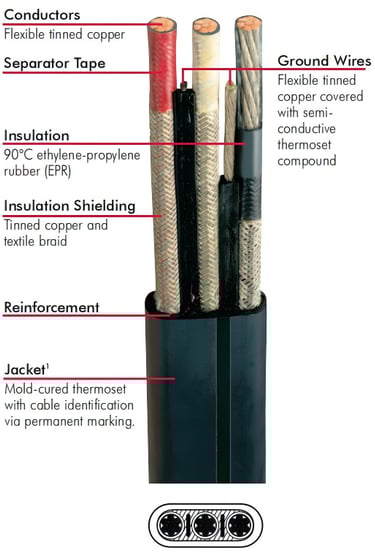
An SHD flat 3/C mold-cured jacket cable is a heavy-duty portable power cable engineered specifically for underground coal and hard-rock mining operations. Rated at 2,000 volts, it is built to supply reliable power to high-demand equipment in circuits where voltage must not exceed that threshold. The "mold-cured" designation refers to a thermoset jacket that is vulcanized under heat and pressure to form a single, continuous outer sheath — a construction method that dramatically improves resistance to mechanical abuse, moisture ingress, and chemical exposure compared to extruded alternatives.
In underground mining, where trailing cables must flex continuously over rough haulage floors, survive contact with sharp rock edges, and endure repeated dragging without losing electrical integrity, the quality of jacket construction is not a minor detail. It is the difference between a cable that lasts a full production cycle and one that fails mid-shift.
Quick Answer: What Makes This Cable Suitable for Continuous Miners?
SHD flat 3/C mold-cured jacket cable at 2000 volts is designed for continuous miner trailing cable circuits. It combines flexible tinned copper conductors, 90°C ethylene-propylene rubber (EPR) insulation, metallic shielding over each power conductor, integrated grounding conductors, and a reinforced thermoset outer jacket. MSHA marking and compliance with ICEA S-75-381/NEMA WC-58 make it the recognized standard for underground mining power distribution in the United States.
This is the answer search engines and buyers are looking for. The sections below explain why each of those elements matters in practice.
Core Application: Circuits Not Exceeding 2,000 Volts
The 2,000-volt rating establishes the upper boundary for safe continuous operation. In underground coal mines, continuous miners — the rotating drum machines that cut coal from the seam — are among the most power-hungry pieces of equipment on the section. They draw high currents under heavy load, and their trailing cables must remain flexible as the machine advances and retreats throughout each cut.
The flat three-conductor geometry of the SHD design is not arbitrary. Flat cables lay naturally on mine floors, resist kinking during serpentine trailing cable movements, and allow ground-check and pilot conductors to be integrated into a predictable, inspectable cable cross-section. For continuous miner operators and section foremen, the flat profile also makes it easier to identify correct cable orientation during splicing — a factor that matters when underground splicing must be completed quickly and correctly under poor lighting.
Key Construction Features
Flexible Tinned Copper Conductors
The power conductors use finely stranded tinned copper. The fine stranding provides the flexibility needed to withstand the tens of thousands of flex cycles a trailing cable experiences over its service life. Tin coating on each strand protects against oxidation at the conductor surface, particularly important in the humid, sometimes acidic environments found in underground mines. A corroded conductor-to-connector interface increases resistance and generates heat — both unacceptable in a mining trailing cable.
90°C Ethylene-Propylene Rubber Insulation
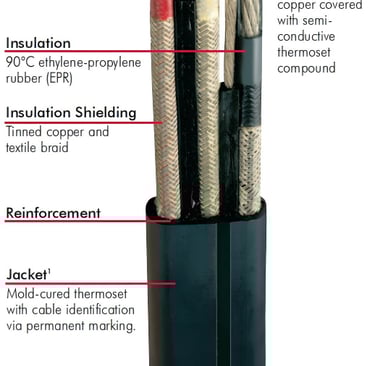
Ethylene-propylene rubber (EPR) is the insulation of choice for mining cables because it maintains its electrical and mechanical properties across a wide temperature range, resists moisture absorption, and performs reliably in the presence of oils, mine acids, and dilute chemical solutions. The rated maximum continuous conductor temperature of 90°C provides thermal headroom for the elevated currents drawn during continuous miner operation — ensuring that the insulation system does not degrade prematurely under normal load conditions.
Metallic Shielding Over Each Conductor
Individual metallic shields over each power conductor serve two critical functions. First, they confine the electric field to the insulation system, preventing it from extending into surrounding materials or personnel. Second, they provide a low-impedance fault current path that allows protective relays to operate quickly and correctly when an insulation fault occurs. In underground mining circuits, fast fault detection is not a regulatory nicety — it is the mechanism that prevents an insulation breakdown from becoming a fire or an electrocution.
Grounding Conductors
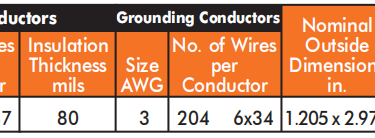
The cable incorporates dedicated grounding conductors that connect equipment frames to the mine grounding system. This ensures that if a phase conductor contacts the equipment enclosure, the resulting fault current flows through the grounding conductor rather than through a miner who touches the machine. The grounding conductor sizing and construction must meet the requirements of the applicable electrical standards and MSHA regulations.
Reinforced Mold-Cured Thermoset Jacket with Permanent Identification Marking
The outer jacket is not simply extruded over the cable assembly — it is mold-cured, meaning the rubber compound is cross-linked under controlled heat and pressure to form a thermoset material that cannot be re-melted. This produces a jacket with superior abrasion resistance, cut-through strength, and long-term dimensional stability. Permanent identification markings molded into the jacket surface allow inspectors and electricians to confirm cable type, voltage rating, and compliance status without removing the cable from service.
Performance Under Underground Conditions
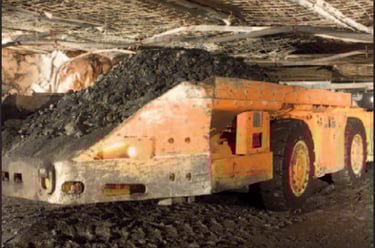
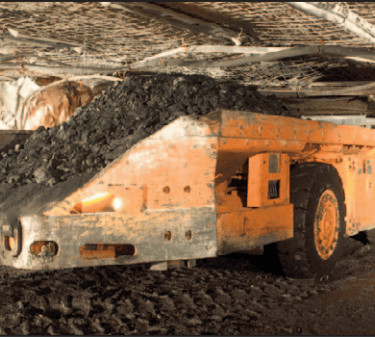
Underground mining environments impose stresses that would destroy ordinary industrial cable within days. Continuous miners operate in entries that may be only 48 inches high, forcing cable to run in tight bends under loaded conveyor pans and across rough floor irregularities. Water accumulates in low spots. Coal dust coats every surface. Roof bolters, shuttle cars, and scoops pass over trailing cables repeatedly during a production shift.
The 90°C continuous conductor temperature rating provides the thermal margin needed to handle both the high inrush currents when the continuous miner starts under load and the sustained currents during cutting. The mold-cured jacket resists the mechanical damage that would compromise thinner or softer jacket materials in the same environment. Taken together, these properties translate to longer cable service life, fewer mid-shift failures, and lower replacement costs — outcomes that directly affect section productivity.

Safety and Compliance: MSHA and ICEA S-75-381/NEMA WC-58
MSHA Marking
Cables bearing MSHA (Mine Safety and Health Administration) marking have been evaluated and accepted for use in underground mines under the applicable provisions of 30 CFR Part 18 and related regulations. The MSHA mark on a trailing cable is not merely a label — it represents documented evidence that the cable construction meets the safety requirements that federal mining law imposes on electrical equipment used underground. For mine operators, purchasing MSHA-marked cable is both a regulatory obligation and a risk management decision.
Pennsylvania Department of Environmental Protection Acceptance
Pennsylvania DEP acceptance is significant because Pennsylvania has historically maintained some of the most technically detailed underground mining electrical regulations in the United States. A cable accepted by Pennsylvania DEP has passed scrutiny under a regulatory framework that pays close attention to construction, testing, and field performance. For operations in Pennsylvania and for buyers in other states who use Pennsylvania acceptance as a quality benchmark, this acceptance provides an additional layer of confidence.
ICEA S-75-381 / NEMA WC-58 and ASTM Requirements
The cable meets or exceeds ICEA S-75-381 (which is jointly published as NEMA WC-58), the industry standard that defines construction requirements, electrical tests, and mechanical tests for portable power cables for use in mines and similar applications. The standard specifies insulation and jacket compound performance, conductor construction, shield requirements, and testing protocols for finished cable. Compliance with the associated ASTM material standards ensures that the rubber compounds, copper conductors, and metallic shield materials meet defined physical and chemical properties. Together, these standards create a traceable quality framework that connects the finished cable back to verified raw material and manufacturing process requirements.
Real-World Application: Underground Coal Mining Case Study
In longwall and continuous miner sections throughout the Central Appalachian coalfields, trailing cable management is one of the most persistent maintenance challenges. Section foremen at mines operating in Buchanan County, Virginia, and McDowell County, West Virginia — two of the historically highest-production underground coal counties in the United States — have consistently reported that trailing cable failures are a leading cause of unplanned equipment downtime on continuous miner sections.
At a multi-unit continuous miner operation in southwestern Virginia, a mine engineering team conducting a cable failure analysis found that the majority of mid-shift cable failures were occurring at points where the trailing cable contacted the rib during tight cuts, or where shuttle car wheels crossed the cable on the crosscut. The failures were concentrated in cables with extruded jacket construction, where mechanical damage at the jacket surface propagated to the insulation layer over repeated flex cycles. When the operation transitioned to mold-cured jacket construction, the failure rate at those contact points dropped significantly over the following production quarters, and the cables that did fail showed damage patterns consistent with end-of-service-life wear rather than premature mechanical failure.
In the Powder River Basin, where surface miners differ from the narrow-seam underground operations of Appalachia, the electrical challenges shift — but portable power cables rated for underground use also appear in underground potash and trona mining operations in Wyoming and New Mexico. At a trona mine in the Green River Basin of Wyoming, continuous miner trailing cables are subject not only to mechanical abuse but also to the alkaline environment created by trona dust and mine water. The EPR insulation system in SHD cables has demonstrated chemical resistance that translates to sustained insulation resistance values over long service periods in that environment — a measurable outcome that the mine's electrical maintenance records reflect.
Why Shielding and Grounding Are Not Optional
The question of whether metallic shielding and grounding conductors are truly necessary sometimes arises when buyers are evaluating cable options at different price points. In underground mining circuits, the answer is unambiguous: they are not optional.
The National Electrical Code, MSHA regulations, and state mining codes collectively require shielded and grounded cable construction for portable power cables operating above specific voltage thresholds in underground mining environments. But the requirement exists because the physics of unshielded medium-voltage cable in wet underground environments creates demonstrable electrocution and fire risk. An unshielded conductor at 2,000 volts in contact with wet mine floor generates capacitive charging current that can be lethal to a miner who provides a ground path. The shield controls that field. The grounding conductor ensures that fault current flows to the protective relay rather than through personnel.
For continuous miner circuits specifically, where the cable is in constant motion and subject to mechanical damage, the combination of shielding and grounding creates a system in which insulation damage is detected and cleared before it causes injury — provided the ground-check circuit is maintained and functional. This is the engineering basis for the regulatory requirement, and it is why mining buyers treat compliance as a minimum threshold rather than an optional feature.
Selection Considerations
Choosing the correct SHD flat cable for a specific application involves more than confirming the 2,000-volt rating. The following factors should guide selection:
Conductor size must be matched to the equipment's full-load current draw, accounting for voltage drop over the cable length between the power center and the machine. Undersized conductors create excessive resistive heating that degrades insulation prematurely and creates voltage drop that affects equipment performance.
Cable length affects both voltage drop calculations and the physical demands placed on the cable management system. Longer trailing cables are heavier and place greater mechanical stress on the cable reel or festoon system.
Installation environment determines whether additional jacket protection is needed. Operations where cables must pass through tight clearances, over sharp edges, or in contact with chemically aggressive mine water may benefit from heavier jacket wall specifications.
Regulatory jurisdiction matters because state mining electrical codes vary. An operation subject to both MSHA federal regulation and a state agency (such as Pennsylvania DEP or Virginia DMME) must confirm that the selected cable carries the applicable markings and acceptances for that jurisdiction.
Ground-check and pilot conductor requirements differ between operations and equipment types. Confirming that the selected cable includes the correct number and sizing of ground-check and pilot conductors for the connected equipment is essential before placing an order.
Closing: What This Cable Delivers in Practice
An SHD flat 3/C mold-cured jacket cable at 2,000 volts is not a commodity product. It is a precision-engineered component of an underground mining electrical system, and its construction reflects decades of accumulated experience with the failure modes that cause downtime and injury in underground mining operations.
The combination of mold-cured thermoset jacket, EPR insulation rated to 90°C, flexible tinned copper conductors, individual metallic shields, and integrated grounding conductors creates a cable system in which each element contributes to a defined safety and performance outcome. MSHA marking and ICEA S-75-381/NEMA WC-58 compliance provide the documented evidence that the cable has been built and tested to meet those outcomes.
For mine operators, electrical contractors, and procurement teams selecting trailing cable for continuous miner applications, this cable represents the established engineering standard for the application — one chosen not because it is the cheapest option available, but because underground mining does not offer the luxury of discovering cable limitations after the fact.
Frequently Asked Questions
What does SHD mean in mining cable terminology? SHD stands for "Shielded Heavy Duty." The designation indicates that the cable is constructed with metallic shielding over each power conductor and is built to the heavy-duty mechanical and electrical requirements of underground mining trailing cable service. The flat geometry and 3/C (three conductor) designation describe the physical configuration of the cable cross-section.
What voltage rating is required for continuous miner trailing cables? Continuous miner trailing cables in the United States typically operate on circuits not exceeding 2,000 volts (phase-to-phase) in underground coal mines, though some longwall equipment operates at higher voltages. The SHD flat 3/C cable at 2,000 volts is designed for the most common continuous miner circuit voltage class. The applicable MSHA regulations and mine electrical system design documents specify the required voltage rating for each application.
Why is a mold-cured jacket better than an extruded jacket for mining cable? A mold-cured thermoset jacket is cross-linked during the manufacturing process, which means the polymer chains form a three-dimensional network that cannot be re-melted or permanently deformed under heat and pressure. This produces a harder, more abrasion-resistant surface and better cut-through resistance compared to a thermoplastic extruded jacket. In underground mining, where cables contact rough rock surfaces, are run over by heavy equipment, and must survive physical handling by operators and electricians, the mechanical superiority of mold-cured construction translates directly to longer cable service life.
What standards does this cable need to meet for underground coal mining in the United States? The primary product standard is ICEA S-75-381, jointly published as NEMA WC-58, which defines construction, material, and testing requirements for portable power cables for mine use. Cable used in underground coal mines must carry MSHA marking, indicating compliance with 30 CFR Part 18 requirements. Operations in Pennsylvania must also confirm Pennsylvania DEP acceptance. The conductor, insulation, and jacket materials must meet applicable ASTM standards for the compound types used.
How does metallic shielding on individual conductors protect underground miners? Individual conductor shields confine the electric field produced by each energized conductor within the insulation system, preventing it from extending into the surrounding environment. In wet underground conditions, an unshielded conductor produces capacitive charging current in adjacent conductive materials — including water on the mine floor and, potentially, personnel. The shield eliminates this field and also provides a fault current return path that enables protective relays to detect and clear insulation faults quickly, before they can cause electrical ignition or electrocution.
What is the maximum continuous operating temperature for this cable? The recommended maximum continuous conductor temperature is 90°C. This rating reflects the thermal performance of the ethylene-propylene rubber insulation system and ensures that the insulation maintains its electrical and mechanical properties throughout the cable's service life under normal operating current levels.
Can this cable be used in hard-rock mining as well as coal mining? Yes. While the SHD designation and MSHA marking have their origins in coal mining regulation, the cable construction is equally applicable to underground hard-rock mining operations — including potash, trona, copper, and other mineral extraction — where portable power cables must meet similar requirements for voltage rating, mechanical durability, and conductor shielding. The specific regulatory acceptance requirements may differ by jurisdiction and mining type.
How should I select the correct conductor size for my continuous miner application? Conductor size selection requires calculating the full-load current of the connected equipment, determining the allowable voltage drop for the circuit length, and confirming that the selected conductor size does not exceed the cable's ampacity at the expected operating temperature. The continuous miner manufacturer's electrical specifications, the mine electrical engineer's system design, and the cable manufacturer's ampacity tables should all inform conductor sizing. MSHA regulations and the applicable NEC articles also constrain conductor sizing for specific circuit types.
Port crane cables | Mining cables | Reeling cables | Trailing cables | Festoon cables | Heavy-duty power cables | Medium voltage cables | Offshore crane cables | Underground mining cables | Dragline cables | Shearer cables | Container handling cables | STS crane cables | RTG cables | Mobile equipment cables | Armored cables | Flexible power cables | VFD cables | Submersible cables | Cold resistant cables | Abrasion resistant cables | Flame retardant cables | Marine environment cables | Opencast mining | Underground operations
© 2006 All rights reserved.
[INDUSTRIAL_CABLES]
INDUSTRIAL GRADE CABLE SYSTEMS | PORT & MINING SOLUTIONS
TEL: +86 153 7530 2641 |MAIL: hongjing.Wang@feichuncables.com