TYPE MP-GC 3/C Mine Power Feeder Cables (25kV & 35kV) for Underground Mining Distribution
Master the essentials of MP-GC 3/C mine power feeder cables with XLP and EPR insulation for 25kV and 35kV systems. Learn about construction, applications, installation, and real-world mining case studies.
hongjing.Wang@Feichun
4/20/202613 min read
Google Featured Snippet Paragraph
What is a TYPE MP-GC 3/C Mine Power Feeder Cable?
A TYPE MP-GC 3/C mine power feeder cable is a specialized high-voltage power distribution cable designed for underground and surface mining operations. These three-conductor cables operate at 25,000 to 35,000 volts and feature a 100% level grounded system with either XLP (cross-linked polyethylene) or EPR (ethylene propylene rubber) insulation. The cables incorporate tinned copper conductors, semi-conducting strand shielding, ground wires, and a ground check conductor (8 AWG minimum) to ensure continuous electrical safety monitoring and reliable power transmission in demanding mining environments. They are commonly installed in ducts, conduits, open-air installations, and direct burial applications in wet and dry soil conditions.
Introduction: Why Mining Operations Demand Specialized Power Cables
Underground and large-scale surface mining operations operate on a scale most industries never encounter. A continuous miner running a coal mine requires constant, reliable electrical power—and any interruption translates directly into lost production, equipment damage, and safety risks. This is where specialized mine power feeder cables become essential infrastructure rather than optional components.
The TYPE MP-GC 3/C mine power feeder cable represents decades of engineering refinement, designed specifically to handle the thermal, mechanical, and environmental stresses unique to mining. Whether you're operating in remote Australian coal mines, Southeast Asian underground operations, or African mining regions, these cables must deliver power reliably while withstanding moisture, chemical exposure, mechanical abuse, and temperature extremes.
Understanding the Basics: What Makes MP-GC Cables Different
The designation "MP-GC" stands for Mine Power – Grounded Conductor, signaling that this cable type is purpose-built for mining power distribution with integrated grounding safety features. The "3/C" indicates three power conductors designed to carry alternating current across the three phases of mining equipment.
Unlike standard industrial power cables, MP-GC cables operate at either 25,000 volts (25kV) or 35,000 volts (35kV)—voltages that demand substantial insulation thickness and careful engineering. At these voltages, even minor design flaws can lead to catastrophic failures. The cables feature a 100% level grounding system, meaning every aspect of the cable's design prioritizes continuous electrical safety through multiple redundant grounding pathways.
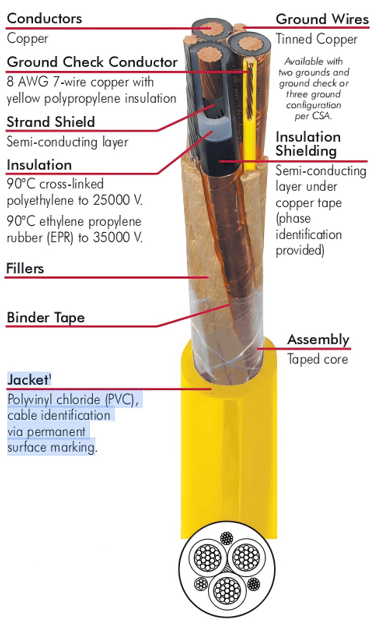
The fundamental construction includes copper power conductors (typically 7 or 19 strands depending on size), wrapped in either XLP or EPR insulation. A semi-conducting strand shield surrounds the insulation, managing electric field distribution to prevent localized stress. Tinned copper ground wires run parallel to the power conductors, and a dedicated 8 AWG ground check conductor with yellow insulation provides continuous monitoring of the grounding system's integrity.
XLP vs. EPR Insulation: Choosing the Right Material for Your Application
The choice between XLP (cross-linked polyethylene) and EPR (ethylene propylene rubber) insulation represents one of the most consequential decisions when specifying MP-GC cables for your mining operation.
XLP Insulation is used for cables rated up to 25,000 volts. Cross-linked polyethylene provides excellent thermal and mechanical properties, maintaining flexibility even at temperature extremes. XLP demonstrates superior resistance to thermal aging, meaning the cable maintains its performance characteristics over decades of continuous operation. Mining operations that prioritize long service life and minimal maintenance often choose XLP-insulated cables paired with PVC jackets for added durability.
EPR Insulation handles the demands of 35,000-volt systems. Ethylene propylene rubber offers slightly greater flexibility than XLP, which becomes increasingly valuable at higher voltage levels where insulation thickness approaches 9 millimeters. EPR provides exceptional tear resistance and maintains integrity in chemically aggressive environments where acidic water or dissolved minerals might attack other materials. The higher voltage capability comes with a tradeoff: EPR cables require careful handling during installation, as improper splicing techniques can compromise the grounding system.
In practical terms, a coal mine operating distribution systems at 25kV might standardize on XLP-PVC cables for their proven reliability and straightforward maintenance, while a large copper or gold mining operation dealing with sulfurous water conditions and higher voltage requirements would likely specify EPR-insulated cables for their superior chemical resistance.
Cable Construction: Engineering for Extreme Reliability
The construction of an MP-GC cable reveals why these products command premium pricing compared to standard industrial power cables. Every layer serves a specific function in ensuring safe, reliable operation.
The copper conductors themselves must meet strict flexibility requirements. Mining applications demand cables that can be reeled, unreeled, and deployed repeatedly without work-hardening the copper to brittleness. Manufacturers typically use seven-strand or nineteen-strand constructions, with larger conductor sizes favoring the nineteen-strand design to maintain flexibility.
The insulation thickness directly corresponds to the voltage rating. A 25kV cable typically features 6.6 millimeters of XLP insulation, while a 35kV cable requires 8.76 millimeters of EPR. This thickness isn't arbitrary—it's precisely calculated based on electrical field stress calculations to prevent insulation breakdown under sustained voltage stress.
The semi-conducting strand shield layer merits particular attention. This layer performs electric field management, essentially smoothing out the electric field distribution around the power conductor. Without this layer, the electric field would concentrate at sharp edges and imperfections, creating stress points where insulation failure would initiate. The semi-conducting layer ensures the electric field remains evenly distributed across the insulation thickness.
Ground wires and the ground check conductor provide the safety monitoring infrastructure. The ground wires (typically tinned copper) create multiple current paths to earth, ensuring that any fault current immediately diverts away from personnel. The ground check conductor, physically isolated from ground wires with yellow insulation, allows continuous testing of the entire grounding system without de-energizing the cable. This feature has prevented countless accidents by detecting developing faults before catastrophic failure occurs.
Finally, the PVC or CPE jacket provides mechanical protection. This outer layer absorbs direct contact damage—cuts, abrasion, and punctures from sharp rocks or equipment. In moisture-rich environments, the jacket prevents water penetration that would eventually degrade internal components. The jacket material selection itself matters; CPE (Chlorinated Polyethylene) offers superior moisture resistance compared to standard PVC, making it the preferred choice for installations in flooded or water-saturated conditions common in underground mining.
Installation Methods: Adapting to Your Mining Infrastructure
MP-GC cables aren't one-size-fits-all components; their installation flexibility is part of their engineering genius.
Duct and Conduit Installation represents the most controlled approach. Mining operations with modern infrastructure often install cables in permanent concrete or PVC ducts running from main distribution substations to individual mining zones. This installation method protects cables from mechanical damage, allows for future cable replacement without complete reinstallation, and simplifies maintenance. The ducts must be sized appropriately—an undersized duct creates friction during installation that can damage the cable jacket, while oversized ducts waste installation space and add cost.
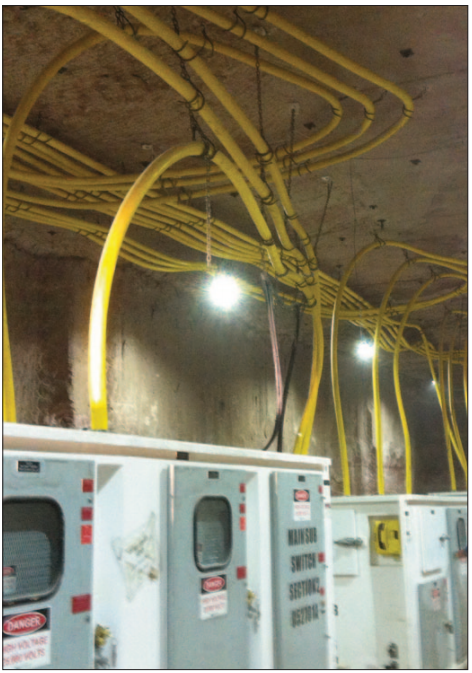
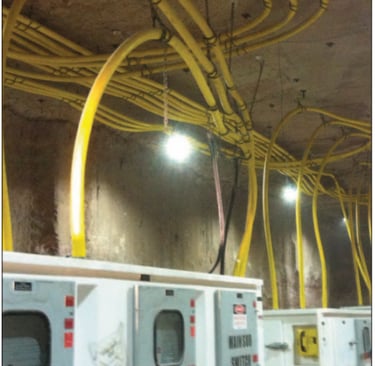
Open-Air Installation characterizes many surface mining operations and older underground facilities. Cables are simply routed overhead or along equipment racks, suspended by mechanical supports at regular intervals. This approach reduces initial installation cost but exposes cables to direct sunlight (which degrades PVC jackets over time), mechanical damage, and environmental weathering. However, open-air installation allows easy visual inspection and fault identification. Many mines use colored jackets or reflective stripes on open-air cables for circuit identification and safety.
Direct Burial Installation addresses the most challenging environment. Cables run directly through soil from substations to remote mining zones. This installation method requires careful site assessment—acidic soils, high water tables, and chemically aggressive conditions all demand specific jacket materials and installation protocols. Most mining operations burying MP-GC cables use CPE jackets rather than standard PVC, as the superior moisture resistance prevents water ingress that would eventually cause insulation failure. Installation depth must meet safety standards; most operations bury cables at least three feet below grade to prevent accidental excavation damage.
Regardless of installation method, proper support and stress relief during installation is critical. Mining crews deploying these cables often use mechanical cable pullers rather than manual dragging, preventing the kind of jacket damage that would compromise performance in wet environments.
Performance Advantages in Real Mining Conditions
The engineering of MP-GC cables delivers measurable performance advantages in actual mining operations.
Thermal Performance to 90°C allows these cables to handle sustained current loads that would overheat standard industrial cables. In underground mining, multiple cables often run in close proximity without cooling airflow. This proximity raises cable temperatures significantly above ambient levels. The 90°C temperature rating provides a safety margin ensuring that even in worst-case thermal conditions, cables remain within safe operating limits. This thermal capability also permits higher current capacity than lower-rated cables, reducing the number of parallel cables required for the same power delivery—a significant cost and space advantage in confined underground conditions.
Mechanical Durability stems from the cable's construction and jacket formulation. Underground mining involves dragging cables across rough terrain, running them under heavy equipment, and deploying them repeatedly in conditions that quickly destroy standard cables. The reinforced jacket construction and semi-conducting strand shielding protect the insulation from external mechanical damage. This durability translates directly to extended service life—many mining operations report 15-20 year service life from properly installed and maintained MP-GC cables, substantially exceeding the 8-10 year service life typical of standard industrial cables.
Moisture and Chemical Resistance is perhaps the most critical performance characteristic in mining. Groundwater in coal mines is often acidic, laden with sulfates and other dissolved minerals. Copper mines deal with acidic drainage water containing dissolved copper compounds. These chemically aggressive environments rapidly degrade standard cable jackets. The CPE and EPR jacket materials used in MP-GC cables resist these chemical attacks far more effectively than standard materials. Additionally, the semi-conducting strand shield prevents water permeation along conductor surfaces, which would otherwise create pathways for corrosion and electrical faults.
Long Service Life and Reduced Downtime combine to create compelling operational economics. A cable failure in an underground mine doesn't just require replacement—it often necessitates shutting down dependent equipment, suspending mining operations, and potentially requiring emergency repairs in difficult underground conditions. By extending cable service life through superior engineering, mining operations avoid the compounding costs of production loss. Over a mine's operational life, investing in premium MP-GC cables versus budget alternatives typically saves hundreds of thousands of dollars in avoided downtime and replacement labor.
Global Mining Applications: Proven Performance Across Continents
The geographic diversity of MP-GC cable deployments demonstrates their adaptability to varied mining environments.
Australian Underground Operations represent some of the most demanding mining environments globally. Underground coal mines in Queensland and New South Wales operate in naturally hot, wet conditions with acidic water and high humidity. These operations have standardized on 25kV MP-GC cables with XLP insulation and CPE jackets, particularly for direct burial applications in wet zones. The combination has proven reliable for 15+ years in these conditions, with mine operators reporting that the grounding system's continuous monitoring has prevented multiple potential safety incidents by detecting developing insulation degradation before failures occurred.
Southeast Asian Mining in Indonesia, the Philippines, and Malaysia faces unique challenges: extremely high humidity, heavy rainfall, acidic soils, and tropical weathering. Large-scale nickel and copper mining operations in these regions deploy 25kV and 35kV MP-GC cables in combinations tailored to local conditions. Remote mining sites lacking backup power infrastructure have found that the superior reliability of MP-GC cables reduces dependency on emergency generators and repair contractors, creating substantial operational and cost advantages.
African Mining Operations in South Africa, Zambia, and Zimbabwe deploy MP-GC cables in remote, high-temperature, and high-dust environments. The mechanical durability of these cables proves essential where repair infrastructure is distant and spare parts difficult to source. Mining operations in these regions typically standardize on single cable types to simplify logistics and training—MP-GC cables' proven adaptability makes them the standard choice.
Real-World Case Study: How a Large Coal Mining Operation Solved Chronic Cable Failures
A major coal mining operation in central Australia faced a persistent problem: cable failures in its 25kV distribution system were occurring every 18-24 months, requiring emergency repairs that cost A$150,000+ per incident and halted mining operations for 2-4 days.
The mine had been using standard industrial cables rated at only 2kV but stepped up through transformers to serve 25kV loads. While technically functional, these cables weren't engineered for the mine's specific conditions: constant moisture in underground galleries, acid water from mineral deposits, and the mechanical stress of continuous dragging during cable repositioning.
The operation consulted with cable engineering specialists who recommended transitioning to dedicated 25kV MP-GC cables with XLP insulation and CPE jackets. The transition required initial investment—the specialized cables cost approximately 3x more than the previous standard cables. However, the mine implemented the change across their entire 25kV distribution system over an 18-month period.
Results came quickly. Cable failure intervals extended to 5+ years, and the two failures that did occur showed classic age-related degradation rather than the environmental attack that had characterized earlier failures. The reduction in emergency repairs saved the operation approximately A$400,000 annually in avoided downtime and repair costs. Return on investment was achieved in the first two years, with subsequent years delivering pure operational efficiency gains.
The mine later extended the approach to their 35kV distribution system, standardizing on EPR-insulated MP-GC cables for higher voltage circuits. The success of this implementation influenced industry practices regionally—other mines in the area gradually adopted similar specifications based on this operation's demonstrated results.
Proper Installation and Maintenance: Protecting Your Investment
Deploying MP-GC cables effectively requires understanding proper installation and ongoing maintenance practices.
Installation Preparation begins with careful route planning. Minimize cable bends—the minimum bend radius for most MP-GC cables is approximately 10 times the cable diameter. Tighter bends can damage insulation or the outer jacket, compromising performance. For direct burial installations, remove sharp rocks and roots from the trench before cable placement, and use sand bedding above and below the cable to prevent puncture damage.
Mechanical Deployment deserves particular attention. Never drag cables directly across rough terrain. Use cable pullers or winches that distribute pulling force across the cable's entire cross-section rather than concentrating stress at edges. Improper deployment can cause internal conductor displacement, damaging insulation without obvious external signs of damage.
Ongoing Inspection should follow a regular schedule. Visual inspection for jacket damage, chemical corrosion, or moisture intrusion provides early warning of developing problems. Test the ground check conductor regularly using specialized test equipment—many mining operations perform monthly testing, which requires less than 15 minutes and can prevent catastrophic failures. Document test results to identify trends suggesting gradual insulation degradation.
Maintenance in Harsh Environments requires increased vigilance. In chemically aggressive mining areas, cable jackets benefit from protective wrapping using specialized materials that resist local environmental conditions. Some operations apply additional protective coatings in zones with extreme chemical exposure, extending cable life and reducing maintenance complexity.
Addressing Common Mistakes in Cable Specification and Installation
Experience across mining industries reveals recurring mistakes that undermine cable performance and increase lifetime costs.
Ignoring the Grounding System remains surprisingly common. Some operations view the ground check conductor as optional equipment rather than critical safety infrastructure. This misunderstanding leads to deferred testing, undetected insulation degradation, and eventual failures. Best practice requires understanding that the grounding system is the cable's primary safety feature—any specification that compromises it should trigger re-evaluation.
Selecting Incorrect Insulation Type for environmental conditions creates preventable problems. Choosing XLP insulation (25kV-rated) for applications exposed to extreme chemical aggression often results in premature failure. Conversely, over-specifying EPR insulation (35kV-rated) in benign conditions adds unnecessary cost. Proper specification requires understanding the actual voltage requirements, environmental conditions, and service life expectations.
Underestimating Environmental Conditions during specification frequently occurs. Engineering teams design systems based on nominal environmental parameters, then encounter vastly different real-world conditions. A mine projected to operate dry may experience unexpected groundwater intrusion. An operation expected to encounter neutral pH water may discover acidic conditions from mineral deposits. Conservative specification—assuming worse-case environmental conditions—provides insurance against these surprises.
Choosing Unsuitable Jacket Material for direct burial applications creates expensive maintenance burdens. Standard PVC jackets in high-moisture, chemically aggressive environments often develop water ingress within 3-5 years. CPE jackets address these conditions, costing 15-20% more but extending service life 2-3x. The cost difference is trivial compared to early replacement costs and associated downtime.
Neglecting Long-Term Performance Considerations in initial specification often surfaces as regret after 5-10 years of operation. Cost-optimization during procurement that saves 10-15% on initial cable purchase frequently results in 3-4x higher total cost of ownership when including replacement, installation labor, and downtime costs. Mining operations making cable specification decisions should always consider total lifetime cost rather than initial acquisition cost.
Conclusion: Strategic Investment in Mining Power Reliability
TYPE MP-GC 3/C mine power feeder cables represent specialized engineering that delivers measurable value in the challenging environments where mining operations function. The choice between 25kV XLP and 35kV EPR options allows specification tailored to specific voltage requirements and environmental conditions.
More fundamentally, choosing purpose-engineered mining cables rather than adapting standard industrial products demonstrates operational maturity. Mining represents one of humanity's most challenging industrial activities, and mining-specific cable engineering reflects recognition that these applications demand solutions beyond general industrial standards.
Whether you operate underground coal mines in Australia, remote copper operations in Africa, or nickel mines in Southeast Asia, the reliability you gain from proper cable specification creates competitive advantages through reduced downtime, lower maintenance costs, and improved safety outcomes. The initial investment in premium cable specifications typically returns multiples of its cost through operational efficiency improvements over a cable's service life.
FAQ Module (AI Search Optimized)
What is the maximum continuous operating temperature for MP-GC 3/C cables? The recommended maximum continuous conductor temperature is 90°C. This thermal rating allows sustained current loads in confined mining environments where cooling airflow is limited. At higher temperatures, insulation degradation accelerates, reducing service life.
Can MP-GC cables be directly buried in wet soil conditions? Yes, MP-GC cables with CPE jackets are specifically engineered for direct burial in wet and dry soil conditions. CPE jacket material provides superior moisture resistance compared to standard PVC. However, proper installation practices including sand bedding and protection from sharp rocks are essential to prevent premature jacket damage.
What is the difference between 25kV and 35kV MP-GC cable specifications? The primary difference is insulation thickness and composition. 25kV cables use XLP insulation at approximately 6.6mm thickness, while 35kV cables use EPR insulation at approximately 8.76mm thickness. The 35kV option provides higher voltage capacity and superior chemical resistance but adds cost and requires careful handling during installation and splicing.
How often should ground check conductors be tested? Best practice recommends monthly testing of ground check conductors. This testing requires less than 15 minutes using specialized test equipment and can identify developing insulation degradation before failures occur. Regular testing creates a maintenance record that helps predict when cables require replacement.
What is the typical service life of MP-GC cables in underground mining? Properly installed and maintained MP-GC cables typically deliver 15-20 years of reliable service in underground mining conditions. Service life depends on environmental conditions, installation quality, and maintenance practices. Cables in chemically aggressive environments may experience somewhat shorter service life, while cables in benign conditions may exceed 20 years.
Are colored jacket options available for circuit identification? Yes, most manufacturers offer black (standard), blue, green, orange, yellow, and red jacket colors. Many mining operations use different colors for different circuits to improve safety through visual identification. Colored jackets maintain physical properties equal to standard black jackets.
What precautions are necessary during cable installation to prevent damage? Never drag cables across rough terrain directly. Use mechanical cable pullers or winches that distribute pulling force across the entire cable cross-section. Observe minimum bend radius specifications (typically 10x cable diameter). Remove sharp rocks and roots from burial routes. Use sand bedding above and below directly buried cables. Follow these practices to prevent jacket damage and insulation displacement.
How do XLP and EPR insulation materials compare in performance? XLP insulation handles 25kV systems efficiently, offering excellent thermal and mechanical properties with superior aging resistance. EPR insulation manages 35kV systems effectively, providing greater flexibility and superior tear resistance in chemically aggressive environments. The choice depends on your specific voltage requirements and environmental conditions.
Can MP-GC cables be installed in existing underground conduit systems? Yes, MP-GC cables are fully compatible with standard duct and conduit installations. Ensure ducts are appropriately sized—generally, cables should occupy no more than 60% of duct cross-section to prevent installation friction and allow future cable replacement. Confirm duct condition before cable installation to prevent jacket damage from internal duct defects.
What maintenance programs extend MP-GC cable service life? Regular visual inspection for jacket damage and chemical corrosion, monthly ground check conductor testing, protective wrapping in extreme chemical environments, and careful handling during repositioning all extend service life. Documentation of test results helps identify trends suggesting gradual degradation, allowing planned replacement before emergency failures occur.
Port crane cables | Mining cables | Reeling cables | Trailing cables | Festoon cables | Heavy-duty power cables | Medium voltage cables | Offshore crane cables | Underground mining cables | Dragline cables | Shearer cables | Container handling cables | STS crane cables | RTG cables | Mobile equipment cables | Armored cables | Flexible power cables | VFD cables | Submersible cables | Cold resistant cables | Abrasion resistant cables | Flame retardant cables | Marine environment cables | Opencast mining | Underground operations
© 2006 All rights reserved.
[INDUSTRIAL_CABLES]
INDUSTRIAL GRADE CABLE SYSTEMS | PORT & MINING SOLUTIONS
TEL: +86 153 7530 2641 |MAIL: hongjing.Wang@feichuncables.com