Type W Flat 4/C Mold-Cured Jacket 600/2000 Volts: A Practical Guide for Underground Mining Applications
Explore Type W Flat 4/C mold-cured jacket mining cable, designed for AC off-track mining equipment, shuttle cars, drills, cutting machines, and loading equipment in demanding underground environments.
hongjing.Wang@Feichun
4/3/202613 min read
What Is a Type W Flat 4/C Mining Cable?
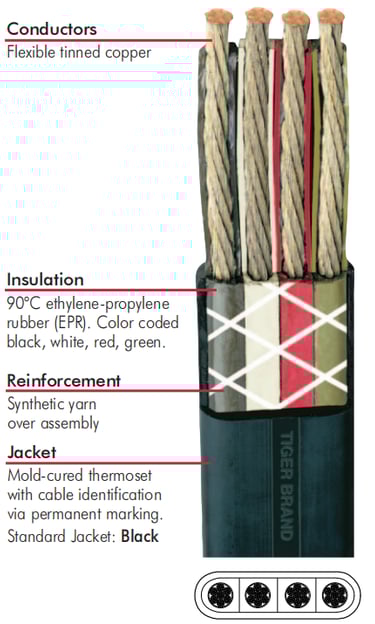
Type W Flat 4/C mold-cured jacket cable rated at 600/2000 volts is a four-conductor, flat-geometry power cable designed for AC off-track underground mining equipment. It uses flexible tinned copper conductors, 90°C ethylene-propylene rubber (EPR) insulation, and a mold-cured thermoset outer jacket to deliver durable, continuous power to shuttle cars, drills, cutting machines, and loading machines in harsh underground environments.
This cable format has become one of the most relied-upon trailing power solutions in underground coal and hard-rock mining operations. Its flat construction, rugged jacket, and four-conductor layout address a specific need: delivering stable AC power to equipment that moves constantly, operates in cramped headings, and endures daily mechanical stress that would quickly degrade a lesser cable design.
Understanding what makes this cable suitable for underground use — and how to select the right specification for your equipment — can directly affect both mine safety and operational uptime.
What "Type W Flat 4/C" Actually Means
Mining cable designations carry precise technical meaning, and getting them right matters when you are sourcing replacement cables or specifying new installations.
Type W is a classification used in North American mining cable standards, specifically under ICEA S-75-381 and NEMA WC-58. It denotes a portable power cable rated for use in general mining applications. Type W cables are built to handle the mechanical abuse of underground environments — repeated flexing, dragging across mine floors, and exposure to water, coal dust, and rock debris.
Flat refers to the physical cross-sectional geometry of the cable assembly. Rather than grouping conductors in a round bundle, flat cables align the conductors side by side in a single plane. This geometry matters in underground operations where cable management is constrained by roof height, rib-to-rib width, and the way equipment moves through entries.
4/C means four conductors. In an AC mining circuit, three conductors carry power (typically color-coded black, white, red, and green for grounding purposes). The four-conductor layout is standard for equipment that requires a neutral or additional circuit leg as part of the AC power system.
Mold-Cured Jacket describes how the outer protective layer is formed. During manufacturing, the jacket compound is vulcanized under heat and pressure in a mold, creating a dense, uniform protective layer that is chemically bonded to the cable assembly beneath it. This process produces a jacket with superior resistance to compression cuts, abrasion, and fluid penetration compared to extruded-only jacket designs.
Primary Application Areas
The Type W Flat 4/C cable is explicitly designed for AC off-track mining equipment. Understanding the operating environment of each equipment type helps explain why this cable specification was developed the way it was.
AC Shuttle Cars
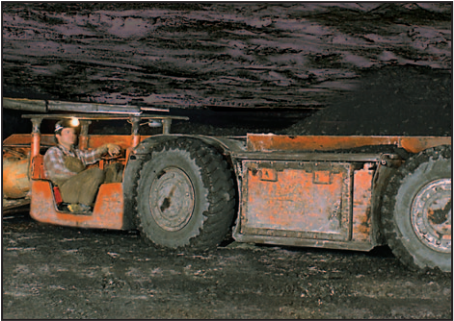
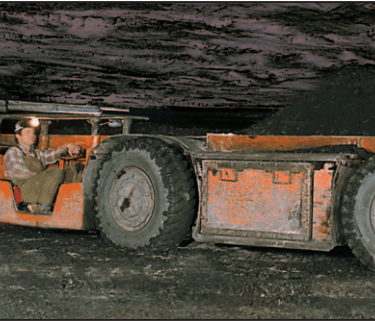
Shuttle cars are continuous haulage vehicles that carry coal or ore from the continuous miner face to a feeder or conveyor belt. In most underground coal mines, shuttle cars operate on AC power supplied through a trailing cable that unspools behind the vehicle as it travels away from the power center and reels back as it returns. The cable is subjected to repeated cycling — paying out and reeling in dozens of times per shift — while running across rough mine floors, under the car body, and through areas congested with other equipment and personnel.
The flat geometry of the 4/C Type W cable is particularly well-suited here. Flat cables tend to feed more evenly onto reel drums and lie flatter on mine floors, reducing the tendency to coil, tangle, or roll under equipment wheels. This reduces mechanical damage and improves operator visibility of the cable path.
Drills
Underground roof bolting machines and exploratory drill rigs depend on reliable trailing cables throughout each shift. Drill cables are moved frequently as the machine advances along a heading, and they must withstand the oil, water, and rock fragments common around drilling operations. The mold-cured jacket provides a tight, consistent surface that resists penetration by cutting fluids and hydraulic oil, both of which can degrade cable insulation if they reach the conductor level.
Cutting Machines
Continuous miners and other cutting machines advance through the coal or ore seam while dragging their trailing cable behind them. The cable must flex repeatedly as the machine cuts in an arc or repositions between entries. At the same time, it must maintain electrical integrity in an environment saturated with coal dust and water used for dust suppression. The EPR insulation used in Type W cables maintains stable dielectric properties in the presence of moisture, making it a reliable choice for this application.
Loading Machines
Loading machines — including scoops, load-haul-dump units (LHDs), and feeder breakers — operate in tight areas and require a cable that can be repositioned quickly without kinking or developing hot spots from bent conductors. The flexibility built into the Type W flat design supports this kind of frequent repositioning without accelerating insulation fatigue.
Key Performance Priorities in Underground Mining
Underground mining imposes a specific set of demands on power cables that surface installations rarely encounter simultaneously.
Flexibility Under Load
A cable that carries full operating current while being dragged, bent, and stepped on must maintain both electrical continuity and mechanical integrity. The flexible stranded conductors used in Type W cables are designed to accommodate repeated bending without work-hardening or breaking individual strands. In practical terms, this means the cable can follow equipment movement without developing resistance hot spots or mechanical failures at bend points.
Resistance to Abrasion and Moisture
Mine floors are abrasive. Cable dragged across rock, coal, and debris accumulates surface damage that eventually penetrates the jacket and reaches the insulation. The mold-cured thermoset jacket used in Type W flat cables is engineered to resist this progressive abrasion. At the same time, underground operations involve significant water — from aquifer infiltration, dust suppression systems, and hydraulic equipment — and the EPR insulation used in this cable type maintains stable electrical properties when wet.
Continuous Operation at 90°C
The recommended maximum continuous conductor temperature of 90°C for Type W cables reflects a practical engineering limit for underground trailing cables. Operating below this temperature consistently extends cable life significantly. Running a cable beyond this rating, even intermittently, accelerates insulation aging and increases the risk of insulation failure. Selecting the correct cable size for the actual load current of the connected equipment — rather than simply matching voltage rating — is the primary way operators control conductor temperature in service.
Construction Overview
The flat cable geometry serves a practical function beyond simple aesthetics. By arranging four conductors side by side in a single plane rather than in a round bundle, the cable presents a lower profile when lying on a mine floor. This reduces the effective obstacle the cable presents to equipment tires and tracks, which lowers the frequency of runover damage. It also means the cable tracks more predictably on cable reel drums.
The four-conductor arrangement powers the AC circuits used by shuttle cars, drills, and cutting machines. Three conductors carry the active power phases of the AC supply. The fourth conductor, typically insulated in green per industry color-coding conventions, provides the equipment grounding path. This grounding conductor is a safety-critical element: it provides the low-impedance fault return path required for the ground fault protection systems mandated by mining regulations in the United States and Canada.
The mold-cured thermoset jacket is formed around the entire conductor assembly in a single manufacturing step that integrates the jacket with the reinforcement layers beneath it. This creates a cable where the jacket does not peel, separate, or delaminate when cut, abraded, or bent repeatedly. The result is a cable that maintains its protective properties throughout its service life rather than progressively losing jacket integrity as it ages.
Materials and Design Features
Flexible Stranded Copper Conductors
The conductors in a Type W flat 4/C cable are constructed from multiple strands of tinned copper wire twisted together in a rope-lay configuration. Tinning the copper strands provides corrosion resistance in wet environments and maintains good electrical contact at terminations. The rope-lay strand configuration — where groups of wires are twisted in one direction and then assembled into a conductor twisted in the opposite direction — produces a conductor that bends freely without concentrating stress at any single point. This is what allows the cable to flex thousands of times over its service life without developing strand breaks that create resistance hot spots.
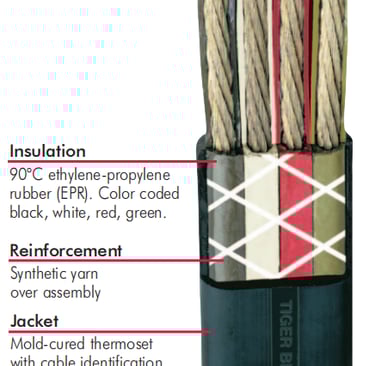
Ethylene-Propylene Rubber Insulation
EPR is the insulation material of choice for underground mining cables because it combines high dielectric strength with excellent moisture resistance and flexibility across a wide temperature range. Unlike some thermoplastic insulation materials, EPR does not become brittle in cold underground environments or soften excessively in warmer headings near mine power equipment. It maintains stable electrical properties when saturated with water, which is an important characteristic given the wet conditions common in underground mining operations. The 90°C temperature rating of the insulation determines the continuous ampacity limits published in cable specifications.
Synthetic Yarn Reinforcement
Between the individual conductors and the outer jacket, Type W flat cables incorporate a synthetic yarn reinforcement layer applied over the conductor assembly. This reinforcement provides mechanical stability to the flat cable geometry, prevents the conductors from migrating within the assembly under repeated bending, and adds a layer of protection between the insulated conductors and the outer jacket. If the jacket is damaged and material is removed, the reinforcement layer provides an additional barrier before the insulation is exposed.
Mold-Cured Thermoset Jacket
The outer jacket compound is a thermoset material — meaning it cross-links chemically during the curing process and cannot be re-melted or reformed after manufacturing. This cross-linked structure gives the jacket superior resistance to compression cutting, the failure mode that occurs when cable is run over by equipment and the weight of the vehicle concentrates on a small area of cable surface. Thermoset jackets also resist degradation from the oils, hydraulic fluids, and mine atmospheres encountered in underground operations.
Why Mines Use This Cable Format
Underground mining operations run on margins that make cable reliability a genuine economic issue. A cable failure that takes a shuttle car or continuous miner out of service creates a production gap that ripples through the entire operation. The tail section stops filling, the conveyor runs empty, and the mine's output for that shift drops.
The Type W flat 4/C design addresses the failure modes most commonly responsible for cable-related downtime in underground coal and hard-rock mines. The flexible conductors reduce strand break failures. The EPR insulation resists moisture-related degradation. The mold-cured jacket resists the surface damage from dragging and runovers that eventually expose the insulation in cables with softer or extruded-only outer layers. The flat geometry reduces the profile the cable presents to equipment wheels, lowering the frequency and severity of runover events.
Mines also benefit from the handling characteristics of flat cables during repositioning. Underground personnel move trailing cables frequently — clearing them from travel routes, repositioning them as equipment advances, or recovering them after a cable becomes pinched or trapped. A flat cable that lies predictably and handles without tangling reduces the time spent on cable management and the risk of personnel injury during cable handling operations.
Real-World Mining Application Cases
Coal Mining Operations in the Illinois Basin
Several underground coal mines in Illinois and Indiana running room-and-pillar sections with AC shuttle cars have documented the advantages of flat trailing cable designs in their section cable management programs. In operations where entries run to depths of 1,000 feet or more, shuttle cars cycle continuously throughout each production shift. The flat cable design allows cable handlers to move cables quickly when clearing travel roads between equipment passes, reducing the time personnel spend in the path of moving equipment. Operations that transitioned from round to flat cable designs on their shuttle car fleets reported measurable reductions in cable damage incidents attributable to cable-handling difficulties in congested entries.
Hard-Rock Mining in the Canadian Shield
Underground nickel and copper mining operations in Ontario and Manitoba operate in environments where water infiltration rates are high and mine temperatures vary significantly between near-surface and deeper workings. Load-haul-dump units and electric drills in these operations depend on EPR-insulated trailing cables that maintain stable electrical properties through wide temperature swings and continuous exposure to groundwater. Operations in the Sudbury Basin, one of the world's most productive nickel mining regions, have long specified EPR insulation for trailing cable applications because the mineral content of the groundwater in that geology accelerates degradation in cables with less chemically resistant insulation systems.
Surface-to-Underground Transition Applications in Appalachian Coal Mines
In Appalachian underground coal mines operating longwall and continuous miner sections, trailing cables for section equipment pass through environments that range from relatively dry main entries to wet, low-coal faces where roof conditions require frequent water application for dust control. Cables used on cutting machines in these sections are expected to function reliably through continuous water exposure while maintaining the flexibility needed to follow the machine through its cutting arc. Mines in southwestern Virginia and southern West Virginia have standardized on Type W cable designs with mold-cured jackets for their continuous miner trailing cables after experiencing higher failure rates with alternative jacket formulations in wet face conditions.
Potash Mining in Saskatchewan
Underground potash mines in Saskatchewan, Canada, operate in unique geological conditions where the ore seam is relatively flat but the operating widths are broad and equipment travel distances are long. Electric mining machines — including continuous miners adapted for potash extraction — trail cables over distances that can exceed 500 feet. The repeated cycling of cables over long distances places particular stress on conductor stranding. Operations at several Saskatchewan potash mines have adopted highly flexible stranded conductor specifications for their trailing cables after conductors with lower strand counts developed fatigue failures at higher rates during long-distance cycling.
Selection Considerations
Selecting the correct Type W flat 4/C cable for a specific underground application involves more than matching the voltage rating to the supply system.
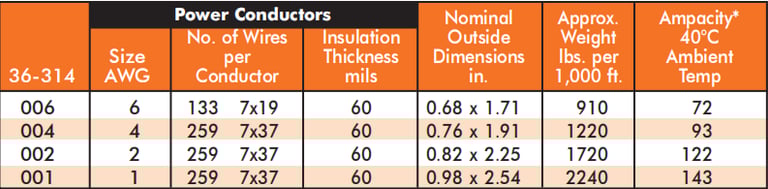
Equipment Type and Current Draw: The conductor size must be selected to carry the full-load current of the connected equipment without exceeding the 90°C conductor temperature rating. Undersized conductors run hot, accelerate insulation aging, and create thermal failure risks. Mining equipment nameplates specify full-load amperage, and cable ampacity tables — corrected for ambient temperature and reel conditions if applicable — determine the minimum conductor size for each application.
Voltage Level: The 600/2000 volt dual rating of Type W flat cables reflects the common AC supply voltages used in underground mining. Section power in many U.S. underground coal mines is distributed at 995 volts or 4,160 volts at the mine power center, stepped down to lower voltages for section equipment. Verifying the actual supply voltage at the equipment connection point is essential before specifying cable voltage rating.
Physical Layout and Cable Length: Flat cables perform best when they can lie flat on mine floors and spool evenly onto cable reels. Tight corners, irregular floor conditions, or unusually long cable runs can affect cable behavior. Consulting with a cable engineering specialist for non-standard installations helps avoid selection errors that become apparent only after the cable is in service.
Operating Temperature and Ambient Conditions: Cable ampacity tables are typically published at a reference ambient temperature of 40°C. Underground environments that are significantly hotter require derating the cable's ampacity. Very cold environments — common in entries near mine portals in northern climates during winter — can affect jacket flexibility and handling characteristics. Both extremes should be considered when selecting cable specifications.
Movement Frequency: Equipment that cycles its cable very frequently — shuttle cars in high-production sections may cycle their cables hundreds of times per shift — places greater mechanical demand on the cable than equipment that moves less often. Higher cycle rates justify selecting cables with higher strand counts and more flexible conductor constructions, even if the electrical requirements could be met by a simpler design.
Common Questions About Type W Flat 4/C Mining Cable
The following section addresses questions that mine operators, electrical engineers, and procurement specialists commonly ask when evaluating this cable type.
What is the difference between Type W and Type G mining cable? Type W cables do not include a bare grounding conductor running through the cable assembly. Type G cables add one or more uninsulated ground wires to the conductor bundle, providing an additional grounding path that is required in some underground electrical circuits, particularly where ground fault protection systems mandate a dedicated equipment ground return path separate from the insulated grounding conductor.
Can Type W flat 4/C cable be used on DC equipment? The four-conductor flat Type W design discussed in this guide is configured for AC circuits. A separate two-conductor flat Type W design is available for DC off-track equipment applications. Using an AC-configured cable on DC equipment, or vice versa, can create grounding circuit incompatibilities with the mine's ground fault protection system. Always verify the circuit type before specifying cable.
How is cable ampacity affected when cable is stored on a reel? When cable is wound on a reel, the layers of cable act as thermal insulation for the inner layers, reducing the cable's ability to dissipate heat generated by load current. Standard reel derating factors apply: one layer of cable on a reel typically requires reducing the rated ampacity to 85% of the free-air value; two layers require reduction to 65%; three layers to 45%; four or more layers to 35%. These factors are published in ICEA S-75-381 and should always be applied when any portion of the cable will remain on the reel during operation.
What does the MSHA marking on the cable indicate? The Mine Safety and Health Administration (MSHA) listing marking on a mining cable indicates that the cable has been evaluated by MSHA and found to meet the flame resistance requirements established under federal mining safety regulations. In U.S. underground mines, using cables that do not carry the appropriate MSHA listing marking is a regulatory violation. The specific marking number also indicates the Pennsylvania Department of Environmental Protection approval where applicable.
How often should trailing cables be inspected? U.S. federal mining regulations under 30 CFR Part 75 require that trailing cables be examined for damage before each use in underground coal mines. Visual examination should look for jacket cuts, abrasions, compression damage, splice quality, and connector condition. Cables with exposed insulation, damaged connectors, or splice repairs that do not meet regulatory standards must be taken out of service until properly repaired or replaced.
What causes premature jacket failure in underground trailing cables? The most common causes of premature jacket failure are mechanical damage from equipment runovers, repeated sharp bending at cable entry points to connectors, chemical attack from hydraulic fluid or oil leaks, and ultraviolet degradation (rarely a factor underground but significant in surface installations). Proper cable handling practices — using cable handlers or mechanical assistance for heavy cables, avoiding pinch points, keeping cables clear of equipment travel paths — extend jacket life significantly.
Closing: Choosing the Right Cable for Your Underground Operation
Type W Flat 4/C mold-cured jacket cable rated at 600/2000 volts represents a mature, well-proven solution to one of underground mining's persistent engineering challenges: delivering reliable AC power to equipment that moves constantly in a physically destructive environment.
The design choices embedded in this cable type — flat geometry for floor profile and reel performance, flexible stranded copper conductors for cycle life, EPR insulation for moisture resistance and thermal stability, and a mold-cured thermoset jacket for mechanical protection — reflect decades of application experience in underground coal and hard-rock mining operations across North America.
Selecting the right cable means matching conductor size to actual load current, confirming voltage compatibility with the circuit supply, and evaluating the cable's mechanical demands based on equipment type and cycle frequency. When those selection factors are addressed correctly, a Type W Flat 4/C cable provides dependable service life in the conditions underground mining creates — and reduces the cable-related downtime that costs mines production on every shift where a cable failure takes equipment out of service.
For specific technical specifications, conductor sizing guidance, or regulatory compliance questions related to underground mining cable selection, consulting with a qualified mining electrical engineer or a cable manufacturer's application specialist is recommended before finalizing cable specifications for new installations or replacement programs.
For technical specifications referenced in this article, consult ICEA Standard S-75-381 / NEMA WC-58, the applicable MSHA regulations under 30 CFR Part 75, and CSA Standard C22.2 #96 for Canadian underground mining applications.
Port crane cables | Mining cables | Reeling cables | Trailing cables | Festoon cables | Heavy-duty power cables | Medium voltage cables | Offshore crane cables | Underground mining cables | Dragline cables | Shearer cables | Container handling cables | STS crane cables | RTG cables | Mobile equipment cables | Armored cables | Flexible power cables | VFD cables | Submersible cables | Cold resistant cables | Abrasion resistant cables | Flame retardant cables | Marine environment cables | Opencast mining | Underground operations
© 2006 All rights reserved.
[INDUSTRIAL_CABLES]
INDUSTRIAL GRADE CABLE SYSTEMS | PORT & MINING SOLUTIONS
TEL: +86 153 7530 2641 |MAIL: hongjing.Wang@feichuncables.com