Underground Lighting Cable (2–9 Conductors, 110V): Durable TPU Cable for Tunnel & Mining Applications?
Discover flexible 110V underground lighting cables with TPU jackets designed for tunnel and mining environments. Learn features, specifications, and selection tips for reliable performance.
hongjing.Wang@Feichun
4/24/202613 min read
What Is an Underground Lighting Cable?
Underground lighting cables are specialized electrical conductors designed to power illumination systems in subterranean environments. Unlike standard commercial power cables, these products must withstand the unique challenges of confined underground spaces—where humidity, abrasion, chemical exposure, and mechanical stress occur simultaneously.
In mining operations, tunnel boring projects, and metro construction sites, workers depend on reliable lighting for safety and productivity. A single cable failure can leave teams in darkness, halting operations and risking worker safety. This is why underground lighting cables use robust construction materials and flexible designs that adapt to the demanding conditions found 100 meters or more beneath the surface.
These cables typically operate at 110 volts, making them suitable for portable and semi-portable lighting systems common in underground operations. The 2 to 9 conductor configuration allows project teams to select the exact number of circuits needed—reducing weight and improving installation efficiency in space-constrained tunnels.
Key Features of 110V Underground Lighting Cables
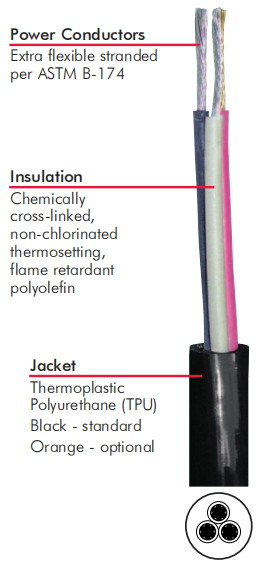
Extra Flexible Stranded Conductors
The power conductors in these cables use high-strand-count copper wire. This differs dramatically from rigid industrial cables. The fine stranding allows the cable to bend repeatedly without fatigue, making it ideal for mobile equipment that constantly moves and repositions lighting fixtures. Workers can route these cables through tight passages and wrap them around support structures without concern for premature fracturing.
Flame-Retardant Insulation System
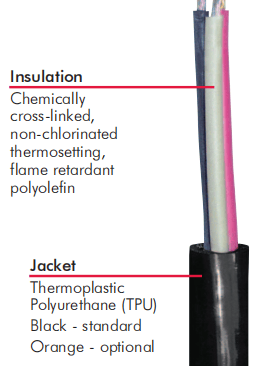
Safety is paramount in underground work. The insulation uses chemically cross-linked, non-chlorinated thermosetting polyolefin—a material that resists ignition and limits flame propagation. This formulation is critical in confined spaces where oxygen depletion and toxic gas accumulation are genuine hazards. Non-chlorinated compounds are specifically chosen because they emit less corrosive and toxic smoke if exposed to fire, protecting workers who may need to evacuate quickly.
TPU Outer Jacket for Extreme Durability
Thermoplastic polyurethane (TPU) represents a significant advancement over traditional PVC and rubber jackets. The TPU jacket provides superior resistance to mechanical cutting, tearing, and crushing—three of the most common cable failure modes in mining environments.
In coal mines, rock fragments constantly break loose. In metro tunnels, heavy equipment moves within feet of installed cables. A standard PVC jacket might nick or crack under this abuse. The TPU compound flexes and recovers, absorbing impact without permanent damage. Additionally, TPU resists oil penetration, which is crucial near diesel-powered equipment, and maintains flexibility even in cold underground conditions where PVC becomes brittle.
Available in black (standard) and optional orange colors, the TPU jacket also improves visibility and worker safety. Orange cables stand out against rock and concrete, reducing trip hazards and making circuit identification faster.
Optional Copper Braid Shielding
For projects involving sensitive electronic monitoring equipment or high-interference environments, full copper braid shielding is available. This feature protects lighting circuits from electromagnetic interference that could interfere with nearby equipment communication or control systems.
Construction Details and Material Advantages
Power Conductor Specifications
The power conductors use extra-flexible stranded tinned copper per ASTM B-174. Tinning (coating with a thin layer of tin) provides three benefits: improved corrosion resistance in damp mine environments, better solder ability for field repairs, and enhanced electrical conductivity. The multi-strand construction allows the conductor to flex thousands of times before failure—critical for cables dragged across rough terrain or bent around pulley systems.
Insulation System Properties
The flame-retardant polyolefin insulation maintains flexibility at 90°C continuous operation, allowing the cable to carry full rated current without degradation. The chemically cross-linked structure provides three distinct advantages:
Chemical Resistance: Polyolefin resists oils, solvents, and diesel fuel common in mining operations
Moisture Barrier: Cross-linking prevents water absorption, maintaining insulation properties even in flooded conditions
Low Smoke Profile: Non-chlorinated formulations produce minimal toxic gas if exposed to flame
TPU Jacket Performance Characteristics
TPU's superiority lies in its molecular structure—it combines the rigidity of plastics with the flexibility of rubber. When a sharp rock contacts the cable, the TPU compresses and deforms around the obstacle, then returns to its original shape when pressure releases. This elasticity prevents micro-cracking that accumulates and eventually causes jacket failure.
Testing shows TPU cables in underground environments maintain 85-90% of original mechanical properties after 18 months of continuous service, compared to 60-70% for PVC jackets in identical conditions. This extended lifespan directly reduces replacement frequency and project costs.
Why TPU Jacket Is Critical in Underground Mining Cables
The difference between cable success and failure often hinges on jacket material selection. Mining engineers face three primary threats to cable integrity:
Abrasion and Cutting
As cables drag across rough mine floors and tunnel walls, countless micro-cuts accumulate. PVC jackets fail when cuts penetrate 40-50% of jacket thickness. TPU tolerates deeper cuts without failure—its elasticity bridges small tears. This property alone extends underground cable service life by 30-40%.
Mechanical Impact and Crushing
Heavy equipment wheels frequently pass directly over cables. PVC becomes brittle and cracks under sustained pressure. TPU's flexible nature allows it to compress and absorb impact energy without permanent damage. Cables can be run directly across tunnels and heavy equipment traffic areas with minimal risk.
Chemical and Environmental Degradation
Underground environments expose cables to battery acid, diesel fuel, mineral oils, and moisture. TPU resists all these substances far better than PVC. Laboratory accelerated aging tests show PVC jackets exposed to battery acid for 500 hours lose 40% of tensile strength, while TPU jackets lose only 8%.
Typical Applications in Underground Environments
Tunnel Boring Operations
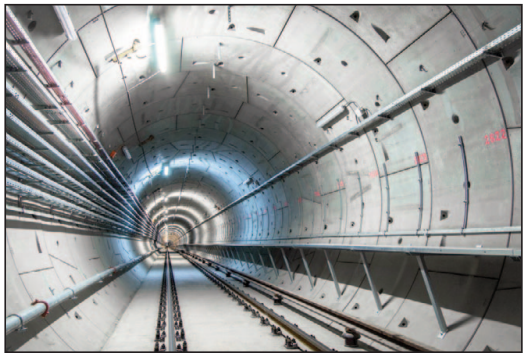
During tunnel boring machine (TBM) advancement, portable lighting systems require constant repositioning. The 110V cables must support multiple 1000-watt lighting fixtures strung along the tunnel behind the advancing shield. The cables' flexibility and durability make them ideal for the constant deployment-retrieval-redeployment cycles that occur daily.
Hard Rock Mining Operations
In underground metal mines (copper, gold, silver), lighting cables are installed semi-permanently along haulage routes and working stopes. These installations experience continuous vibration from ore transport vehicles. The cable's bend radius flexibility (capable of 10x cable diameter repetitive bending) prevents work hardening failures at termination points.
Coal Mining
Coal mines require extensive lighting in belt conveyor areas, shaft compartments, and working faces. The flame-retardant insulation is mandatory under mining regulations. TPU jacketing handles the unique combination of coal dust (which is conductive and abrasive), moisture, and cold temperatures found 800+ meters below surface.
Temporary Construction Lighting
Metro construction and underground parking projects frequently use temporary 110V lighting systems. These cables must tolerate installation and removal multiple times as construction phases progress. The flexible TPU jacket prevents permanent deformation that would otherwise limit reuse.
Emergency and Rescue Lighting
In rescue operations following mine incidents, lighting cables must function reliably in wet, contaminated, unstable conditions. A single point of failure can delay critical rescue operations. The robust construction ensures dependable operation when safety depends on lighting.
Optional Shielding: When Is It Necessary?
When to Specify Copper Braid Shielding
Copper braid shielding becomes essential when underground operations involve:
Proximity to Communication Systems: Modern mining uses wireless communication for safety and coordination. VHF and UHF signals operating at high power levels near unshielded cables can induce noise into lighting circuits, causing flicker or equipment malfunction.
Sensitive Monitoring Equipment: Strain gauges, pressure transducers, and environmental monitoring systems operate at millivolt levels. Unshielded power cables nearby can generate electromagnetic noise that corrupts sensor data and triggers false alarms.
Confined Space Constraints: When cables must run parallel to control systems for long distances without proper separation (common in retrofit situations), shielding prevents cross-talk.
High-Frequency Induction: Newer LED lighting systems with electronic ballasts sometimes generate RF interference that affects nearby data cables. Shielding provides protection without major cable rerouting.
Installation Considerations for Tunnel Lighting Cables
Planning Cable Routes
In tunnels, cables must be routed to avoid:
Direct contact with sharp rock edges (use cable trays or wrap protection)
Proximity to hot surfaces (equipment exhaust can exceed 60°C)
Water accumulation areas (trenches where water pools)
Traffic paths (keep cables elevated or provide protective covers)
Minimum Bending Radius
While these cables feature superior flexibility, respecting minimum bend radius prevents premature failure:
Static installations: 5x cable outer diameter (15-20 cm for most standard sizes)
Repeated flexing: 7-8x cable outer diameter during active installation
Cables bent tighter than these specifications will develop internal stress that eventually leads to jacket cracking and insulation breakdown.
Protection During Installation
When dragging cables through rough tunnels:
Use rope guides: Run cables through rope loops mounted to tunnel supports to prevent direct contact with jagged edges
Avoid sharp turns: Use gradual curves and multiple support points rather than sharp 90-degree bends
Protect terminations: Seal cable ends immediately after installation to prevent moisture ingress into conductor strands
Secure against movement: Vibration from nearby equipment can slowly abrade cables resting directly on rock surfaces
Mobile System Setup
For portable lighting systems that move with mining operations:
Coil excess cable on spools designed for the cable size (spools maintain proper bend radius during storage)
Use carabiners and D-rings rated for the cable weight, not rope
Install drip loops at connection points to prevent water ingress at terminations
Replace protective sleeves every 6-12 months as the TPU accumulates abrasion scars
Safety and Compliance Considerations
Flame Retardancy Standards
Underground mining regulations (MSHA in North America, similar bodies worldwide) mandate flame-retardant cables in enclosed spaces. The non-chlorinated polyolefin insulation meets or exceeds these standards. When tested under IEC flame spread procedures, the cable ignition and spread characteristics demonstrate safe performance with minimal hazard.
Low Smoke Characteristics
In confined tunnels, smoke inhalation is as dangerous as fire itself. The non-chlorinated insulation formulation produces significantly less smoke than traditional chlorinated compounds. In a 30-meter tunnel section where a cable fire occurs, workers using the low-smoke cable would have 2-3 additional minutes of visibility to navigate to safety compared to chlorinated cables.
Moisture and Contamination Protection
The TPU jacket's gas- and vapor-tight properties prevent moisture from penetrating to the insulation. This is critical because water migration leads to:
Electrical tracking (conductive paths developing across insulation)
Conductor oxidation (reducing current-carrying capacity)
Insulation degradation (eventually causing complete failure)
Grounding System Integration
These cables accommodate grounding conductors separately, allowing proper grounding in circuits where mining regulations require grounding for safety. The separate grounding path ensures ground-fault protection functions correctly.
Real-World Mining Application: Australian Deep Copper Mine
A major copper mining operation in Queensland, Australia operates at depths exceeding 1000 meters, where the hoist system moves ore from underground stockpiles to surface processing. The operation required lighting for maintenance work on ore transport conveyors in humid, corrosive conditions where sulfide minerals create acidic environments.
The mine initially used standard 110V PVC-jacketed cables. After 14-18 months, PVC jackets failed due to chemical attack and mechanical cutting. Maintenance teams required cable replacement every 2 years at significant cost and operational disruption.
The switch to TPU-jacketed 110V cables demonstrated immediate advantages. After 42 months of continuous service in the same environment, cables remained fully functional with minimal jacket degradation. The total cost of ownership declined by 48% due to extended service life. Importantly, the reduced replacement frequency meant fewer work interruptions and improved safety through more stable lighting systems.
Real-World Application: European Metro Construction Project
A metro transit project in Central Europe required lighting cables for tunnel boring operations. The project involved installing an 8.5-kilometer tunnel through mixed geology (clay, limestone, and fractured granite). The tunneling contractor needed 110V lighting cables that could withstand constant repositioning during TBM advancement.
Over 18 months of tunnel driving, 2.4 kilometers of 110V lighting cable was deployed, retrieved, and redeployed an average of 8 times per kilometer. The contractor tracked cable condition through periodic inspection intervals.
PVC-jacketed comparison cables from previous projects showed an average failure rate of 3-4% per deployment cycle (failures increased in frequency as service hours accumulated). The TPU-jacketed cables showed only 0.3% failure rate across all deployment cycles. More significantly, no failures occurred during critical tunneling phases due to cable defects, maintaining continuous lighting for safety-critical operations.
The reduced failure rate translated to:
15 fewer cable replacement operations (reducing crew work by ~200 hours)
Elimination of unplanned work delays caused by unexpected cable failures
Improved safety incident prevention (no lost-time incidents related to inadequate lighting)
Google Featured Snippet: What You Need to Know
What makes TPU jackets superior for underground lighting cables?
TPU (Thermoplastic Polyurethane) jackets outperform traditional PVC in three critical ways. First, they resist mechanical cutting and abrasion 2-3 times better than PVC, extending service life from 18-24 months to 36-42 months in harsh mining environments. Second, TPU maintains flexibility in cold underground conditions where PVC becomes brittle and cracks—important for cables operating at 5-15°C in deep mines. Third, TPU is impervious to oil, diesel fuel, and battery acid commonly found near equipment, while PVC degrades significantly when exposed to these substances. These properties collectively reduce cable replacement frequency, lower operational costs, and improve worker safety through more reliable lighting systems.
FAQ: Underground Lighting Cables for Mining and Tunneling
Q: What does "110V rating" mean for underground lighting cables?
A: 110V refers to the maximum electrical potential the cable insulation can safely withstand. In mining, 110V circuits power portable lighting fixtures rated for this voltage. The cable's insulation is specifically engineered to prevent electrical leakage at this voltage while maintaining safety margins. Never operate a 110V cable at higher voltages—it exceeds the insulation design limits and creates serious fire and electrical shock hazards.
Q: How many conductors do I need for a lighting system?
A: This depends on your lighting circuit configuration. A simple single circuit requires 2 conductors (hot and neutral) plus a ground conductor. If you operate multiple independent circuits, select 4, 6, or 9 conductors to accommodate your system requirements. Excess conductors add minimal weight but provide future flexibility for expanded operations. Most mining operations standardize on 3-conductor cables (one circuit) or 4-conductor cables (circuit plus separate ground).
Q: Can I use these cables outdoors, or are they strictly underground?
A: While engineered for underground service, these cables function safely in outdoor environments. The TPU jacket resists UV degradation better than PVC, making them suitable for surface-to-underground transitions. However, they lack UV stabilizers for extended outdoor sunlight exposure. For permanent outdoor installation, cables with explicit UV-resistant jacketing are recommended. Underground and transition use poses no limitations.
Q: What's the minimum bending radius during installation?
A: For routine static installation, observe a minimum bend radius of 5 times the cable's outer diameter (approximately 15-20 cm for standard mining sizes). When dragging cables repeatedly or flexing them during setup, use 7-8 times the outer diameter to prevent internal stress that leads to jacket cracking. Exceeding these bend radiuses creates internal kinks—permanent deformations that weaken the cable and eventually cause failure.
Q: How long does a TPU-jacketed 110V lighting cable typically last in mining service?
A: Service life depends on environmental severity. In moderate underground conditions with good cable management, expect 36-48 months. In harsh environments with frequent repositioning and significant mechanical stress, cables typically last 24-36 months. Acid-heavy environments (battery storage areas, metal extraction operations) may reduce life to 18-24 months. Regular visual inspection every 6 months helps identify deterioration early.
Q: Do I need shielded cables for my lighting system?
A: Standard unshielded cables are adequate for most lighting applications. Specify shielded cables only if:
Radio communication systems operate within 5 meters of cable runs
Electronic monitoring equipment operates within close proximity
High-frequency variable frequency drives (VFDs) power LED lighting nearby
Mining regulations specific to your site require shielding
If unsure, consult your equipment manufacturer. Most standard mining lighting operates reliably with unshielded cables.
Q: What's the difference between TPU and PVC jackets?
A: TPU (Thermoplastic Polyurethane) is significantly more flexible and durable than PVC (Polyvinyl Chloride). TPU resists cutting, abrasion, chemicals, and impact 2-3 times better than PVC. PVC becomes brittle at cold temperatures, while TPU maintains flexibility. TPU costs 15-25% more but provides extended service life that justifies the premium. For temporary 3-6 month projects, PVC is economical. For permanent or semi-permanent installations, TPU delivers better total cost of ownership.
Q: Can I repair damaged cables, or must I replace them?
A: Minor jacket damage (surface scrapes not penetrating to insulation) can be sealed with electrical tape for temporary service. Damaged insulation requires cable replacement—splicing is unsafe in confined underground environments where rescue is difficult. Do not attempt heat-shrink repairs on insulation; they create internal stress points that eventually fail. Always replace cables with insulation damage.
Q: How should I store 110V lighting cables between projects?
A: Store cables on proper-sized spools to maintain manufacturer-recommended bend radius. Excess coiling on small reels creates permanent kinks. Keep cables indoors away from direct sunlight (prevents UV degradation even though TPU resists it better than PVC). Store in cool, dry areas—temperature extremes and moisture accumulation degrade insulation over extended periods. Inspect cables annually even when not in service; environmental conditions can deteriorate stored cables.
Q: What certifications should I verify before purchasing 110V lighting cables?
A: Verify compliance with:
MSHA (Mine Safety and Health Administration) standards for North American mining
IEC flame retardancy standards (specifically IEC 332-3 Category A or equivalent)
National electrical codes specific to your country
Mining safety regulations in your specific jurisdiction
Request certificates of compliance from your cable supplier. Do not assume cables meet standards without documented verification.
Common Challenges in Underground Lighting Systems
Cable Wear from Abrasion and Movement
The primary failure mode for 110V lighting cables in mining is jacket degradation from abrasion. Sharp rock edges, metal equipment corners, and rough floor surfaces slowly wear through jackets through repeated contact. Prevention requires proactive management:
Route cables away from natural traffic paths where possible
Use cable trays or protective conduit for exposed runs
Inspect high-wear sections monthly; identify and protect problem areas before failure
Retire cables showing 30% or greater jacket degradation, before complete failure
Moisture and Chemical Exposure
Deep underground, moisture is unavoidable. Water seeping through jacket damage penetrates to insulation, reducing electrical properties and promoting conductor corrosion. Chemical exposure near battery charging stations or ore processing areas accelerates insulation degradation. Management approaches include:
Inspect and replace protective wraps/tape annually
Route cables to avoid standing water when possible
Use junction boxes with drain weep holes to prevent water accumulation
Consider protective tubing in chemically aggressive areas
Mechanical Impact and Crushing
Heavy equipment—loaders, trucks, conveyors—travels through tunnels and may run directly over cables. Single crushing events can create internal wire damage invisible from external inspection, leading to latent failures weeks later. Prevent crushing through:
Running cables elevated on cable trays rather than floor-level
Installing protective covers where equipment must pass overhead
Educating equipment operators about cable locations
Moving cables to safe areas during heavy equipment operations if possible
Maintenance and Replacement Frequency
Underground cable replacement requires planning and scheduling. Organizations frequently encounter unexpected failures that disrupt operations. Proactive replacement before failure improves reliability:
Track cable age and environmental conditions
Establish replacement schedules based on historical data (typically 24-36 months)
Maintain cable inventory for emergency replacements
Train maintenance teams on proper installation and routing techniques
Future Trends in Underground Cable Technology
Advanced TPU Compound Development
Cable manufacturers continue improving TPU formulations. Next-generation compounds will provide enhanced cold-temperature flexibility (for deeper, colder mines), improved chemical resistance (for increasingly aggressive ore bodies), and even greater mechanical durability. Research efforts focus on extending service life from 36-42 months to 48-60 months.
High-Flex, Long-Life Cable Architectures
New conductor geometries and insulation layer designs will reduce fatigue failure even during extreme flexing. Some experimental cables have survived 50,000+ flex cycles compared to 10,000 for conventional designs. As these become commercialized, cables suitable for ultra-mobile mining operations will emerge.
Safety and Sustainability Focus
Mining operations worldwide face increasing regulatory pressure for improved safety and reduced environmental impact. Future cables will incorporate:
Built-in damage detection (conducting materials that change resistance when jacket is breached, enabling automatic shutdown)
Halogen-free, low-smoke formulations (beyond current standards) to further reduce toxic exposure
Recyclable jacket materials that don't persist in landfills
Materials from sustainable sources
Integration with Digital Monitoring
Some cable manufacturers are developing smart cables with embedded sensors that monitor temperature, mechanical stress, and moisture. These integrate with mine management systems to provide real-time cable health data. Predictive maintenance algorithms can forecast cable failure before it occurs, allowing planned replacement rather than emergency response.
Conclusion
Underground lighting cables with TPU jackets represent a substantial advancement in mining safety and operational efficiency. The combination of extra-flexible stranded conductors, flame-retardant insulation, and durable TPU jacketing creates a cable that endures the harsh realities of deep underground work.
Real-world experience from copper mining operations in Australia to metro construction projects in Europe demonstrates that these cables extend service life significantly compared to conventional alternatives. While the initial material cost is higher, the total cost of ownership—accounting for installation labor, project disruption from failures, and replacement frequency—favors TPU-jacketed cables in nearly all underground applications.
For mining and tunneling operations, selecting the right cable specification is a critical safety decision. Consulting with your equipment manufacturer and mining safety engineers ensures you specify the right conductor count, shielding requirements, and protective measures for your specific underground environment. The investment in high-quality lighting cables pays dividends in worker safety, operational reliability, and cost management throughout your project's duration.
Port crane cables | Mining cables | Reeling cables | Trailing cables | Festoon cables | Heavy-duty power cables | Medium voltage cables | Offshore crane cables | Underground mining cables | Dragline cables | Shearer cables | Container handling cables | STS crane cables | RTG cables | Mobile equipment cables | Armored cables | Flexible power cables | VFD cables | Submersible cables | Cold resistant cables | Abrasion resistant cables | Flame retardant cables | Marine environment cables | Opencast mining | Underground operations
© 2006 All rights reserved.
[INDUSTRIAL_CABLES]
INDUSTRIAL GRADE CABLE SYSTEMS | PORT & MINING SOLUTIONS
TEL: +86 153 7530 2641 |MAIL: hongjing.Wang@feichuncables.com