Understanding VDE 0250 Part 813 and Part 814 Standards for Heavy-Duty Reeling Applications: A Technical Guide for Middle Eastern Port Infrastructure
Discover how VDE 0250-813 and Part 814 define NSHTÖU cable construction, testing, and approval requirements for reliable crane and reeling applications.
hongjing.Wang@Feichun
7/10/202610 min read
1. Introduction
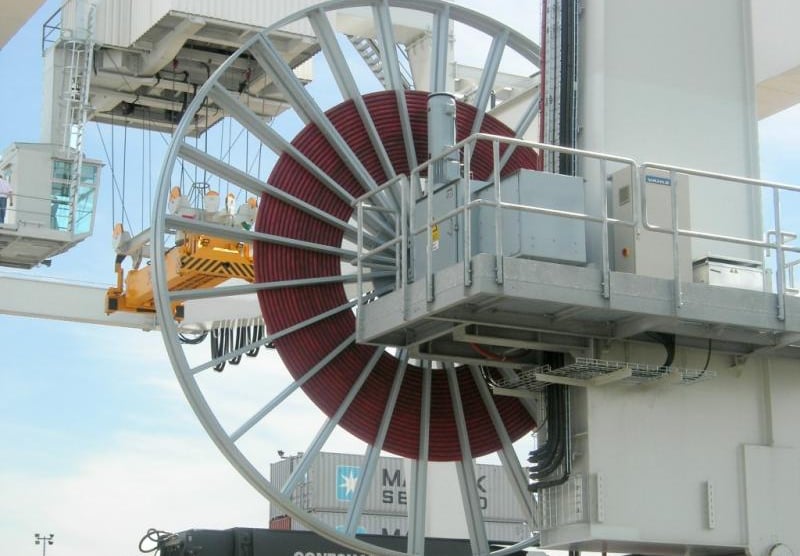
In the highly competitive maritime logistics sector of the Middle East, terminal reliability defines the boundary between profitable high-throughput operations and costly disruption. Major container hubs such as Jebel Ali Port in Dubai, Khalifa Port in Abu Dhabi, King Abdullah Port in Rabigh, and the Port of Salalah in Oman operate under continuous pressure to maintain crane uptime, preserve yard efficiency, and support increasingly automated terminal workflows.
For consultants, EPC teams, and port technical directors, cable selection is not a minor procurement detail. Moving cables used on cranes, hoists, transport systems, and conveyor equipment must perform as dynamic machine components, not static electrical products. They are expected to move repeatedly, resist mechanical stress, and maintain stable electrical performance under frequent winding and unwinding cycles.
The Feichun NSHTÖU cable series is designed for exactly this kind of application. According to the technical product information, it is a reelable low-voltage power and control cable intended for crane applications, conveyor technology, hoists, transport systems, and other industrial motion equipment operating under low to medium mechanical stress. Its role is not to serve as a rigid fixed-installation cable, but to function reliably in reelable systems where motion, bending, and torsion are part of the operating routine.
The purpose of this guide is to explain the engineering logic behind the NSHTÖU designation, its structural design, the relevant VDE standard background, the mechanical performance features that matter in practice, and the documentation engineers need for specification approval. For Middle Eastern port infrastructure projects, this knowledge helps ensure that cable selection aligns with real operating conditions rather than with generic assumptions.
2. What NSHTÖU Means
Cable designations in the German engineering tradition are not random product names. They encode performance expectations, structural intent, and application suitability. For technical buyers and consultants, understanding the meaning of the NSHTÖU designation is the first step in evaluating whether the cable fits a motion-based industrial application.
The prefix N indicates a standardized German cable type within the VDE framework, which signals that the product is designed and tested according to recognized engineering rules rather than proprietary marketing language. The letters SHT point to a heavy-duty rubber flexible cable construction suitable for severe industrial motion. The character Ö indicates oil resistance, which is critical in terminal environments where hydraulic fluids, lubricants, and diesel contamination are common. The suffix U indicates suitability for reeling and winding applications, meaning the cable is designed to move repeatedly on drums or reel systems rather than remain fixed in one position.
This designation matters because it immediately tells consultants that the cable is intended for dynamic movement, not for static power distribution. In port and industrial settings, that distinction is essential. A cable that is acceptable for a fixed tray installation may fail quickly if exposed to winding, reverse bending, or torsional stress.
3. Standard Background
The NSHTÖU family is associated with VDE-based reeling cable specifications that define the engineering expectations for flexible cables used in moving applications. In practice, manufacturers often reference VDE 0250-814 type certification for this cable family, alongside related international conductor and material standards. For technical teams, this matters because it places the product within a recognized engineering framework rather than a purely commercial category.
The logic behind these standards is different from that of ordinary fixed-installation cables. A standard utility cable is designed to remain stationary for long periods, often in conduit, tray, or buried installations. Its main priorities are electrical insulation, long-term dimensional stability, and cost-effective material performance.
A reelable crane cable must do much more. It must survive repeated acceleration, deceleration, bending, and torsion while continuing to carry electrical power without internal damage. That is why reeling cables are evaluated as mechanical systems as much as electrical ones.
In this context, the NSHTÖU cable should be understood as a flexible, reelable industrial cable for crane and conveyor duty, not as a universal heavy-duty cable for every drum application. That distinction is important when writing specifications for consultants, because it keeps the language accurate and avoids overclaiming performance beyond the cable’s intended use.
4. Cable Structure Requirements
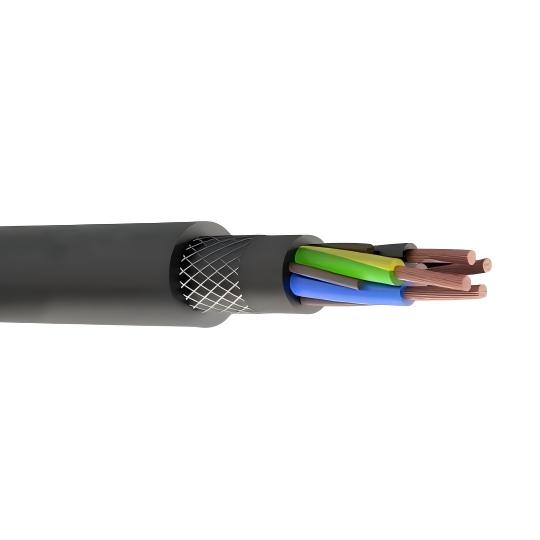
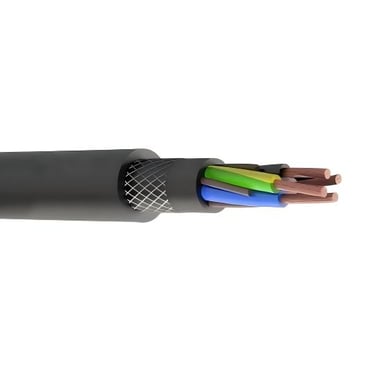
A reelable cable survives motion not because it is stiff, but because it is carefully engineered layer by layer. The Feichun NSHTÖU construction reflects this principle. Each layer contributes to the cable’s ability to bend, twist, and reel while preserving electrical integrity.
At the center of the cable are fine-stranded tinned copper conductors. Tinned copper is especially valuable in coastal and humid environments because the tin layer adds extra corrosion resistance. This helps protect the conductor against long-term environmental exposure in port atmospheres where moisture, salt, and industrial contaminants are present.
Around the conductors is the core insulation layer, made from an EPR rubber compound, type 3GI3. This insulation provides a strong combination of elasticity, dielectric performance, and thermal stability. Because the cable is intended for motion, the insulation must remain flexible while still maintaining electrical separation between cores under vibration and repeated bending.
The product structure also includes an integrated support braid. This is one of the most important features in the Feichun NSHTÖU design because it helps stabilize the cable during winding and reduces the risk of unwanted twisting. In a reelable system, the support braid is not a decorative detail; it is a mechanical function layer that contributes directly to cable life.
The outer sheath is made from a heavy-duty rubber compound, type 5GM3. Its role is to protect the cable from abrasion, UV exposure, oil contact, weathering, and moderate crushing damage. In Middle Eastern ports, where high ambient temperatures, direct sunlight, and industrial fluids are common, the sheath must do much more than simply cover the cable. It must act as the cable’s first line of defense.
This layered design is what makes the Feichun NSHTÖU suitable for reelable motion systems in cranes, hoists, and conveyor equipment. Its flexibility is intentional, because the cable is meant to move repeatedly without fixing, while its structure prevents internal deformation and twist-related failure.
5. Conductor Requirements
The performance of a moving cable begins with the conductor. For reelable applications, rigid conductors are not appropriate. They cannot tolerate repeated flexing, and their internal metal structure would fatigue too quickly under continuous movement.
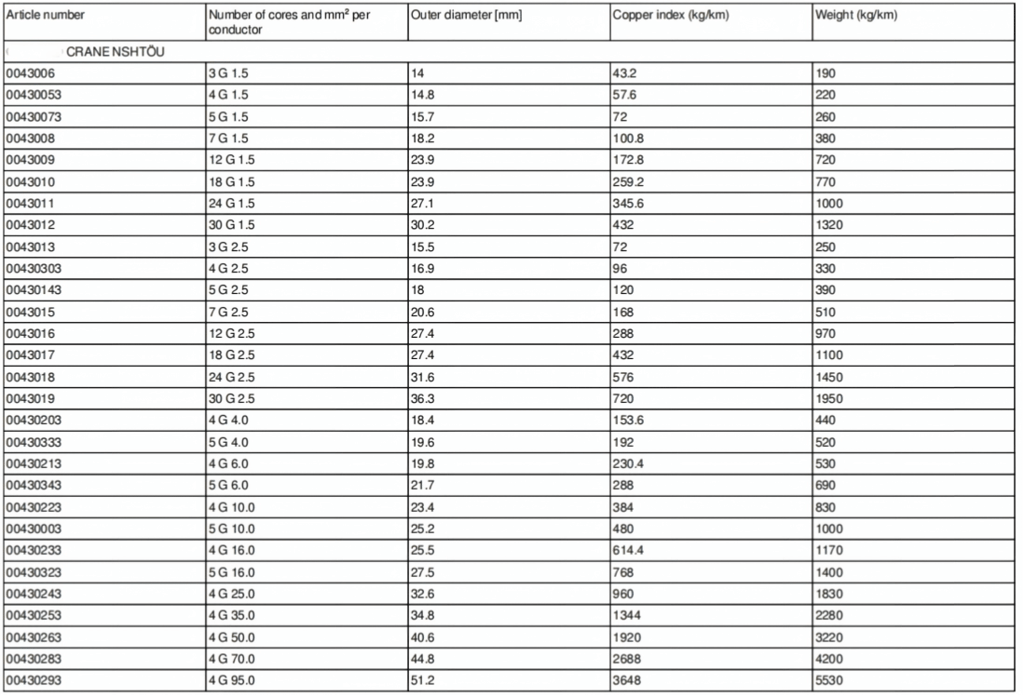
For this reason, the Feichun NSHTÖU uses fine-wire flexible copper conductors conforming to Class 5 under IEC 60228 / EN 60228 requirements. This conductor class is essential because it combines high flexibility with reliable current-carrying capability. The fine strands distribute bending stress across many small wires instead of concentrating it in a rigid core.
This is important for three reasons. First, the cable becomes easier to bend around a reel drum or guide system. Second, the conductor is less likely to break under repeated movement. Third, the electrical continuity remains stable over long operational cycles.
For port engineers, the practical meaning is simple: if the conductor is not sufficiently flexible, the cable will not survive reeling duty. The mechanical movement itself becomes a source of electrical failure. That is why Class 5 fine-wire construction is one of the most important structural decisions in a reelable crane cable.
6. Insulation Layer
The insulation layer is responsible for maintaining electrical integrity while the cable is in motion. In a static cable, insulation mainly needs to resist voltage and aging. In a reelable cable, insulation must also stay flexible, elastic, and resistant to mechanical deformation.
The Feichun NSHTÖU uses EPR insulation, type 3GI3, which is well suited to dynamic industrial cable applications. EPR is widely used because it offers a strong balance of dielectric performance and mechanical resilience. It can handle repetitive flexing better than many stiffer insulation materials.
Temperature performance is also crucial. The product documentation indicates a flexible use temperature range of -25°C to +80°C for this cable family. That makes the NSHTÖU suitable for outdoor port environments where night temperatures may drop while equipment still needs to operate reliably.
In practice, insulation failure often begins with microdamage. Repeated bending, vibration, and twisting can slowly weaken the insulation surface or cause internal stress points. Once those stress points grow, the risk of conductor exposure or short circuit increases. The EPR insulation in the Feichun NSHTÖU is designed to resist that process and preserve dielectric integrity throughout the cable’s working life.
7. Outer Sheath Performance
The outer sheath is the cable’s environmental shield. In Middle Eastern ports, this layer faces some of the harshest conditions in industrial cable service. High UV exposure, heat, dust, salt air, oil contamination, and abrasion all attack the outer surface of a moving cable.
The Feichun NSHTÖU outer sheath uses a type 5GM3 rubber compound designed for exactly that kind of environment. The sheath is oil-resistant, UV-resistant, cold-resistant, and mechanically durable. These are not secondary benefits. They are core requirements for a cable that will be exposed to real port infrastructure conditions.
Oil resistance matters because terminal machinery often leaks hydraulic fluid or lubricant. Without oil resistance, the sheath can soften, swell, or crack. UV resistance is equally important in the Middle East because sunlight can rapidly degrade ordinary rubber compounds. Abrasion resistance protects the sheath from guide rollers, moving frames, and repeated contact points. The cable must also tolerate occasional compression and surface wear without losing its protective function.
For port projects, the outer sheath is often the part that fails first if the cable is not properly matched to the application. That is why the Feichun NSHTÖU’s sheath specification is a major part of its value proposition for crane and conveyor systems.
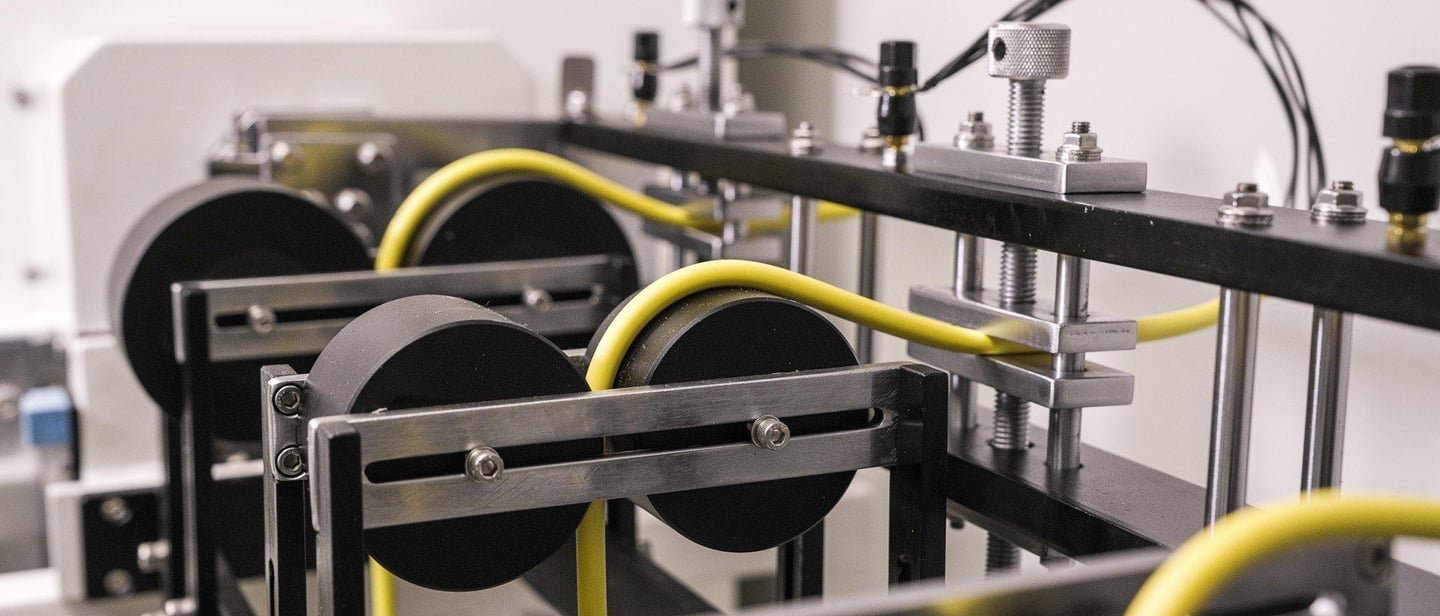
8. Mechanical Testing Requirements
Mechanical testing is the part of the specification that proves the cable can survive real motion. Consultants and port engineers are usually less concerned with marketing claims than with whether the product has been validated under bending, tensile, and torsional stress.
8.1 Bending Test
A reelable cable must survive repeated bending cycles without jacket cracking, conductor distortion, or internal movement damage. That is why minimum bending radius is one of the first things engineers review.
The Feichun NSHTÖU data sheet specifies a minimum bending radius for flexible use of 5 times the outer diameter for cables below 21.5 mm and 6.25 times the outer diameter for larger versions. This is a critical design parameter because it tells installers how tightly the cable can move without premature fatigue.
For practical specification writing, it is better to present bending radius as an application rule, not as a vague recommendation. If the reel geometry is too tight, the cable will fail early even if the electrical rating is correct.
8.2 Tensile Test
Reeling cables also experience longitudinal pulling force. During crane motion, the cable is not only bending but also being pulled and guided through a moving system.
The purpose of a tensile test is to confirm that the cable can tolerate this pulling force without stretching, deforming, or damaging the internal conductor structure. The Feichun NSHTÖU series is intended for low and medium mechanical stress reeling duty, so the tensile performance should be understood in that context: enough to support reelable motion, but not to be misrepresented as an extreme heavy-pull cable for the most demanding high-tension main drum systems.
8.3 Torsion Test
Torsion is one of the most common causes of moving cable damage. When a cable twists repeatedly under load, the internal structure can shift and the outer sheath can develop a corkscrew effect.
The integrated support braid in the Feichun NSHTÖU is specifically intended to help prevent this problem. A torsion test demonstrates whether the cable can maintain its shape and internal stability while moving across a reel or through a crane system. For consultants, this is especially important because twist resistance directly affects service life.
8.4 Cold Bending Test
Even in hot port climates, cold bending performance still matters because the cable may be used outdoors in different climates or stored and transported through lower-temperature environments.
The Feichun NSHTÖU flexible temperature range of -25°C to +80°C indicates that the cable remains usable in colder conditions without becoming brittle. A cold bending test confirms that the outer sheath and insulation continue to flex without cracking at low temperatures.
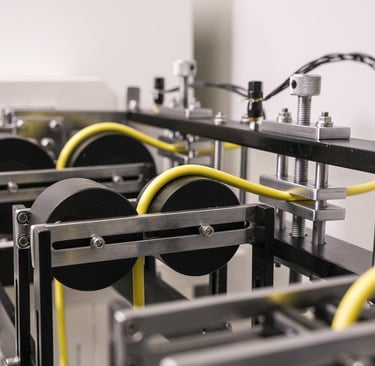
9. NSHTÖU vs. Standard Rubber Cable
The real comparison is not between “good cable” and “bad cable.” It is between a reelable motion cable and a general-purpose rubber cable. Standard rubber cables may be flexible enough for many applications, but they are not engineered for repeated reeling, winding, and torsional stress.
The Feichun NSHTÖU is designed specifically for dynamic motion. Its Class 5 conductors, EPR insulation, support braid, and rubber sheath work together as a system. A standard rubber cable may have one or two of these characteristics, but not the full mechanical package needed for crane and conveyor reel duty.
The practical difference shows up in service life. A general-purpose cable used in a reel system may look acceptable at installation but will often fail early due to twist, bending fatigue, or jacket damage. The NSHTÖU, by contrast, is built to support repeated movement as part of normal operation.
For consultants and EPC teams, this distinction matters because it affects not only product selection but also the credibility of the technical specification. If the cable’s function is reelable motion, the document should say so clearly.
10. Certification and Documentation
In port projects, the cable itself is only half the procurement story. The other half is documentation. EPC teams, inspectors, and consultants need proof that the product meets the stated engineering requirements.
For the Feichun NSHTÖU, the key documents should include VDE type certification, a technical test report, and a declaration of conformity. These documents help prove that the product design, material composition, and performance claims are not simply marketing statements but verified technical facts.
This is especially important in projects where approval must pass through multiple parties. The clearer the documentation, the smoother the submittal process. When the cable data sheet states Class 5 conductor construction, EPR insulation, support braid, voltage rating, temperature range, and minimum bending radius, consultants can quickly check alignment with project requirements.
11. Why This Matters in Procurement
From a procurement perspective, a cable is never just a cable. It is a risk-control component. If the wrong moving cable is installed on a crane or conveyor system, the resulting downtime can affect berth productivity, terminal scheduling, and equipment availability.
The Feichun NSHTÖU helps reduce that risk by matching a reelable cable design to the actual duty profile of crane and industrial motion systems. It is not a fixed-installation product being forced into a moving application. It is a motion-engineered cable with a structure that reflects its intended use.
For Middle Eastern ports, this matters even more because the operating environment is harsh. Heat, UV, oil, dust, and continuous equipment motion all increase the chance of premature failure. By specifying a product with clear reelable-cable intent and documented performance characteristics, engineering teams can improve reliability while reducing maintenance exposure.
12. Conclusion
In modern Middle Eastern port infrastructure, reliability depends on selecting components that match the actual duty cycle of the equipment. For cranes, hoists, and conveyor systems, that means using a reelable flexible cable rather than a generic industrial cable.
The Feichun NSHTÖU is best understood as a reelable low-voltage power and control cable for low and medium mechanical stress applications. Its fine-wire Class 5 conductors, EPR insulation, integrated support braid, and oil-, UV-, and weather-resistant sheath make it suitable for dynamic industrial motion where repeated bending and winding are part of normal operation.
For consultants, EPC teams, and port technical directors, the key takeaway is simple: accuracy in cable positioning matters. If the cable is expected to reel, bend, and twist as part of its service life, then the specification must reflect that reality from the beginning. The Feichun NSHTÖU provides a technically credible solution for that purpose.
Port crane cables | Mining cables | Reeling cables | Trailing cables | Festoon cables | Heavy-duty power cables | Medium voltage cables | Offshore crane cables | Underground mining cables | Dragline cables | Shearer cables | Container handling cables | STS crane cables | RTG cables | Mobile equipment cables | Armored cables | Flexible power cables | VFD cables | Submersible cables | Cold resistant cables | Abrasion resistant cables | Flame retardant cables | Marine environment cables | Opencast mining | Underground operations
© 2006 All rights reserved.
[INDUSTRIAL_CABLES]
INDUSTRIAL GRADE CABLE SYSTEMS | PORT & MINING SOLUTIONS
TEL: +86 153 7530 2641 |MAIL: hongjing.Wang@feichuncables.com