
What Is BS6346 Cable? A Practical Guide to PVC Insulated Armoured Cables for Building and Industrial Fixed Wiring
Learn what BS6346 cable is, its construction, technical parameters, applications in buildings and industrial projects, how to choose PVC or XLPE versions, and how it compares with BS5467, BS6724, and IEC 60502.
hongjing.Wang@Feichun
6/26/202610 min read
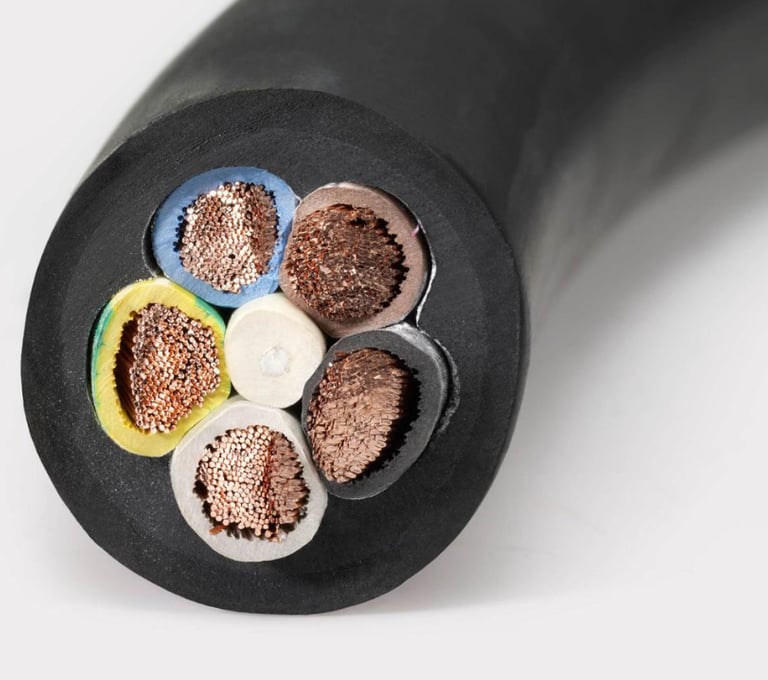
When you receive a project specification for a power distribution system, an industrial plant, or a large commercial building, you will often see one reference repeated across the cable schedule: BS6346. For procurement teams, electrical contractors, and project engineers across the Middle East, understanding exactly what this designation means is the difference between ordering the right cable and facing costly delays on site.
This guide explains what BS6346 cable is, how it is built, where it performs best, and how to choose the correct version for your installation. We will also compare it directly with the other standards you are most likely to encounter on a tender, so your team can make confident decisions quickly.
1. What Is BS6346 Cable?
BS6346 is a British Standard that specifies PVC insulated, armoured cables used for electricity supply in fixed installations. In plain terms, it covers a robust power cable designed to carry electricity reliably while resisting the mechanical knocks, pressure, and rough handling that come with industrial and construction environments.
The standard covers two main voltage ratings: 600/1000 V for the vast majority of low-voltage power and distribution work, and 1900/3300 V for higher-grade installations. The 600/1000 V version is by far the most commonly specified and stocked, while the 1900/3300 V grade serves heavier industrial duty where greater insulation thickness is needed.
It is worth being clear about one point from the start. BS6346 is a legacy British Standard. The published specification was formally withdrawn, and for new thermosetting (XLPE) armoured cable designs the industry has largely moved toward BS5467 and BS6724. Despite this, BS6346 has not disappeared. It continues to appear in project specifications, consultant drawings, manufacturer catalogues, and procurement references throughout the region. Many factories still produce cable "to BS6346" or "generally to BS6346" because clients, especially in established industrial and utility projects, continue to call for it by name.
So when you see BS6346 on a document, treat it as a practical, recognised reference for a PVC insulated armoured power cable intended for fixed wiring, power circuits, and industrial installations, rather than as flexible trailing cable or specialised fire-performance cable. Understanding its construction and limits is what allows you to either supply it correctly or recommend a suitable modern equivalent.
2. BS6346 Cable Construction
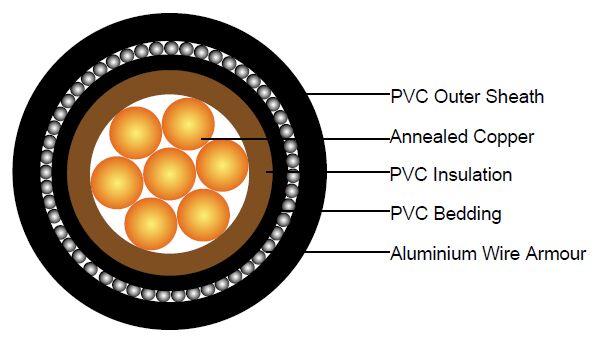
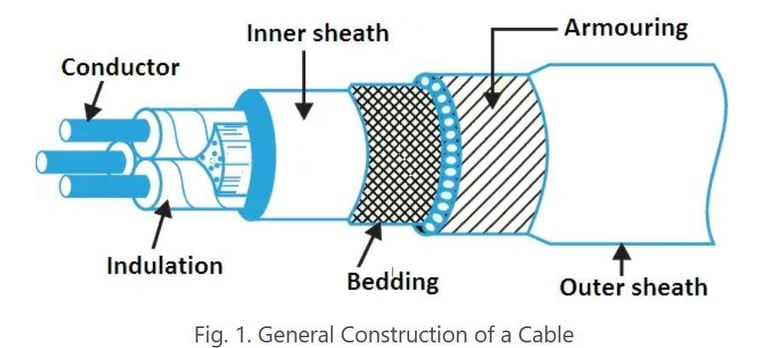
The strength of a BS6346 cable comes from its layered construction. Each layer has a specific job, and reading a cable from the centre outward tells you exactly what it is built to withstand. Here is how a typical BS6346 power cable is assembled.
Conductor
At the core sits the conductor, which carries the current. BS6346 cables use either copper or aluminium, supplied as solid or stranded conductors and shaped for larger cross-sections. These are typically Class 1 (solid) or Class 2 (stranded) conductors in line with IEC 60228. Copper is chosen for its superior conductivity and is the default for most projects, while aluminium offers a lighter, lower-cost option for larger feeder runs where weight and budget matter.
Insulation
Each conductor is wrapped in PVC (polyvinyl chloride) insulation, often referenced as Type TI1. This is the defining feature of BS6346. The PVC insulation electrically separates the conductors and is rated for a maximum conductor operating temperature of 70°C under normal continuous service. Cores are colour-coded for identification, following the familiar brown, black, grey, and blue scheme for line and neutral conductors, with green-yellow for earth.
Bedding (Inner Sheath)
In armoured multi-core cables, the laid-up cores are bound together and covered with a bedding layer, also called an inner sheath, usually extruded PVC. The bedding cushions the insulated cores, fills the gaps between them to create a round profile, and protects the insulation from being damaged by the armour wires pressing against it.
Armour
The armour is what gives the cable its mechanical toughness and is the layer that matters most for site protection. The configuration depends on the number of cores:
Multi-core cables use Steel Wire Armour (SWA) or steel tape armour, applied helically over the bedding. Steel gives excellent crush and impact resistance.
Single-core cables use Aluminium Wire Armour (AWA) instead. Single energised conductors create an alternating magnetic field that would induce circulating currents and heating in steel; non-magnetic aluminium avoids this problem.
Beyond protecting the cable from physical damage, the armour also serves as an earth-continuity path and a measure of additional electrical protection.
Outer Sheath
Finally, an extruded PVC outer sheath (commonly Type TM1) covers everything. This is the cable's first line of defence against moisture, abrasion, soil chemicals, and general wear. It is typically black and can be specified with enhanced properties such as flame-retardant, UV-resistant, oil-resistant, anti-termite, or anti-rodent compounds where the environment demands it.
Cross-section, centre outward: Conductor → PVC Insulation → Bedding (inner sheath) → Armour (SWA for multi-core / AWA for single-core) → PVC Outer Sheath. A simple cross-section diagram placed here is highly valuable for engineers and procurement teams scanning the page, so we recommend adding one in your final published version.
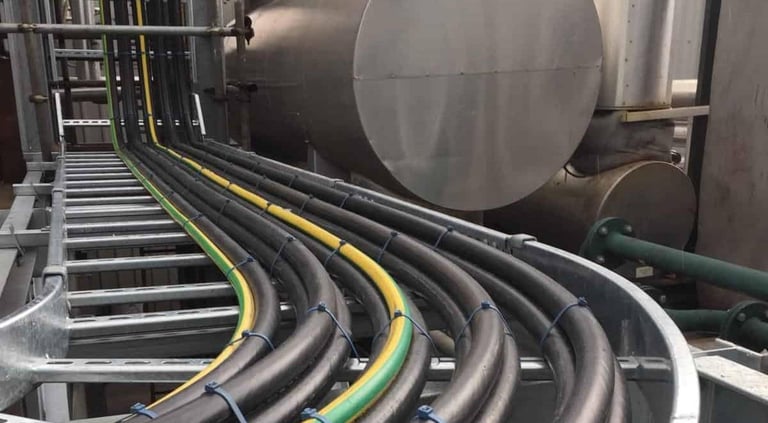
3. Technical Parameters
These are the core figures buyers and design engineers check before approving a BS6346 cable for a project. Confirm them against the specific manufacturer datasheet, since options vary by construction type, but the typical values are as follows.
ParameterTypical ValueRated voltage (U0/U)600/1000 V (also available as 1900/3300 V)Maximum conductor temperature70°C (continuous operation)Minimum ambient / installation temperatureTypically 0°C during installation; service range as per datasheetMinimum bending radius — single core10 × overall cable diameterMinimum bending radius — multi-core8 × overall cable diameterFlame retardant performanceTo IEC 60332-1 (BS 4066 Part 1) for standard flame-retardant gradesUV resistanceAvailable as a sunlight-resistant PVC sheath option for outdoor runsOil resistanceAvailable as an oil-resistant PVC sheath option for refinery and plant areas
A few points are worth highlighting for selection. The 70°C conductor rating is the most important technical distinction of BS6346 and the reason many specifiers now prefer XLPE-based cables, which run at 90°C and therefore carry more current for the same conductor size. The bending radius values are critical for cable tray design and pulling through ducts; getting them wrong on site risks damaging the insulation. And because standard PVC does not inherently resist sunlight, oil, or chemical attack, the special sheath options are not luxuries in the Middle East. They are frequently mandatory given the heat, UV exposure, and petrochemical environments common across the region.
If you supply several construction variants, it is best to separate the technical tables by type (for example, standard PVC, UV-resistant, and oil-resistant grades) so buyers can match the cable to the environment at a glance.
4. Applications of BS6346 Cable
BS6346 cable earns its place wherever electrical power must be delivered reliably and the cable itself needs to survive a demanding physical environment. Its armour and rugged PVC construction make it a workhorse across the sectors that drive construction and industrial demand in the Middle East.
Commercial buildings. Office towers, malls, hotels, and mixed-use developments rely on armoured power cables for main distribution, riser feeds, and supplies to mechanical and electrical plant rooms. The armour protects cables routed through busy service areas and shafts.
Industrial plants. This is the natural home of BS6346 cable. In factories and processing facilities, cables face mechanical stress, vibration, and the occasional impact. Steel wire armour and a tough sheath keep the supply intact in these conditions.
Power distribution. From substations and switchrooms out to distribution boards and large loads, BS6346 cable handles the feeder and sub-main circuits that form the backbone of a site's electrical network.
Infrastructure projects. Roads, utilities, water and wastewater facilities, and transport schemes use armoured PVC cable for power supplies that may be buried, run outdoors, or installed in ducts and trenches.
Manufacturing facilities. Production lines, machinery, and supporting services need dependable power feeds. The cable's mechanical protection suits the rough-and-ready conditions of a working shop floor.
Utility installations. Power authorities and contractors use armoured cable for distribution networks, pumping stations, and similar fixed assets where durability and long service life are essential.
In terms of installation environment, BS6346 cable is suitable for indoor and outdoor routing, underground burial (often in ducts or with mechanical protection), and moist or damp locations, thanks to its PVC sheath. For direct burial, outdoor, and chemically aggressive areas, the appropriate special sheath grade should be specified, as covered in the selection section below.
5. How to Choose the Right BS6346 Cable
Choosing the correct cable is less about the standard number and more about matching construction to the real conditions of your project. Walk through these questions with the project environment in mind, and the right specification falls into place.
PVC or XLPE? This is the first and most consequential decision. Standard BS6346 uses PVC insulation rated at 70°C. If your design needs higher current-carrying capacity, better thermal performance, or longer-term efficiency, an XLPE-insulated cable (rated at 90°C) to BS5467 may be the better choice for the same conductor size. Many modern projects default to XLPE; BS6346 PVC remains appropriate where the specification calls for it, where 70°C operation is acceptable, or where existing infrastructure must be matched.
Is armour required? If the cable will be exposed to mechanical risk — crushing, impact, rodents, or general site abuse — choose the armoured construction (SWA for multi-core, AWA for single-core). For protected routes inside conduit or trunking where no mechanical threat exists, an unarmoured cable may suffice, but for the industrial applications BS6346 typically serves, armour is the norm.
Indoor or outdoor use? Indoor runs can use standard sheathing. Outdoor installations exposed to direct sunlight should specify a UV-resistant (sunlight-resistant) PVC sheath, which is particularly important under the intense solar exposure found across the Gulf and wider Middle East.
Direct burial suitability. For underground installations, confirm the cable is rated for direct burial and consider soil conditions. Armoured cable is well suited to burial, but aggressive soils may call for additional sheath protection or installation in ducts.
Mechanical protection requirements. Match the armour type and sheath toughness to the worst-case physical conditions on the route, not the average. Plant areas, vehicle crossings, and exposed external runs all raise the requirement.
Special environments. For refineries, chemical plants, and fuel-handling areas, specify oil-resistant or chemical-resistant sheaths. Where fire safety and smoke emission are concerns — public buildings, tunnels, hospitals, airports — PVC may not be acceptable at all, and a low-smoke, halogen-free cable to BS6724 should be considered instead.
In short: confirm the insulation grade your design needs, decide on armour, then layer on the sheath options that match heat, sunlight, burial, and chemical exposure. That sequence lets a procurement team quickly judge whether a given BS6346 cable fits the project, or whether a related standard serves better.
6. BS6346 vs Other Standards
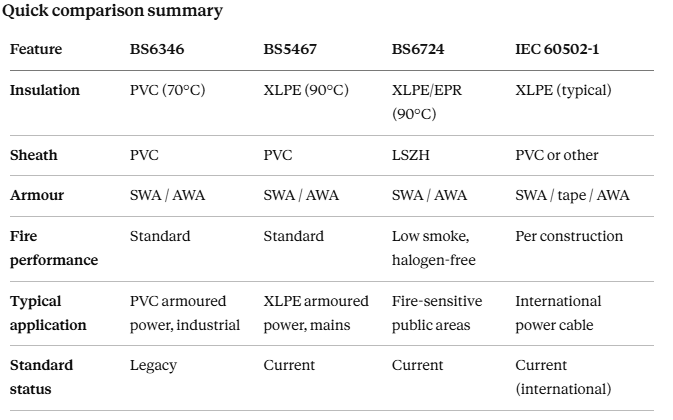
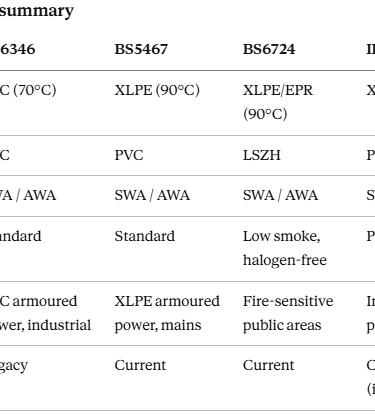
On most tenders, BS6346 appears alongside three closely related standards. Knowing how they differ helps you interpret a specification correctly and propose suitable alternatives when needed. The headline distinction comes down to insulation material, sheath material, and fire performance.
BS6346 vs BS5467
This is the most common comparison, because the two are direct alternatives for low-voltage armoured power cable.
Insulation: BS6346 uses PVC (70°C); BS5467 uses XLPE (90°C).
Sheath: Both use a PVC outer sheath.
Armour: Both use SWA for multi-core and AWA for single-core.
Performance: BS5467's XLPE insulation allows higher operating temperature and therefore greater current capacity for the same conductor size, plus better short-circuit performance.
Status: BS6346 is a legacy standard; BS5467 is the current, widely specified standard for XLPE armoured cable.
Bottom line: Where a project allows it, BS5467 is often the more efficient modern choice. BS6346 remains valid where PVC insulation is specifically required or where existing systems must be matched.
BS6346 vs BS6724
This comparison is really about fire safety.
Insulation: BS6346 uses PVC; BS6724 uses XLPE (or EPR/thermosetting) at 90°C.
Sheath: BS6346 uses PVC; BS6724 uses a Low Smoke Zero Halogen (LSZH/LSOH) sheath and bedding.
Fire performance: This is the key difference. BS6724 cables produce significantly less smoke and corrosive gas when exposed to fire, with hydrogen chloride emissions held to very low levels. Standard PVC cables like BS6346 release dense smoke and corrosive halogen gases when they burn.
Status: BS6724 is the current standard for armoured LSZH cable.
Bottom line: In public buildings, tunnels, transport hubs, hospitals, and any space where people congregate and smoke toxicity is a life-safety concern, BS6724 is specified in place of PVC cables. BS6346 is not suitable where low-smoke, halogen-free performance is required.
BS6346 vs IEC 60502
This is a national-versus-international comparison rather than a like-for-like product swap.
IEC 60502 is the international standard for extruded-insulation power cables in the 1 kV to 30 kV range. IEC 60502-1 covers the 0.6/1 kV class most relevant here.
BS6346 is a British Standard; it is related to but not equivalent to IEC 60502-1.
IEC 60502 cables are commonly XLPE-insulated and are the dominant reference in many international and Middle East projects, often sitting alongside or instead of British Standards on a specification.
Construction conventions (armour, bedding, sheath types such as ST2 versus BS Type 9) differ in detail between the two.
Bottom line: Many regional projects specify IEC 60502 as the primary standard, sometimes cross-referenced with British Standards. Always confirm which standard governs and whether equivalence is accepted before substituting.
Quick comparison summary
7. Frequently Asked Questions
What is BS6346 cable used for? BS6346 cable is used for fixed power wiring and electricity supply in industrial and building installations. Typical applications include commercial buildings, industrial plants, manufacturing facilities, power distribution, utility installations, and infrastructure projects, especially where mechanical protection from the armour is needed.
Can BS6346 cable be installed outdoors? Yes. BS6346 cable can be installed outdoors and underground thanks to its armour and PVC outer sheath. For outdoor routes exposed to strong sunlight — a real consideration across the Middle East — specify a UV-resistant (sunlight-resistant) sheath. For direct burial, confirm the cable is rated accordingly and account for soil conditions.
Is BS6346 cable suitable for industrial applications? Yes, industrial use is exactly what it is built for. The steel wire armour on multi-core cables provides strong mechanical protection against impact, crushing, and rodents, making it well suited to factories, plants, and refinery areas. For oil or chemical exposure, request an oil-resistant sheath grade.
How do I choose the correct BS6346 cable? Work through the environment step by step: decide whether PVC (70°C) is acceptable or whether XLPE (90°C, BS5467) suits better; confirm armour is required; check indoor, outdoor, or buried installation; add UV, oil, or chemical-resistant sheath options as the site demands; and verify the voltage rating. If low-smoke fire performance is required, choose BS6724 instead.
Final Thoughts
BS6346 remains a familiar and practical reference for PVC insulated armoured power cable across the Middle East, even as the wider industry shifts toward XLPE and LSZH alternatives. For procurement teams and engineers, the priority is not the history of the standard but the fit: confirm the insulation grade, the armour, and the sheath options against the real conditions of your project, and check whether a related standard such as BS5467, BS6724, or IEC 60502 is the better match for the specification in front of you.
Get those decisions right and you secure a cable that delivers reliable power and long service life, even in the heat, dust, and demanding industrial settings that define the region's projects.
This article is intended as a general technical guide. Always confirm specifications against the relevant manufacturer datasheets and project requirements, and consult a qualified electrical engineer for installation design.
Port crane cables | Mining cables | Reeling cables | Trailing cables | Festoon cables | Heavy-duty power cables | Medium voltage cables | Offshore crane cables | Underground mining cables | Dragline cables | Shearer cables | Container handling cables | STS crane cables | RTG cables | Mobile equipment cables | Armored cables | Flexible power cables | VFD cables | Submersible cables | Cold resistant cables | Abrasion resistant cables | Flame retardant cables | Marine environment cables | Opencast mining | Underground operations
© 2006 All rights reserved.
[INDUSTRIAL_CABLES]
INDUSTRIAL GRADE CABLE SYSTEMS | PORT & MINING SOLUTIONS
TEL: +86 153 7530 2641 |MAIL: hongjing.Wang@feichuncables.com