What Is (N)TSCGEWOEU-F Cable? A Complete Guide to Medium Voltage Flexible Mining Power Cables for Fixed Installations
Discover the features, specifications, and real-world applications of (N)TSCGEWOEU-F medium voltage flexible mining cables. Learn how this rugged, oil-resistant, UV-stable cable supports conveyor systems, transformers, and open-pit mining equipment under the harshest conditions — from Australian iron ore mines to automated port terminals.
hongjing.Wang@Feichun
3/27/202612 min read

What Is (N)TSCGEWOEU-F Cable?
(N)TSCGEWOEU-F is a medium voltage, flexible power supply cable engineered specifically for fixed and semi-fixed installations in open-pit mining and heavy industrial environments. Classified under the mining cable category, it is designed to deliver reliable electrical power to equipment that operates under continuous mechanical stress — including conveyor belts, bucket wheel excavators, spreaders, and transformer connection points.
The cable covers a broad voltage range, from 3.6/6 kV up to 18/30 kV, making it one of the most versatile medium voltage solutions available for mining power infrastructure. Its combination of fine-stranded copper conductors, EPR insulation, and a heavy-duty rubber outer sheath gives it the flexibility and durability required in some of the world's most demanding industrial sites.
Quick Answer (Featured Snippet): (N)TSCGEWOEU-F is a medium voltage flexible mining cable rated from 3.6/6 kV to 18/30 kV. It is used in fixed and semi-fixed open-pit mining installations — including conveyor systems, transformer connections, and bucket wheel excavators. Key features include a fine-stranded Class 5 copper conductor, EPR rubber insulation, oil and UV resistance, a maximum conductor temperature of 90°C, and the ability to withstand short-circuit temperatures up to 250°C. It operates reliably from -40°C to +80°C in fixed installations.
Key Technical Specifications of (N)TSCGEWOEU-F Cable
Voltage Ratings and Electrical Performance
The cable is available across six rated voltage levels:
3.6/6 kV — Maximum permissible AC operating voltage: 4.2/7.2 kV; DC: 5.4/10.8 kV
6/10 kV — Maximum permissible AC operating voltage: 6.9/12 kV; DC: 9/18 kV
8.7/15 kV — Maximum permissible AC operating voltage: 10.4/18 kV; DC: 13.5/27 kV
12/20 kV — Maximum permissible AC operating voltage: 13.9/25 kV; DC: 18/36 kV
14/25 kV — Maximum permissible AC operating voltage: 17.3/30 kV; DC: 22.5/45 kV
18/30 kV — Maximum permissible AC operating voltage: 20.8/36 kV; DC: 27/54 kV
This voltage range allows procurement teams to standardize on a single cable family across multiple medium voltage distribution levels within a single open-pit operation — from primary feeder runs down to equipment-level supply.
Thermal Operating Range
The cable's thermal envelope is one of its most important advantages in outdoor mining environments:
Fixed installation: -40°C to +80°C ambient temperature
Flexible operation: -25°C to +80°C ambient temperature
Maximum permissible conductor temperature: 90°C (continuous operation)
Maximum short-circuit temperature at conductor: 250°C
The -40°C lower limit makes this cable suitable for operation in cold-climate mining regions — including Canadian oil sands, Siberian coal fields, and high-altitude South American copper mines — without requiring supplementary cold-weather cable variants.
Mechanical Strength and Flexibility
Despite its classification as a fixed installation cable, (N)TSCGEWOEU-F is engineered to handle the mechanical demands of semi-dynamic applications:
Maximum tensile load per conductor: 15 N/mm²
Torsional resistance: ±100°/m
Bending radius: in accordance with DIN VDE 0298-3
These parameters enable the cable to survive continuous slight movement — such as the slow swing of a free-hanging cable run on a bucket wheel excavator arm — without fatigue cracking or insulation failure.
Cable Construction and Materials Explained
Conductor Design
The conductor consists of plain copper wires, finely stranded to Class 5 in accordance with DIN EN/IEC 60228. Class 5 stranding provides significantly greater flexibility compared to Class 1 or Class 2 solid or stranded conductors, enabling the cable to tolerate the bending and twisting common in semi-fixed mining layouts without conductor breakage over time.
Available cross-sections range from 3×25 mm² up to 3×185 mm² for main conductors, paired with protective conductor cross-sections from 3×25/3 to 3×95/3, allowing engineers to match the cable precisely to load requirements and system protection coordination.
Insulation System
The insulation architecture consists of three layers working together:
Inner semi-conductive stress control layer — equalizes electrical field distribution around the conductor, preventing localized stress concentrations at the conductor surface that could initiate insulation breakdown over time.
EPR compound — an ethylene propylene rubber-based insulation with improved electrical and mechanical characteristics, formulated in accordance with DIN VDE 0207-20. EPR is preferred over XLPE in mining applications for its superior flexibility at low temperatures and resistance to ozone degradation.
Outer semi-conductive insulation shield layer — provides a uniform outer field boundary and facilitates more reliable high-voltage testing.
Sheath and Protection Layers
Inner sheath: Synthetic rubber compound, type GM1b per DIN VDE 0207-21, filling the interstices between the laid-up cores. This layer maintains the circular cross-section of the cable and prevents moisture ingress between cores.
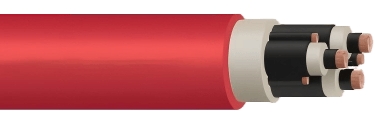
Outer sheath: Heavy-duty rubber compound, type 5GM5 per DIN VDE 0207-21, colour red with inkjet marking. The red outer sheath serves a dual function — it provides the primary mechanical protection layer and acts as a visual identifier in cable management systems, immediately distinguishing medium voltage mining cables from lower-voltage auxiliary cables on a crowded cable tray.
Why (N)TSCGEWOEU-F Is Ideal for Mining Applications
Designed for Open-Pit Mining Conditions
Open-pit mining environments subject power cables to stresses that do not exist in conventional industrial settings. Cables must survive:
Continuous outdoor UV exposure across decades of service life
Ozone-rich atmospheres generated by electrical equipment and blasting operations
Contact with hydraulic oils, diesel fuel, and mine-grade lubricants
Heavy equipment traffic in areas where cable management is imperfect
Thermal cycling from cold desert nights to hot summer days
The (N)TSCGEWOEU-F is rated for unrestricted use indoors and outdoors, with explicit resistance to ozone, UV, and moisture — making it suitable for direct surface laying without additional protective conduits in most open-pit installations.
High Mechanical Durability
The type 5GM5 outer sheath compound is classified as a heavy-duty rubber formulation, selected specifically for abrasion resistance under the mechanical demands of mining environments. Cable runs that cross vehicle access routes, pass through cable troughs filled with dusty aggregate, or are dragged during shovel repositioning all benefit from the extra sheath thickness and compound hardness.
Fire and Safety Performance
The cable complies with DIN EN/IEC 60332-1-2 for flame retardance under single vertical cable burning tests. This is a mandatory requirement for underground-adjacent and surface mine installations where cable fires can escalate rapidly in the presence of fine coal dust, methane seepage, or petroleum-soaked ground.
The combination of EPR insulation and rubber sheathing also produces a relatively high oxygen index compared to thermoplastic compounds, further reducing the risk of sustained combustion.
The cable also carries RoHS 2015/863/EU compliance and CPR 305/2011 certification, meeting European regulatory requirements for restricted substances and construction product performance declarations.


Typical Applications: Real-World Mining and Port Scenarios
Conveyor System Power Supply — Pilbara Iron Ore Region, Western Australia
Long-distance overland conveyors are the backbone of iron ore logistics in the Pilbara region of Western Australia, where individual conveyor runs can extend for more than 20 kilometres. These systems require a distributed medium voltage power supply with multiple drive stations spaced along the conveyor route.
Medium voltage mining cables of this class are deployed as the primary power feed running parallel to the conveyor structure. The cable must tolerate continuous UV exposure in one of the world's highest solar radiation environments, extreme daily temperature swings between cool nights and temperatures exceeding 45°C in summer, and occasional contact with ore dust and maintenance lubricants. The -40°C lower operating limit — while rarely tested in the Pilbara — ensures the same cable specification can be used across the company's cold-climate operations in Canada without restocking a different product family.
The slight flexibility requirement here arises from thermal expansion movement of the cable support structure, which causes the cable to shift position over the course of each day. The ±100°/m torsional tolerance accommodates this without fatigue accumulating at cable support clamp points.
Bucket Wheel Excavator Supply Cable — Lignite Open-Cast Mine, Central Europe
Lignite (brown coal) open-cast mining in Central Europe relies heavily on bucket wheel excavators — some of the largest land vehicles ever built — which require continuous medium voltage power supply as they traverse the mining face. The power cable to the excavator must be able to handle:
Free-hanging cable loops between the fixed cable drum on the ground and the moving excavator
Continuous slow torsional movement as the excavator slews its superstructure
Seasonal temperature extremes from -25°C winter operation to summer ambient temperatures above 35°C
The (N)TSCGEWOEU-F's combination of Class 5 stranded conductors and ±100°/m torsional resistance makes it the appropriate specification for this semi-dynamic application. EPR insulation maintains its flexibility at low temperatures, avoiding the stiffening that would cause bending stress concentrations in colder XLPE alternatives. The 15 N/mm² tensile load rating per conductor accommodates the self-weight of long free-hanging cable spans without conductor elongation.
Automated Container Terminal — Port of Hamburg, Germany
Modern automated container terminals represent one of the most demanding medium voltage cable environments outside of traditional mining — and one where the parallels between port and mine requirements are most visible.
Automated stacking cranes (ASCs) at terminals such as the Hamburg Container Terminal Altenwerder operate continuously, 24 hours a day, with rubber-tyred gantry cranes or rail-mounted variants traversing the terminal apron. Medium voltage cables of this type supply the shore power and drive systems of these cranes. Key requirements include:
Resistance to seawater spray and high atmospheric humidity
UV stability under continuous outdoor exposure
Tolerance for cable drum winding and unwinding cycles — addressed by the flexible stranding and torsional resistance specification
Oil resistance against hydraulic fluid from crane mechanisms
The red outer sheath provides high visibility for cable identification during maintenance, and the cable's weather resistance rating covers the North Sea coastal environment without requiring additional weatherproofing.
Transformer Connection in Open-Pit Copper Mine — Atacama Desert, Chile
At high-altitude open-pit copper mines in the Atacama Desert, mobile and semi-mobile transformer substations are repositioned as the mining face advances. The connection cables between the primary supply ring and the substation LV bushings must tolerate:
Extreme UV radiation at altitudes above 3,000 metres where atmospheric UV filtering is reduced
Temperature variation from sub-zero nights to intense afternoon heat
Dust ingress from ore blasting and truck traffic
Infrequent repositioning moves that place the cable in a semi-flexible role during transport and re-installation
The (N)TSCGEWOEU-F's suitability for both fixed and semi-fixed service — alongside its UV resistance and oil resistance ratings — makes it well suited to this mobile substation connection application, where a single cable must serve reliably in both static and occasional-movement service modes.
Installation Conditions and Environmental Resistance
Suitable Installation Types
The cable is rated for:
Fixed installations — permanent cable trays, conduit runs, and surface cable routes with no planned movement
Semi-fixed installations — cable routes subject to infrequent repositioning or the continuous slight movements associated with large mobile equipment
Free-hanging spans — where the cable bridges between a fixed support structure and a moving piece of equipment, subject to torsion and sway
Water-laying — the weather resistance and sheath construction support installation in wet ground conditions
Environmental Resistance Features
Oil resistance: Tested to DIN EN/IEC 60811-404. The outer sheath compound resists swelling and softening on contact with the mineral oils and hydraulic fluids common in mining environments.
UV resistance: Unrestricted outdoor use. The rubber sheath compound includes UV stabilizers that prevent surface degradation and cracking over extended outdoor service life.
Ozone resistance: The EPR insulation and rubber sheath both have inherent ozone resistance, a critical property near high-voltage switchgear and electrical equipment.
Moisture resistance: The inner sheath fills all interstices in the core arrangement, blocking longitudinal moisture migration.
Advantages Compared to Standard Mining Cables
Standard fixed-installation medium voltage cables designed for purely static service — such as XLPE-insulated armoured cables — are often adequate for underground mine fixed distribution but may underperform in open-pit environments for several reasons.
The (N)TSCGEWOEU-F addresses these gaps:
Greater flexibility at low temperatures: EPR insulation remains pliable well below 0°C, unlike standard XLPE formulations that stiffen in cold conditions and become vulnerable to cracking during installation or equipment movement.
Torsional resistance: Standard fixed cables are not designed for torsional loading. The (N)TSCGEWOEU-F's construction — including the Class 5 fine stranding and robust inner sheath filling — enables it to withstand ±100°/m torsion, an essential property for equipment that slews or rotates.
Wide voltage range in a single product family: A single cable family from 3.6/6 kV to 18/30 kV simplifies procurement, warehousing, and maintenance. Mine sites operating across multiple voltage levels can standardize on one cable product family rather than managing multiple specifications.
Long service life in harsh conditions: The combination of heavy-duty rubber sheath, EPR insulation, and explicit environmental resistance ratings translates into a longer maintenance-free service life compared to standard industrial cables used outside their intended service conditions.
How to Select the Right (N)TSCGEWOEU-F Cable
Key Selection Factors
Voltage level: Match the rated voltage to the system voltage. Allow for the maximum permissible operating voltage headroom — for example, a 3.6/6 kV cable in a 6 kV system has a maximum permissible AC operating voltage of 4.2/7.2 kV, which is below the 6 kV phase-to-phase voltage in a solidly earthed system. Confirm system earthing arrangements and select the appropriate U₀/U rating accordingly.
Conductor cross-section: Select based on current-carrying capacity per DIN VDE 0298-4, considering the installation method, grouping derating factors, and ambient temperature. Short-circuit withstand current (1 second) values are published for each conductor size and voltage class, and should be checked against the upstream protection device's fault current clearing time.
Installation type: Fixed installation cables can use the full -40°C to +80°C ambient range. If the cable will be subject to regular movement or repositioning, ensure temperatures remain within the -25°C to +80°C flexible operation range.
Environmental exposure: If the installation involves contact with non-mineral oils or specific chemical agents, confirm compatibility with the 5GM5 outer sheath compound beyond the published IEC 60811-404 oil resistance.
Tensile load: Calculate the maximum tensile force for the installation — particularly for free-hanging spans. The maximum permissible tensile force values are published per conductor cross-section for each voltage variant. Ensure the calculated span weight and dynamic loading factors remain within these limits.
Common Mistakes to Avoid
Underestimating the tensile load in free-hanging installations is one of the most common errors. Engineers who design the cable run for static weight often fail to account for wind loading and dynamic shock loads when a bucket wheel excavator changes direction or accelerates.
Selecting a cable rated for flexible operation at -25°C for a fixed installation that experiences -40°C winters is unnecessarily conservative but causes no operational harm. The reverse — selecting a fixed-only rated cable for a dynamic application — leads to premature fatigue failure.
Choosing the wrong voltage rating is particularly costly in medium voltage mining installations, where cable replacement in a working mine requires a production shutdown. Always verify the rated voltage against both the nominal system voltage and the maximum permissible operating voltage for the specific system earthing arrangement.
Frequently Asked Questions (FAQ)
What is (N)TSCGEWOEU-F cable used for? (N)TSCGEWOEU-F is a medium voltage flexible power cable used in open-pit mining and heavy industrial environments. Typical applications include power supply alongside conveyor systems, connection cables for mobile and fixed transformers, and supply cables for large mining machines such as bucket wheel excavators and spreaders that require a cable tolerant of continuous slight movement and torsion.
What voltage range does (N)TSCGEWOEU-F cover? The cable is available in six rated voltage variants: 3.6/6 kV, 6/10 kV, 8.7/15 kV, 12/20 kV, 14/25 kV, and 18/30 kV, covering the full range of medium voltage distribution levels used in modern open-pit mining operations.
What is the operating temperature range of (N)TSCGEWOEU-F? In fixed installation, the cable operates in ambient temperatures from -40°C to +80°C. In flexible operation — such as on a moving machine — the lower ambient limit is -25°C. The maximum continuous conductor temperature is 90°C, with a short-circuit conductor temperature limit of 250°C.
Can (N)TSCGEWOEU-F be used in dynamic applications? Yes, with qualification. The cable is classified for fixed and semi-fixed installations, meaning it can tolerate continuous slight movements such as free overhang, slow torsion, and minor repositioning. It is not classified for continuous dynamic flexing or drum winding in the same class as fully flexible trailing cables. Its ±100°/m torsional stress rating accommodates the slow slewing movements of bucket wheel excavators and similar large mining machines.
Is (N)TSCGEWOEU-F resistant to oil and UV exposure? Yes. The outer sheath is tested for oil resistance per DIN EN/IEC 60811-404, covering contact with mineral oils and hydraulic fluids common in mining environments. The cable is rated for unrestricted outdoor use with resistance to UV radiation, ozone, and moisture, making it suitable for permanent surface installation without additional protective conduit in most open-pit applications.
Can (N)TSCGEWOEU-F be installed in wet ground or near water? Yes. The cable construction — with inner sheath filling all interstices and a robust outer rubber sheath — supports installation in wet ground conditions. The weather resistance rating covers exposure to moisture in outdoor surface installations. For fully submerged applications, specific installation standards should be reviewed.
What conductor sizes are available? The cable is available from 3×25 mm² up to 3×185 mm² for main conductors, depending on the voltage class. Protective conductors are available in various cross-sections split symmetrically in the interstices. Custom cross-sections and core counts can be produced on request.
How long is the warranty on (N)TSCGEWOEU-F cable? The cable carries a 24-month warranty from the manufacturer.
Does (N)TSCGEWOEU-F comply with RoHS and CPR regulations? Yes. The cable is compliant with RoHS 2015/863/EU (restriction of hazardous substances) and carries CPR 305/2011 certification under the EU Construction Products Regulation.
Conclusion: Is (N)TSCGEWOEU-F the Right Choice for Your Project?
For engineers specifying medium voltage power cables in open-pit mining, automated port terminals, or other heavy industrial environments where equipment is large, service conditions are harsh, and reliability is non-negotiable, (N)TSCGEWOEU-F offers a well-engineered solution backed by clearly published performance parameters.
Its combination of EPR insulation, heavy-duty rubber sheathing, fine-stranded Class 5 copper conductors, and a voltage range spanning 3.6/6 kV to 18/30 kV addresses the core requirements of most open-pit and port medium voltage power distribution scenarios. The explicit oil resistance, UV resistance, and low-temperature performance ratings remove the guesswork from environmental suitability assessments.
Where (N)TSCGEWOEU-F may not be the right choice is in continuously dynamic applications — cable reeler systems, festoon cables, or trailing cable arrangements where the cable is wound, unwound, and flexed thousands of times per year. Those applications call for a cable classified to a higher flexibility class.
For the large and commercially important segment of mining cable applications that fall between purely static underground cable and continuous dynamic trailing cable — the conveyor runs, the excavator supply cables, the mobile substation connections — (N)TSCGEWOEU-F represents a technically appropriate and operationally proven choice.
Technical data sourced from the (N)TSCGEWOEU-F product datasheet. Specifications are subject to change; consult the manufacturer's current documentation for project-specific selection.
Port crane cables | Mining cables | Reeling cables | Trailing cables | Festoon cables | Heavy-duty power cables | Medium voltage cables | Offshore crane cables | Underground mining cables | Dragline cables | Shearer cables | Container handling cables | STS crane cables | RTG cables | Mobile equipment cables | Armored cables | Flexible power cables | VFD cables | Submersible cables | Cold resistant cables | Abrasion resistant cables | Flame retardant cables | Marine environment cables | Opencast mining | Underground operations
© 2006 All rights reserved.
[INDUSTRIAL_CABLES]
INDUSTRIAL GRADE CABLE SYSTEMS | PORT & MINING SOLUTIONS
TEL: +86 153 7530 2641 |MAIL: hongjing.Wang@feichuncables.com