What Is NTSCGEWOEU-W .../3 Medium Voltage Mining Cable and Why Is It Ideal for Submersible Mining Power Systems?
iscover how NTSCGEWOEU-W .../3 medium voltage mining cable supports dredgers, floating docks, and submersible pumps in open-pit and water-based mining. Learn its construction, water resistance ratings, and proven performance in real-world Middle Eastern mining operations.
hongjing.Wang@Feichun
3/23/202613 min read

What Is NTSCGEWOEU-W .../3 Medium Voltage Mining Cable? (Featured Snippet)
NTSCGEWOEU-W .../3 is a medium voltage, flexible power supply cable engineered for use in water-exposed mining environments, conforming to DIN VDE 0250-813. It is designed to power open-pit mining equipment — including dredgers, floating docks, and submersible pumps — while enduring continuous submersion in sewage, salt water, and brackish water. The cable features tinned copper class 5 conductors, EPR-based insulation with semi-conductive stress control layers, a synthetic rubber inner sheath optimized for water application, and a heavy-duty 5GM3 rubber outer sheath. Available in rated voltages from 3.6/6 kV up to 18/30 kV, it is certified to RoHS 2015/863/EU and CPR 305/2011 standards, and rated for ambient temperatures from -40 °C (fixed installation) to +80 °C.
The Growing Need for Water-Resistant Medium Voltage Cables in Mining
Mining operations worldwide — particularly in arid and semi-arid regions — increasingly rely on water-intensive extraction processes such as hydraulic dredging, slurry pumping, and submerged ore recovery. These processes demand reliable, uninterrupted electrical power delivered through cables that must survive in conditions no standard industrial cable was ever designed to handle.
Power Infrastructure Challenges in Open-Pit and Water-Based Mining
Open-pit and water-based mining sites present a unique combination of electrical and physical challenges. Cable runs often stretch across hundreds of meters, connecting high-voltage substations to mobile dredgers and floating pump platforms operating in the middle of flooded excavation zones. Cables are exposed to constant water immersion, abrasive slurry, corrosive mineral-laden water, and the mechanical strain of equipment in continuous motion.
In the Middle East, where large-scale phosphate, potash, and mineral sand extraction projects are expanding rapidly, the challenge is compounded by extreme ambient temperatures. Cables must remain stable at ground-level temperatures that can reach well above 50 °C in summer, while the submerged portions of the installation encounter corrosive brackish groundwater.
Why Conventional Power Cables Often Fail in Mining Water Environments
Standard medium voltage cables — even those rated for outdoor or industrial use — are not designed for prolonged submersion under mechanical stress. Their insulation systems lack the semi-conductive stress control layers required to manage voltage gradients at medium voltage levels when water ingress occurs. Their outer sheaths lack the abrasion and chemical resistance needed to survive in slurry-laden mining environments. And their conductors, if not properly tinned, degrade rapidly under repeated wet-dry cycling.
The result is premature insulation breakdown, ground faults, and unplanned shutdowns — all of which carry serious safety and productivity consequences in high-output mining operations.
Overview of NTSCGEWOEU-W .../3 Medium Voltage Flexible Mining Cable
Key Electrical Characteristics
The NTSCGEWOEU-W .../3 cable covers a broad range of rated voltages — from 3.6/6 kV through 6/10 kV, 8.7/15 kV, 12/20 kV, 14/25 kV, and up to 18/30 kV — making it applicable across the full spectrum of medium voltage mining power distribution. The maximum permissible conductor temperature under continuous load is 90 °C, with a short-circuit tolerance of up to 250 °C at the conductor. This thermal headroom is essential for mining environments where load management is difficult and transient overloads are common.
Current-carrying capacity for each voltage and cross-section combination is determined in accordance with DIN VDE 0298-4, ensuring that thermal derating under real installation conditions is properly accounted for.
Operational Temperature Range
For fixed installations — where the cable is routed along a trestle, buried in a trench, or suspended from a floating platform — the rated ambient temperature range is -40 °C to +80 °C. For flexible operation, where the cable must bend and move with mobile mining equipment, the range is -25 °C to +80 °C. This dual rating recognizes the distinct mechanical demands placed on a cable that flexes repeatedly compared to one that remains stationary.
Designed for Flexible Power Supply Systems
Unlike rigid armored cables intended only for fixed infrastructure, the NTSCGEWOEU-W .../3 is explicitly engineered for flexible power connections. Its class 5 finely stranded conductor construction and rubber-based insulation and sheathing system give it the suppleness required for dynamic applications — moving dredger arms, floating pump barges that rise and fall with water levels, and retractable cable reels on mobile mining equipment.


Advanced Cable Construction for Harsh Mining Conditions
Tinned Copper Class 5 Conductors for High Flexibility
The main power conductors and protective conductor are both constructed from tinned copper wires, finely stranded to IEC class 5 in accordance with DIN EN/IEC 60228. Tinning serves a dual purpose: it protects the copper strands from corrosion in wet and chemically aggressive environments, and it improves the solderability and termination reliability of the conductor ends. Class 5 stranding — the finest flexible stranding class in the IEC standard — maximizes the cable's ability to bend repeatedly without conductor fatigue or strand breakage.
Rubber Insulation System for Electrical and Mechanical Protection
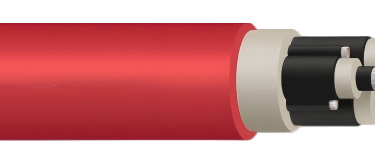
Each main core carries a three-layer insulation system specifically engineered for medium voltage service in water-exposed conditions. An inner semi-conductive stress control layer smooths the electrical field at the conductor surface, preventing localized stress concentrations that could initiate insulation degradation over time. The main insulation layer is an EPR (ethylene-propylene rubber) compound conforming to DIN VDE 0207-20, chosen for its excellent dielectric properties, flexibility across a wide temperature range, and resistance to moisture and chemical attack. An outer semi-conductive insulation shield completes the insulation system, providing field uniformity at the insulation-to-screen interface.
This three-layer structure is standard practice in medium voltage cable engineering and is a prerequisite for reliable long-term performance in high-voltage water-exposed applications.
Heavy-Duty Rubber Outer Sheath
The outer sheath is a heavy-duty rubber compound of type 5GM3, also conforming to DIN VDE 0207-21. This compound is selected for its superior resistance to mechanical abrasion, impact, and the physical punishment of mining site deployment — cable dragging across rocky terrain, contact with mining equipment, and the cyclical tension and compression of flexible operation. The outer sheath is finished in red with inkjet marking for identification. Between the inner and outer sheath, a synthetic rubber inner sheath based on GM1b provides an additional protective layer specifically optimized for water application, forming part of the cable's water management system.
Core Arrangement and Water Blocking
The power cores are laid up around a semi-conductive centre element, with the protective conductor split into three portions distributed in the outer interstices between cores. This arrangement maintains a circular cable cross-section that performs predictably under bending and torsion. Critically, the assembly incorporates a high-performance water blocking element. This longitudinal water blocking system prevents water from traveling along the cable interior even if the outer sheath is breached — a vital feature for cables that may be damaged at one point in a long underwater run, where capillary migration of water along the cable length would otherwise cause progressive degradation of the entire installation.
Environmental Resistance That Supports Mining Operations
Water Resistance for Continuous Submerged Operation
The NTSCGEWOEU-W .../3 is tested and rated for water resistance in accordance with EN-50525-2-21. The cable is explicitly designed and approved for operation in sewage water, salt water, and brackish water environments — the three most demanding water exposure conditions encountered in mining operations. This makes it suitable for use in flooded open-pit mines, coastal mining operations where seawater intrusion occurs, and drainage management systems where cables are permanently submerged.
Oil and Chemical Resistance in Industrial Mining Sites
Oil resistance is certified in accordance with DIN EN/IEC 60811-404. Mining sites are invariably contaminated with hydraulic oils, lubricants, and fuel from the heavy machinery operating on site. Cables that lack oil resistance degrade rapidly when wetted with these fluids, suffering sheath swelling, cracking, and eventual mechanical failure. The 5GM3 outer sheath compound of the NTSCGEWOEU-W .../3 is specifically formulated to resist these contaminants.
UV and Weather Resistance for Outdoor Mining Installations
The cable is rated for unrestricted outdoor use, with resistance to ozone, UV radiation, and moisture. Open-pit mining operations expose surface-routed cables to years of direct sunlight and weather cycling. UV degradation is a common cause of premature rubber sheath failure in outdoor cable installations. The NTSCGEWOEU-W .../3's sheath compound resists this degradation, maintaining its mechanical integrity over the cable's intended service life.
Fire behavior in the event of a fault is characterized in accordance with DIN EN/IEC 60332-1-2, confirming that the cable does not propagate flame — an important safety characteristic for cables routed through or near occupied mining infrastructure.
Mechanical Strength for Heavy Mining Equipment
High Tensile Strength for Mobile Mining Equipment
The maximum permissible tensile load is 15 N/mm² per conductor — a specification that, when applied across the full conductor cross-sections available (from 25 mm² to 150 mm²), translates into tensile forces ranging from approximately 1,125 N for smaller cross-sections to over 6,750 N for the largest available configurations. This tensile rating allows the cable to be deployed on cable reels and through cable drag chains on mobile mining equipment without risk of conductor stretch or sheath damage.
Torsional Resistance for Dynamic Mining Applications
The cable is rated for torsional stresses of ±25°/m — meaning for every meter of cable length, it can tolerate a twist of 25 degrees in either direction. This torsional rating is essential for dredger arm connections and cable reel deployments where the cable rotates as equipment moves. Without adequate torsional resistance, repeated twisting causes conductor fatigue, insulation cracking, and ultimately electrical failure.
Bending Radius for Continuous Flexing
Minimum bending radii are specified in accordance with DIN VDE 0298-3, the German standard governing cable installation practices. Adherence to these radii ensures that repeated bending cycles do not exceed the fatigue limits of the stranded conductors or cause insulation micro-cracking.
Real-World Applications: Middle Eastern Mining Operations
Mining operations across the Middle East — particularly in Jordan, Saudi Arabia, and the UAE — provide compelling real-world examples of exactly the conditions the NTSCGEWOEU-W .../3 was designed to address.
Phosphate Dredging Operations in Jordan
Jordan holds some of the world's largest phosphate reserves, concentrated in the Eshidiya and Al-Abiad mining districts in the southern part of the country. Phosphate extraction in these areas involves hydraulic mining techniques in which water is used to disaggregate ore and transport slurry through pipelines to processing facilities. The submersible pumps that drive these slurry systems operate in aggressive phosphate-laden water with elevated mineral content. Cables powering these pumps must tolerate continuous immersion in chemically active water, high ambient surface temperatures exceeding 45 °C in summer, and the mechanical stress of pump operation in confined underground sumps. Medium voltage flexible cables meeting the NTSCGEWOEU-W .../3 specification are well-suited to these demanding power supply requirements, offering the water resistance, chemical tolerance, and mechanical flexibility that standard cables cannot provide.
Potash Mine Dewatering in the Dead Sea Region
The Dead Sea potash industry — operated across large evaporation pond complexes in both Jordan and Israel — depends on vast networks of submersible pumps to manage brine levels and transfer saturated solutions between processing stages. Brine is significantly more corrosive than fresh water, with chloride concentrations that accelerate corrosion of unprotected copper conductors and degrade standard cable insulation systems. The NTSCGEWOEU-W .../3's tinned copper conductors, water-blocking construction, and chemically resistant outer sheath make it a technically appropriate choice for medium voltage power distribution in these brine-flooded environments. Dewatering pumps in potash operations typically operate at medium voltage levels — 6/10 kV or 8.7/15 kV — precisely within the cable's rated voltage range.
Mineral Sand Mining and Dredging on the Arabian Peninsula
The Arabian Peninsula hosts significant mineral sand deposits — including ilmenite, rutile, and zircon — that are extracted using floating dredgers operating in purpose-flooded mining pits. These dredgers are self-contained mining platforms that require reliable medium voltage power supply through flexible trailing cables connecting them to shore-based substations. As the dredger advances into the pit, the cable must accommodate the constant movement of the floating platform — requiring the combination of high flexibility, torsional resistance, and water resistance that the NTSCGEWOEU-W .../3 provides. In coastal or near-coastal locations, the water in the mining pit may be saline or brackish, further emphasizing the need for a cable rated for salt and brackish water service.
Saudi Arabia Desalination Plant Construction Support
Large-scale water infrastructure projects in Saudi Arabia — including desalination plant construction sites along the Red Sea and Arabian Gulf coasts — present power supply challenges that closely parallel those of mining operations. Submersible dewatering pumps managing groundwater during foundation excavation, and floating plant for offshore pipeline laying, both require medium voltage flexible cables with the water resistance and mechanical robustness of the NTSCGEWOEU-W .../3 specification. The cable's suitability for salt water environments makes it directly applicable to these coastal construction and infrastructure contexts.
Installation Considerations for Water-Based Mining Cable Systems
Flexible Cable Routing in Submerged Environments
When routing NTSCGEWOEU-W .../3 in submerged applications, cable management must ensure that the minimum bending radius per DIN VDE 0298-3 is never exceeded at any fixed bend point — including entry and exit points from cable trays, conduit entries, and termination enclosures. Underwater cable routes should be surveyed for sharp edges, rocky outcrops, or other surface features that could impose localized mechanical stress on the outer sheath.
Managing Mechanical Loads in Mining Cable Installations
Tensile load management is critical in any mining cable installation where the cable hangs vertically, is suspended horizontally across a span, or is subject to pull forces from moving equipment. The 15 N/mm² tensile load rating per conductor must be respected at all points in the installation. For cable reel applications, the maximum load condition occurs when the cable is fully paid out and the reel exerts a back-tension on the cable as equipment moves away from the reel.
Ensuring Long-Term Reliability in Wet Mining Conditions
Long-term reliability in wet environments begins at installation and requires ongoing maintenance attention. Cable terminations must be correctly sealed to prevent water ingress into the termination itself — even though the cable's longitudinal water blocking prevents ingress from traveling along the cable core, a poorly sealed termination exposes the conductor ends and the insulation cut-back zone to moisture. Regular inspection of the outer sheath for abrasion damage, cuts, or chemical attack is recommended, particularly in areas where the cable is subject to contact with moving mining equipment or abrasive materials.
Why Selecting the Right Medium Voltage Mining Cable Matters
Improving Safety and Power Reliability
In mining operations, electrical faults in power supply cables are not merely equipment problems — they are safety events. A ground fault in a medium voltage cable powering a submersible pump or dredger can create hazardous touch voltages on the water surface or on the metallic structure of floating equipment. Selecting a cable with the correct water resistance, insulation integrity, and mechanical robustness for the application is a fundamental element of electrical safety management on mining sites.
Reducing Equipment Downtime in Mining Operations
Unplanned cable failures in mining power systems trigger a cascade of operational consequences: pump shutdown, flooding of working areas, halt of ore production, and the logistical challenge of replacing a damaged cable in a flooded or submerged installation. The cost of a single unplanned shutdown in a large open-pit mining operation can easily exceed the cost of the entire cable installation. Using a cable specified correctly for the application — as the NTSCGEWOEU-W .../3 is for water-exposed medium voltage mining service — is the most effective way to reduce unplanned downtime risk.
Extending Cable Service Life in Extreme Environments
The service life of a medium voltage cable is a direct function of how closely its design parameters match the actual installation environment. A cable operated consistently within its rated temperature range, mechanical stress limits, and chemical resistance envelope will deliver its designed service life. A cable operated outside those limits — even intermittently — undergoes accelerated aging and fails prematurely. In Middle Eastern mining environments, where ambient temperature extremes, corrosive water, and demanding mechanical service combine, the NTSCGEWOEU-W .../3's comprehensive environmental and mechanical ratings translate directly into extended, predictable service life.
Frequently Asked Questions (FAQ)
Q: What voltage ratings are available for the NTSCGEWOEU-W .../3 mining cable? A: The cable is available in six standard rated voltage levels: 3.6/6 kV, 6/10 kV, 8.7/15 kV, 12/20 kV, 14/25 kV, and 18/30 kV. Each voltage class has a corresponding AC test voltage and maximum permissible operating voltage for both AC and DC systems, per DIN VDE 0250-813.
Q: Can the NTSCGEWOEU-W .../3 cable be permanently submerged in salt water? A: Yes. The cable is designed and rated for operation in sewage water, salt water, and brackish water. Its water resistance is certified to EN-50525-2-21, its construction incorporates longitudinal water blocking, and both its inner and outer sheath compounds are selected for water-exposed service.
Q: What conductor sizes are available? A: Available conductor cross-sections range from 3×25 mm² to 3×150 mm² for the main power cores, with protective conductor sizes varying by configuration. Custom cross-sections and core configurations can be produced on request.
Q: Is the cable suitable for use in explosive atmospheres? A: The cable carries a designation for use in explosion hazardous areas. Applications in classified hazardous zones should be verified against the specific zone classification and applicable regulatory requirements for the installation country.
Q: What is the maximum tensile load the cable can withstand? A: The maximum permissible tensile load is 15 N/mm² per conductor cross-section area. For a 3×95 mm² configuration, this corresponds to a maximum tensile force per conductor of 1,425 N.
Q: What standards and certifications does the NTSCGEWOEU-W .../3 comply with? A: The cable is designed in accordance with DIN VDE 0250-813. It is certified to RoHS 2015/863/EU (restriction of hazardous substances) and CPR 305/2011 (Construction Products Regulation). Fire behavior is tested to DIN EN/IEC 60332-1-2, oil resistance to DIN EN/IEC 60811-404, and water resistance to EN-50525-2-21.
Q: How does the cable's torsional rating benefit dredger applications? A: The ±25°/m torsional rating allows the cable to absorb the rotational movement generated as a dredger arm sweeps through its working arc without accumulating damaging twist stress in the cable. This is essential for maintaining cable integrity over years of continuous dredger operation.
Q: What is the difference between the fixed installation and flexible operation temperature ratings? A: For fixed installation (cable does not flex during operation), the ambient temperature range is -40 °C to +80 °C. For flexible operation (cable bends repeatedly during use), the range is -25 °C to +80 °C. The narrower cold-end range for flexible operation reflects the reduced flexibility of rubber compounds at very low temperatures.
Q: Can the cable be used on cable reels? A: Yes. The class 5 stranded conductors, rubber-based insulation and sheathing, and torsional resistance rating all support cable reel deployment. Minimum bending radius requirements per DIN VDE 0298-3 must be observed in reel drum design.
Q: What is the warranty period for this cable? A: The cable carries a 24-month warranty.
Conclusion
The NTSCGEWOEU-W .../3 medium voltage flexible mining cable represents a purpose-engineered solution for one of the most demanding categories of electrical infrastructure: power supply in water-exposed open-pit mining environments. Its combination of medium voltage capability up to 18/30 kV, full water resistance certification including salt and brackish water service, high-flexibility class 5 tinned copper conductors, comprehensive rubber insulation and sheathing system, and mechanical ratings for tensile load, torsion, and bending makes it directly suited to the power supply challenges of dredgers, floating dock installations, and submersible pump systems.
For mining operations across the Middle East — where phosphate dredging in Jordan, potash brine management in the Dead Sea basin, mineral sand dredging on the Arabian Peninsula, and coastal infrastructure projects in Saudi Arabia all demand cables that can deliver reliable medium voltage power in corrosive, water-flooded, mechanically demanding conditions — the NTSCGEWOEU-W .../3 specification addresses the full range of environmental and operational requirements.
Selecting the correct cable for water-exposed medium voltage mining service is not a procurement decision that should be made on price alone. The safety implications of cable failure in wet mining environments, the operational cost of unplanned shutdowns, and the long-term economics of extended service life versus premature replacement all favor the investment in a cable that is genuinely engineered for the application. The NTSCGEWOEU-W .../3, designed and manufactured to DIN VDE 0250-813, is that cable for water-based mining power systems.
Primary Keywords: NTSCGEWOEU-W mining cable, medium voltage mining cable, underwater mining power cable Secondary Keywords: dredger power cable, submersible pump power cable, flexible mining cable for water environments, medium voltage rubber mining cable Long-Tail Keywords: medium voltage cable for dredgers and floating docks, flexible mining cable for submerged equipment, water-resistant cable for open-pit mining operations
Port crane cables | Mining cables | Reeling cables | Trailing cables | Festoon cables | Heavy-duty power cables | Medium voltage cables | Offshore crane cables | Underground mining cables | Dragline cables | Shearer cables | Container handling cables | STS crane cables | RTG cables | Mobile equipment cables | Armored cables | Flexible power cables | VFD cables | Submersible cables | Cold resistant cables | Abrasion resistant cables | Flame retardant cables | Marine environment cables | Opencast mining | Underground operations
© 2006 All rights reserved.
[INDUSTRIAL_CABLES]
INDUSTRIAL GRADE CABLE SYSTEMS | PORT & MINING SOLUTIONS
TEL: +86 153 7530 2641 |MAIL: hongjing.Wang@feichuncables.com