What Is TYPE G-GC ROUND 3/C 2000V Cable? Applications, Construction & Selection Guide for Mining Equipment
Discover TYPE G-GC ROUND 3/C 2000V mining cable — its construction, real-world applications, and key selection factors. A comprehensive guide for engineers and procurement teams in mobile mining operations requiring grounding and ground check protection.
hongjing.Wang@Feichun
4/9/202617 min read
What Is TYPE G-GC ROUND 3/C 2000V Cable?
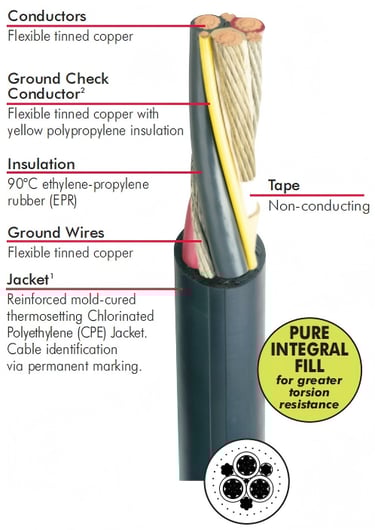
TYPE G-GC ROUND 3/C 2000V cable is a heavy-duty, flexible power cable designed for mobile underground mining equipment operating in circuits up to 2,000 volts. It features three power conductors, multiple bare grounding conductors, and a dedicated ground check conductor — a combination that enables real-time monitoring of circuit integrity. Built with 90°C ethylene-propylene rubber (EPR) insulation, a reinforced chlorinated polyethylene (CPE) jacket, and tinned copper conductors, it is rated for use in harsh, wet, and mechanically demanding mining environments, including continuous miners, drills, AC shuttle cars, and mobile pumps.
What Is TYPE G-GC ROUND 3/C 2000V Cable?
In underground mining, power cables are not simply conduits for electricity — they are critical safety infrastructure. Every cable that trails behind a continuous miner or wraps around a mobile pump must endure relentless mechanical stress, moisture, abrasion, and chemical exposure, often simultaneously. Choosing the wrong cable type in these environments doesn't just cause equipment downtime — it can create lethal electrical hazards.
TYPE G-GC ROUND 3/C 2000V cable was engineered specifically to meet these demands. The "3/C" denotes three power conductors, "G" signifies that bare grounding conductors are included, and "GC" indicates the presence of a dedicated ground check conductor — a wire that allows monitoring systems to verify grounding continuity in real time, even while equipment is operating.
At a rated voltage of 2,000 volts, this cable covers the majority of mobile underground mining equipment operating on AC circuits. Its round form factor, as opposed to flat cable designs, gives it superior torsional resistance, making it the preferred choice wherever cables must coil, bend, and trail through irregular terrain repeatedly during each shift.
The ground check function is what truly distinguishes this cable type from simpler designs. If the grounding system is compromised — whether from a cut, a failed connection, or a damaged conductor — the ground check system detects the fault before it escalates into a dangerous ground fault current incident. This makes TYPE G-GC cable not merely a power delivery solution but a fundamental component of a mine's electrical safety architecture.
Key Applications of TYPE G-GC Cable in Mining
TYPE G-GC ROUND 3/C 2000V cable is purpose-built for mobile mining equipment — machinery that moves, drags cable, and operates continuously in confined, high-risk environments. Understanding its specific applications helps procurement engineers and mine electricians make precise selections.
Continuous Miners and Cutting Machines
Continuous miners are among the most demanding cable applications in underground coal and hard rock mining. These machines advance constantly into the face, dragging their trailing cables across the mine floor. The cable experiences repeated bending cycles, compressive loads from equipment treads, chemical exposure from cutting dust and water sprays, and torsional stress from the machine's movement pattern.
A real-world example from longwall coal operations in eastern Kentucky illustrates the stakes: a coal producer operating a fleet of continuous miners experienced repeated cable failures at the strain relief points — the locations where cables enter the machine's cable entry box. Investigation revealed that the standard Type W cables in use lacked adequate grounding conductors for the circuit configuration, and there was no ground check monitoring. After transitioning to TYPE G-GC ROUND 3/C construction, they were able to integrate the mine's ground fault protection system directly with the cable's ground check conductor, enabling automatic machine shutdown within milliseconds of detecting any grounding anomaly.
Drills and Loading Machinery
Rotary drills and roof bolters in underground mines operate in environments where rock dust, drilling water, and explosive concussions are routine. These machines require cables capable of maintaining insulation integrity even when partially submerged in drill water runoff — a condition TYPE G-GC cables are rated to handle due to their moisture-resistant construction and EPR insulation system.
AC Shuttle Cars
Shuttle cars transport cut material from the continuous miner to the conveyor loading point, moving repeatedly back and forth across the mine entry. Unlike stationary equipment, shuttle cars accumulate cable wear at an exceptional rate — studies from Australian underground coal operations have estimated that a single shuttle car can traverse tens of thousands of meters of travel per shift, dragging its trailing cable the entire time. The round cross-section of TYPE G-GC cable is particularly valuable here, as it resists the "cabling" and kinking behavior that flat cable designs are prone to under repeated coiling and uncoiling.
Mobile Pumping Systems
Underground water management relies on mobile pumps that may be repositioned regularly as mining advances. These pumps often operate in sumps or low-lying areas where cable submersion is not just possible but routine. TYPE G-GC cable's suitability for shallow water submersion, combined with its ground check capabilities, makes it the standard choice for pump feeder circuits in many North American underground coal mines.
Construction of TYPE G-GC ROUND 3/C Cable
The performance characteristics of TYPE G-GC cable are a direct result of deliberate construction choices across every layer of the cable assembly.
Conductors
The power conductors are manufactured from flexible tinned copper — a construction that differs meaningfully from the solid or semi-rigid copper used in fixed power distribution cables. Tinning the copper strands with a thin layer of tin serves two purposes: it provides a degree of corrosion resistance against the moist, chemically active atmosphere of an underground mine, and it helps maintain strand-to-strand electrical contact in high-strand-count conductors over time.
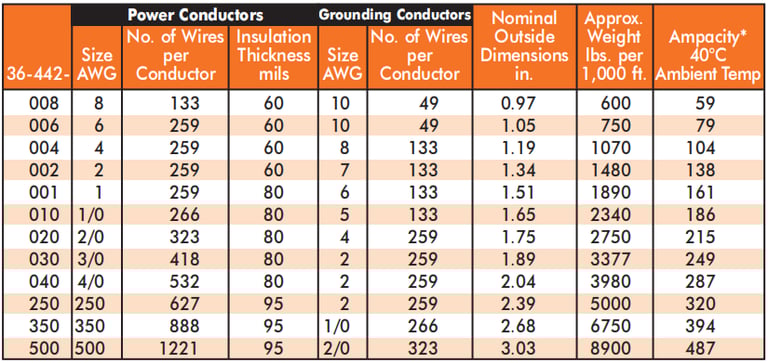
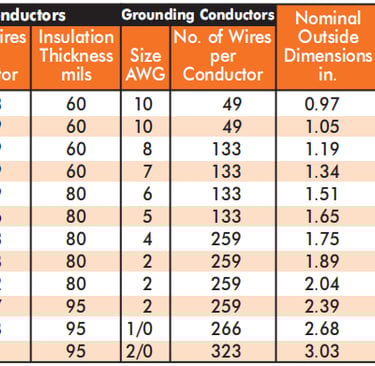
The flexible construction typically involves hundreds of individual fine strands arranged in a specific geometric pattern — for example, a 4/0 AWG conductor in this cable series uses 532 individual strands arranged in a 19×28 configuration. This extreme stranding is what enables the cable to flex repeatedly without work-hardening and fracturing the conductor, a failure mode that rigid conductors experience under the bending cycles of mobile equipment.
Grounding System
The grounding conductors in TYPE G-GC cable are bare (uninsulated) flexible tinned copper conductors positioned within the cable assembly around the insulated power conductors. These conductors provide the return path for fault current — if an insulation failure occurs and a power conductor contacts the mine equipment's metallic frame, the grounding conductors carry that fault current back to the power source, allowing protective relays to trip and isolate the circuit before the fault current can reach hazardous levels.
In underground mining, a functioning grounding system is the last line of defense against electrical fatalities. Ground fault currents in a 2,000-volt mining circuit can reach lethal magnitudes in milliseconds; the grounding conductor must have sufficient cross-sectional area to carry this fault current long enough for protective devices to operate without failing itself.
Ground Check Conductor
The ground check conductor is a smaller, insulated conductor — typically covered in yellow polypropylene insulation for immediate visual identification — located at the center or within the assembly of the cable. It does not carry power; instead, it is integrated into a monitoring circuit that continuously checks whether the grounding conductors maintain electrical continuity.
In practice, the ground check circuit works by passing a small pilot current through the ground check conductor. If this circuit is broken — indicating a potential grounding failure — the monitoring relay opens, shutting down the connected equipment before any personnel can contact an ungrounded electrical system. This system has prevented numerous fatalities in underground coal mining over the decades since its widespread adoption.
Insulation Material
Each power conductor in a TYPE G-GC cable is individually insulated with ethylene-propylene rubber (EPR). This material is selected for mining applications because of its combination of electrical performance and physical resilience. EPR maintains its dielectric properties across a wide temperature range, remains flexible even at low temperatures, and resists degradation from moisture, ozone, and the chemical compounds present in mine atmospheres.
The thermal rating of 90°C refers to the maximum continuous temperature the insulation can sustain at the conductor surface without accelerated degradation. Operating cables within this thermal rating is essential to achieving their full service life — cables that are routinely loaded beyond their ampacity rating run hotter, which accelerates insulation aging even when no immediate failure occurs.
Outer Jacket
The outer jacket of TYPE G-GC ROUND 3/C cable is a mold-cured chlorinated polyethylene (CPE) thermoset compound. CPE jacketing is the dominant choice in underground mining trailing cables because of its broad chemical resistance — it resists oils, hydraulic fluids, acids, and alkalis without swelling or cracking. It also maintains flexibility across the temperature range encountered in underground operations and provides excellent resistance to abrasion and compressive cutting loads.
The mold-cured construction, as opposed to extrusion-only processes, creates a jacket with particularly uniform physical properties throughout its cross-section and a surface finish that resists cable-to-cable and cable-to-rock abrasion more effectively than extruded-only alternatives.
The jacket is also available in colors beyond the standard black — blue, green, orange, yellow, and red options allow operations to implement color-coded cable management systems, making circuit identification faster and reducing the risk of incorrect connections during maintenance.
Internal Tape Layer
Beneath the outer jacket, a non-conducting tape layer serves as a separation layer between the jacket and the cable core assembly. This tape prevents the jacket material from bonding to the conductors and insulation during the manufacturing curing process, which would otherwise make field splicing and cable repair impractically difficult. It also contributes to the cable's torsional stability by distributing compressive and shear forces from the jacket across the core assembly rather than transmitting them directly to individual conductors.
Key Features and Performance Advantages
TYPE G-GC ROUND 3/C 2000V cable's construction translates into several performance characteristics that make it the cable of choice in demanding mobile mining applications.
Its extreme strand-count conductor construction gives it a flexibility level that allows the cable to be coiled, trailed, and reeled repeatedly without the stiffening and work-hardening that causes premature failure in less finely stranded cables. Field data from underground coal operations in West Virginia and Wyoming has consistently shown that trailing cable service life correlates strongly with conductor strand count — cables with higher strand counts survive more bend cycles before developing conductor fractures at stress points.
The CPE jacket's resistance to the full range of chemicals encountered in underground mining means the cable maintains its physical integrity even when it contacts hydraulic fluid spills from mining equipment, acid drainage in certain geological environments, and the alkaline shotcrete used in ground support applications.
The cable's rating for shallow water submersion is not merely a theoretical specification — in many underground mine environments, particularly those with high natural groundwater inflow, cables routinely lie in pools of standing water during normal operations. The combination of EPR insulation's moisture resistance and the CPE jacket's impermeability ensures that this exposure does not create an accelerated degradation pathway.
Temperature and Environmental Ratings
The 90°C maximum continuous conductor temperature rating governs how the cable must be loaded in service. Ampacity tables for TYPE G-GC cables are calculated based on this thermal limit, assuming operation in a 40°C ambient environment. In practice, underground mine temperatures rarely reach 40°C except in very deep operations or in areas near active production equipment, meaning most installations operate with a comfortable thermal margin.
When cables are wound on a reel — as is common in shuttle car and trailing cable management systems — ampacity must be derated because heat generated within the inner layers of a cable reel cannot dissipate as effectively as it would in an open installation. The number of layers on the reel determines the correction factor applied.
For wet environment applications, the cable's construction ensures that neither the insulation nor the jacket absorbs water to a degree that would compromise electrical performance during normal service life. EPR insulation, in particular, has a very low water absorption rate compared to alternatives like PVC, which is one reason it is preferred in inherently wet underground environments.
Why Ground Check Matters in TYPE G-GC Cable
The ground check conductor is the element that elevates TYPE G-GC cable from a simple power delivery product to a safety system component. In the context of underground mining electrical systems, this distinction is critical.
Underground mining regulations in major coal-producing jurisdictions have long required ground fault protection on trailing cable circuits — the ground check conductor is the enabling technology that makes this protection practical in a mobile cable environment. Without a ground check conductor, verifying grounding continuity requires manual testing; with it, the verification is continuous and automatic.
Consider an actual scenario documented from an underground coal operation in southern Illinois: a continuous miner trailing cable suffered a partial jacket breach from a roof fall impact. The outer jacket was torn, and one of the grounding conductors was severed — but the power conductors remained intact, meaning the machine continued to operate normally with no immediately visible symptoms. In an installation without ground check monitoring, this condition might have persisted undetected until a second fault created a dangerous ground fault current incident. With ground check monitoring active, the monitoring relay detected the loss of continuity in the ground check circuit immediately and shut down the miner within one second of the fault occurring, allowing the mine electrician to locate and address the cable damage safely.
This is the core value proposition of TYPE G-GC cable: it enables the mine's electrical protection system to catch developing faults before they become life-threatening emergencies.
How to Select the Right TYPE G-GC Cable
Selecting TYPE G-GC cable correctly requires matching the cable's specific parameters to the demands of the application.
Based on Equipment Type
Different mobile mining machines impose different mechanical demands on their trailing cables. Continuous miners impose the most severe combined bending and torsional loads because of their continuous advance and the cable's tendency to pile up behind the machine. Shuttle cars impose primarily bending and compression loads. Drills impose moderate mechanical loads but high exposure to water and drilling fluids.
For continuous miner applications, selecting a cable with the highest feasible strand count within the required conductor size range provides the best service life. For shuttle cars, the cable's torsional resistance — enhanced by the round construction and integral fill design — is the primary mechanical selection criterion.
Based on Mechanical Stress
The frequency and severity of bending cycles is the dominant factor in trailing cable service life. Operations with very short cable runs and high machine cycling rates impose more bend cycles per shift than operations with long cable runs and slower-moving equipment. Where bending severity is high, selecting a cable with a smaller bending radius rating — which correlates with higher strand count and softer jacket compounds — is advisable.
Based on Environmental Conditions
Moisture exposure, chemical contact, and temperature determine the suitability of the cable's insulation and jacket materials. In operations with known acid mine drainage, confirming the chemical resistance of the CPE jacket compound to the specific pH and chemical composition of the drainage is good practice. In very cold environments — such as underground mines in northern Canada or at high altitude — confirming the cable's low-temperature flexibility rating is essential; cables that stiffen in cold conditions become more susceptible to jacket cracking and conductor damage.
Based on Electrical Requirements
Conductor size selection must ensure that the cable's ampacity at the installation's ambient temperature exceeds the maximum continuous load current of the connected equipment. The appropriate sizing tables for TYPE G-GC cables account for the 90°C conductor temperature rating and apply correction factors for ambient temperature deviation from the reference 40°C condition.
For the voltage rating, TYPE G-GC ROUND 3/C cables rated at 2,000 volts are suitable for the majority of underground mobile mining equipment circuits. Applications exceeding this voltage require the 5,000-volt rated construction of the SHD-GC cable family.
Common Mistakes When Choosing Mining Cables
Even experienced procurement professionals make avoidable errors when specifying mining trailing cables.
Ignoring ground check requirements is perhaps the most consequential mistake. Some operations attempt to reduce cost by specifying Type G cable — which includes ground conductors but no ground check conductor — in applications where ground fault protection systems require a ground check circuit. The cost saving is marginal; the safety compromise is significant.
Underestimating environmental stress is another common error. Catalogs and data sheets specify cable capabilities under standardized test conditions that may not reflect the actual severity of a specific installation. An operation where cables routinely pass under equipment tracks, through water accumulations of uncertain depth, and around corners of rock ribs presents combined stress that individually specified parameters may not fully capture.
Selecting the wrong insulation material — for example, specifying a PVC-insulated cable designed for surface infrastructure installations in an underground mining application — can result in rapid insulation degradation because PVC lacks EPR's moisture resistance and flexibility at mining-relevant temperatures.
Overlooking flexibility needs is particularly damaging in continuous miner applications, where operators sometimes specify heavier, less flexible cables intended for semi-portable equipment in misguided attempts to get longer physical service life. A stiffer, less flexible cable in a high-cycle bending application typically fails faster than a properly flexible cable because it cannot distribute bending stress across its full length.
TYPE G-GC vs Other Mining Cables
Understanding where TYPE G-GC cable fits in relation to other trailing cable types clarifies when it is — and is not — the right choice.
Type W cable, whether flat or round, does not include grounding conductors or a ground check conductor. It is appropriate for specific DC equipment applications where the circuit configuration does not require a grounding conductor in the cable itself — certain shuttle car and loading machine DC circuits fall into this category. It is not appropriate where AC circuits or ground fault protection systems require grounding conductors.
Type G cable adds bare grounding conductors to the Type W construction but does not include a ground check conductor. It is suitable for applications where grounding is required but the mine's electrical protection system does not utilize a ground check monitoring circuit — an increasingly rare configuration in modern mining operations as ground check monitoring has become nearly universal in underground coal mining and is growing in hard rock mining applications.
Type SHD-GC cable serves applications operating above 2,000 volts — specifically circuits up to 5,000 volts — where the power conductors require metallic shielding over the insulation in addition to the grounding and ground check conductors. Continuous miner circuits operating on 4,160-volt AC systems, for example, require SHD-GC construction rather than G-GC construction.
For mobile equipment on 2,000-volt AC circuits where ground fault protection is required — which describes the majority of underground coal mining mobile equipment in North America — TYPE G-GC ROUND 3/C cable is the standard, appropriate, and well-proven choice.
Mining Application Case Studies
Case Study 1 — Underground Coal Mine, Bowen Basin, Queensland, Australia
A longwall coal operation in Queensland's Bowen Basin was experiencing abnormally high cable replacement rates on its continuous miner fleet working in the development panels ahead of the longwall. Investigation revealed that cables were failing at mid-run locations rather than at the typical high-stress entry points, suggesting that the cables were sustaining damage from being driven over by the miner's tracks during the turn-and-advance cycle.
The operation had been using flat cable designs in their development miners because of a historical preference for the simplicity of flat cable management. After switching to TYPE G-GC ROUND 3/C construction, which has inherently better torsional recovery and distributes compressive loads more uniformly due to its round cross-section, mid-run failure rates dropped significantly. The round cable's ability to roll rather than fold under the machine's tracks was identified as the primary mechanical reason for improved performance.
Case Study 2 — Underground Gold Mine, Timmins, Ontario, Canada
A underground gold mining operation in the Timmins camp in Ontario was expanding its mechanized development fleet and needed to select trailing cable for a new batch of electric jumbo drill rigs. The mine operates in an environment with significant groundwater inflow, and cables routinely lie in water flowing through drifts and drill headings.
The electrical engineer's initial specification called for a Type G cable without ground check conductor based on cost considerations. However, the mine's electrical contractor pointed out that the ground fault protection relays already installed on the mine's distribution system — selected during an earlier electrical upgrade — required a ground check conductor to function as intended. Without the ground check circuit, the relays would need to be replaced or the protection strategy reworked, at a cost that substantially exceeded the price difference between Type G and Type G-GC cable. TYPE G-GC ROUND 3/C cable was ultimately specified, preserving the existing protection infrastructure.
Case Study 3 — Underground Potash Mine, Saskatchewan, Canada
A large potash mining operation in Saskatchewan was experiencing accelerated jacket deterioration on trailing cables used with its continuous mining equipment. Chemical analysis of the jacket material from failed cables revealed that the CPE jacket compound was being degraded by exposure to saturated potash brine solution — a chemically aggressive environment that is inherent to potash mining and differs significantly from the coal mine environments for which most trailing cables are primarily formulated.
Working with their cable supplier, the mine's engineering team identified a CPE jacket formulation with enhanced resistance to high-concentration salt solutions. This modified compound was applied to TYPE G-GC ROUND 3/C cables of the conductor sizes required for their equipment. Service life under brine exposure conditions improved substantially compared to the standard compound, demonstrating the importance of matching jacket material chemistry to the specific chemical environment of each mining application rather than relying on standard specifications alone.
Frequently Asked Questions (FAQ)
Q: What does "G-GC" mean in the cable designation TYPE G-GC ROUND 3/C?
A: "G" indicates that the cable includes bare grounding conductors in addition to the power conductors. "GC" stands for "ground check" — a dedicated insulated conductor that allows electrical monitoring systems to continuously verify that the grounding conductors maintain electrical continuity during operation.
Q: What is the difference between TYPE G and TYPE G-GC cable?
A: Both types include grounding conductors. TYPE G-GC adds a ground check conductor, which enables continuous monitoring of grounding circuit integrity. TYPE G-GC is required in applications where the mine's electrical protection system uses ground check monitoring — the dominant configuration in North American underground coal mining and increasingly common in hard rock mining.
Q: Can TYPE G-GC ROUND 3/C 2000V cable be used in wet conditions?
A: Yes. TYPE G-GC cables are rated for shallow water submersion. The ethylene-propylene rubber (EPR) insulation has very low water absorption characteristics, and the CPE outer jacket is impermeable to water under normal service conditions. This makes the cable suitable for the routinely wet environments encountered in most underground mining operations.
Q: What conductor sizes are available for TYPE G-GC ROUND 3/C 2000V cable?
A: The cable is available in a range from 8 AWG through 500 kcmil in the power conductors. Grounding conductor sizes are matched to the power conductor size per applicable standards. Larger kcmil sizes are available in the 250, 350, and 500 kcmil range for high-ampacity applications such as large continuous miners or high-powered loading machines.
Q: How should I size the conductor for my mining equipment?
A: The conductor size must be selected so that the cable's ampacity at the installation's ambient temperature exceeds the maximum continuous current draw of the connected equipment. Published ampacity values are typically based on a 40°C ambient reference temperature; correction factors apply at higher or lower ambient temperatures. Additionally, if the cable is wound on a reel, reel correction factors must be applied to account for reduced heat dissipation within the reel layers.
Q: Why is EPR insulation preferred over PVC in mining trailing cables?
A: EPR maintains superior flexibility across a wide temperature range, including low temperatures where PVC becomes rigid and prone to cracking. EPR also has significantly better moisture resistance than PVC, which is critical in underground environments where cable submersion is common. Finally, EPR's high inherent electrical resistivity provides reliable insulation performance over long service lives in chemically active mine atmospheres.
Q: Can the outer jacket color be specified for TYPE G-GC ROUND 3/C cable?
A: Yes. In addition to standard black, TYPE G-GC cables with CPE jackets are available in blue, green, orange, yellow, and red. Colored cables allow mines to implement circuit identification systems that make visual inventory and maintenance significantly faster and safer.
Q: What is the maximum operating temperature for TYPE G-GC ROUND 3/C 2000V cable?
A: The maximum continuous conductor temperature is 90°C. Published ampacity ratings are calculated to ensure that conductor temperature does not exceed this limit under steady-state load conditions. Exceeding this thermal limit accelerates insulation aging and reduces cable service life.
Q: When should I choose TYPE SHD-GC instead of TYPE G-GC?
A: TYPE SHD-GC cable is required when the circuit voltage exceeds 2,000 volts — specifically for circuits up to 5,000 volts. The SHD-GC construction adds metallic shielding over each conductor's insulation, which is necessary at higher voltages to manage electrical stress concentration and prevent corona discharge degradation. For circuits at or below 2,000 volts where grounding and ground check are required, TYPE G-GC is the appropriate and more economical choice.
Conclusion
TYPE G-GC ROUND 3/C 2000V cable occupies a specific and important position in the underground mining power distribution ecosystem. It is the cable type that bridges the gap between the basic mechanical performance of Type W cables and the high-voltage shielded construction of SHD-GC cables — providing the grounding integrity, ground check monitoring capability, and mechanical resilience that mobile 2,000-volt AC mining equipment demands.
Its construction — flexible tinned copper conductors, EPR insulation, bare grounding conductors, a yellow-insulated ground check conductor, and a reinforced CPE outer jacket — addresses every major failure mode encountered in trailing cable service: conductor fatigue, insulation moisture ingress, jacket abrasion, and grounding system failures. The round cross-section and integral fill construction give it the torsional resistance that keeps it performing through the coiling, trailing, and reeling cycles that mobile mining imposes day after day.
Proper cable selection requires matching the cable's mechanical, electrical, and chemical specifications to the actual demands of the installation. For the vast majority of underground mobile mining equipment operating on AC circuits at or below 2,000 volts — continuous miners, shuttle cars, drills, and mobile pumps — where ground fault protection is in use, TYPE G-GC ROUND 3/C cable is the established, proven, and appropriate choice.
Getting this selection right is not merely a procurement decision. In underground mining, where electrical faults can be fatal and cable failures mean costly production stoppages, the quality of cable specification is a direct input into both personnel safety and operational efficiency. Engineers, electricians, and mine managers who understand the construction and capabilities of TYPE G-GC cable are better equipped to make those decisions well.
Port crane cables | Mining cables | Reeling cables | Trailing cables | Festoon cables | Heavy-duty power cables | Medium voltage cables | Offshore crane cables | Underground mining cables | Dragline cables | Shearer cables | Container handling cables | STS crane cables | RTG cables | Mobile equipment cables | Armored cables | Flexible power cables | VFD cables | Submersible cables | Cold resistant cables | Abrasion resistant cables | Flame retardant cables | Marine environment cables | Opencast mining | Underground operations
© 2006 All rights reserved.
[INDUSTRIAL_CABLES]
INDUSTRIAL GRADE CABLE SYSTEMS | PORT & MINING SOLUTIONS
TEL: +86 153 7530 2641 |MAIL: hongjing.Wang@feichuncables.com