What Is TYPE SHD-PCG Longwall Cable (2000V)? Structure, Applications, and Selection Guide for Underground Mining
Discover TYPE SHD-PCG longwall cable (2000V), including its structure, components, and key applications in underground mining. Learn how to select the right heavy-duty cable for longwall shearers and high-flex environments.
hongjing.Wang@Feichun
4/14/202610 min read
Introduction to TYPE SHD-PCG Longwall Cable
TYPE SHD-PCG longwall cable is a heavy-duty underground mining cable designed for longwall shearer systems that require power transmission, control signaling, and grounding in one rugged construction. It is commonly specified for 2000V systems and is typically built for continuous conductor temperatures up to 90°C, which makes it suitable for demanding mining environments where heat, moisture, vibration, and repeated movement are part of daily operation.
In longwall mining, the cable is not just a passive component. It is part of the production chain. If the cable fails, the shearer stops, the face conveyor can be disrupted, and the entire panel may lose output. For that reason, longwall cables are engineered to combine flexibility, electrical integrity, and mechanical strength. TYPE SHD-PCG is one of the cable constructions used when the machine needs shielded power conductors, control conductors, and a grounding conductor in a single assembly.
Why Longwall Mining Needs Specialized Cable
Longwall mining places unusual stress on electrical cable systems. Unlike stationary industrial wiring, longwall cables move constantly as equipment advances through the panel. The cable may be dragged, reeled, bent, twisted, compressed, or exposed to sharp edges, mud, coal dust, water, and vibration. Ordinary power cable is not designed for that environment, which is why specialized mining cable exists.
The electrical requirements are also demanding. Longwall shearers and associated machinery often operate under high load, and the cable must carry stable voltage without overheating or losing integrity. At the same time, many systems need control conductors for signaling, interlocks, and machine coordination. Grounding is also critical because underground mines require strong fault protection and safe current return paths. TYPE SHD-PCG addresses these needs by integrating the functions into one cable structure.
Another reason these cables matter is uptime. In a longwall operation, even a short interruption can create cascading delays. A damaged trailing cable may require production to stop while the equipment is isolated, inspected, and repaired. That is why mining engineers pay close attention to jacket durability, conductor flexibility, shielding design, and bend performance when choosing a cable for this application.
Google Snippet Definition
TYPE SHD-PCG is a longwall mining cable designed for underground shearer systems. It is built for 2000V service, 90°C continuous conductor temperature, and high-flex trailing applications where power, control, and grounding must work together reliably.
Key Applications in Longwall Mining Equipment
The most direct application for TYPE SHD-PCG cable is longwall shearer service. The catalog information identifies it specifically for use on longwall shearers where three shielded power conductors, three unshielded control conductors, and a grounding conductor are required. That makes it well suited to systems where the machine needs both energy supply and operational signals in the same cable route.
It is also relevant in broader underground mining systems where a similar mix of power and control is needed, especially where mechanical motion is continuous and severe. Longwall face systems often include conveyors, pumps, and other mobile equipment that must remain electrically connected while moving through a confined underground path. In these conditions, cable design can directly affect safety, reliability, and maintenance frequency.
A practical example can be seen in a longwall face where the shearer traverses repeatedly across the panel and the trailing cable is constantly shifting position. In such a setting, a cable with poor torsion resistance may fail at the conductor or shield layer long before the machine reaches its planned maintenance cycle. A properly designed SHD-PCG cable helps reduce that risk by using flexible tinned copper conductors, insulation shielding, separator layers, and a reinforced thermoset outer jacket.
Cable Construction Overview
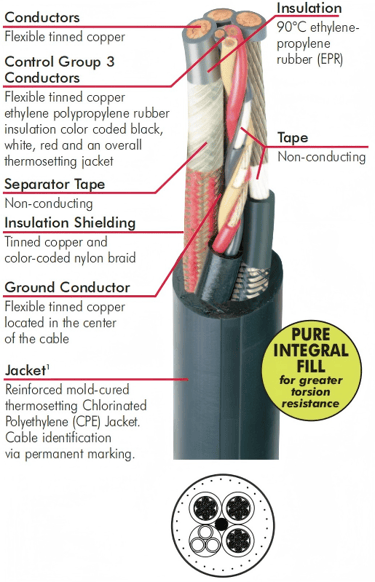
TYPE SHD-PCG cable follows a layered construction strategy. Each layer serves a different role, and together they create a cable that is both electrically stable and mechanically rugged. The catalog indicates flexible tinned copper conductors, EPR insulation, shielding for power conductors, a centered ground conductor, a three-conductor control group, separator tape, and a mold-cured CPE jacket. This kind of structure is typical for longwall duty because no single material can solve every underground problem by itself.
The overall design focus is clear: protect the electrical system while preserving flexibility. That balance is essential because mining cable often fails when a cable is made too rigid or when it is flexible but not strong enough to resist wear. The SHD-PCG structure attempts to solve both problems at once.
Power Conductors
The power conductors are made from flexible tinned copper. Tinning helps improve corrosion resistance, which matters in damp and chemically aggressive underground conditions. Fine stranding also improves flex life, allowing the cable to bend repeatedly without rapid fatigue.
These conductors are the main path for electrical power to the longwall shearer. They must handle significant load while the cable is in motion, so the conductor design is a major factor in both ampacity and mechanical durability. In practical terms, better strand flexibility usually means better service life in trailing applications.
Control Conductors
The cable includes a three-conductor control group with black, white, and red insulation colors for identification. These control conductors are unshielded in the longwall 2000V construction and are used for signal or control transmission. Their presence allows the cable to support machine coordination, monitoring, and operational control without needing a separate cable for low-voltage functions.
In underground mining, control circuits are not a minor detail. They can support start-stop logic, interlocks, feedback signals, and safety-related communication between machine sections. By integrating control conductors into the same cable, the system becomes more compact and easier to manage in a longwall environment where space and movement are both limited.
Ground Conductor
A flexible tinned copper ground conductor is located in the center of the cable. This central placement supports a balanced construction and provides a dependable grounding path. In underground electrical systems, grounding is a core safety requirement because it helps reduce hazard exposure in the event of insulation damage or fault current.
The grounding conductor also helps support fault protection strategies in the broader mining power system. If a fault occurs, the ground path can help clear the condition more effectively and reduce the risk to equipment and personnel. For a longwall shearer, that is especially important because the machine is operating in a high-energy, high-contact environment.
Insulation System
The catalog specifies 90°C ethylene propylene rubber, or EPR, insulation. EPR is widely used in mining cables because it offers strong dielectric performance, good flexibility, and resistance to moisture and mechanical stress. In a longwall setting, those characteristics matter because the cable may be exposed to wet coal, condensation, and repeated flexing throughout the production cycle.
Temperature performance is equally important. A 90°C rating gives the cable a stronger thermal margin under load than lower-temperature constructions. That helps the cable remain reliable when current demand rises, ambient conditions are difficult, or ventilation is imperfect. In practice, thermal stability can be the difference between a cable that lasts and one that fails early.
Insulation Shielding
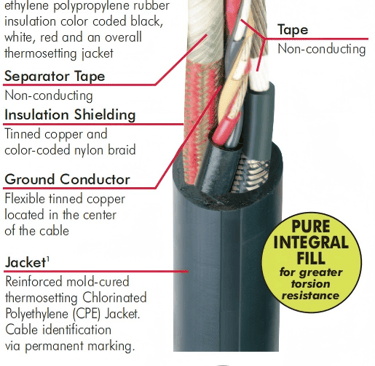
TYPE SHD-PCG includes tinned copper and color-coded nylon braid insulation shielding around the conductors. Shielding reduces electrical interference and helps create a more controlled electromagnetic environment around the power and control elements. That is valuable when the cable is being used in an electrically noisy mining system with variable loads and multiple machine functions.
Shielding also supports insulation performance by helping manage the electric field around the conductor. In longwall service, where mechanical motion and electrical stress happen at the same time, that extra layer of protection improves reliability. It is one reason shielded mining cable is preferred when the application is more demanding than basic portable power service.
Separator and Non-Conductive Tapes
Separator tape and non-conductive tape are used to keep the internal components organized and protected. These materials help prevent abrasion between layers and contribute to the cable’s torsion resistance. Without them, repeated twisting and flexing could allow the conductors to rub against one another and accelerate wear.
This layer may not seem as visible as the outer jacket, but it is important to cable life. In longwall applications, internal movement can be severe enough to damage the cable from the inside out if separation is not maintained. A cable that preserves internal spacing and structural integrity is much more likely to survive a full production cycle.
Outer Jacket
The outer jacket is a reinforced mold-cured thermosetting chlorinated polyethylene, or CPE, jacket. This is the cable’s first line of defense against abrasion, oil, moisture, chemical exposure, and rough handling. The mold-cured construction helps create a durable bond and a rugged external surface suited to underground mining.
A good jacket is not only about chemical resistance. It also affects how the cable moves, how it responds to bending, and how well it survives dragging and contact with hard surfaces. In a mine, the jacket is often the first layer to show damage, so a stronger jacket can extend the cable’s usable service life and reduce replacement frequency.
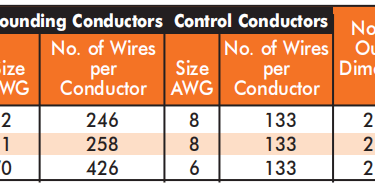
Key Features and Performance Advantages
TYPE SHD-PCG offers several advantages that make it a strong choice for longwall systems. First, it is designed for continuous movement. That means it can handle trailing and flexing better than general-purpose cable. This is essential in longwall service where the cable may move many times in a single shift.
Second, it combines power, control, and grounding functions into one cable. This reduces complexity, simplifies routing, and helps keep underground installations more organized. Fewer separate cables can also mean less clutter and fewer handling errors during operation and maintenance.
Third, the combination of EPR insulation and CPE jacket improves durability in harsh conditions. The insulation supports electrical performance, while the jacket handles the external environment. Together, they form a cable that is practical for underground production rather than merely technically compliant.
Fourth, shielding and grounding enhance operational safety. In mining, safety is not an optional feature. It is part of the cable’s purpose. A well-designed longwall cable helps support fault protection, signal stability, and lower exposure to unexpected electrical failures.
Real Mining Application Example
A representative underground coal operation using a longwall shearer may see the cable move continuously along the face during production. In one typical scenario, the operator experiences repeated jacket wear near the machine connection point because the cable bends sharply every time the shearer changes direction. After switching to a properly specified SHD-PCG longwall cable with improved flex construction, the mine can reduce premature wear at the termination area and improve maintenance intervals.
This kind of result is common in longwall applications because the cable is exposed to repetitive stress patterns. The most important lesson is that cable failures are often not random. They are usually the result of mismatch between the cable design and the mechanical reality of the mine. A correct specification can improve uptime, reduce repair labor, and help the mine avoid avoidable shutdowns.
How to Select the Right Longwall Cable
Selecting a longwall cable begins with electrical requirements. The voltage rating must match the machine and system design, and current-carrying capacity must be checked carefully. If the conductor size is too small, heat buildup and voltage drop can become serious problems.
Mechanical conditions must also be considered. The amount of dragging, reeling, bending, and torsion expected in service will influence whether a cable will survive long enough to justify its use. Longwall cable needs to be selected not only for what it carries electrically, but also for how it moves physically.
Environmental exposure is another major factor. Underground mines often deal with moisture, coal fines, oils, cleaning chemicals, and rough surfaces. A jacket material that works in one mine may fail quickly in another if the environment is harsher than expected. That is why the jacket and insulation system should be chosen with the actual operating conditions in mind.
It is also important to evaluate grounding and shielding needs. If the equipment depends on signal integrity or safety interlocking, those functions should be built into the cable design from the start. Skipping these considerations can create hidden reliability problems that show up later as downtime or electrical faults.
Installation and Handling Best Practices
Proper installation has a direct effect on cable life. Longwall cable should be routed to avoid sharp edges, pinching, and severe bending at connection points. Excessive bend radius reduction can damage conductors and insulation even if the cable is otherwise correctly specified.
Storage matters too. Cable should be kept in a way that prevents crushing, contamination, and unnecessary deformation. When the cable arrives at the mine, handling practices should protect the jacket and preserve the cable’s internal structure before it is ever energized.
Routine inspection is equally important. Maintenance teams should look for jacket wear, cuts, swelling, flattened areas, grounding problems, and signs of insulation fatigue. In a longwall setting, early detection is often the difference between a minor repair and a full production interruption.
Common Mistakes to Avoid
A common mistake is selecting a cable that is electrically adequate but mechanically unsuitable. For example, a cable may meet voltage requirements but still fail quickly if it cannot tolerate the bending and traction of longwall service. Mechanical suitability must be judged alongside electrical rating.
Another mistake is ignoring the control function. In modern underground systems, control conductors are not optional accessories. They can be essential to machine operation, and omitting them or specifying them incorrectly can create integration problems.
A third mistake is underestimating the jacket. Underground mines are aggressive environments, and a weak outer sheath often becomes the first point of failure. Choosing the wrong jacket material can dramatically shorten service life even when the conductor and insulation layers are otherwise correct.
Conclusion
TYPE SHD-PCG longwall cable is a specialized underground mining cable built for the severe operating demands of longwall shearers. Its 2000V rating, 90°C insulation system, shielded power conductors, control conductors, centered grounding conductor, and mold-cured CPE jacket make it a strong fit for high-flex, high-load environments.
For mine operators, engineers, and procurement teams, the key value of this cable lies in its balanced design. It is not just a power cable. It is a complete electrical and mechanical solution for longwall systems where reliability, safety, and continuous operation are essential. Selecting the right cable can help reduce downtime, improve production stability, and support safer underground work.
Featured snippet answer:
TYPE SHD-PCG longwall cable is a 2000V heavy-duty mining cable built for longwall shearers. It combines shielded power conductors, control conductors, and a grounding conductor in a flexible mold-cured construction for underground trailing service.
FAQ
What does SHD-PCG stand for in mining cables?
SHD-PCG refers to a shielded heavy-duty cable construction that includes power conductors, control conductors, and a grounding conductor. In longwall mining, this combination is used to support both electrical power and operational control in one cable.
What is the difference between SHD-PCG and SHD-GC cables?
SHD-PCG cables are designed for longwall shearers and include three shielded power conductors, three control conductors, and a ground conductor. SHD-GC cables are built for other mining applications that require grounding and ground-check functions, but they do not serve the same longwall-specific control arrangement.
Why are control conductors required in longwall cables?
Control conductors carry signaling and control information needed for equipment coordination, interlocking, monitoring, and safe machine operation. They are especially important in automated or semi-automated longwall systems.
What insulation material is used in SHD-PCG cables?
The cable uses 90°C ethylene propylene rubber, or EPR, insulation. This material is valued for flexibility, electrical stability, and resistance to underground moisture and mechanical stress.
How do you select the right longwall cable for mining equipment?
Selection should consider voltage, current capacity, flexing severity, torsion, grounding, shielding, and environmental exposure. The best cable is the one that matches both the machine’s electrical needs and the mine’s physical conditions.
Port crane cables | Mining cables | Reeling cables | Trailing cables | Festoon cables | Heavy-duty power cables | Medium voltage cables | Offshore crane cables | Underground mining cables | Dragline cables | Shearer cables | Container handling cables | STS crane cables | RTG cables | Mobile equipment cables | Armored cables | Flexible power cables | VFD cables | Submersible cables | Cold resistant cables | Abrasion resistant cables | Flame retardant cables | Marine environment cables | Opencast mining | Underground operations
© 2006 All rights reserved.
[INDUSTRIAL_CABLES]
INDUSTRIAL GRADE CABLE SYSTEMS | PORT & MINING SOLUTIONS
TEL: +86 153 7530 2641 |MAIL: hongjing.Wang@feichuncables.com